

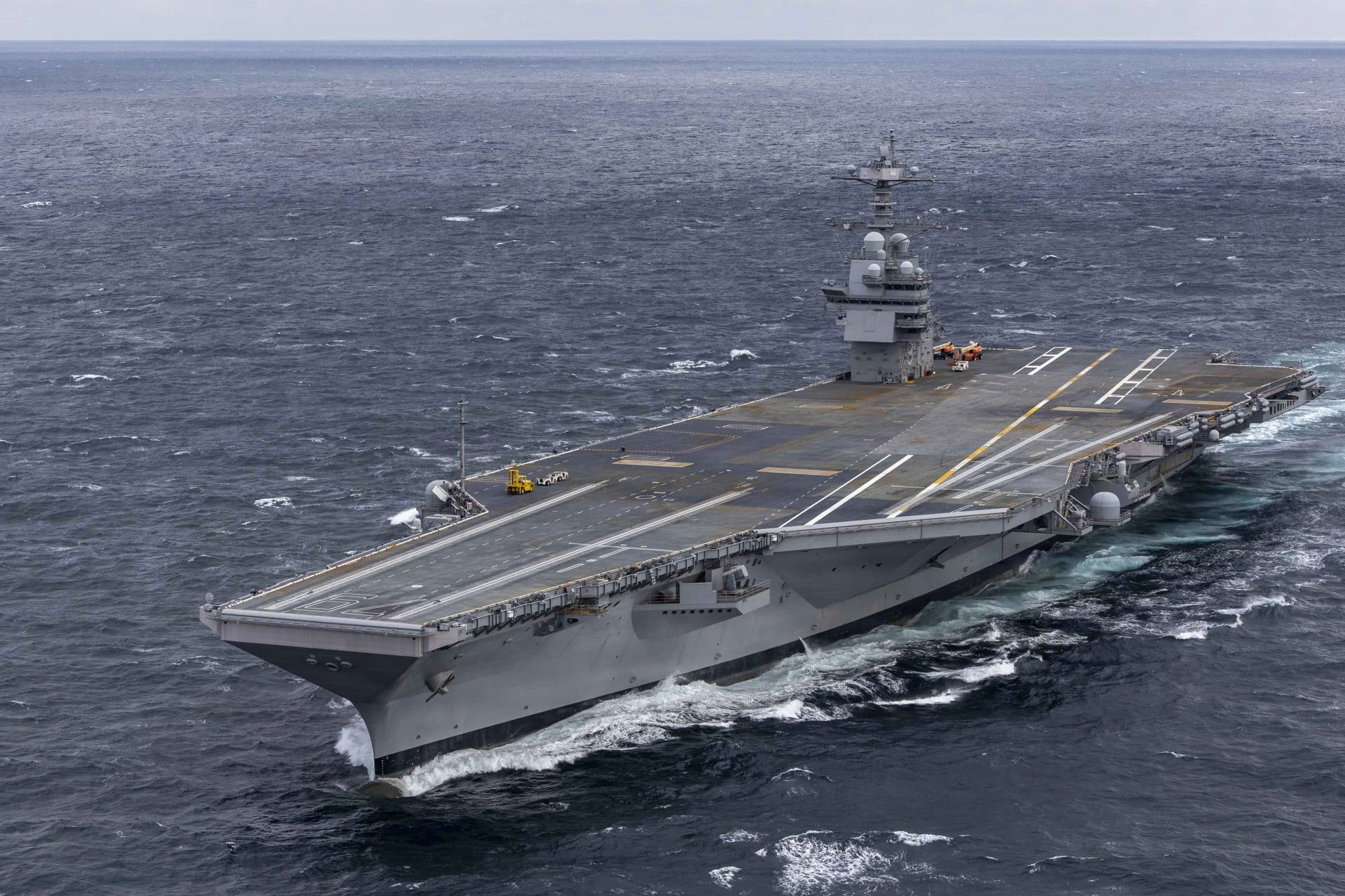
The US Navy has awarded HII a $336 million contract to begin buying long-lead materials for the planned aircraft carrier CVN 82, starting advance procurement for components needed before full construction gets underway, according to the shipbuilder.
The undefinitised contract was awarded to HII’s Newport News Shipbuilding division and will initially fund procurement of propulsion plant materials considered critical to the future construction of the nuclear-powered carrier.
Long-lead items are components which can take considerable time to manufacture or source and therefore need to be ordered well ahead of the main shipbuilding schedule. HII said the award represents the first material procurement step for CVN 82 and will also begin sending work into the wider industrial base supporting US aircraft carrier construction.
Bryan Caccavale, vice president of programme management at Newport News Shipbuilding, said: “Ordering the materials necessary to build the world’s mightiest aircraft carriers is a critical first step as we begin planning for CVN 82.”
He added: “This contract sends an important demand signal to the thousands of suppliers across the nation who make up the aircraft carrier industrial base.”
The US Navy contract announcement covers advance procurement rather than the full construction contract for the ship, with HII beginning work on equipment that has particularly long manufacturing timelines.
Newport News Shipbuilding is the US industrial base’s specialist nuclear-powered aircraft carrier yard and has responsibility for construction and major work on the Navy’s carrier fleet. CVN 82 is planned as another nuclear-powered carrier and will continue the U.S. Navy’s long-running programme of building large-deck carriers at Newport News.
The early purchase of propulsion plant material allows the yard and its suppliers to start work on some of the most time-consuming elements before the wider ship reaches full-rate construction. HII said the award is also important for maintaining continuity across the network of companies which supply specialist components for carrier construction, with thousands of suppliers contributing material and equipment to the programme.





Finally the USS Bill Clinton cuts first steel 🫡🇺🇸
Such a shame they never went for the F32 with its nickname “Monica” – just for this moment.
Trump will want a name change of the carrier, when he hears about it?
The USN top brass probably not told him yet!
Is it Trump compliant? Have they ordered the massive rubber band for the catapullt and the paddle wheels?
I’m sure they are stringing Trump along assuring him that the steam is being condensed and bottled at this very moment, but you can all but confirm it will be Emals as much as anything because the ability to build the steam catapults no longer exists and will have to be re learnt, re-constituted and no doubt re designed and certified for any future installation especially as the aircraft will be somewhat different and steam rather more fussy about adjusting them, so much retraining by then too. Probably be more costly and problematical than persisting with Emals now that it is as good as perfected.
I think you are probably right there.
The reality is that this ship will be laid down at the end of the Dump presidency. Which gives plenty of time to wash the tangerine tint off everything he touched.
The whole point of EMALS is the calibrated power.
Don’t think Trump in the EMALS Case is that wrong..EMALS apparently has been Problamatic in Service..Like to hear Anyone’s thoughts on Why ..?
Did hear a suggestion about Twisting Hull Alignment..?
Would you suggest steam catapults were not problematic in service?
Large systems doing energetic things tend to have troubles. They get fixed or worked around.
known issues already have work arounds, EMALS does not
Hi
From what I have been told. The catapult side of it works as expected. The problem is the energy storage. In a steam catapult it was easy to vent the steam and make the system safe. With EMALs , it is not so easy. What do you do with a seriously significant amount of stored electrical energy.
The topic of which catapult is very important. The catapult type affects the design of the ship considerably. Its not feasible to swap one type for another on a whim.
Yes, those with brains understand this. The orange one with his claimed massive IQ however does not :/
Yep look at ours…..
The UK needs 2 or 3 of these instead of the 2 lame ducks we built. Scrap em and lets build 2 proper super carriers!!
Our Carriers were built with Cost and Rolls Royce involvement in F-35B in Mind…!
No.
Yes
Cost of ownership of a catapult carrier is much greater than a ramp one. If we had enough F-35Bs and they carried the weapons they are supposed to, it would have been a good choice. It was still the better choice, as going with EMALS would have been worse. We need to get on with buying the extra F-35Bs, training the pilots and engineering crews, and looking to update as many as possible of the current F-35s to block 4 standard.
You could argue that we should resurrect EMKIT for drones, and I wouldn’t necessarily disagree.