

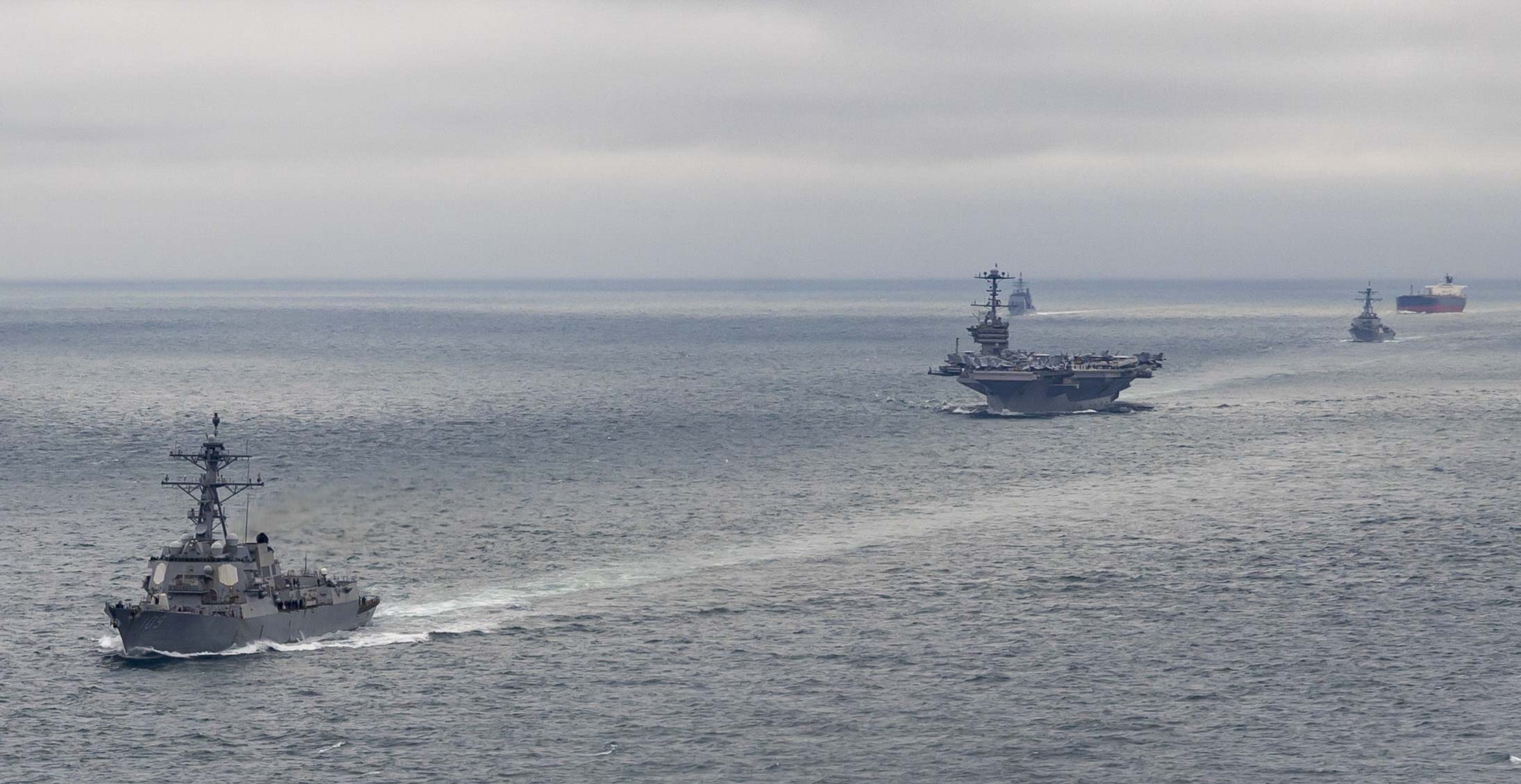
The U.S. Navy has awarded Newport News Shipbuilding a $5.1 billion contract to carry out the Refuelling and Complex Overhaul of the aircraft carrier USS Harry S. Truman (CVN 75), with the ship due to return to the fleet in November 2031, according to the service.
The contract with the HII division uses a Fixed Ceiling Incentive structure, which the U.S. Navy says shares risk between the service and the shipbuilder while rewarding improved performance against required delivery dates. It is the first carrier RCOH contract awarded since the establishment of Portfolio Acquisition Executive (PAE) Maritime.
Rear Admiral Casey Moton, Acting PAE Maritime, said in the release: “This award is the latest example of how we are leveraging innovative contracting approaches to drive improved outcomes.” He added: “Our program management and contracting teams have worked side by side to arrive at a contract that incentivises schedule performance, addresses key lessons learned, shares risk appropriately so that we can re-deliver Truman to the Fleet on budget and on schedule.”
An RCOH involves refuelling the carrier’s two nuclear reactors alongside the modernisation, upgrade and repair of the ship’s systems. The U.S. Navy describes the work as a full recapitalisation intended to keep the ship relevant through the second half of a service life of more than 50 years, and says the availability accounts for nearly a third of the maintenance and modernisation the carrier will receive over its lifetime.
Truman will be the eighth Nimitz-class carrier to go through the process at Newport News, following Nimitz, Dwight D. Eisenhower, Carl Vinson, Theodore Roosevelt, Abraham Lincoln, George Washington and John C. Stennis. Recent overhauls have run beyond their planned durations. George Washington spent close to six years in its RCOH before returning to the fleet in 2023, and the John C. Stennis availability, which began in 2021, has also experienced significant schedule delays.
The carrier’s overhaul was itself once in doubt. In its fiscal 2020 budget request, the U.S. Navy proposed skipping Truman’s RCOH and retiring the ship early to free up funding for other priorities, a plan that was reversed weeks later following opposition in Congress.
Commissioned in 1998, Truman has deployed repeatedly to the Mediterranean and Middle East. Its most recent deployment, which ended in June 2025, saw the carrier strike group conduct strikes against Houthi targets in Yemen. During that cruise, the ship was involved in a collision with the merchant vessel Besiktas-M near Port Said, Egypt, in February 2025, after which its commanding officer was relieved. The carrier also lost three F/A-18 Super Hornets during the deployment, including one shot down in a friendly fire incident involving the cruiser USS Gettysburg.
According to the U.S. Navy, Truman will rejoin the fleet as the most technologically advanced carrier of the Nimitz class when the overhaul is completed.




$5.1 billion to carry out the Refuelling and Complex Overhaul of the aircraft carrier USS Harry S. Truman….and it will take 5-6 years. Ouch! A lot of that cost will be relating to the overhaul and refuelling of the two nuclear reactors. Cost and time out of service are two good reasons for us not to have selected nuclear power!
There are plenty of other negatives about nuclear power, for carriers and only one advantage and even that is debatable.
You do realize that life-of-ship cores now exist, right? The Fords will not need refueling and will follow a more traditional maintenance schedule. Also, a lot more of that cost is related to the fact that the USN basically leaves a LOT of maintenance on the ship until RCOH and does it all at once. E.g. they didn’t repair the collision damage to Truman and let it wait until the ship was out of action for RCOH. And as far as the one advantage, that advantage is hardly debatable. A Nuke Carrier can STAY ON STATION rather than rushing to refuel over and over and over. The onboard fuel tankage can be exclusively devoted to aviation rather than being split.
You do realise that not a single ship has ever completed “life-of-ship core”, that it’s a design aim not a fact. Also it doesn’t mean the fuel will not have to be removed for some other purpose. It’s one of those brochure claims that while entirely true has a whole ton of buts. All carriers, including nuclear powered ones are subject to the limitation of food, fuel and ammunition provision and of course their escorts.
I dunno. There’s a whole pack of Virginia class submarines out there with ‘life of ship’ cores. So, I’d call that a ‘fact’ and not a design’. And also, why would I remove the fuel if I don’t need to refuel it? There has literally been no case where a USN carrier needed to have its fuel removed when not undergoing RCOH.
And I never said the ship isn’t limited by food, fuel, and ammunition provision. I said the CARRIER could stay on station without resupply longer. Nor do I need to refuel every escort at once and take the whole task force off station, but I have to take the whole task force off station if I’m refueling the CARRIER.
Would you? A whole fleet of Virginia class submarines that have gone their whole service life and are now retired and they never needed to be refuelled? Nope. It’s a design aspiration. As for removing fuel, you don’t know that. HMS Vanguard had exactly this kind of problem. Public knowledge of such issues is naturally limited. As for your other bit, you said ” I said the CARRIER could stay on station without resupply longer”, so being nuclear powered means the crew eat less? The aircraft need less amm? Being nuclear powered makes not a jot of difference to how long on station a carrier can remain.
The ship is pretty much rebuilt internally. Its 25 years old. Most everything will be pulled out and replaced with modern gear. Structures will be refurbished/upgraded, upgrades to handle f-35, FA-XX and drones (MQ-25), most if not all wiring replaced. When mid life upgrades are done they basically have a brand new, modern carrier fit for another 25 years of service.
The Ford class on the other hand never need to be refueled which is a huge plus, the reactors can run for 50 years without needing fuel swapped out. But they will still undergo a massive mid life upgrade to keep them modern.
Look at the french and the folly of having 1 giant nuclear powered carrier. It’s why those who advocated for the QE’s to be conventionally powered can sleep soundly knowing the out of service times are drastically lower our end. Im not saying they are perfect but this time we actually made the right decision, and for operating 2 was a smart choice.
Too bad you Brits don’t have enough airplanes to fly off of those carriers or enough escort ships to protect them from missiles or drones, or able to keep them at sea. Yeah, you Brits are so much smarter than those Yanks.
What facts are you presenting to back up your claims? The RN though no longer the size of the USN still maintains the ability to deploy a carrier at very short notice with escorts and 30+ F35s!
How’s Moscow today? Is it still raining drones?
If I were you I would definitely start looking into higher education or just education in your case. While looking into that I would strongly suggest using google and artificial intelligence to help you investigate the subject matter you clearly lack knowledge of – that way you wouldn’t make such a tool of yourself.
Good luck – you need it 👍
pkcasmir, I hope it wasn’t my post that has inspired you to produce a prickly post; rather than criticising the US decision to build nuclear powered carriers, I just said that I was glad that we did not go down that path.
If we Brits have often not had enough jets it might be because Lockheed Martin was very slow to build our first tranche – we ordered in 2012 and the last of 48 was delivered in 2026.
On CSG25 we had 24 F-35Bs on our deployed carrier – that is more 5th gen stealth jets on one platform at sea than any other country has managed….and that includes the USA.
You are so right in your comments about our escort ships.
Not able to keep our carriers at sea? Defence Planning Assumptions of course envisage just one of our two carriers to be at sea or immediately ready for sea duties at a given time. I am pretty sure that remit has been met.
We had been out of the carrier business for 10 years and Industry was rusty and made some design and construction mistakes – teething troubles on a new design. Even an experienced carrier-building nation like the US, which did not have a 10-year hiatus, has experienced teething troubles with a new class – the Gerald R Ford class has had many teething troubles, not all resolved.
Wow. Saw the headline and immediately jumped to the conclusion that it was the Gerald R. Ford going in to be converted to steam.
Baffled by the wisdom of this approach. Is it not time for the US to scale back it’s carriers. 6 seems ample and if they don’t need the heavy maintenance that keeps 70% of them alongside or in dry dock then what’s the issue.
For that price tag they could have one of our toy ones.
It’s a 3rd of the price of a brand new carrier, and the same with how long to build one. Then, as highlighted it comes out pretty much as a brand new carrier. Value for money. As for they only need 6, they currently have 6 deployed, 2 in maintenance and the other 3 I believe are on their way back from deployments. Seems like 6 is not the bare minimum. What’s more, the Royal Navy has shown what it’s like when you run with the absolute bare minimum. You end up not being able to deploy when the poop hits the fan.
I think there are two US carriers on station, also one on it’s way to a deployment and one returning home: Washington, Bush, Roosevelt and Lincoln. Not 9 on deployment or in transit as you stated. The rest that aren’t in deep refit or conducting acceptance trials, are in port in Norfolk or San Diego: resting, conducting local exercises or working up from there.
Having 2 to 2.5 on station with a target of 3 is the average. There’s a war on so I’d actually have expected three on station, but it looks like two to me. Perhaps if I’m wrong you can tell me which and where these supposed six deployed and three returning are.
Nah not six. During the gulf war they surged six but not now. Surge capacity is three. As you’ve seen they struggle to keep one on extended station away from any bases. The logistics simply don’t exist anymore. Look up ‘What’s going on with shipping’ on Tube. The guy does a great breakdown of the issues.
I’ve always said they should have six of our toy ones. By the time they’d stuck a couple of catapults on there, a few more weapons and built a companion oiler, you’d be looking at half the sortie rate for half the price. So pair them up! By stationing two in Europe the same way they do a Nimitz in Yokosuka (Europe won’t allow nuclear carriers, but conventional would be less of a problem), you’d increase percentage time on station to approximately 33% for the conventional carriers instead of 25% for the nuclear powered. So six wouldn’t be the equivalent of three Nimitz carriers, they’d be the equivalent of four. For three quarters of the price. Best of all, they’d have got rid of the HII build bottleneck, which could slow to one every six years, and they could retire a couple of the older Nimitz class too.
Alas, the USN would imagine Admiral Saint Rickover rotating in his grave and refuse to even consider it.
I would wager that it will cost more and take longer.
If US has urgent itching to bomb countries, then they need another dozen Ford carriers to bomb anyone, anytime, anywhere, for any reason.
Looks like it was a close decision to overhaul. Nimitz itself was refueled/ overhauled from1998 to 2001 and will now serve on until 2027- 52years from commissioning . $5b for 26 years of service life against $15b for a new Ford class carrier.