

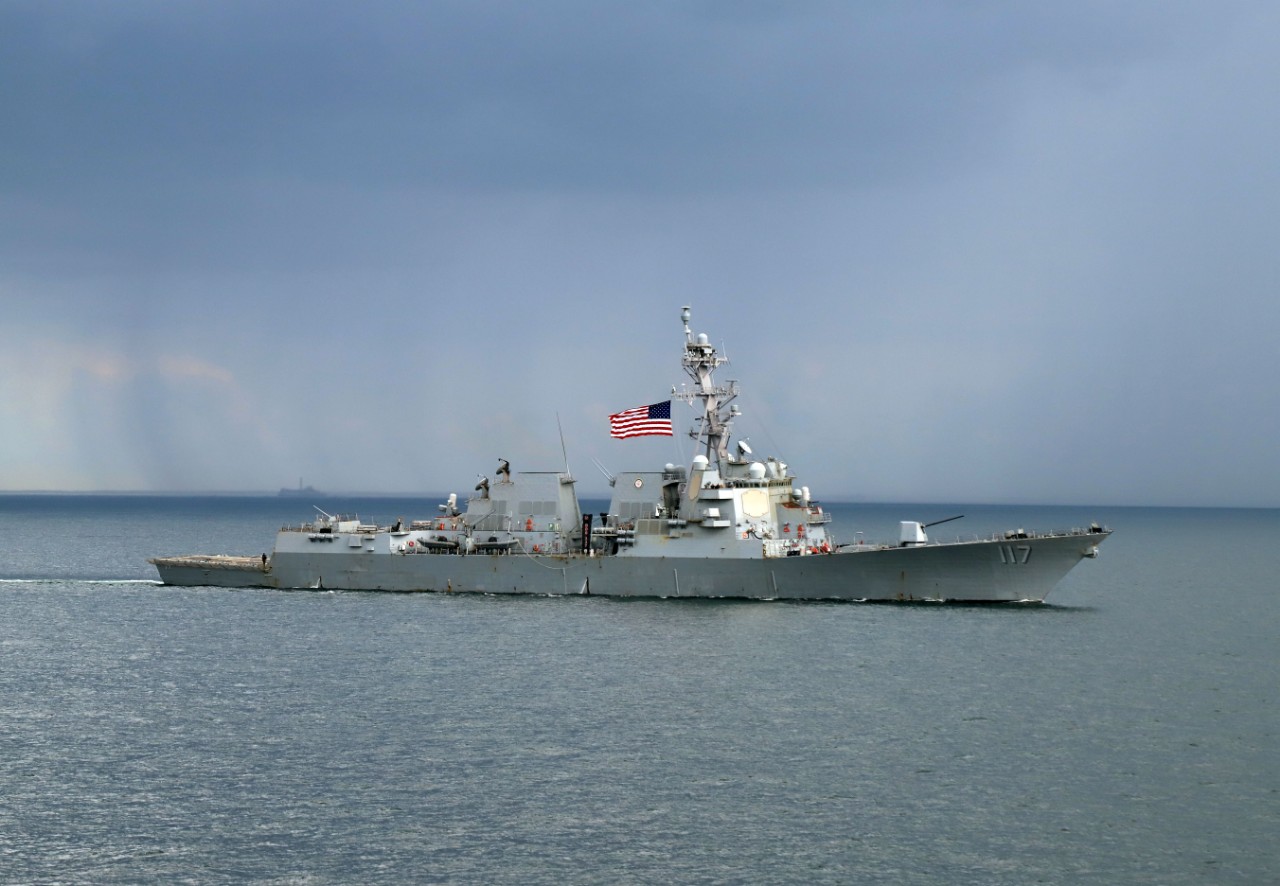
The U.S. Navy guided-missile destroyer USS Paul Ignatius is taking part in a routine port visit to Scotland.
The Arleigh Burke-class destroyer, equipped with the Aegis combat system, is operating under U.S. Naval Forces Europe-Africa and routinely deploys across the North Atlantic and European waters. Its arrival follows regular patrols and exercises in the region, with port visits forming a standard element of allied naval operations rather than an indication of any specific contingency.
U.S. destroyers have made repeated calls at the Clyde in recent years, reflecting the close maritime relationship between London and Washington and the importance of the west of Scotland as a hub for North Atlantic operations.
Commissioned in 2019, USS Paul Ignatius is among the newer ships of the Arleigh Burke class and is designed for multi-role operations, including air and missile defence, anti-submarine warfare and surface combat. The ship forms part of the U.S. Sixth Fleet’s surface combatant force, which maintains a persistent presence to support NATO deterrence and maritime security.
Routine port visits typically allow time for logistics, maintenance and crew rest, alongside professional engagement with the Royal Navy and local authorities. Such calls also support interoperability between allied navies and provide visible reassurance of transatlantic defence ties.
No details have been released on the length of the visit or any planned activities ashore.






Uh oh, this is just how the Venezuela thing kicked off.
Do you think they will still be visting if the Orangutan seizes Greenland?
Can anyone tell me why US warships have such busy/messy upper masts compared to modern European and Japanese warships?
There seems to be an awful lot of things hanging up there.
Even the constellation seemed to have the same thing. Is it a function of AEGIS perhaps?
Hi Jim,
Similar antennas and systems that clutter a US ship’s tripod mast are mirrored to some degree on a type 45 on the black, “steeple” mast between the stack and the S1850M. Likewise on the Type 26, they are on the two pole masts above the hangar. The sensors and antennas are all still there and exposed, just in different places.
The Mogami class actually have a similar mast setup to the (very tall) arrangement on French FREMMs. The sensors are covered by the “unicorn horn” structure on the Mogami class, and thus look much neater and less cluttered.
Thanks for the explanation
A lot of the bar shaped things are for lightening strikes they attract the bolts rather than affecting the radars s for the rest….
Should put the 2nd Battalion of the 2nd highland Haggis (parachute volunteers) Regiment on standby just in case
Is the RN assigning a ship to shadow it…?
No because HMS Enterprise has been decommissioned.😁🖖
God bless the American servicemen and hope he gives them the strength to put up with the orangutan in power
I feel dirty. Feels like allowing nazi Germany to base its military here in the 1930s. I hope one day we can cut all dependencies and keep them at arms length.
Yes – and lets invite the Russians and Chinese in too. Because they’re much nicer……..
No, let’s do without any of them. Just because someone is worse doesn’t mean we should associate with bad countries like the US. Tell them to go visit somewhere else.
Agreed. About time they took their kit and troops as well. They elected Trump and he has made them deeply unpopular. If they want someone to blame they need only look in a mirror for the current situation.
Someone really needs exposure to some history books if you really think that.
That was an incredibly uneducated statement to make and I’ve seen some doozies on this site
“That was an incredibly uneducated statement to make and I’ve seen some doozies on this site”.
Some ? 🤔😁
Reinforcements!
We await the U.S. cavalry, also much needed since we now barely have any of our own!
‘Ours not to reason why……!’
I know that the USA is effectively a two party system, but Trump did get nearly 50% of the people voting for him, compared to Labour who only got 33%
You could therefore say, he has a greater mandate from the US population than Starmer has from the UK.
Let’s stop bashing the USA, I know they aren’t perfect, but he will be gone in just under 3 years, whilst as it currently stands we are stuck with Starmer until the middle of 2029.
PS: No NOT a fan of Trump, but I think whilst he is rattling sabres, it appears that he is only doing what he said he would. Unlike weasel Starmer, who has carried out more U turns, than a lost EVRI driver. (Other delivery companies are available 😀😀😀😀😀)
Well said. This Labour government is not only a joke but the most unrepresentative government we’ve had in a long time
Liz Truss?
That Trump has widespread support and arguably a mandate for the things that he is doing is actually far more scary than the alternative. With public support, he is dismantling alliances and the world order that we have taken for granted. European nations (like us) are now cast as a problem and adversary. We are vulnerable.
And while he may (or may not) leave in 3 years, his ideas may well be here to stay. A president Vance would be ferociously anti-EU – and if we keep trying to suck up to the US and hoping that we’ll go back to being best friends (which we never really were), we will become an American vassal state in truth.
I’m not concerned by how democratic he is. I’m concerned by what he means for our way of life.
A US warship eh! Looks like Trump wants to annex Scotland this time it’s for golf courses not oil