

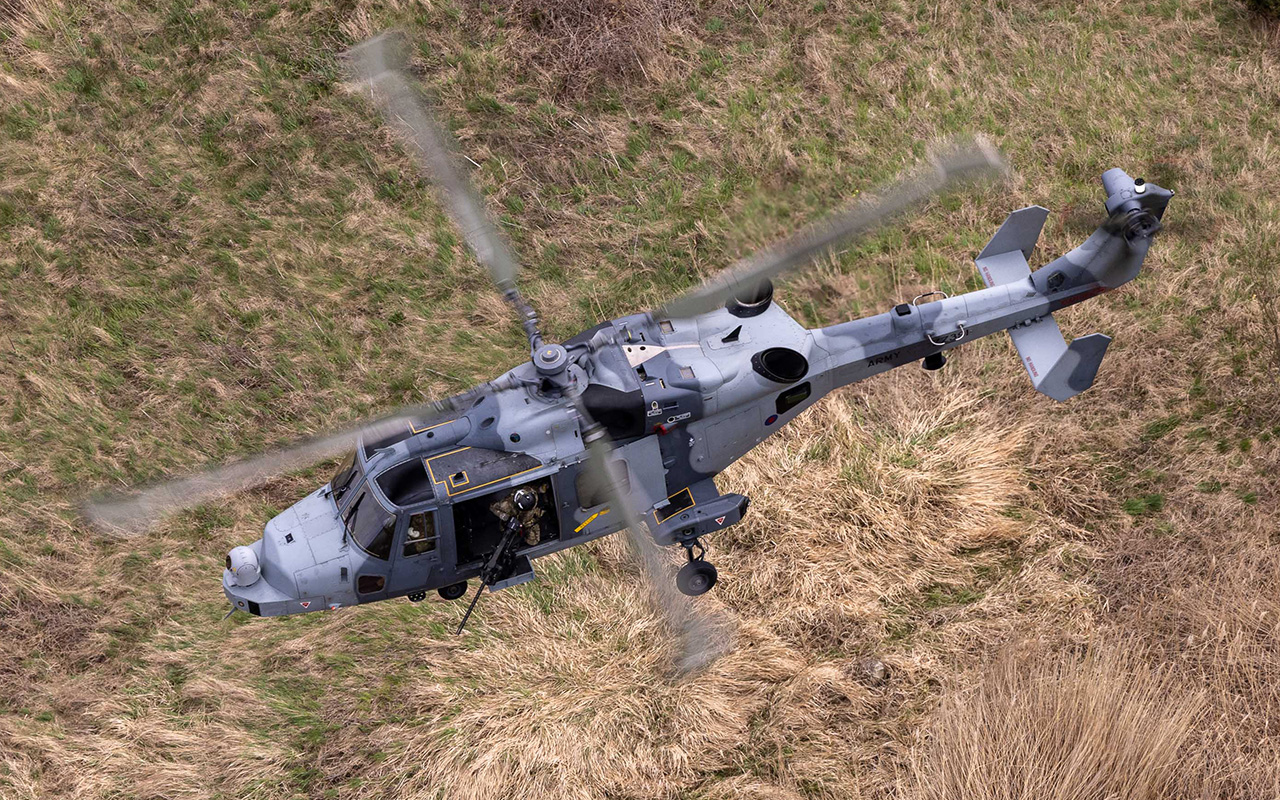
The British Army’s 34 Wildcat battlefield reconnaissance helicopters will begin to be retired from 2027, with the Ministry of Defence saying that uncrewed systems will take over the task of scouting ahead of friendly forces, officials said.
Officials setting out the Defence Investment Plan said the retirement reflected a wider shift in the balance between crewed and uncrewed aircraft and pointed to the Wildcat as one of the clearest examples of where that change now applies, with one official arguing that sending a crewed helicopter forward over enemy lines to search for targets by eye “doesn’t feel like it makes any sense in a modern battlefield,” a judgment they tied both to the threat such aircraft now face and to the experience of Ukraine, where small drones have absorbed much of the reconnaissance role at far lower cost and far lower risk to people.
In place of the Wildcat the department said it would invest in new uncrewed technology to carry out the same scouting job, as part of a broader Army push into drones, electronic warfare and networked sensors under what it calls its recce strike concept, and the move sits alongside additional funding for Army lethality that takes in both basic and more advanced drones as well as longer-range fires. Launching the plan, Sir Keir Starmer said the government would build “an army that is 10 times more lethal,” with attack drones flying alongside Apache helicopters and “a new fleet of surveillance drones, collecting intelligence and finding targets,” which is much the work that crewed reconnaissance helicopters such as the Wildcat have until now carried out, while Defence Secretary Dan Jarvis said the plan put more money into increasing the British Army’s lethality.
The retirement is one of several decisions reshaping the Army’s rotary fleet, since officials also said the plan would require some helicopter ambitions to be delayed and would bring a phased withdrawal of some older Chinooks as they reach maintenance milestones, even as the separately announced New Medium Helicopter programme continues.
The reasoning officials offered is that the available money is being concentrated on the capabilities judged to matter most against the threat, with crewed reconnaissance among the roles they consider better handled by autonomous systems, though the counter-consideration that has shadowed past helicopter decisions is that the uncrewed replacements really need to be in service and proven before the crewed aircraft are withdrawn, or else the Army risks a spell without the capability while the new systems are still maturing.






If my eyes roll any harder they’re in danger of rolling out of my head
Hybridsycpters to land on our new toy ships.
Yet again the only thing written in stone in that statement is they are retiring the helicopters. Hopefully that is just the role and not the actual helicopters. They can surely use them elsewhere? The sticking point for me is they WILL invest in a replacement which WOULD take over the role. So definitely getting rid of the choppers with nothing yet to replace them. Based on past performance what could possibly go wrong with that?
They have already been replaced, 10,000 drones currently in inventory.
No Jim, those 10,000 drones are mostly FPV and even UGV. The deep recce capability hasn’t been purchased to fill the gap Wildcat will leave.
If you think Wildcat would do deep recce your delusional. The Army Air Corps has never done deep recce. The Army Air Corps has only ever done Recce at the FEBA hence why it never got a radar. FPV drones are doing recce up to 20km beyond the FEBA, Wildcat is redundant
Well when it got too risky for Russian attack helicopters to be too near the frontline, they just adopted a longer range missile, so they could stay a safe distance back. I think Korean Wildcat have Spike Nlos. Adopt that missile for AAC Wildcat & you have your safe stand off range.
Just to clarify, your proposal is that the AAC should adopt Spike Nlos as this will enable them to conduct, checks notes, deep recce?
The plans to get a radar and tactical data link have been on and off for a decade. They never got them because other priorities kept stealing the budget. Ideally they should be transferred to the Navy to give a bit more depth and resilience to the naval capability which the DIP says won’t be replaced until the first half of the 2030s.
The AAC didn’t get a radar because they didn’t want it! The myopia at the time was astonishing to behold. They were blind to the whole concept as well as seeing as a threat to Apache.
Ruth, Wildcat does more than recce at the FEBA. As a Utility helicopter it has a variety of other tasks.
🤣 same excuse with the Watchkeeper. Different role.
Mate – this is a bad call. I hope the MOD carefully evaluated the tasks that Wildcat performs that current drones can’t do on the battlefield. Trooping immediately comes to mind. Given how thin the ACC is on utility helos, this feels like a bad call. 14 years of operational use is a waste of an expensive asset.
Barking.
If the FEBA is too dangerous use it elsewhere.
I’m curious to see what replaces it.
Ditto! 👍
Army wildcat always was absolutely bloody useless, its been in service for years now looking for an actual job to do. Get shot, hopefully the Navy will pick some up, then some for spares recovery and sell the rest off.
John, the Forces procure against a Requirement document, so they don’t usually procure something that doesn’t have a role!
The MoD website states that the Army Wildcat Utility helicopter was procured to perform a range of tasks on the battlefield including reconnaissance, command and control, transportation of troops and material, and the provision of Force Protection (FP).
Admittedly the FP argument was slim with just a pintle mounted GPMG as weaponry. But surely it did the other things?
Clearly the battlefield recce task was up to and not beyond the FEBA if the enemy had AD assets!
Install a radar and some avionics like CEC and give them to the FAA. That won’t happen because the real motivation is to cut costs.
Could the Navy use the airframes? I know there are differences, but….,
Certainly they could be broken up for spares to sustain the Navy’s airframes. Or they might be sold, or gifted to Ukraine. Surely not scrapped given the amount of remaining life these must have.
It would make sense if some were retained for use in HADR operations, where basic recce (for damage assessment) and VERTREP to remote/ cut-off locations are useful.
It might also be an idea if some were retained for use as planeguard on the carriers, as well as a boost to the numbers lent to the RM by the Army
Was wondering the same. I agree for recon they are obsolete in the drone era but could still have a lot of use at sea for air support roles for the marines or even limited sub hunting. Fairly new platform, it would be a shame not to make use if possible.
To put on what surface ships the Navy already has 30 Wildcats for 19 surface combatants
28.😉
62 Wildcat bought, split 34,28.
Cuts covered up with spin.
In a war, helicopters tend to get damaged so having a few spares isn’t a bad idea. Furthermore a B2 River can operate a Wildcat for a couple of weeks, a Tide can carry at least one, probably two, each escort can operate two. A single aircraft carrier can carry all 28 of them. There are no shortages of naval spots. And the Navy can operate some from land, in conjunction with ships for lilypadding and refuelling.
You’re just talking drivel now. B2 River can land and refuel Wildcat but operate is entirely different to landing. Where’s the rooms for the 3 aircrew or 5-6 maintainers. You expect them to do an engine change on a pitching deck with no shelter? Obviously never worked with Aircrew or Aircraft technicians, I’m sure there going to be chuffed with sleeping in the corridors. Though all Wildcats are navalised, being out side on a low draft pitching offshore patrol vessel is insane. You say that helicopters tend to get damaged in war, been to war in helicopters have you? Naval helicopters tend to get less battle damaged than land based, so why would you want 34 for attrition/Battle damage? There’s a reason you don’t have 100% replacement fleets and that’s cost, why do we not have another 106 Typhoons sat in hangars for Battle Damage replacement? Ok you say there’s no shortage of Naval spots (and we have already cast out your river class idea), let’s say full blown war with Russia or China it’s 2035 and 1/3 of are fleet is not available. That’s 1 carrier, 4 Type-45, 7 Type-26 and 5 Type-31 and we have 30 Merlin Mk2 all for ASW as Crowsnest has been replaced, and 28 Wildcats with 25% in deep maintenance so that’s 22 Merlin’s and 21 Wildcats HMA.2. The Carrier that’s going to have 3 Squadrons of F-35B 36 Planes we may get a 4th Squadron from the US Marines bringing 46 Airframes (US Marines Sqn are 10 airframes per squadron) or 10 CCA’s. 4 UAS Tankers and 4 UAS AE&W with 4 Merlin Mk.2 for additional ASW/VertRep that a complement 58 let’s throw in 4 Wildcat HMA.2 for fleet defence in the littoral that’s 62 aircraft CSG. 4 Merlin Mk2’s for the Type-45, for the Type-26 7 Merlin Mk2 and 7 Wildcats HMA2 can be carried, Type-31 ASW is the preference to increase the ASW capability of the Type-31 that’s 5 Merlin Mk2. That’s leaving 2 Merlin Mk2 and 10 Wildcats HMA2 from the Active pools and you want to keep Wildcat AH1 because you think we have more spots than we have aircraft. That’s 2 Merlin and 10 Wildcats for the River Class batch 2! Then you say we could use them from land, doing what? Dropping troops off or maybe doing ISTAR Recce, hasn’t that already been determined by the Army it’s not needed🤣😂🤣😂. I am being generous with the Type-26 as Wildcat can be stored in the Mission bay but I would imagine this mission bay being full with other mission equipment so,there’s another 7 airframes. So let’s look at your idea of using the other carrier, let’s assume 1 CSG(F-35) with 2x Type 45 2x Type-31 for the High North Mission that leaves 2 Type 45 for UK Mainland BMD defence and the rest of the surface fleet for the Atlantic Bastion Mission 6x Type 26 and 3x Type 31 (likely that Type-31’s would be split between Caribbean/Mediterranean. Who’s going to escort PoW with 25 ex-AAC Wildcats that have no strike capability?
Pretty certain the Wildcat is used for a plethora of other roles than just recce. Just sounds like yet more cuts, for the sake of eking out the budget!
The lunatics are running the asylum.
The Gazelles went without replacement. The 100+ army Lynx were replaced with 27 Wildcat. The AAC is not awash with helicopters. What about all those occasions when there was too great a risk of IED/landmines on the roads, so moving men was done by Gazelle/Lynx? Scrapping Wildcat is another cut dressed as being cool & hip.
Exactly Jon- it’s another cut.
MRAPs where bought for that not Helicopters. Gazelles where Recce/Liaison you don’t need Liaison that’s what Teams/Zoom video calls are for. Recce we have already established FPV are more cost effective. The 100+ Lynx where replaced by 67 Apache AH64D not Wildcat, ultimately we couldn’t afford the 67 and dropped down to 50 which means 24 Combat coded airframes of 4 sqn of 6 airframes. The 24 Lynx Mk9 became redundant they where bought for moving Milan Teams around the battlefield for 16 Air Assault, but the Army bought NLAW and Javelin and integrated them directly at Company Level rather than a dedicated anti-tank company as such it became cheaper to put all these in Ch-47 in one drop. Chinooks increase in all up mass also made Lynx Mk9 roll more redundant. The Army Air Corps became less relevant from these roles, it was a god send that we bought AH-64 when we did. Another death blow for Lynx/Gazelle was the peace in Northern Ireland and to some extent Puma as well. It’s very doubtful we will get involved in counter insurgency at all due to the size of the Army there’s no way we could support Brigade level like Afghan for 10+years. And this is a friend of Mathew “Biffa” Bacon that was killed by and IED in Iraq due to not enough Support Helicopters.
Kajaki. Chinook has too much downwash to pick up a casualty, when it could risk setting off nearby mines. This is why you need some small to medium helicopters.
Pretty much. Remember though, they’re “colonial.”
They can be replaced in the recc role ( wonder what ) but there’s plenty of other uses for them.
Another 62 aircraft gone.
Mainly officers taxi service. It can only carry four passengers, utter waste of money.
The Navy can certainly make use of them.
Thats if they give the to the RN! Seems very sensible to top up RN helo stocks as a back up to drones and having a patrol surface attack roles, SF assist, all non Merlin tasks. Even if they keep a remnant and sell off the others to pay for something else.
Will they update the Merlin with Martlet & Venom? I believe the Italian EH101s have ashm ability with Marte.
Unfortunately, as we now know Wildcat is being entirely redacted as a radical fleet cut.
I dont agree with the other cuts, but getting rid of the Navy Wilcats inparticular is unfathomable to me.
You are putting a Frigate on an individual tasking in the same position as a similar vessel from the 1950’s, no ability to cross deck personnel, no ability to support SF operations etc.
It’s a bloody ‘crazy’ move Quentin.
Will a drone be able to pick up a person from in the sea.
Just another ploy by Crab Air to deny Teeny Weeny Airways aircraft!
Some are used for SF. NMH was going to replace the Dauphins, maybe SF will take a few Wildcats to get a standardised fleet and retire the Dauphin?
Again.
What a waste..
They ought to go to the Navy if at all possible. Leonardo might like some airframes for conversion to an unmanned standard, perhaps?
Ukraine might like a few as arent they getting 20+ ex Navy Lynx’s from Germany? Might be a good upgrade and useful for carting small drone teams around the countryside?
Pretty soon anyone with 4hrs a day on Call if Duty will be ripe for a role in the armed forces. No other qualifications needed. Perhaps they already are?
Not quite sure what discussing aircraft being retired early has got to do with call of duty,but whatever floats your boat I suppose!
Surely they could be used by the Navy, for humaitarian missions transfers, rescue, training etc instead of using the the rn version to keep the hrs down for the armed missions, also with all the new autonomous boats coming they can take the mechanical around them when the need fixing.
It was just a point of so much unmaned kit coming in the place of manned kit that anyone who’s good in that sphere will be ripe for recruitment. Still, the MOD will save a bundle on wages/pensions.
Righto got your point👍
Why retire ?
Why not repurpose/reassign?
Yet again MOD retains habit of throwing away perfectly good kit
Yep and then pisses and whines that it needs more money for capital expenditure.
The Starmer dividend continues to pay off.
I struggle to understand Starmer’s (repeated) assertion that the army is on track to be “ten times more lethal”. I eagerly await the imminent delivery of 1480 Abrams M1A3….
Trevor, I think it is the many thousands of attack drones now in service that are supposed to making the army more lethal.
Couple of reasons for conversation…. The reason for AH retiring is staggering cost LHUK charge to support. Eye watering daylight rip off . Second the Army have never really wanted them and TBH don’t have the REME to maintain them. Probably hoping NMH will be scrapped (can only hope ) and they will get Blackhawks. Only people who use the AH is 847 NAS and they use it very well for royal marine insertion . So brings to the point I understand completed the battlefield recce isn’t an option as drones can do it , but who will be ferrying the troops around ? Chinooks ? Oh we are scrapping some of them as well. I am sat wondering who is running the asylum…. Jeremy Corbyn maybe or Gerry Adam’s
Not true Army did want Wildcat, it was the Navy that didn’t want it. We also have a huge Chinook fleet for a vey small army (51)
Wrong on 3 counts. From someone who is in the fielding team I can tell you the Army were very uninterested in the Lynx mk10 ……
Well your not in the fielding team now, and as a close friend of one of the fielding team pilots the Army Air Corps where totally committed to the Wildcats.
Nope, a pointless politically forced procurement, that was in real terms, less capable than the Lynx it replaced.
Load of usless crap as an Army asset, good Naval asset though…
How can you say less capable than the Lynx😏. BERP IV rotor blades giving greater hot and high performance than Mk9a , more armoured airframe with greater fatigue life than the Mk7 or Mk9 airframes these cabs where continuously in Fleetlands getting structurally repaired. 21st century Avionics. The Wescam MX-15 Wescam Electro Optical Device (EOD) is 100 times better than the Legacy TOW sight and it has a laser range finder that gives accurate targeting co-ordination. Not to mention HIDAS-15 defensive aid system. Yes the Mk9a could carry more underslung load but there’s a trade off with all these improvements in terms of weight. It was never envisioned to carry a fire team off anti-tank (Milan) or 1.3 tonnes of cargo like the Mk.9a was.
Morning, so the Lynx could lift more and carry double the amount of people, so what was Wildcat procured for, apart from the obvious job of keeping the Leonardo factory open???
A serious drop in relevant capability, happy its going to be honest, but it should have been replaced by a helo with ‘at least’ the previous aircraft’s capability.
It’s in reality, just another cut, leaving the Army with no organic lift.
lol double the amount of people 😂🤣😂🤣 Ever been in a Lynx with a Door Gunner and 6 Blokes in full patrol gear? That’s all it could carry. It had 9 seats but you’d need to be 9 Kate Moss’s to fit in them! Since the end of Northern Ireland Lynx hasn’t had a troop job and to some extent neither has Puma. The Mk9’s were procured for Milan Company in 16 Air Assault Brigade, this changed when they bought NLAW and Javelin and integrated them as organic anti-tank at Company level. You could put them all in Chinook in one go. Plus our beautiful woke society and H&S culture everybody needs a crash resistant seat, though I’ve yet to see anyone walk out a Helicopter after falling out the sky from 500ft 😏. So the only reason Lynx could lift more is because the Lynx had less capable armoured seats and didn’t have additional armoured floor that can be removed in the Wildcat. Navy Wildcat do not have the armour fitted unless they know they need it.
Ok let’s put it another way..
A: What is Army Wildcats job?
B: Did the Army actually want it?
The answers are, nobody has a clue what its supposed to do, but senior staff most certainly appreciate the taxi service it provides.
And, No, the Army didn’t want it and were particularly vocal about it too.
So why was a ‘very expensive’ helicopter, of such little actual utility and absolutely no hope of meaningful export orders procured you might ask??
Answer, to keep an Italian owned factory in business, that was actual operational requirement Wildcat was built to perform.
As Wildcat exits stage right, say hello to the next ‘save the Italian helicopter industry ‘ effort, I give you a pointless handful of exquisitely expensive, all singing all dancing AW149’s.
Bless them, the government will pay any price to keep that Italian factory open…
I suspect we will be ordering chocolate tea pots from Leonardo next….
Well the Army & RN were originally going to get an extra 5 each, but they were cut 2 decades ago. So if you cut the size of the fleet, then the support back up per airframe goes up.
Bob, you wrote: “The reason for AH retiring is staggering cost LHUK charge to support. Eye watering daylight rip off . Second the Army have never really wanted them and TBH don’t have the REME to maintain them”.
you say AH – Attack Helicopter? Therefore Apache? I assume you are however talking about Wildcat. LHUK is Lockheed UK? Why do they have a role in supporting Wildcat when it is a Leonardo (was Westland) helicopter?
Why do you think the army didn’t want them? – they had to replace both Gazelle and also Lynx in its utility role – surely Wildcat did that.
Where has the 1st and second line REME gone to?
Graham Wildcat in the Army is referred as Wildcat Ah.1
Ruth, thanks. When I was serving AH was the abbreviation for Attack Helicopter. We called Wildcat by its name ‘Wildcat’, not ‘AH’ as Bob said. OK, no biggie.
People change terminology used in the past. Also when I was in the mob, CH was short for Chieftain and CR short for Challenger. Now everyone abbreviates Challenger to CH or Ch.
Army Wildcats are AH1.
LHUK. Leonardo Helicopters UK.
7 Battalion REME.
Daniele, aimed at me, by any chance? My second question to Bob was to ask where 1st and 2nd line REME had gone to as he said the AAC don’t have REME. As an ex-REME I was very aware that 7 Bn REME has always done 2nd line for army avn. But where has it gone to as Bob thinks it has disappeared.
Bobs comment was :”Second the Army have never really wanted them and TBH don’t have the REME to maintain them”.
Will they eventually put the Chinooks where they belong or will they disband the Army Air Corps?
MT Air should be an Army asset.
Another cut with a hope for new toys in the future if and only if they can be developed and hopefully work.
Said with the Wildcat naval variant and the T45 articles.
.
.
Idiots.
.
.
Further proof there are no smart people in decision making positions (all levels).
Are we really ready for all these drones to just do about everything .? Even to do the job of a Type 83 what was on the drawing board .Yes I believe the day will come, but do think HMG are just hoping this all works out and can do the job of our platforms we have in service at present .Me personally it’s the governments way of saving money with just more cuts .Yes drones play a roll on the Battlefield in the air and at sea without a doubt .But it’s HMG doing this on the cheap.
Will a drone be able to pick up a person from in the sea?.
Cuts covered up with spin.
So if wildcat is now vulnerable what is apache? Why keep one if retiring the other?
Shane, that makes no sense. Its like thinking that the RN would retire frigates as T45 destroyers will not now be replaced by T83 destroyers.
Apaches can operate without Wildcat, as they once used to operate without Lynx.
No. It makes sense. Your misunderstanding. The same threats that render wildcat redundant seemingly render apache redundant. Apart from still experimental airburst from the 30mm, how does an apache survive in the same battlespace that renders the wildcat obsolete?