

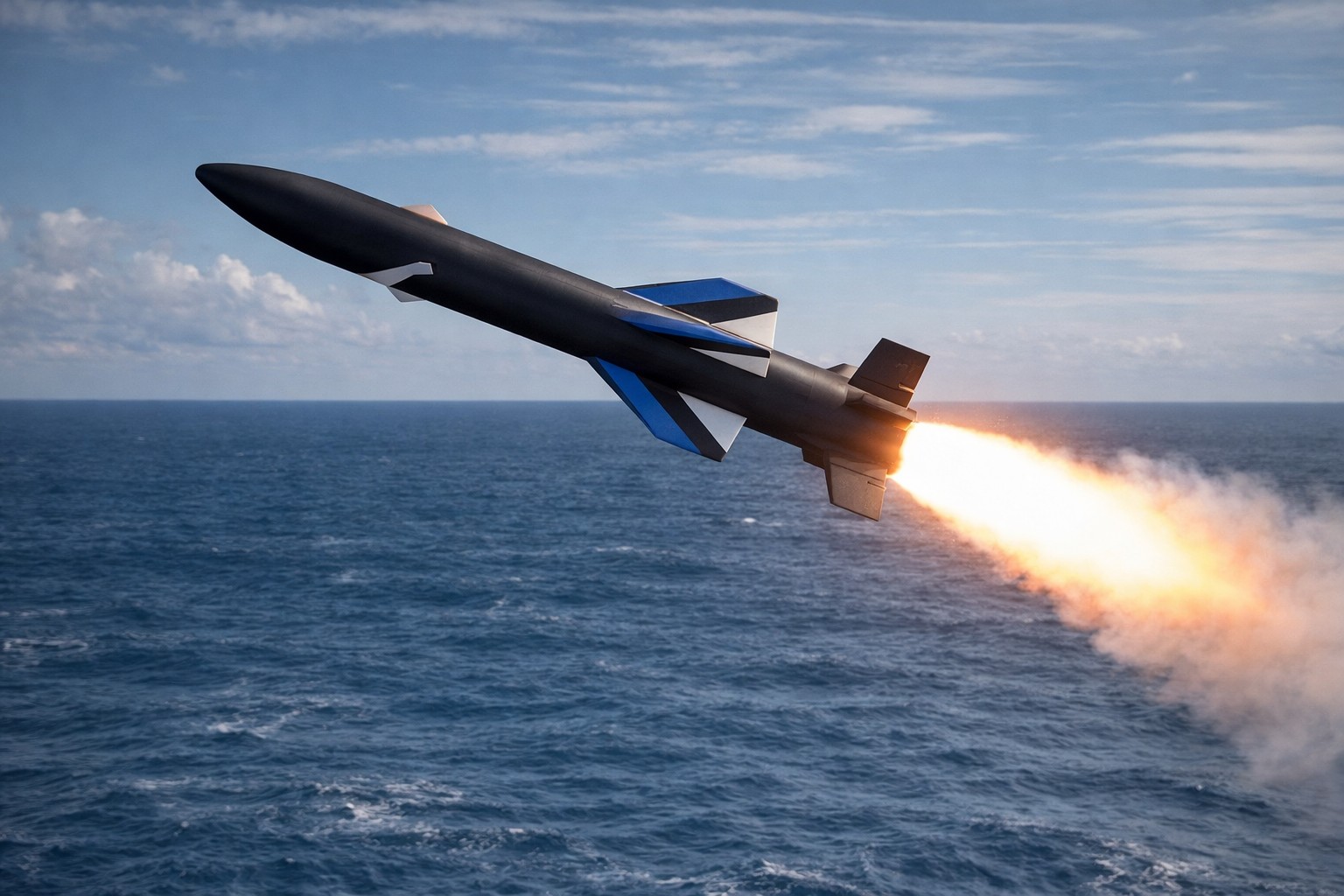
Babcock has signed a memorandum of understanding with Frankenburg Technologies to explore the development of a maritime counter-drone air defence system aimed at addressing the growing use of one-way attack drones, according to the company.
Under the agreement, the two firms state they will examine the development of a containerised and cost-focused launch platform designed to fire Frankenburg Technologies’ low-cost missiles. The proposed system is intended to provide a kinetic option against one-way attack drones, with affordability and scalability highlighted by the companies as central design goals.
According to Babcock, the concept is intended to support the protection of deployed forces and critical national infrastructure across Europe, reflecting what the companies describe as changing threats in the maritime domain. Frankenburg Technologies states that its missile manufacturing approach is focused on producing systems at pace to meet anticipated demand.
The partnership also includes an industrial element. With Frankenburg’s engineering activity led from the UK, both companies say the collaboration could contribute to the development of a sovereign capability, support skilled employment in the UK, and open potential export opportunities, according to the companies involved.
Commenting on the agreement, Babcock Chief Executive Officer David Lockwood said: “Defence has entered a new era with the rapid development of drone warfare and industry needs to respond to this growing threat. We work with the brightest start-ups on defence’s most critical challenges, and we’re pleased to be working with Frankenburg Technologies on the development of an innovative maritime counter-drone air defence system.”
Frankenburg Technologies Chief Executive Officer Kusti Salm added: “Frankenburg Technologies’ mission is clear: to bring affordability and scale to modern air defence. The drone threat has changed the character of warfare, and every layer of defence now needs to be designed for mass and speed from the outset. Partnering with Babcock, a recognised leader in maritime defence, allows us to combine rapid innovation with proven naval and industrial expertise, accelerating the delivery of an operational maritime capability.”












The Frankenburg mk1 only has 2km range, it’s very much a self-defence weapon. Perhaps these launchers, if self-contained, are supposed to be fitted to RFAs or even merchant vessels?
I know they’re focussed on naval solutions, but having a self-contained counter-drone system that could be quickly plonked down outside any airbase would be convenient.
And something that is cheap for civilian infrastructure as well..
Problem is that Lossie, Coningsby and BZ are all more than 2km long and nearly 2km wide. Plonking it down outside the base wouldn’t cover everywhere so you’d need it near the middle of the runway.
IMO as it’s a subsonic missile we could do a lot better with the Octopus or Skyhammer type interceptor drones, that exchange part of that speed for much longer range.
Simplistic I know but did you consider using more than one per base? Sort of around the perimeter in a ring?
The criticism and negativity to everything on this site is beyond belief.
That would undermine the point of using these low-cost missiles, as the launchers are always the most expensive part. A little extra cost on the missile stocks to add more than 2km range saves a lot of money on duplicating launchers.
But for the maritime role the range doesn’t matter against slow drones, it’s just a specific limitation with airfield defence that they are large sites.
I would think the truck-mounted Terrahawk or the Tridon Mk2 would be more convenient. At the moment, we don’t know the cost or specs apart from it apparently having a 2km range. We will have to see.
Just to point out that the photo (above) gives the impression that the missiles are quite large. They are actually quite small, about the size of an 81mm mortar shell.
60cm long
Just a thought, what about containerised attack drones arriving on civilian ships?
Russia has already been using civilian tankers to facilitate drone attacks, but we’ve not yet seen a Ukraine-style surprise attack, with thousands of drones coming from a tanker.
As I’m currently sat on a very small island camp, the thought had crossed my mind.
I can’t see this being cheaper than a 40mm Bofors firing 3P ammo. And with the range 2km a 40mm outranges it by quite the distance. It feels like a rather convoluted solution.
That’s what I was thinking. From what I have searched, Matlet is about £30,000 and has a range of 5 miles, helicopter/ship mounted, and a 3/2 kg warhead. But obviously even though you have to by the borfors 40mm cannon each shot, depending on the round and contract, just cost a few hundred pound ish per round with a range of 3 to 7 miles, details vary. Not to mention Phalanx as well. It will be interesting to see if this can compete with these systems on cost. But that range though, unless its drone mounted. The lack details from Babcock is also annoying.
Like Jacob I’m not sure on this solution for a basic anti drone defence.. the reason we use missiles against missiles is that they are very fast threats and so you need a fast system to intercept them.. drones are slow and so can be intercepted by a slow anti drone system. But in the end a cheap blast frag round for 2km range coverage would work for military sites and an anti drone drone could be used for civilian site coverage.
It does seem like an odd choice. Understandably, we need a way of dealing with large volumes of cheap drone weapons without breaking the bank, and a high-capacity launcher of cheap missiles would be a good way of doing that.
The thing is though, is it the best way of doing it? Currently we have Phalanx and 30mm guns, we’re already investing in more capable 40mm and 57mm guns, as well as Dragonfire entering initial service in ~2027. If we’re looking at a layered defence system, we’ve already got plenty of solutions for the ranges this weapon is covering – what we currently lack is an intermediate option between CIWS and the full-fat interceptors like Sea Ceptor and Aster.
The Bofors 57mm and Mk45 5″ on the T31 and T26 respectively somewhat cover that intermediate window, but we’ve already got an underutilised system in service that fills that niche nicely – Martlet/LMM. The trials as a combined 30mm gun/launcher on T23 had backblast issues with where they were mounted, but there is little practical reason a standalone launcher resolving these issues couldn’t be developed quickly.
We know Phalanx is outdated, hence why the USN and allies are replacing it with SeaRAM – a self-contained, 11-cell launcher for a weapon more than twice the size and six times the weight of Martlet. If we’re smart about this, we build our own direct replacement for Phalanx – integrated sensors and a large capacity of 30-40 missiles. Replace Phalanx on the escorts with a battlefield-ready system, huge gain in protection for auxiliaries (plus lower maintenance requirements on a sealed missile than a gun), and in a sensible world you would stick it on OPVs and potential future sloops for both protection and marketing opportunities.
And that is the thing phalanx was outdated due to hypersonic or high gee manovering missiles… for blasting things Travelling at 100 mph its probably great….