

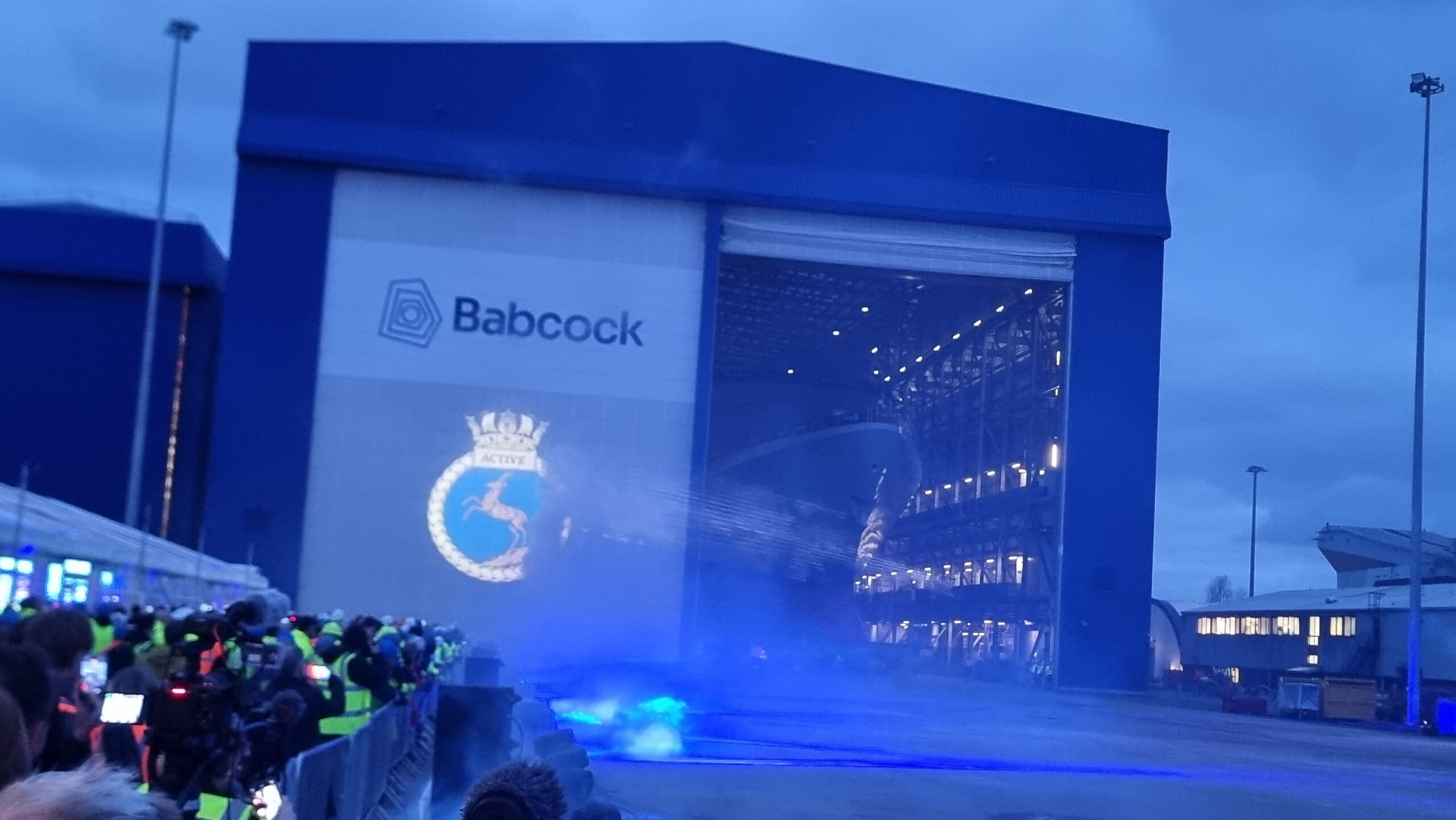
Babcock has marked two major milestones on the Royal Navy’s Type 31 programme in a single day, cutting steel on HMS Bulldog while rolling HMS Active out of the build hall at Rosyth.
The steel cut ceremony formally begins construction of the fourth of five Inspiration-class frigates. At the same time, HMS Active, the second ship in class, emerged from the purpose-built assembly hall and will now prepare to enter the water for the first time.
The twin events highlight the production rhythm now established at Rosyth’s modern, modular “frigate factory”. With each hull, sequencing, integration and supply chain lessons are being absorbed into subsequent builds. Increased pre-outfitting of compartments and systems in manufacturing bays is intended to reduce time spent on integration inside the main hall, improving overall delivery efficiency.
David Lockwood, Chief Executive of Babcock, said: “Delivering the Steel Cut for HMS Bulldog and the Rollout of HMS Active on the same day is a powerful demonstration of the drive and delivery focus of our Type 31 programme as we build the next modern, future ready fleet for the Royal Navy. These milestones show the maturity of our facility, the success of the design and build process, and the skill and dedication of our Babcock team.”
He added: “We are not only building a new class of ship at Rosyth, we are also at the forefront of a national endeavour that is strengthening the UK’s shipbuilding industry, supporting sovereign and allied maritime capability, while creating an advanced industrial footprint and expertise that will support the future of global shipbuilding for generations to come.”
The Type 31 programme sustains around 2,500 jobs, with the majority of work taking place in Fife and supported by a broad network of UK and international suppliers, including small and medium-sized enterprises. The ships are based on Babcock’s Arrowhead 140 design, which has also been selected by Poland for its Miecznik programme and is in build in Indonesia under licence.
Defence Minister Luke Pollard said: “These milestones show Scottish shipbuilding at its best. From starting construction for HMS Bulldog to rolling out the impressive HMS Active, this programme is delivering world-class warships for the Royal Navy and real economic benefits for communities across Scotland and the wider UK.”
He added: “The frigates will serve our nation for decades to come, and the skills and infrastructure we’re building here will secure the future of Scottish shipbuilding for generations.”
Scotland’s Deputy First Minister Kate Forbes said: “Today’s ceremony is testament to the skill, dedication and innovation of the workforce at Babcock – and a powerful symbol of Scotland’s enduring contribution to security in an uncertain world.” She highlighted the importance of apprenticeships and skills retention, noting Scottish Government support for aerospace, defence, marine and space companies through enterprise funding.
Fleet Commander Vice Admiral Steve Moorhouse said: “These milestones reflect the momentum, ambition and national commitment behind the regeneration of our future frigate force.” He described the Type 31 as “a major step forward in modernising our fleet”, adding that their modular design and combat systems would allow upgrades throughout their service lives.
The five Type 31 frigates are intended to undertake roles including interception, intelligence gathering, defence engagement and humanitarian operations. HMS Venturer, the first of class, rolled out in 2025, while HMS Formidable, the third ship, entered assembly following her keel laying late last year.







As I said on NL unless #1 shows signs of starting trials having #2 in fitout isn’t going to help matters a great deal as we all know the fitout supervision and engineering/test/certification trades are the real pinch point.
Yup the panel line may well be highly automated and welding may be becoming more and more efficient by the day – which is to be genuinely celebrated buuuut the fitout and commissioning depends on skilled sets of hands.
Fair enough. If they have guys hanging around with nothing to do, they could take the RAF route of go-karting, city tours, adventure training, etc. but the costs would add up. The army way is more cost-effective: polishing brass, cleaning kit, tidying stores, painting fences, picking up fag butts, or doing extra PT. Just a thought 🤷🏻
Grass doesn’t paint itself green you know, and who ever heard of not cleaning your kit 🙂
aaah – my old infantry past time; chicken parade on a Saturday morning , picking up fag buts. .
Back in the day , an army marched on it’s nicotine intake.
Anyway D, hope you’re well.
Back in my day, 4 KORBR were given a Sunday morning 10 miler(?8?) from around Rampside, along the Coast Road and then up to summit Birkrigg, wearing patrol webbing and carrying that rifle; the old and bold had gone on the piss in the bar Saturday night, smoked their 40 tar sticks, not sure if they even turned in, and then gone for the full English in the morning.
I summitted Birkrigg, although the 4 tonner didn’t, it had gone back to Barrow with the dying lance jacks, cpls and sgts.. who had heaved the contents of their stomachs along the road and were desperately gasping for oxygen; that Sunday, I had a very quiet, afternoon pint in the Bar, sans company, sans cigarette smoke, and went home.
Cheers D, excellent (but frightening) story- thanks for posting!
As a non-smoker I always took joy in SNCO’s who didn’t believe in making non-smokers pick up “other peoples fag butts”
Excellent D 👍
‘Go to the stores and ask for a long weight.’
‘Right! I need two volunteers for a motorbike licence.’
Now you’ve done it.
Grasmere Co-op, Cumbria, right dickhead, go and ask Vicky for a left handed broom. And he did.
Can you ask the Store Manager if they have any elbow grease, please?
Haha! Forgot about the old ‘left handed broom.’
Plus two tins of tartan paint and some waterproof teabags (and a jar of elbow grease if they have any)
My favourite was once one of the Screws in my TU told our bod to ask the CQMS for a pull through for a GPMG blank barrel.
😉 😉 😉
Bad camel.
“Needs a special kind of pull through don’t you know, the normal ones just won’t work on a blank barrel.”
I would not be too negative, we have frigates hitting the water at a pace not seen anywhere in the west for decades. Fitting out also requires less in the way of specialist facilities and ultimately we have a much larger set of workers from across Britain that can do it. The UK has built almost no ships for decades but ship fitting and repair is still a massive industry.
I think the bigger issue is likely to be the MoD and the sea trials acceptance process. The RN should be doing everything it can onshore and concurrently to skip past this.
However I get the distinct impression they are not.
“ Fitting out also requires less in the way of specialist facilities and ultimately we have a much larger set of workers from across Britain that can do it. The UK has built almost no ships for decades but ship fitting and repair is still a massive industry.”
I really wish that was true.
I’m not at all sure where the teams who can get naval DC and weapons system integrations working are.
You do realise that this is the Elizabeth Line fallacy that an electrician can wire up anything with a wiring diagram? They really can’t as most of them cannot read a complex circuit.
Then there are the testers and certifiers….
Yes, I do get that and obviously specialist military systems require specifics training.
SB, thread derail. ”I know we will buy the trains from one supplier: Bombardier (Alstom) and the signalling and control from another company (Siemens?) and expect them to work in perfect harmony,”
Cue a very small, just multi-billion budget over-run (think around FOUR T26 iirc), and finally they kind of do work together…
I know, let Civil Servants do train and systems procurement because what could possibly go wrong.
That wasn’t actually the issue.
There are five different signalling systems which had to integrate with each other and talk to the trains.
So the solution was complex wiring to get round this and using traditional relay logic.
The only problem was that the number of people who really understand the various kinds of rail signalling is tiny. The next issue was deliberate sabotage – cutting of wires.
If the issue had been solved in the digital domain….but it wasn’t.
Isn’t part of the problem that the infrastructure around London is so *old* and made by so many different companies that getting anything to run on it is a minor miracle, but upgrading it all to the same standard is too mamoth a task?
Each railway company had its own signal wiring standard.
Then yet others were introduced as part of modernisation.
As Ken Livingston said a lot of it belonged in a museum.
The solution is analogue to digital conversion with the different wiring standards accommodated in the interface.
And when you remember that the Northern Line was built by two seperate Railway Companies you see the scale of the problem I guess (shakes fist at Charles Yerkes)
Fincantieri say ‘Hold my Beer’ 🤔 😐.
If (and it’s a big if) Navy Lookout’s reporting on this subject is accurate, Active will be the final Type 31 fitted with the 12-cell Sea Ceptor VLS. The other three, Formidable, Bulldog and Campeltown, will receive the Mk41 VLS during construction.
A pity they did the roll-out at night so we don’t get any top views. That was when we realised Venturer only had the 2 CAMM slots.
They should be able to cut additional slots out for the mk41s easily enoug but it’s a pretty wasteful use of space and plate material isn’t it? But these ships do look like they’re finished well and coming out of the shed door pretty quickly now. Hopefully some follow up orders to keep the momentum going.
I guess with Babcocks ever improving productivity and the BAE shipyards for T26 . If building T26 and T31 ships was infinite for UK industry we could have at least 2 new frigate destroyers a year maybe 3 or 4 a year off this emerging conveyer belt, for domestic and export orders . A nice thought
A nice thought however we also need to guard against the prospect of falling off a cliff again in ten years time. HMG must mirror the French and Spanish and be prepared to subsidise foreign builds and manage RN numbers based on ensuring continuous orders. If ramp up is required (like now) we should be prepared to use foreign yards to build blocks maintaining a core of UK ship yards that can be sustained in any economic climate.
A surface fleet of 30 combatants is what we need to keep two yards going at a minimum.
That’s precisely the point Jim, the RN needs to be restored to 30 plus escorts.
I would suggest
12x T26
12x T31
9 x T45/ T83
Back that up with a number of reconfigurable Trimaran, 3000 ton lean manned ships and unmanned ‘loyal wingmen’ .
That makes for a balanced and flexible fleet.
That in turn means a fleet big enough to keep a drumbeat of ship building viable.
That would of course require a ‘minimum’ of 3.5% on defence now and ring fenced for decades to come.
Never mind the infrastructure and personnel requirments!
You are living in a fantasy world… Right now the Royal Navy cannot deploy the ships that it has and that’s a tiny little number.
Yes the word is right now.. 30 escorts would not occur until the late 2030s … that’s 10-15 years manpower can be managed in that time if there is a will.. the reality is industrial capacity is the harder issue to crack.
We’ll be at 19 in 2035 or later…… dream on
Hugo Hugo.. you literally have zero idea where the geostrategic position will be 1 year let alone five.. we are discussing what we think should be.. you could be dead in a day so could I, we have literally zero idea what the future holds as it does not exist so we can make whatever forecasts we like or consider what we think is that appropriate number of escorts…. Because we don’t KNOW…. If you had told anyone in 1990 that by 2026 the RN would have been heading to less than 11 escorts they would have laughed in your face and called you a doom munger.
Hugo is right though, there is simply not the money in the defence budget to get anything like like 30 escorts..Even if the missing £28bn is found,.there will be just enough.budget to get to 19 by 2035/6. (6 T45, 8 T26, 5 T31).
When people dream up these fantasy fleets, they tend to overlook.that the budget also has to fit in 3 x FSSS, another Proteus, replacements for the 3 River 1s, 3 more Castle MCMVs etc – it’s not all there just to buy warships with a 5″ gun on the pointy end. The RN has a surface vessels procurement budget of £2.4bn a year IIRC but that is equipment AND support. The latter is the larger part, with things like T23 LIFEX, T45 PIP, Carrier prop shafts etc etc eating a big hole in the budget.
Yes the budget now.. but as the government has agreed to raise the core defence budget to 3.5% of GDP that tends to not be a driver long term.. we have to remember basic escorts are not actually that expensive as things go.. you can get an escort for 400 million capital cost and 10 million a year running costs…so over a 30 year life that’s 700 million…at today’s money . An armoured brigade over 30 years would cost you 9 billion pounds ( 300 million a year).. essentially you can get and run 12-13 GP frigates for the cost of an armoured brigade… so yes when we essentially add 50% to the defence budget on real terms over the next 8 years or so there will be many many billions of choices.. as I keep saying now is not the future and we are not buying or paying for these frigates now we would be paying for most of them in a decade.
A surface fleet of about 30 frigates/destroyers is probably the sort of figure we should be aiming for anyway! OK, Wishful thinking.
Agreed, although there is zero chance of the RN getting 30 surface combatants again unless you include unmanned/lean-manned sloops and corvettes. 6 T45/T83, 8 T26, 5 T31 and an unknown number of T91/92’s seems as good as we can hope for by the mid/late 2030’s. Like France, Italy and Spain, we must become expert at filling gaps in domestic MOD orders with export sales. If that means occasionally selling an in-build RN ship at cost, so be it. The upside is that the MOD may become encouraged to place larger or more frequent warship orders – gaining much needed economies of scale whilst never having to pay for and accept them all.
Relevantly, I see that an announcement by Sweden on who has won its Luleå-class frigate program order is imminent. The bookies strong favourite seems to be the FDI based proposal from France’s Naval Group – a hot construction line with a promise to deliver the first ship within 3 years of order and all four by end-2030. The ALFA 4000 design by Navanti is next up, probably a very low price and and again a very aggressive delivery schedule. But the AH120 based proposal from Babcock/Saab shouldn’t be totally discounted as despite the year or more of design work that will be required before steel can be cut, the much higher level of Swedish content than the other two bids will surely be politically attractive.
If they are moving to one ship a year, that means two years from now we need to know what ship Babcock will start construction of. Working backwards, depending on what is built, we should be looking at contract signing early next year, which requires some solid decision making this year. I don’t think we are at the one ship a year mark because Active took a long time to build. Nevertheless, the RN need to decide what they want Rosyth to build next. If they can’t make up their minds (nothing new there) they really need to order another T31 and not risk moving to another boom and bust.
Why don’t we have an OPV design waiting in the wings in case they can’t decide?
I suspect the design ‘waiting in the wings’ will be 3 off ‘Absalon’ style T31 MRSS with stern ramp and/or side access for Mexflote: or possibly a well dock and 4 new CIC. That is to say T32 merges into MRSS.
Whenever I’ve seen the Absalon class suggested as the solution for MRSS, somebody pops up to say it doesn’t have enough troop carrying capacity. But it would be better than nothing, I say, which is what we’re in danger of ending up with.
I reckon a well dock version could easiy land ~80+ troops and light vehicles. If you paired the frigate up with a Bay then heavier vehicles and more troops. A T31 will support a Merlin; + a Bay has 2 landing spots I think. Not too shabby an amphibious expeditionary capability. It’s just that you might have to assemble 2 or 3 ships. A bonus is that when you are not doing amphibious landings ( most of the time) you can reduce the crew of the T31 and deploy it on other frigate duties and the Bay is free for humanitarian work. Plus, as Supportive says, Babcock need the work. They have the base design experience and its probably all we can afford. QED
Why do you suspect that when there’s been absolutely zero mention of such an idea by official sources.
Just reading tbe Runes. I could be wrong of course but tbe jigsaw fits.
Indeed HMG are running out of dithering space in the next orders for Rosyth.
I’m guessing March 3rd is the key date. That’s the date Reeves gave the Office of Budget Responsibility to publish the Spring forecast. It’s the reason parliamentary the answers to question on anything – Ajax, NMH, DIP…- is always ‘by the end of March’. She wants to be sure how much money there is to spend before she releases it. There was a bigger than expected borrowing surplus in January. Hopefully if that turns into a trend for Feb we might be pleasantly surprised 🤞
“ Feb we might be pleasantly surprised”
If you are expecting spending to buy off back benchers expect to be pleasantly surprised.
If you are expecting a defence spending anything you will be disappointed. Starmer is clinging on by his fingernails.
I do think we may possibly see a lot of investment in building things.. starmer seems to be building his premiership on 2 things ( apart from the usuals government incompetence)..
1) the fact the international order is collapsing or collapsed
2) re industrialisation..
Because of this I think we may see more shipbuilding than we might otherwise expect from a Labour government.. I would lay a sneaky bet on another uplift in defence spending, think we may see the 2.5% come into effect a year early in the 26/27 financial year with another .1% uplift in 27/28 and another 0.1% for 2028/29 and hitting 2.8% by 2029/30.. otherwise the 3.5% promise will not be achievable.. because defence could not just effectively absorb a whole 1% of gdp increase within a couple of years… you need to build up these things or the money gets pissed away.
I do think there will be a second batch of T31 for delivery post 2030 and in this I don’t agree with Hugo’s pessimism, I also think if the geostrategic situation continues to go down the toilet by 2030 they will in desperation order a batch 3 as it’s an open line for a good cheap adaptable combatant with lots of margin… the only thing that would prevent that is 1) peace breaks out and we all sing around the campfire ( not likely) 2) they get large long range autonomous combatants that can replace a crewed warship in all functions to work ( personally I think that’s even less likely than peace breaking out)…
So whatever the “we know what is happening” brigade think.. I would put a final fleet of 10-15 T31 versions floating around in 2040 as possible to likely ( the 30-50% range chance ).
I have never thought that the 3.5% was politically achievable. I simply didn’t see that anyone had the chops to make the cuts to NHS, pensions, benefits that would be required to find that cash. Unless you are prepared to look in those areas it is la-la-land.
Which was why I was saying, from ~2022 that 2.75% was the real number of merit.
If that had been delivered from 2022 then the mess that everyone is in now would not be nearly as bad.
If you want a ship appearing in 2032/33, it’s no good getting desperate in 2030. The hot line may have cooled by then and you really need to give more notice. Fingers crossed, we should see steel cut for the last T31B1 next year, and the build-capability gap will start somewhere in 28 or 29. Will they keep everyone on for eighteen months or two years without orders? I hope something Scandanavian fills in, but that would create its own issues for T31B2.
I don’t even think the lack of decision is primarily finance related. I think last-minute is culturally embedded. We could easily say where we expect MRSS to be built for preference. We could even say two 30K tonners in Belfast and four 15Ks in Rosyth. While having alternative build sites is a good thing, that doesn’t preclude expressing a preference assuming manufacturers aren’t playing it cute. Leaving choice fully open until the last minute is pretty damned expensive. Weirdly, not something MOD considers a priority. You’d have thought….
Agree as I said we need batch two deliveries from 2030 so essentially it needs to be in the DIP.. then if 2030 shows the world is even worse ( which I think it may be) then they can do a 2030 rethink and order batch 3 then for the mid to late 2030s that would essentially be the trajectory for 15 Type 31s… five more orders in 26/27 then as the world gets more deadly the opportunity for another 5 ordered in 2030… I don’t think HMG will ever come out and say we are build the fleet up to 29-30 escorts.. but I can see an incremental panic moving it from the planned 19 now and possibly 24 to after the DIP a definite 24 by 2035/36 and then in 2030 a further adjustment to 29/30 for 2040.. the most important thing is steady orders and keeping the capacity open.. as a 2 escorts a year capacity gives us massive geostrategic flexibility.
I read somewhere (albeit just Westminster lobby journo rumors) that Starmer is pushing for a much quicker uplift, but treasury is resisting due to concerns over VFM and potential bottomless money pits like Ajax and AUKUS.
Public finances have improved a bit, and lower borrowing costs could, in the near future, give further leeway. Especially if defence capital procurement gets redefined as investment in growth (in order to ostensibly stay within the debt rules) which is a framing that even Reeves now uses publicly.
So it’s plausible that money can somehow be found, but (just as with HS2), MOD need to pull their socks up and get a grip, before funding for further scope will be forthcoming. Programs which demonstrably offer excellent VFM and low technical risk (such as T31 and CAVS) should be an easy sell here.
That Tax money wont repeat. It was people adjusting for their lives abroad and for another 3 years of Labour.
We will need 30 escorts for when the CCPN deploys into the Atlantic.
Yes correct. We either need the Danish/Swedish orders or we need to order T32. Can’t afford to let this production line go cold.
Preferably both as Babcock have said they would need another big shed and have planned for that if the orders materialise.
If T31 does well at trials I can see Babcock pumping these big GP frigates out with spiral improvements as well as AAW and ASW variants.
It is a very good news story on the hull manufacturing drumbeat
Swedish order looks to me like a shoo-in for Babcock but indications are the Danish bid may be dead. RDN original proposal was to downgrade the Huitfeldts to replace some aging OPVs, and replacing the cascaded IH frigates with new AH140 from Rosyth. But the Danes just confirmed orders for several new OPVs to be built at local yards, which likely means they don’t need any new frigates for now. Hopefully I’m reading this wrong though.
I don’t think new OPV’s means the Frigate order is dead. The IH system breakdown in the read sea I think has seriously shaken the Danish faith in their ships and I don’t see them not wanting to replace them.
That’s the RDN’s view certainly, but there is also a lot of politics involved with Danish contractors lobbying against loosing orders to overseas suppliers. The Swedish bid is in a much better position here because it’s a partnership with Saab.
SNP like to jump on the UK bandwagon when it suits! Other than that, it’s good news, if ship build capacity increases we can compete on the export market for a change.
‘… Scottish Government support for aerospace, defence, marine and space companies through enterprise funding…’ worthy words true, though the wider picture of Space in Scotland (uk generally indeed) hardly looks inspiring presently considering the painful loss of Orbex, despite having a nearly complete rocket and investments by the European Space Agency and even out of Germany. Sadly the UK Govt is not willing to invest in the manner of Germany, France, Spain and Italy to the common European launcher funding project. Would be nice to hear their reasoning, beyond the caveat that Orbex had not matched public investment with enough private investment despite just months ago the ESA seemed confident enough to include it in the final 5 to receive investment. More importantly in light of the above quote what does the Scottish Govt feel about its loss. Now all down to Skyora which ironically did not get similar European support. If Spain can succeed in launchers it seems rediculous to think Britain can’t. Perhaps another sign of the wider feeling of talk over action from UK Govt. Either way Europe needs launcher companies so is this another example of short sightedness and lack of industrial vision?
Was shocked the Orbex went, but in retrospect not really that surprising as they’ve had so little investment. I guess it’s all on Skyraura now?
Is it me or is this process so much quicker than many other glacial projects, or is time flying so fast that I’m just thinking so! Let’s be pleased however we are getting some hulls in the water now it’s time to fit them out and get them crewed and armed properly! We may be relying on one or two of these to cover the gaps of the T26 deliveries to Norway! Albeit not as an effective ASW platform. I fear we just aren’t prepared (as a government) to go full blast in preparation for a probable conflict within the next 24 months. Methinks we have dropped the ball many years ago and there is limited time to find it and pick it up!
I think the only option for the MoD ( if they were forced onto a semi war footing) to increase the size of the escot force in the near term, would be to carry out yet more extremely expensive refits and updates of say 8 T23’s and run them on in service alongside the T26 and T31s as they join the fleet.
Obviously, while ordering a dozen or more additional escorts….
I don’t see any other option, apart from buying a frigate from abroad, as an emergency purchase.
There’s no way the 23s could be seen as a “near term” solution, the work for them would take too long.
Really the only moderately quick true emergency thing we could do in 2 years would be to throw out the T31s and T26s that had been build into service without their full second stage first in class trials.. they could also strap a 57mm and 40mm onto the rivers 2s as well as may be some CAMM to. Make a bodged patrol frigate..
There aren’t even 8 T23s LEFT
Yep utterly and completely.. not only dropped the ball but let the neighbours dog run off with it down the street only to see both the ball and dog get flattened by an Amazon delivery van..
2 years time we will probably have lost 3 more T23s and be down to 3 ASW frigates and 1 GP frigate… knowing our luck, fate will truly pay the UK a shite turn for HMG showing contempt for risk and NATO will have politically collapsed.. leading the UK open to Russia having a pop at a maritime conflict with the UK over some pretext to humiliate us.
We could provoke a maritime confrontation with Russia today if we so wished, simply by boarding some of their shadow tanker fleet as it passes the straits of Dover. I believe we are contenting ourselves with asked skippers for proof of insurance, which they commit to emailing but which in any case doesn’t arrive until they have ‘disappeared’; either physically or by changing their flag. I also read of one tanker that was given a Russian navy escort. They are anticipating trouble. The original justification for a RN fleet of T31 patrol frigates wasn’t too far off the mark. HMS Venturer could be very busy.
AB – The Type 31 Programme was always sold as Frigates delivered at Pace, to a tight schedule, some slippage has obviously occurred though.
Really if HMG was really serious about. Possible peer war and increased great power competition the one thing it could do would be to order 2 new batches of T31 derivatives a second batch of 5 for 2030-2035 and a final 3rd batch of 5 for 2035-2040.. they could add a light weight towed array to the second batch but keep it lightly armed and low crewed for second line ASW in the Atlantic bastion.. then the final 3rd batch for the late 2030s could be either second line ASW, second line AAW or surface strike depending on the identities need in the 2030s… then by 2040 they would want to think about ordering the replacement for the T45s.
How’s fantasy land?
Hugo get a grip man.. we are discussing what we as individuals think should be the way forward for a future nobody knows.. we could be in a low level maritime conflict with china next month and having a crash plan to build 2 escorts a year for the next decade with universal conscription..or universal peace could break out and every nation on earth scraps its offensive navies.. You don’t know and I don’t know.. by pretending you do know and shouting insults at others you just make yourself seem like a bit angry.
lol, I didn’t see any exclamation marks or capital letters did you?
But I’d say mine is a far more realistic perspective than yours.
Cynicism Hugo is not realism.. there is a difference.
Im arguing well get exactly what they have stated well get. not any surprise procurements of a whole new frigate fleet.
Well actually at present it’s 24 because the 5 T32 is still policy just paused.. and as I said it’s about options in the 30s now is now not the future.. because apparently our defence infrastructure will have 5% spent on it so who knows what that will look like in the 30s
T32 literally just exists as something Boris said, there is zero serious procurement around that “project
It’s literally mentioned constantly in government planning.. the project formally began the Concept Phase on 21 September 2022.. and that is all we know.. so that is the present.
It might have started that way, but it is technically being treated as a serious project.
The first batch can become second-tier AAW through CIPs. No need to wait until a third batch if we think the T45s are going into Lifex around 2035. It would be good to get the second tier backups sorted some time before then.
There is zero plan for a “second tier” aaw
Nobody claimed there was?
Exactly, so it’s not gonna happen. The DIP is not going to revolutionise or completely change the course of our defense policy
Nobody said it was going to happen. It was a counter-factual thought experiment. Chill out.
And you actually have zero idea what will happen to the T31s in a decade… now is not the future… you can paint any picture of the future because it does not exist.. last year we thought the US was building 20 decent ASW frigates now they are building a load of coastguard cutters..
Type 31s have been designed to fit a captass towed array. That in my opinion would be the most usefull improvement to the class.
Yep that would seem to be the most useful capability for a T31 focused on the Atlantic bastion.. the present Mk41 and NSM set up is more a surface strike asset for other areas.
I’d be more interested to know how the cost of fitting a second-rank TAS or HMS compares to fitting the eight Mk41 modules. The former is a far more important capability, IMO.
A ship with 12-24 CAMM isn’t perfect, but it’s fine for most air threats. A ship without any sonar will be vulnerable to even the most basic semi-submersible or submersible UUVs. To me, it’s pretty clear where the focus should be in upgrading this design.
Ärrowhead can take a Catpas, Type 31 certainly cannot, it is not build with the space for one.
Wrong. Read the white paper by l johnson and M Howard, explaining the development of the type 31. Clearly states hiw dimensions , loadings etc were obtained from thales ti allow for a future fit.
Compare the rear hatches of T26 and T31 then get back to me…:
I think you’re wrong I read that they were able to retrofit light towed array. They have room for the Ops room I’d have thought these a large hull frigate.
Its like banging your head against a brick wall. Type 31 IS arrowhead. It is the base design from which you can add(or take away) more systems. The polish frigates have the same stern and guess what …..they have a captass sonar.
That’s like saying we could have the same radar setup as the polish, we can’t. It’s built differently, we’re not talking about a plug and play ship, just a design that can be altered easily before construction begins.
Wrong…. Read the development paper… The type 31 has been designed to take a captass sonar as a future uograde. Exactly same as it has been designed to take mk 41 vls.
I’m going off of physical evidence not supposed quotes in a paper, just like it would supposedly be easy to give the Qnlz class Cats and traps and totally not cost billions of pounds.
What is the significance of the Danish, Swedish, New Zeeland Chilean and South Korean flags potential export customers ?