

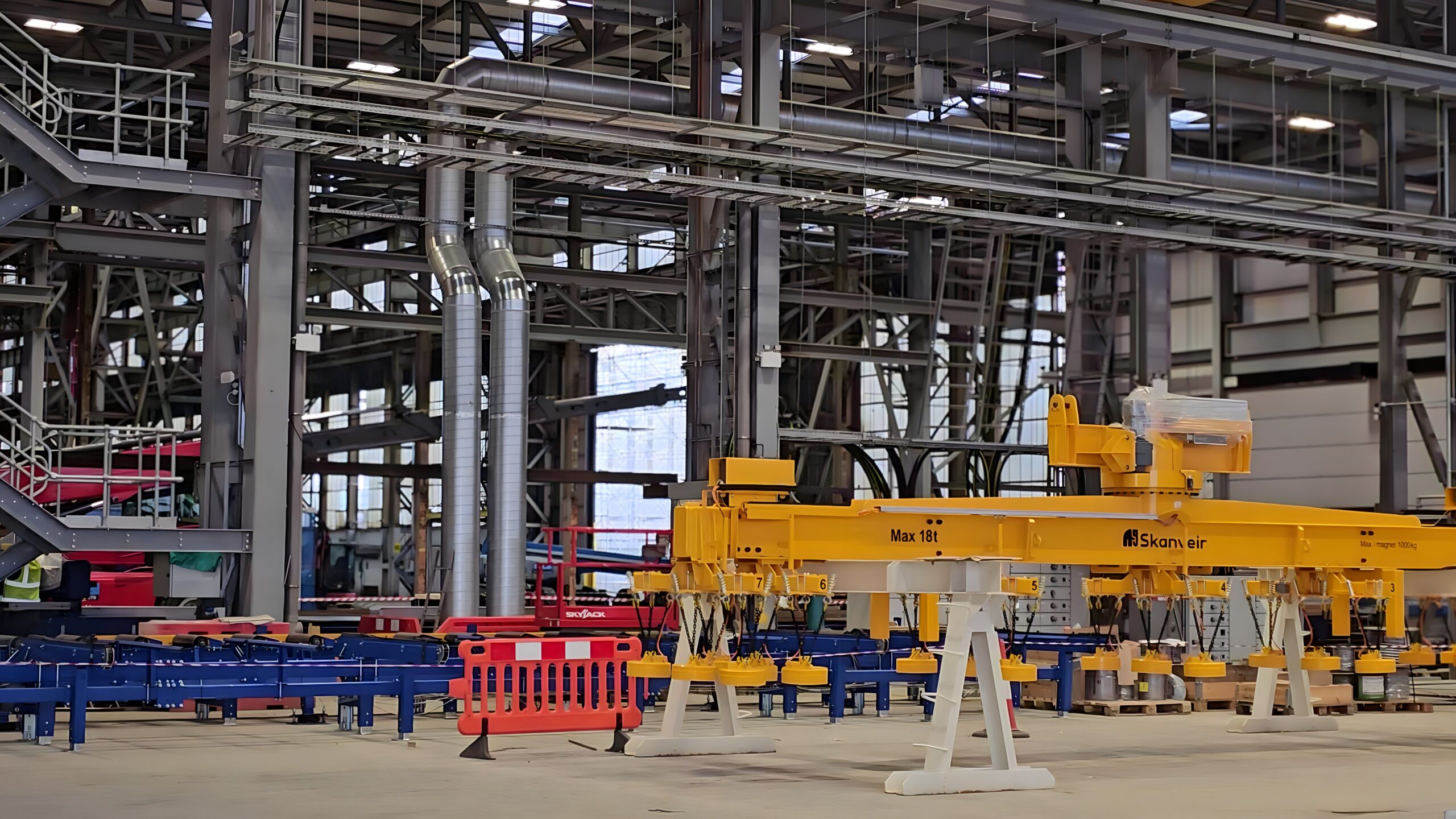
Harland and Wolff’s Belfast yard is being reorganised around a clearer steel-processing flow, with the most visible changes centred on the new extension and the equipment feeding into the panel line.
The focus is whether the yard can move steel through a consistent series of stages at a steady tempo, particularly as the Fleet Solid Support programme moves from milestones toward routine production.
Ben Murray, Chief of Staff at Navantia UK, framed the scale of investment in straightforward terms. “We’ve got £115 million pounds of investment, £90 million pounds of that here in new equipment, new machinery,” he said, linking that spending to the aim of building long-term capacity.
On the ground, the new extension is now largely complete. Peter Rusk, Programme Manager at Harland and Wolff, said the building has passed through certification and is entering its final completion phase. “We received the building control certificate on the 12th of February, and we’re just getting into the practical completion element of it,” he said.
Attention then turns to how steel arrives and moves through the yard before reaching the cutting tables. Rusk described a “mini stockyard” arrangement within the extension, tied to upgrades at the waterfront intake point. “This area is going to be used for like a mini stockyard,” he said. “Steel comes in, goes into the stockyard area, comes down in through here, into this mini stockyard, and then it’s the profile line.” The delivery point itself is also being improved. “We’re also refurbishing one of the greens down at the commissioning quay, where we’ll take the steel deliveries in,” he said, alongside work to level the stockyard area and improve material handling.
Cutting capability is being expanded at the same time as handling equipment. In the extension, Rusk pointed to two new Messer burning machines positioned at the start of the process. “We have two new burning machines from Messer… the capability of it is four burning machines over the span of two tables,” he said. Additional lifting capacity is being installed to support that flow. “We have two new cranes put in here… and next week there will be another crane again going into this bay,” he said.
He also tied the machinery to the scale of production the yard expects to handle. “From here to the very end is 200 metres in length,” he said of the panel line. On plate size, he added: “They can do a 16 metre by 16 metre plate.” And in terms of overall volume: “We’re increasing our own steel processing capacity… to 450 tons per week.” Those figures set the expected throughput through cutting and panel manufacture before constraints appear further along the production chain.
The recapitalisation also includes estate work needed to keep the yard operational. Rusk pointed to ongoing upgrades to roofs and cladding. “In this, the older extension, we’re replacing the roof,” he said. He also spoke about the realities of working with older industrial buildings. “There’s asbestos on the outside,” he said, describing how roof and panel replacements form part of bringing the site up to modern standards.
The yard is also preparing space for different scales of fabrication. Rusk outlined plans for a dedicated sub-assembly area within the hall. “In this area will be like the sub assembly area, so we have a micro panel line… that’s going to be installed… over the coming months,” he said. The plan is for smaller assemblies to be prepared in parallel with the main panel line.
Outside, the dry dock remains the yard’s most recognisable feature and an important piece of working infrastructure. Rusk described how it can be used flexibly so different tasks can run at the same time. “You’re able to essentially shut off the dry dock, fill one half of it with water, while the other one you’re still keeping dry,” he said.










good news for HW and Belfast, lets hope it works out
I do believe UK should have 3 dedicated yards as a minimum 1. Complex Surface, 2, Subs, 3 Large Vessels with HW a good fit for the latter as it has massive dry docks and now some outstanding facilities
It also makes sense that Cammel, HW and Barrow work together as its relatively easy to move between these yards.
“ is being reorganised around a clearer steel-processing flow”
Someone telling my language.
It is a really good opportunity to get it right while it is quiet. Very hard to rearrange a yard mid production.
Good to see this level of investment happening.