

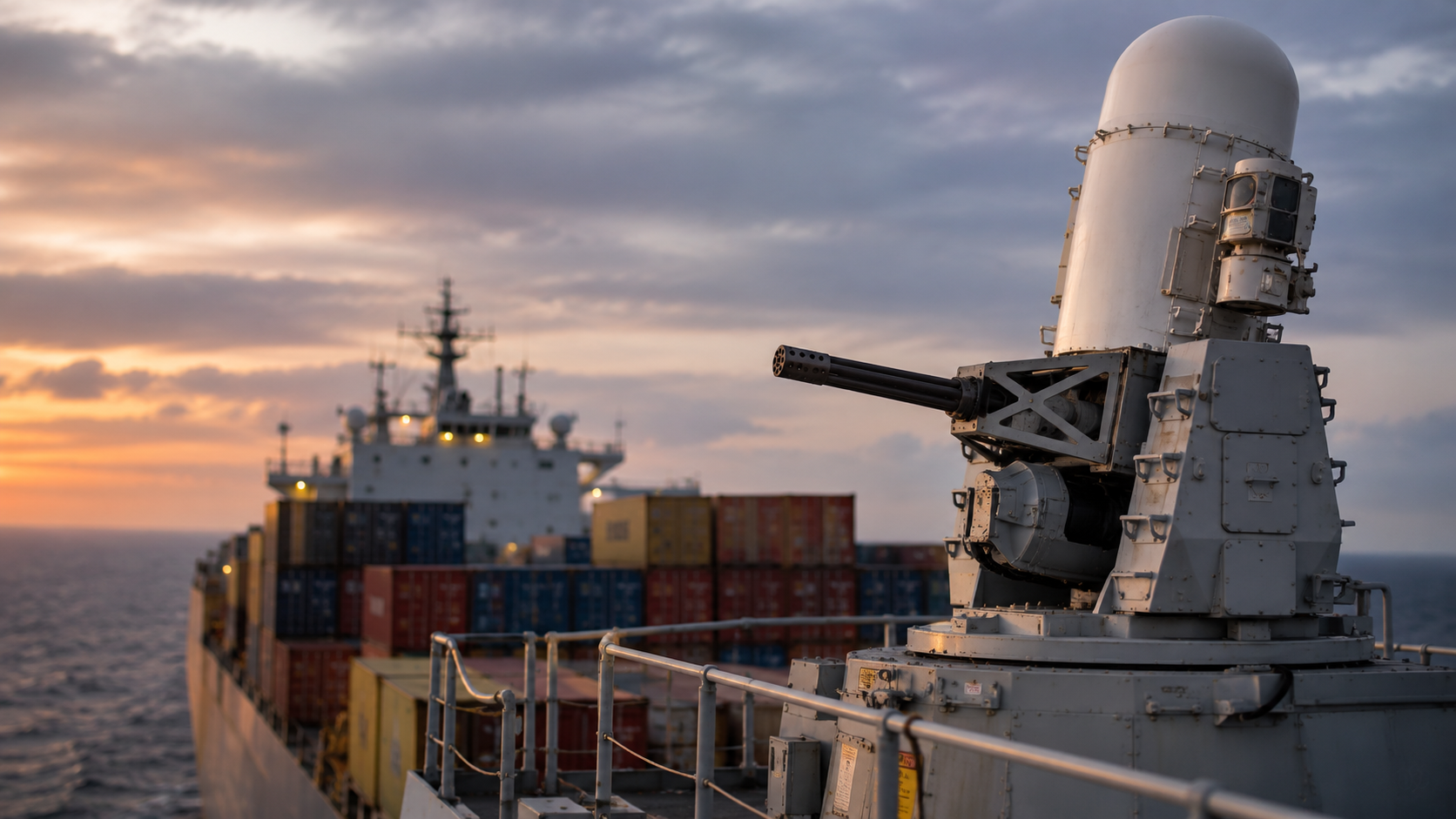
Britain should keep retiring Phalanx guns and decoy launchers in reserve to bolt onto requisitioned merchant ships in a crisis, because NATO navies lack the warships to escort them reliably, according to a new Council on Geostrategy primer.
The paper, written by William Freer, Research Fellow in National Security, also calls for a programme of trials named Project Conveyor, after the container ship SS Atlantic Conveyor, to test bolt-on point defences, decoys, anti-drone netting and reinforced wheelhouses on commercial vessels.
Atlantic Conveyor was hit by two Exocet missiles on 25 May 1982 while carrying helicopters and stores for the Falklands campaign, and 12 men aboard were killed. Freer writes that one reason she was hit was the lack of onboard defences, “partly due to concerns over the legality of placing weapons on the ship.” He adds that the loss led the Royal Navy to fit close-in weapon systems to many of its ships, including Royal Fleet Auxiliary vessels.
The primer says Britain maintains up to 41 Phalanx systems, which rotate between active ships and those in refit. It states: “These weapons are rotated between active ships and ships in refit meaning there are enough to cover the Royal Navy’s existing needs. However, there is no surplus to provide bolt-on options for STUFT vessels deployed into contested waters.”
Freer recommends: “Although it will require some additional investment for storage and maintenance, the UK should establish and maintain old point defences and decoys as they are replaced. Old decoy launchers should be held in a ready reserve along with Phalanx CIWS as they are replaced. Additional orders for bolt-on point defences and decoy systems to ensure adequate numbers in a crisis should also be considered.”
The Royal Navy has ordered 38 trainable decoy launchers for 19 ships under Project ANCILIA to replace the Sea Gnat system, at a cost of £135 million, which the primer suggests would free older launchers for a reserve. It also recalls an irony from 1982, warning that “by deploying their own decoys, modern warships may inadvertently lure threats onto the very ships they are trying to protect – as happened in the case of Atlantic Conveyor.”
The paper argues against copying China’s heavily armed container ships. It cites Zhong Da 79, photographed in Shanghai around the turn of the year with containerised radars, close-in weapons, decoy dispensers and 60 containerised vertical launch cells, and says filling those cells alone would cost tens if not hundreds of millions of pounds and cut cargo space. It concludes that “replicating such a Q-ship approach would be overkill for NATO navies.”
Legal and insurance questions are central. Arming a merchant ship can make it a legitimate target, although the primer notes that ships carrying military cargo could already be treated as such under the San Remo Manual on armed conflict at sea. It urges early work with HM Treasury and insurers on rules of engagement and cover, recalling that Britain fitted some 1,900 merchant ships with defensive weapons in the first six months of the Second World War and 3,400 by the end of 1940.
On the wider threat, the primer states: “Not a single European NATO navy possesses high-end Ballistic Missile Defence (BMD)-capable warships.” It adds that when the Houthis began attacking Red Sea shipping in 2023, “European navies could barely muster a handful of ships with the capabilities required to safeguard maritime traffic.”
The Royal Navy did take part in that effort, and HMS Diamond fought off the largest attack on a Royal Navy warship in decades in the Red Sea in 2024. Figures released in Parliament this week show the Royal Navy surface fleet now numbers 49 vessels, including six destroyers and five frigates.
The study builds on a September paper by Freer and Charlotte Kleberg which found that Britain’s ship requisition system may fail in wartime. That paper said militarily useful British shipping fell from 841 vessels in 2009 to 495 in 2023, adding: “What this means is that STUFT, while a useful tool, cannot guarantee practical access.” The Royal Navy has also trialled using commercial tankers to sustain the fleet.
Freer concludes: “With both state and non-state actors increasingly capable of striking commercial targets at sea – and increasingly willing to do so – the era of relying solely on a shrinking pool of high-end naval escorts to protect vulnerable commercial shipping has closed.”









Has the MoD (N) ever retired (i.e. scrapped) a Phalanx mount? If so, how much of the ‘internals’ (radar, processers and even gun feed system) was ‘recycled’ to go back into the spares loop for the remaining systems? I don’t believe that they just unbolt a Phalanx and chuck it in a ‘bin’. I wonder if the research fellow that authored this has any engineering qualifications or has ever been into Babcock’s Phalanx maintenance facility (which I believe, is in Devonport)?