

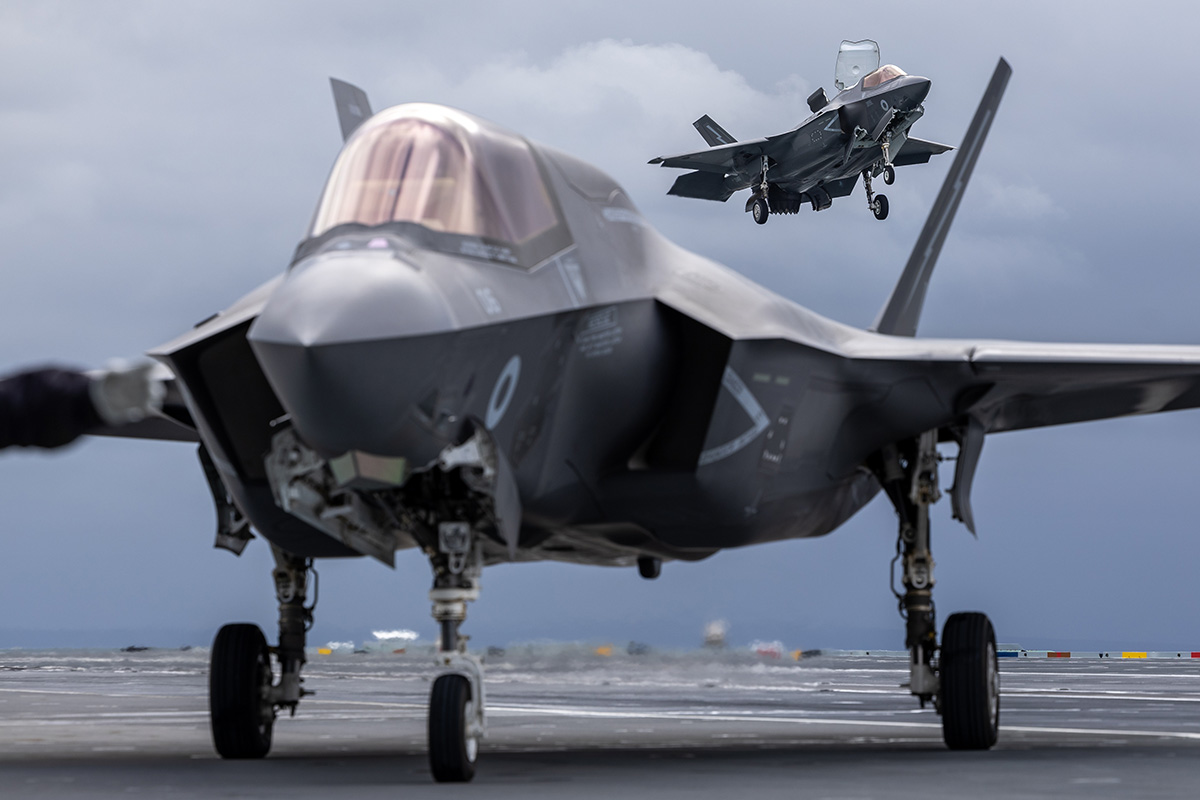
The Minister of State for Defence Readiness and Industry, Luke Pollard, has set out the seven core combat missions that the United Kingdom builds its fleet of F-35 stealth fighters around, doing so in a written parliamentary answer published on 12 June in response to the Conservative MP Ben Obese-Jecty, who has questioned ministers about the programme on a number of previous occasions.
The list is drawn from NATO’s air power doctrine and it covers the full range of jobs that a modern fighter is expected to perform, which the minister grouped under seven headings: attacking enemy aircraft and airfields, known as offensive counter-air; defending friendly airspace, or defensive counter-air; knocking out enemy radar and missile systems, referred to as the suppression and destruction of enemy air defences; striking targets behind the front line, which is called air interdiction; supporting troops on the ground, known as close air support; gathering intelligence and conducting electronic warfare; and carrying out attacks on the most strategically important targets, described as strategic attack.
The fleet in question is known as the Lightning Force, it is operated jointly by the Royal Air Force and the Royal Navy from RAF Marham in Norfolk, and it sits at the heart of Britain’s ability to project air power both from land bases and from the deck of the Royal Navy’s aircraft carriers.
What the minister’s answer describes is the doctrine that the force is designed around rather than a statement of what the jets can do at this precise moment, and it is in that gap between intention and current capability that the more revealing picture begins to emerge.
The F-35 is widely regarded as one of the most capable combat aircraft in the world, and the bodies that have scrutinised the British programme most critically have been careful to acknowledge as much. The National Audit Office, which is the government’s spending watchdog, described the jet in its July 2025 report as a technologically cutting-edge multi-role stealth fighter, while the Public Accounts Committee, in a follow-up assessment published at the end of October 2025, praised the programme’s technological achievements before turning to a series of shortfalls.
The point that runs through almost all of those shortfalls is that they concern the weapons and software the aircraft can carry rather than any failing of the airframe itself, and a great deal of that integration work is controlled not by Britain but by the United States-led office that runs the global F-35 programme.
Defending and attacking in the air
When it comes to the two air-to-air roles, both offensive and defensive counter-air, the British F-35s can already engage enemy aircraft using the missiles that are currently in service, namely the medium-range AMRAAM and the short-range ASRAAM, and they can strike airfields and other surface targets with the Paveway IV guided bomb.
The capability that is supposed to transform this part of the fleet’s performance is the European-built Meteor missile, which is designed to destroy enemy aircraft at far greater distances than the weapons the jets carry today, but its integration has been pushed back repeatedly and is no longer expected to be complete until the early 2030s, a delay that the National Audit Office attributed to poor performance by suppliers, to commercial arrangements that failed to prioritise delivery, and to the low priority given to the missile within the wider international programme.
The biggest gap: striking from a distance
The clearest limitation lies in the role of striking ground targets behind enemy lines, and in much of what counts as conventional strategic attack, because the National Audit Office found that the F-35 currently lacks what is known as a stand-off weapon, meaning a missile that can be fired from a safe distance so that the jet does not have to fly close to heavily defended targets.
The watchdog noted that the Paveway IV bomb the aircraft relies on does not have the range to do that job effectively, which leaves crews having to approach the very air defences that a stealth jet is meant to avoid, and the British answer to the problem, a cruise missile called SPEAR 3 that is made by the European manufacturer MBDA, has itself slipped into the early 2030s.
A separate decision taken some years ago not to fit the Storm Shadow missile to the type means that no other long-range strike weapon is currently planned for it, and to bridge the gap in the meantime the Ministry of Defence confirmed in May 2026 that it would buy an American precision-guided weapon, the Small Diameter Bomb II, which is also known as StormBreaker, through a government-to-government sale as a temporary stand-off capability.
No dedicated weapon to take out air defences
Suppressing or destroying an enemy’s radar and surface-to-air missile systems is, in theory, a task that suits a stealthy aircraft packed with sensors, and the F-35 can contribute to it by surviving in dangerous airspace and by finding and identifying targets for others to attack, yet the British fleet does not yet carry a dedicated weapon designed to do that job itself.
The obvious candidate, an American anti-radar missile known as the AGM-88G AARGM-ER, is among the munitions waiting on the delayed software upgrade, which means that a fully credible capability to knock out enemy defences from the air remains some way off for the moment.
Where the jet is already strong
There are two roles in which the British F-35 is already on much firmer ground, and the first of those is close air support, the task of backing up troops on the ground, for which the Paveway IV bomb is well suited and where the aircraft’s ability to fuse together information from its many sensors makes it an excellent platform for finding and striking targets in support of forces below it.
Reconnaissance is a genuine strength for the same reason, because gathering and sharing a detailed picture of the battlefield is one of the things the F-35 was built to do best, although the position on electronic warfare is rather more mixed, since the aircraft carries a capable built-in jamming and self-protection system while the dedicated electronic warfare missile that was meant to enhance it sits within the same delayed family of weapons, and a United States testing review reported that the major software effort underpinning these systems made no progress in adding new combat capability during 2025.
The nuclear question, and a different jet
The seventh and final role, strategic attack, is the one that most clearly goes beyond what the current fleet can do, because in its nuclear dimension it is simply not possible for the F-35B, which is the short take-off and vertical landing version of the jet that Britain currently flies, to carry nuclear weapons at all.
That limitation is the reason behind the government’s decision, which was announced in June 2025, to buy a dozen examples of a different variant, the conventional take-off F-35A, in order to restore Britain’s contribution to NATO’s nuclear-sharing arrangements by carrying the American B61-12 bomb.
A shared problem, and a fair assessment
The thread that connects nearly all of these gaps is the major software upgrade known as Block 4, which is led by the United States and which acts as the gateway through which almost every new weapon must pass before it can be cleared for use, and Britain finds itself fairly low down a long queue for that work, a frustration that it shares to varying degrees with the other countries that operate the aircraft.
On the wider question of readiness the picture is best described as mixed rather than alarming, because the Ministry of Defence aimed to declare what it calls Full Operating Capability by the end of 2025, which is roughly two years later than was first planned, and the National Audit Office noted that it intended to do so even with significant gaps still unresolved, including the missing stand-off weapon, the absence of a sovereign facility to check that the jets retain their stealth qualities, and a shortage of personnel, while it also warned that the milestone would not be sustainable in the short term.
Aircraft availability did improve during the major carrier deployment of 2025 aboard HMS Prince of Wales, when the fleet broadly met its targets for the proportion of jets ready to fly, although the watchdog cautioned that those rates were unlikely to hold once the deployment came to an end, and the same reports drew attention to a forecast shortage of pilots that lasts until around 2029 or 2030, to a recruitment drive for 168 additional engineers, and to corrosion problems that emerged after long periods of operating at sea on the deployment that was known as Operation Highmast. The National Audit Office also put the likely lifetime cost of the programme at close to £71 billion, which is considerably higher than the figure the Ministry of Defence had previously set out.
None of this should be allowed to obscure the broader conclusion, which is that the seven mission sets the minister listed represent the intended design of a mature F-35 force rather than a checklist that the aircraft has somehow failed, and the type has in any case already been used in combat by both Britain and its allies. As things stand today the Lightning Force can credibly carry out close air support, reconnaissance and the fundamentals of air-to-air combat, while it has openly acknowledged, and very largely funded, the work that is needed to close its remaining shortfalls in long-range strike, in the suppression of enemy air defences, in full electronic warfare and in the nuclear strand of strategic attack.
The fairest way to read the minister’s answer, in other words, is not that the doctrine amounts to wishful thinking, but rather that the fleet remains several years, and one badly delayed software upgrade, away from being able to fly all seven of those missions to their full potential.










I was really hoping we would get a clear and rapid timetable to move up to 138 F35’s in the DiP but the MoD’s leaky pot seems to prohibit that. I can see the extra 0.4% of GDP uplift basically producing zero extra capability now.
A massively expanded F35 force should be the UK’s number one conventional priority. If we find ourselves in a battle against China in the pacific, Iran in the ME or Russia in Europe, an F35 force would be our most important capability. It can defend the UK and strike our enemies at the same time. If the USA is pulling out of Europe we won’t miss their land or naval forces much but we will desperately miss their air power.
We need 90 to create 4 front line squadrons Jim.
There will never be 138, I suspect the proposed top up order of 27, with 12 diverted to F35A plan will be adjusted to the following in the pathetic excuse for a DIP.
12 F35A cancelled, number redacted.
Number of additional F35B, about 15 and that’s all folks.
Total number procured 62.
That means, (taking its dreadful availability into account), we are unlikely to ever have more than 2 operational squadrons, with a third created from the OCU in emergencies only.
You will need all of those 62 aircraft to try and keep two squadrons and and the OCU operational.
By the time the next government get into office, have a defence review, possibly decide to order more and eventually get around to it, it will likely be too late, as LM will have pretty much completed F35B production (early 2030s) and ordering more will be ‘extremely’ expensive.
The reality is LM can’t wait to end F35B production.
You could probably get 3 squadrons and a OCU from 62 front line jets.. but you’re looking at squadron that is not likely to give you 12 aircraft available, more like 8. When you think in 2015 RAf typhoon squadrons had generally 14-16 typhoons.
That’s true, but with the awful availability rates, 8 will likely give you 4 operational jets per squadron most of the time, if deployed.
I think we will be lucky to get to 3 operational squadrons sadly.
I’ve gained $17,240 only within four weeks by comfortably working part-time from home. Immediately when I had lost my last business, I was very troubled and thankfully I’ve located this project now in this way I’m in a position to receive thousand USD directly from home. Each individual certainly can do this easy work & make more greenbacks online by visiting
following website—.,.,.,.,.—>>> JobatHome1.Com
If there’s ever a need to operate both carriers simultaneously wouldn’t 72-80 be more sensible for 36+ each? When are all these wonderful drones going to appear? What about their attrition, durability, losses factored in?
With all these multiple expensive assets and personnel on board what about some additional self defensive armaments? It can’t be too hard to do even if podded, can it? Seems very convenient to delegate nearly all this responsibility to limited number of escorts and usvs.
This might be bonkers, but if LM wants to get rid of the F35B, could the UK take this on exclusively and further develop it?
Can’t ever see more than 24 F35 on the carriers, if dual deployed. F35 availability will be the biggest issue. Drones and helicopters (Merlin, Lynx & Apache) would fill the remaining capacity I would guess.
Equally frustrated at the lack of carrier self defense armament. Laser, 30mm and LMM mounted delivery systems can’t come soon enough.
Wildcat! 🙄
I’ve gained $17,240 only within four weeks by comfortably working part-time from home. Immediately when I had lost my last business, I was very troubled and thankfully I’ve located this project now in this way I’m in a position to receive thousand USD directly from home. Each individual certainly can do this easy work & make more greenbacks online by visiting
following website—.,,…..,………….,,..,.,..,.,,.—>> LIVEJOB1.COM
A navalised RapidSentry, maybe a 2×3 stack or 2×4 stack or the 2×5 RWS without the 30mm. If SeaRAM works there might be a market for a smaller more compact mount? The French are already doing this with their Mistral mounts so why not Starstreak or LMM? Good they’ve put LMM on Wildcats now put it on ships! Maybe with a bit of extra range added in to maximise the EO. Its been suggested before, but SEA and Thales could adapt the Ancilia Decoy mount for Starstreak and LMM.
Of mostly A’s, yes, sure.
I’m content with the B’s we have, small top up order to 60 is OK.
GCAP is about to eat everything though, Jim. If it is cancelled, you may go to the ball with your A’s!
There is one ever so slight problem with the A’s though isn’t there. Well only a problem if you want to bomb anywhere other than France or Germany. We cannot refuel the F-35A in the air which means that the F-35Bs flying from the UK are actually more effective that the As simply because we can refuel them in the air.
Giving the A extra fuel would require a complete rework of the Airtanker contract and a total refit of the Voyager fleets to use a refuelling boom.
Now before anyone jumps down my throat about it, I firmly believe that this is a necessary upgrade for the Voyagers so that we are able to refuel Rivet Joint and the P-8s and E-7s but with everything we know about the DIP and the total lack of investment that is going to be announced I don’t think we are going to get anything like that and with the US seemingly intent on a complete withdraw from Europe ready for Russia to switch belligerence to the west we won’t be able to rely on their tankers either.
It’s a good point, that.
Its quite something when the RAF have more types that it cannot refuel than those it can.
On the US withdrawl, I’ll believe it when I see it. They want the bases for their own power projection, that it helps us us a convenient by product.
51 Sqn gets a top up not long after departure over the North Sea by USAF KCs. Hillarious if they moved back to the US, utterly hillarious.
We are in the countdown to the end of the awful Airtanker PFI. When it ends, we should replace with A330-800 MRTT+, half with the thick centerline hose & the other half with the boom.
Is there any thing the MOD can get right on time and in budget as every thing is touches turns to gold plated crap, year after year nothing is on time, its over cost and orders are dragged out that vehicles fleets are up 10 years old before last one is delivered.
Its a farce that never gets better, never the MODs fault, an utter shambles run by an old boy networks and over the hill stuck in old ways fools, fix that fix defence.
I agree
NO.
Please enlighten me, if feel the MOD is not a problem
You misunderstand him, Martin, he agrees with your first statement.
my mistake , sorry
Yep😊
In pretty sure that’s a bit harsh.. I bet they can buy the teabags and biscuits for bobs Friday afternoon meetings.
Meetings on a Friday afternoon, will there be anybody there?
Hight of efficiency, have the meeting in the afternoon of POETS day, so all the tea and biscuits are still there ready for your Monday morning “how was the weekend” meeting…
Dave, below beat me to it 😏
… and here ends the political broadcast on behalf of Starmer and the Labour party.
The F35 is nothing without full weapon systems but as usual we are dragging our feet.
Its capabilities go well beyond the weapons it can currently deploy Geoff. It’s a flying all aspect stealth ISTAR asset that considerably enhances the capabilities of aircraft its operating with including ground and Naval assets with the air to air capability of a F22. And blk4 is a massive piece of work. More akin to a mid life upgrade rather than just a software drop.
I.m sorry Robert but I’ve just read the article again. It currently has two uses. One is recce. Fair enougth. The other is ground support with a Paveway bomb! Stealth is relevant to the first but a bombing run against concentrated AA fire. Hardly.
It can drop 6 Paveways to 6 separate targets in one pass if need be. People underestimating how capable the Paveway 4 is. All weather day/night precision. GPS or laser targeting. And F35 doesnt need to carry a drag inducing targeting pod. Its all part of the airframe. Fixed and moving targets can be hit, and it can be re-targeted in flight with datalink. Its by far the most used munition by the RAF since it entered service. The warhead can also by dailed down to take out an individual person, or dialled up to to provide 80% of the bang of a 1000lb bomb due to clever fusing options. It’s standoff is also better than many realise.
OK
SDB will help here until SPEAR. I wish they’d buy a proper long range ASM for it though.
It will mate. SDB is a good weapon. JSM would be a good option. Very capable without costing an absolute fortune like LRASM.
Correct me if I’m wrong but isn’t Italy already helping with JSM integration on their F35Bs?
And JSM could be used on the P8s.
Hi mate. Yes. Italy is integrating JSM on its F35Bs. And it would be ideal for P8. The new FC/ASW should go on P8, F35s and Typhoon plus T26/T31. But it will probably only go on Typhoon T26 and T31.
Not only that they are developing a sub launched JSM, that would give access to a European missile that can be fired from the Astute class in time.
I guess the only blocker is our funding will be going towards FC/ASW. And the budget will only go so far.
JSM is a good choice for UK F-35, but I would also look at JDAM-LR as a cheaper alternative we could afford in bulk. I would also add the drop tanks for F-35 that the Israelis are about to put into production.
Yes I don’t know why they don’t go down the JSM route.. you can stick it on an F35 or in the MK41 silos of the new frigates.
Remember the official statement is “lifetime of the program.”
We will never have anything less than 60 on the frontline, the rest will be replacements for the earliest airframes to have entered service.
Er, we will likely never have more than 60, with 24 on the front line you mean Mark.
‘The lifetime of the programme’ is slightly misleading too.
While I have no doubt advanced versions of the F35A will likely still be in production well into the 2040’s, the F35B will be out of production by the early 2030’s, as orders complete.
Restarting production would be ‘extremely’ expensive, especially for a small top up order. So what gets ordered by the MoD in the next year will be the final RAF/FAA F35Bs.
That is what I’m saying. The lifetime of the program is misleading, exactly that.
It’s the same production line, they flexible A, B and C production across the same workstations on the production line.. as long as the lift fan production is still available then you can order more Bs and essentially if you wanted you can trickle that through, so although the main marine core order will be complete by 2033ish as long as you made it clear you were ordering more and kept up a steady order on the long lead items ( lift fans ) then production would continue.
Essentially if the UK turned around and said it wanted 6 F35Bs produced a year from 2033 to 2043 Lockheed Martin, Northrop Grumman, BAE Systems and RR are not going to turn around and say no thanks.
Very true Jonathan, but the reality is we are tied into USMC production. That’s coming to a halt in the next few years.
Only USMC block orders keep the B price down.
Manufacturing the lift fan and all the associated B components ( a lot of unique parts) will then become ‘exquisitely expensive’, unless we are intending to order 50 or more???
Small orders of 20 airframes after USMC production ends, will likely mean a flyaway price 50% higher than today.
Baring in mind Labour doesn’t have the ‘slightest intention’ of of doing anything substantial with defence, yesterday’s resignations are the topping on the cake for that one, then you are talking about the next administration, then their defence review, then their DIP, then (and only then), a possibility of an additional F35B order.
That puts us in late 2030, that’s probably too late???
We can hope not….
The F-35B has a combat range of 520 nmi, the shortest of the three variants, which affects how well it can perform each of the 7 mission profiles. And, given the RN has no organic tanking capability, this limits refueling to land based aircraft.
Hmm, at least double of that of the Sea Harrier.
Sea Harrier had a 150 mile ROA mate, the AV8B was roughly double…
And most fourth generation strike fighters such as the F18 have a air to ground combat radius of about 400-500nm.. infact the F35B has a 70NM or 130km combat radius advantage on an F18 and nobody bitches about the legs on an F18.
Except, the US Navy has an organic air-to-air capability in the Super Hornet, which puts added stress on the airframes and takes numbers away from other missions, but it works. And, it’s been a common practice to use carrier aircraft in the secondary role of a tanker with some modified specifically for that role (e.g., KS-3, KA-6, etc.). With the introduction of the MQ-25, with enough aircraft per carrier wing, that problem ought to be rectified.
But that is a different question, because you can also refuel a F35b..the RAF have the capability to do so, what it cannot do is refuel an f35A.
So the RAF can happy tanker the Bs the As are an issue. As for organic tanker for the Elizabeth’s, that may likely happen at some stage if the funding is there.
Maybe they should then look at having wing fuel tanks which I believe the Israelis are doing with their F35-I’s?
Maybe they should then look at having wing fuel tanks which I believe the Israelis are doing with their F35-I’s?
Could be debated the usefulness of carrier + f35b versus f35A. B is good enough and hopefully tempest comes a dedicated long strike big aircraft.
The USMC, biggest operators of the Harrier, are the main user of the F35B. As long as their doctrine requires STOVL capability, not just for operation from naval vessels, but from austere landing strips on Pacific islands, the B version will remain in production. It is likely that a STOVL successor will be developed given the enormous cost of CATOBAR carriers. But that successor may be unmanned.
For the UK, once GCAP becomes available, the need for the RAF to retain F35B disappears and we require them only for carrier operations. So 60/70 will be enough. It is worth remembering that France has only built 41 Rafael Ms.
I would say that when it really started thinking about a war in Europe and what that will mean to it’s pristine 10km long lovely runways the RAF will not give up the F35b for love nor money’s..
When your happy blowing the ever living out of someone else thousands of miles from your own base, with no risk of a response back it’s all lovely.. when you trying to keep up air defences when the enemy keeps trying to blow up your airbases.. the ability to land or take off without a runway suddenly looks very good indeed….
it’s one of the reasons being able to plonk and hide an aircraft carrier in the north along the threat axis is so useful.
F35B still needs a runway- it isn’t VSTOL, unlike the Harrier. It can only take off vertically with minimal fuel and no weapon load. Harrier could do VTO with a light load. The only other European country to order F35B is Italy which will use it primarily from Cavour and Trieste. Operating an F35B from a forest clearing isn’t really feasible
Half serious, but talking of the Harrier, why not get a newer version of these built in the UK to top up the FAA numbers?
The Harrier could only take-off vertically with no weapons. It only did it at airshows. Not operationally. The Sea Harrier FA2 was very limited. Even from a carrier with the ski jump it was 2 AMRAAM max plus fuel. The GR7 fared better. And the GR7A /GR9A with the more powerful engine was better still. but still not comparable to F35B performance.
It could do so much with the right missiles. Think they have been gaming it with typhoons.