

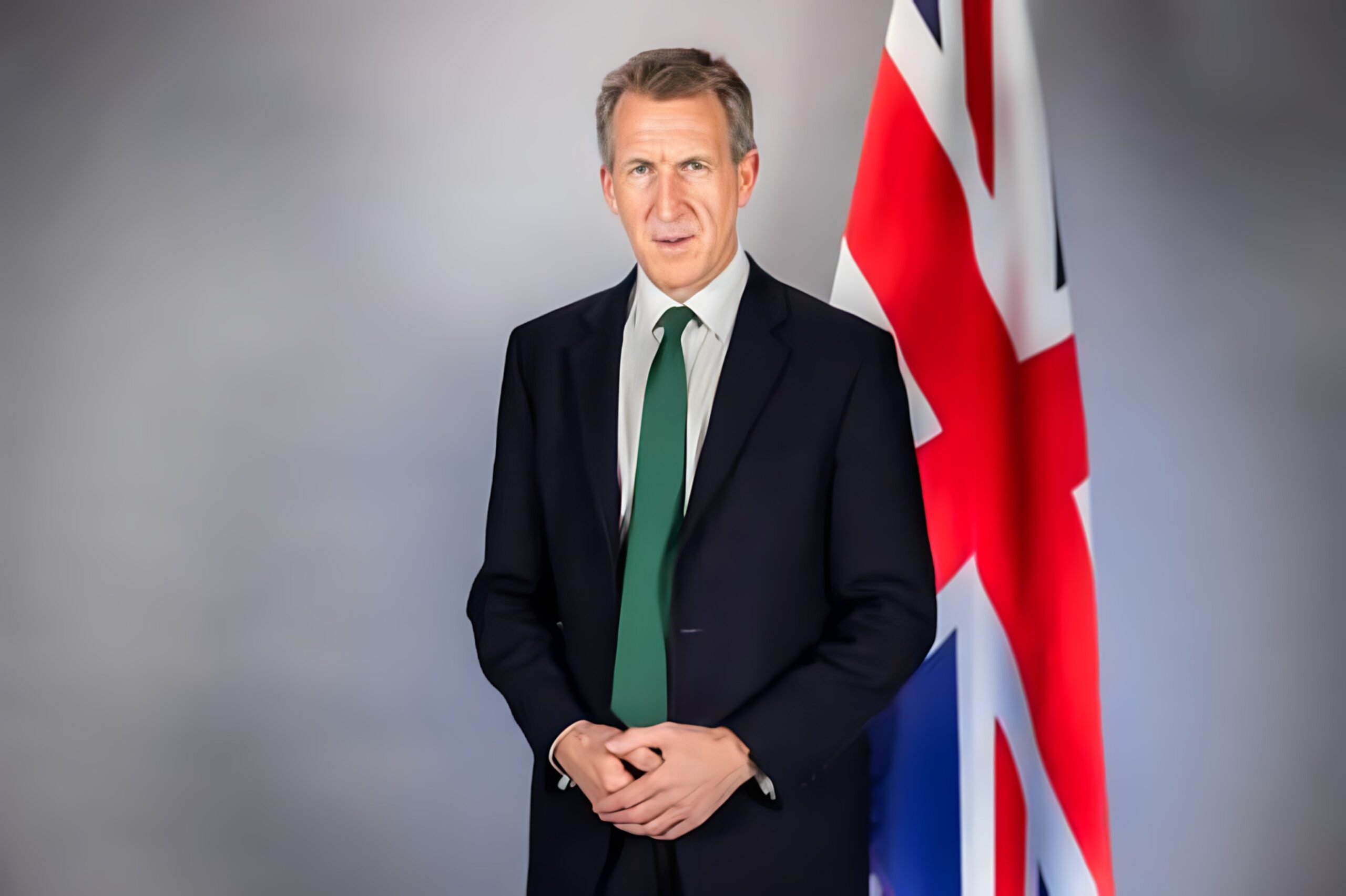
Dan Jarvis has been appointed secretary of state for defence following a day of upheaval in which his predecessor, the armed forces minister and a parliamentary aide all resigned in protest at the government’s defence spending plans.
The Barnsley North MP, a former Parachute Regiment officer who served in Northern Ireland, Kosovo, Iraq and Afghanistan, was confirmed in the role by Downing Street on Thursday evening, less than an hour after armed forces minister Al Carns walked out of government and just hours after John Healey dramatically quit as defence secretary in a dispute with Number 10 and the Treasury over the funding settlement behind the long delayed Defence Investment Plan.
His appointment makes him the first defence secretary since Ben Wallace to bring direct military experience to the post, and he arrives with arguably the deepest operational background of any holder of the office in the modern era.
How the day unfolded
Mr Healey resigned on Thursday morning after receiving a financial settlement for the Defence Investment Plan which he said fell well short of what the armed forces require, and which he claimed the prime minister had been unable, and the Treasury unwilling, to improve.
Under the proposal, defence spending would rise from 2.6% of GDP next year to just 2.68% by 2030, which is understood to amount to an uplift of around £13.5bn, less than half of the £28bn that service chiefs had reportedly said was needed to fund the transformation set out in the Strategic Defence Review.
In his resignation letter, Mr Healey warned that the settlement would force him to take decisions that would reduce the readiness of the armed forces, increase the risk to personnel on operations and could make the country less safe. He argued that while the government has committed to spending 3.5% of GDP on defence by 2035, the trajectory set out in the plan moved far too slowly, with the heaviest pressure to improve warfighting readiness falling in the next two years rather than over the next decade.
Mr Carns, a former Royal Marines officer, followed him out of the door on Thursday evening, telling the prime minister in a blunt resignation letter that he had sat in the rooms, seen the assessments and spoken to the commanders who would be asked to do more with less, and that he could not in good conscience stand at the dispatch box and defend a level of investment he knew to be inadequate to the task. He added that a serious country funds its defence to meet the threat it actually faces rather than the threat it wishes it faced, while parliamentary private secretary Pamela Nash also resigned, citing the delays and difficulties in securing funding for the plan.
Sir Keir Starmer rejected the criticism, insisting that the Defence Investment Plan will provide the resources the military needs to keep the country safe, along with the clarity the British defence industry needs to plan and the certainty required to attract private finance. Announcing the appointment of Mr Jarvis, the prime minister said his first duty was to keep the British people safe, and described his government as delivering the largest sustained increase in defence spending since the Cold War.
That is the political backdrop against which the new defence secretary takes office, because he must now own, finalise and defend in parliament the very settlement that prompted two fellow veterans to walk out of the department he has been asked to lead.
Who is Dan Jarvis?
For readers of this publication, Mr Jarvis requires considerably less introduction than most politicians who arrive at Main Building.
Commissioned into the Parachute Regiment, he served as a platoon commander with 1 PARA, as aide-de-camp to General Sir Mike Jackson and as adjutant of 3 PARA, before working as a staff planner at the Permanent Joint Headquarters and at Army Headquarters following his promotion to major. He went on to command a company in the Special Forces Support Group, and he was appointed MBE for his military service.
In 2011 he became the first person since the Second World War to resign his commission in order to contest a parliamentary by-election, which he won to become the Labour MP for Barnsley Central. He served in a series of shadow frontbench roles, sat on the Joint Committee on the National Security Strategy between 2017 and 2019, and in 2018 was elected the first mayor of South Yorkshire, steering the region through the pandemic and severe flooding before returning to the Commons full time.
He was appointed shadow security minister in September 2023 and, following Labour’s victory at the 2024 general election, served as security minister in the Home Office, where he led on counter terrorism policy including the Terrorism (Protection of Premises) Act, better known as Martyn’s Law. Boundary changes mean he has represented Barnsley North since 2024.
Where he stands on defence
His record suggests a politician planted firmly in the mainstream of Labour’s pro-defence tradition, and one who has at times been well ahead of his party on the issue.
He voted in favour of renewing the nuclear deterrent, backing the replacement of Trident with a new system during the 2015 to 2016 parliament, and during the Corbyn years he went as far as hinting that he might have to leave the party altogether if it abandoned its commitment to the deterrent. In December 2015 he was one of the most prominent Labour voices making the case for RAF airstrikes against the so-called Islamic State in Syria, arguing publicly that the case for action outweighed the case for inaction, a position that drew heavily on his own experience of commanding troops in Afghanistan.
His wider voting record shows a loyalist, with TheyWorkForYou recording a 97% alignment with fellow Labour MPs over the past year across more than 300 divisions, although he has rebelled when he judged it necessary, most notably by opposing a second Brexit referendum at a time when most comparable Labour colleagues supported one. During the Corbyn era he was repeatedly touted as a potential leadership challenger from the moderate wing of the party, although he ultimately declined to enter the contest.
The in-tray
The new defence secretary inherits a formidable workload, with the immediate priority being the Defence Investment Plan itself, which the government had reportedly hoped to publish this week before the resignations intervened. Beyond that sit the delivery of last year’s Strategic Defence Review, the task of sustaining support to Ukraine, the need to reassure allies ahead of key NATO engagements, and the longstanding pressures on personnel retention, equipment availability and readiness that his predecessor cited on his way out of the building.
He will also need to steady a department in which, by the accounts of those who have just left it, military chiefs believe the funding on offer falls dramatically short of the task, while veterans’ organisations have already warned that personnel will be looking for leadership in the wake of Mr Healey’s departure.
There is an obvious personal political risk in accepting the job, because his credibility in Westminster and within the armed forces community rests substantially on his service record and on his reputation for speaking plainly about defence. If he concludes, as Mr Healey and Mr Carns did, that the settlement is inadequate, he will face the same choice they faced, and if he defends it, he will be asked why his judgement differs from that of two fellow veterans.
What is not in doubt is that the Ministry of Defence is once again led by someone who has carried a bergen, commanded soldiers on operations and planned campaigns from inside PJHQ. Whether that experience translates into a better settlement for the armed forces is the question on which his tenure, and arguably the government’s wider credibility on defence, now depends.












He has the CV for it. But if he tries to pass this sham off as good for the military instead of following Healey out the door, then it’s betrayal of the highest order
I’m hoping he resigns as well to show up HMG even more.
Me too, once he’s had a look at the detail in the DIP he walks out the door. Rather think we might be disappointed on that front
I’ve gained $17,240 only within four weeks by comfortably working part-time from home. Immediately when I had lost my last business, I was very troubled and thankfully I’ve located this project now in this way I’m in a position to receive thousand USD directly from home. Each individual certainly can do this easy work & make more greenbacks online by visiting
following website—.,.,.,.,.—>>> JobatHome1.Com
No thanks bellend
At least if he doesn’t we are provided with a very clear metric with which to judge his character. The mere fact that he accepted the job in the first place after his predecessor walked out for eminently good reasons, does not inspire confidence.
He needs to threaten to resign if more money is not forthcoming.
Yes, that will get things done, then the Treasury and the PM’s office will be falling over themselves to give the MoD any money it wants 😀
We need to get the DiP out no matter how much new money is in it or not, if we need to make cuts then so be it, the never ending paralysis and political instability is a far bigger threat to the nation and European security than any defence capability that £5 or £10 billion spent over five years could generate.
Jim, cuts to what? The armed forces are barely functioning. The PM needs to tell his Chancellor and the rest of his party that cuts will be made to Welfare to fund Defence. Apparently, working-age benefits have increased by over £50 billion since 2019. On the Money Saving Expert website it states that benefits are potentially payable to someone earning up to £50k in some circumstances. That’s ludicrous.
Plenty of stuff to cut or reduce
air mobility,
Strategic air lift
The Rangers
armoured recce
special forces support group
light artillery,
the Gurkhas,
attack helicopters,
fleet solid stores (3 to 2)
None of that would have much impact on UK security or NATO commitments.
😆 🤣 😂 You must be a pacifist!
As we have no heavy artillery any more, then cutting light artillery would leave us with what? 14 x Archers?? Might as well get rid if them and be done with it.
This Ain’t France yet…!
🙄
Might as well disarm and finish the job.
We went through each of those in turn the other day, waste of an hour of my life typing clearly.
I don’t really comment on this site much, but love reading what more informed people have to say. But by god Jim you come out with some right verbal manure…. Cut back on those?? Everything has already been cut back to the bare minimum.. I honestly hope you say this crap just for a reaction and done really believe it
Umm Jim
We are an island.. airmobile forces and capabilities are fundamentally important.. Russia loves grey warfare so special forces are core.. we are an island so solid support ships are core.. one of the things that Ukraine has shown is more recce and more recce.. Ukrainian forces are massively recce heavy.
Could I amend your list a bit Jim as I think you had significant typographical errors:
Eliminate the overseas aid budget.
Eliminate the triple pensions lock.
Eliminate quangos (third of government spending through unelected quangos).
Substantially reduce welfare spending on the feckless and lazy. if you are fit an healthy then you have 3 months of benefits and then they are stopped immediately if you reject any job you are offered.
Eliminate aid and support for asylum seekers (send them back to Europe). This includes zero legal aid for them.
Eliminate the net zero agenda from DESNEZ
There I think I fixed your list now.
Overseas aid is an object of foreign and defence policy, and military figures both in the uk amd US have repeatedly stated that cutting aid actually increases international instability and western influence, and hence makes us less safe and keads to additional burdens on defence. Benefits being too high, another right wing trope – certainly makes for excellent throw away attack lines but conflicts with reality. The biggest portions of the benefits bill are pensions by far, and the majority of people in receipt of employment benefit are actually in work, but not paid enough. Employment benefit as proportion of percentage of gdp has also not increased significantly at all for decades, so the notion it’s the reason the services are starved of cash is well off the mark. Disability benefit has increased, but this is in the context of an unhealthier nation after 15 years of austerity and covid. Finally, net zero – climate change is real, the country is not prepared for it at all, but take out the environmental argument – net zero is energy security, it is energy independence, and it is the industries of the future. Those are not in conflict with a proper defence policy, they go hand in hand with it. The lack of finance for defence currently is the chancellors self imposed financial restrictions, nothing else.
Never read so much bull shit in my life! Get rid of air mobility? Without it the whole damn lot is a static waste of money!
The Treasury wanted cuts in current year MOD overspend. How much were these and do you know whether they have happened?
Sniffing
Family allowance up to 50k, but nothing else.
A DIP with little to no new money in it will be worthless whether it’s published or not.
That would be fantastic if he took up the post just to resign within a week. That would show up how inept this government is….Red Ed has sunk two tier, free gear Sir Kier below the waterline….just like our type 83 destroyer plans….still the UK has plenty of rubber dinghies now as well as a an army/navy pf military age young men…I guess that is the defence investment plan….i.e., get third world young men to bring dinghies to the UK and provide for our new invigorated army and navy. What a brilliant plan that is as we can still spend £333 billion on welfare (10.6% of GDP) and £8 billion on overseas aid. Still we are a “soft-in-the-head” power….we should be thankful for that though as we provide benefits and health care for all around the world….
Totally agree and to be honest he should only have accepted the post if the funds were promised up front.
Has MILITARY BACKBONE…!
BUT Does HE Have POLITICAL BACKBONE…?
Only Time Will Tell..
He looks and sounds the part BUT he still has Starmer, Reeves and co. to contend with.
No he doesn’t, his job is merely to get the DiP published and out of the way before the NATO summit and steady the ship before the labour leadership election in a few months. After that he will be out of a job.
What ever internal dialogue there was between The Treasury, The MoD and the PM’s office is done. The MoD has permanently f**ked itself by over reaching because it thought it was in a stronger political position than it was.
In 2024 moving to 2.7% of GDP on defence spending would have been the MoD’s wildest dream. A sum far in excess of what the last government was prepared to spend. Despite that rise they have managed to cause a political scandal big enough to loose a Secretary of State a PM and a Chancellor.
Granted all three needed to go but it means anyone else coming in after, be it Burnham, Badenoch or Farrage will stay well clear of defence spending. There are no votes in it and even when increasing the budget it’s now a political negative.
I’m not sure, I think it may catapult it more into awareness and make it a bit more real for whoever takes over from starmer and reaves.. in the end Healey and Carns who both have their power groups within the party can now freely leaver these to get concessions from whoever is going to be the next leader.
Believe me when I tell you John Healey has no power group in the Labour Party. He is one of the most forgettable people you will ever meet. He was entirely a Starmer appointment.
There will be no concessions to anyone after this unless Starmar makes them and from what I read today Starmar has already put this to bed. The funding is set and the MoD will have to cuts some programs to live inside the budget. They will get the extra £13.5 billion rising the budget to just under 2.7% of GDP and that’s it.
arty politics again Jiom. Where did you get 2.7 per cent from. Dfence spending next year is forecast to be 2.6 and only reach 2.68 in 2030. In real cash terms that means that the budget is going to reduce over the same period.
Hi Geoff is 2.68% not just below 2.7%? Is that not what I said?
Can you explain where you get the budget reducing in real cash terms from please? I haven’t seen that one anywhere. Whats your source?
Hi Jim. Yes it is, but the governments original plan was to hit that figure in 2027. Now it’s going to be 2030 so not so good. Regarding the real terms figures they are readily available…Commons Library, I.S.S. Fact Finder etc. All I’ve done is worked them out. If you increase the budget by 1 per cent and defence inflation is between 4 and 5 per cent then in real spending terms the defence budget has reduced. It actaully happened last year. Not by much but it did happen.
Hi Geoff BBC disagrees with you
By Ben Chu
On 25 February 2025, Prime Minister Keir Starmer announced that UK defence spending would rise to 2.5% of GDP in 2027, funded by aid spending being cut from 0.5% of GDP to 0.3% in the same year.
And the government said that, including spending on the UK’s security and intelligence agencies, the overall defence budget would reach 2.6% of GDP by 2027.
2.6% is what was promised by the end of 2027. That’s now being increased to 2.68%
Where did you get the budget is increasing by 1% from? The budget is rising by a lot more than 1% in cash terms.
Below is from the House of Commons
2024–25: Outturn defence spending totaled £60.2 billion, representing a nominal increase of £6.3 billion (7.7% in real terms) from the previous financial year.
2025–26: Defence spending is planned at £62.2 billion, with the Ministry of Defence retaining one of the largest capital budgets across government to prioritize equipment and infrastructure.
I just can’t see where you are getting this real term cut from or the 1% figure you quote.
we’re going round in circles here Jim. Perhaps it’s me not explaining it properly. I guess we’ll just have to see what happens with the D.I.P.. I’m more than happy to be proved wrong.
The Political Negative I’m Sure the F.O. And Ms BALLS Will tell You is Britains lack of Standing on the World Stage..!
I’m Sure the Current PM Can tell you That.after G7 ..!
The Votes for Any PM is When He can ‘Strut his Stuff’ ( Like Blair or Cameron) on the World Stage And look like A Statesman…! Difficult to do with NO ‘PERCEIVED’ HARD POWER Or SOFT POWER to Back you Up as were Seeing..!
If I were in his shoes I would acceept the plan publicly and state that I would be pushing for the remainder that is needed. I would do this on the basis that this moderate increase is better than no increase at all, but would publicly lay out the compromises that now need to be made and the risk being held.
do think there is an economic argument for uk gov to encourage homegrown companies by putting the orders in now for military kit. europe is buying, we maybe able to sell them stuff as well
This Goverment Has Squeezed the Life out Of British Businesses…Difficult to See were Growth is Coming from other Than by Unsustainable Goverment Spending..?
It won’t work out good for the forces labour will protect benefit spending at all cost and certainly won’t lower Net Zero or money to support illegal immigrants.
The push for net zero is only good for the economy.
Fastest growing sector after AI and gives us cheaper energy than fossil fuels, while reducing our exposure to things like the closure of the Straits of Hormuz.
It doesn’t though does it ? Never that simple. Energy companies bid for contracts. Whosever gets in last with the highest bid, the rest are paid otherwise why bid at all. There was an extensive article about this on BBC, wherein solar is doing well but UK isn’t a solar country. Wind turbines on other hand are still rather niche and expensive to setup. If net zero is making things cheap, NOONE is seeing it. Wake Up ! FFS. Stop using the name Spock, you are disgrace to common sense let alone logic.
“Wake up” – the universal call of conspiracy theorists, whether they are anti-vaxxers, flat-earthers, or climate-change deniers.
You might be whinging that you’re not seeing cheaper electricity, but what you’re not seeing is the more expensive electricity we would have if we were not using renewables. The U.K. has the highest electricity costs in Europe primarily because we burn more natural-gas to generate electricity than other nation.
Wind turbines are not “niche”. Most days that’s where the majority of U.K. electricity comes. Unfortunately we haven’t eliminated the burning of gas, which means our prices are still too high.
As for the U.K. “not being a solar country”, that’s simply not true. Solar panels are most efficient in temperatures of 20C to 25C. They don’t need the searing temperatures and cloud-free skies of the Sahara.
BTW stop using the name Glyn, it makes you sound like a human rather than the odious pile of shit that you are.
Did you really just describe wind turbines as niche? Well over half of our power comes from wind and that is growing massively year on year. Add in some storage capacity and the prices will crash. I really struggle to see why anyone would support oil and gas as an energy source after the debacle caused by the closure of the Straight of Hormuz.
Have you priced required storage capacity, ten year lifespan for project planning purposes, to include recycling costs, offshore carbon footprint?
There Already put Wind Turbines in the Ground in Scotland…Turns out they only have a limited Lifespan and are NOT Recycled..!
Yes…17,000 of these 7 ton blades to be decommissioned over the next few years in Scotland. Surprising that we never hear of the cost of recycling these…
Oh! Apparently the SNP, unlike the rest of Europe, have not banned turbine blades being placed in landfill…as you rightly say! Yet another total nonsense as a consequence of the expensive pursuit of dotty and unevidenced net zero policies
‘A disgrace to common sense let alone logic.’ Hilariously well put…
Understand buried in forest After 20yrs op by Bulldozers..( Very Green !)…Apparently Turbine Blades Suffer from Fatigue over time and have that Approximate life Span!
Wonder What they’ll Do with Offshore Blades.? …perhaps Someone Should Ask ED MILIBAND if we’re building a Fund for Such Disposal for the 2040s….? Otherwise Wonder Who will Pay..????
You are correct. This stuff is never mentioned, let alone featured in any cost benefit analysis:
‘With a lifetime of 20–25 years for a wind turbine, it is predicted that the cumulative composite waste from blades will be needed to be recycled will be in the tens of thousands of tons worldwide by 2050. This poses a potential significant waste legacy that must be addressed. Solutions to deal with waste from wind turbine blades currently involves the three different pathways, direct deposit in a landfill, incineration, and recycling. Unfortunately, only 30% of fibre-reinforced plastic material commonly used in wind turbine blades can currently be reused to form new composite materials’
Who will pay?…you know the rest
Rounding errors mate. Welfare and the state pension are gumming everything up
Levi, State Pension Triple-Lock won’t be changed until after the GE in 2029. Then anybody with a brain (!) will remove NAE and take an average of RPI and CPI. Much, much bigger deal is the amount of ‘working age’ benefits being paid. There’s about 2.8 million people signed-off as long-term sick. Even those that are working can often claim additional benefits and Money Saving Expert website uses an example of being able to claim benefits when someone is earning up to £50k!
In the end the quickest and easiest biggest amount is simply making the state pension means tested.. simply you don’t get state pension over the highter rate tax threshold.. that’s about 10 billion a year starting next year..
Then all of us who have been paying NICs for 30 or 40 years will be marching in Whitehall. It’ll be like the ‘Poll Tax’ protests that Thatcher endured. We have a ‘contract’; we’re all supposed to pay in and everybody who’s paid in is supposed to get someone back.
Much fairer to stop people getting money out of Welfare who’ve paid little or nothing in. The DWP have a record of everybody’s NIC record, you can register on the Government Gatewsy and view yours. Limit working-age benefits to what you’ve paid in would be easy and fair. We won’t have 2.8 million long term sick anymore.
And that’s the thing.. it’s my right it’s my right… until this country actually goes no it not we get no place.. it was every child’s right to get child benefits until it was not.. there is no place for universal benefits.
Most importantly you did not contribute to your pension you paid for your parents and grand parents to have a pension and many many people paid nowhere near enough NI contributions to ever cover the pension they get..look how much it costs to buy a 10,000k triple locked pension on the open market.. it’s going to be about £300,000.. you get that even if your NI contributions were a couple of hundred pounds a year.. one year when I was young I got a full years contribution with £80s.. so no we don’t have a right to a full state pension it’s a benefit.. and unless us older people get off our high horses we are the problem not the wise heads that show the solution.
I’m in agreement with your sentiment but not your unilateral implementation. If you want to phase in a new system, so be it. Whilst none of us were promised PIPs and Universal Credit, we were promised a pension for our NICs.
There’s about 1 million pensioners who are higher rate taxpayers. If you stop their State Pension, that might raise £12.5 billion a year. Meanwhile, the annual bill for UC is £99 billion and PIP is about £56 billion. There could be huge savings made in revisiting these benefits that are clearly out of control.
To me being a utilitarian I would also means test pip payments with the same test.. simple test really if your a higher rate tax payer you don’t get any support full stop.
I would also make everyone out of work who receives benefits undertake some public works, unless they had a specific health related “ cannot work at all card”.
Combine health and social care completely, scrap all the separate NHS trusts and simply have everything run by health authorities ( essentially scrap the entire internal market).
With that money saved ( and it’s a lot) I would fund defence and anything left over I would use in debt reduction.
Well said Rob, I don’t care if someone has earned £25k or £100k a year. If they’ve paid in, the should get something back!! I’m all for people who claim benefits as a way of life getting enough for utilities, basic food. And at a push free travel on public transport…. Christ I grew up in the 80s where we had basic food all the time because my dad didn’t always have work. We wouldn’t have had enough for takeouts or Holidays like all the freeloading scroungers now a days!! And as for the ones that sneak into this country they should all be put up on an island in the Outer Hibrides with nothing more than a tent and warm clothes and fed from a soup kitchen!! All that should save the state a few ££ to put towards the military and also discourage layabouts and illegals
But they did not pay Bob.. my personal pension I paid 9,000 a year into to get about 10,000.. the cost of a 10,000 pension is about £300,000 to £400,000.. your NI was a contribution to help pay for your parents and grandparents pensions.. not to pay for your own, it will be your children and grandchildren that have to pay for that.
It’s my right.. I deserve it.. NO WE DONT.
You’re a tard aren’t you! I didn’t say they’re getting their own money back. I’m not thick I know who it works.. what I meant even though you’re to thick to realise is that if everyone pays into a system. Then at some point they’re entitled to get something out of that same system. Why should someone pay money all those years for dead beats to claim and when the time comes get nothing themselves.. let me guess you’re a Labour fanatic that thinks people with a bit of money should be taxed to high heaven or have all their possessions sold off to pay for the lazy feckless and unwanted in this country.
Tard.. are you three mate. Clearly you dont understand the problems we face..
Not nice calling people a tard
I meant that reply for RobC not Jonathan.
It’s ok Jim. Some people struggle with complex concepts and so have to use simple four letter words they make up to communicate their lack of understanding.
Don’t worry Rob C, National Insurance was never to pay for the basic state pension.
NI started forty years before the basic state pension to pay for health and sickness pay.
Extract from the House of Commons Library: “The UK State Pension has been funded by and linked to National Insurance Contributions (NICs) since its creation under the National Insurance Act 1946, which came into effect in 1948. This link established the “contributory principle” where entitlement is based on an individual’s record of paid or credited”. That’s a long time before I started work.
This is the reality. Im lucky enough to have tagged on the end of a Defined Benefits pension scheme with the company I work for so I do not need to draw on the state pension when my retirement comes. We need to be realistic about what the national coffers can provide for us and if we dont want to contribute more, some of us will just need to expect less.
You’re quite right that welfare is the easier, more moral and far more economically sensible target to go after.
I have to disagree on the state pension though. You signed nothing and funded nothing, your NICs went into the tax system same as all your other tax. It’s a benefit and benefits can be taken away, especially when not needed (i.e., wealth pensioners, or ones sat on huge unrealised gains such as property). The state pension is an unproductive investment for the Treasury and has to be cut for those that do not need it
Levi, I’ll refer you to my recent post regarding the 1946 National Insurance Act. We’re all entitled to a State Pension if we’ve been paying NICs. I’m happy to see the Triple-lock go; we weren’t promised that and the link to NAE is particularly silly and unaffordable for today’s taxpayers (which, includes me) for a few more years.
Also form parliament below, note the word benefit in parliaments text.
There is no explicit or legally binding promise in the UK to pay a state pension. Under current legislation, the state pension is classified as a statutory contributory benefit, rather than a contractual right. This means the government retains the legal authority to alter the eligibility criteria, increase the state pension age, or change payment rates at any time.
As long as he throws away his politicians hat and puts military one on, we should get clear leadership.
Best of luck to Dan Jarvis!
When the idea of the DIP was first announced, I assumed that it would be MoD-authored but with the funding level dictated by HMT who were well aware that the intention of the DIP was to state in fine detail how the recommendations from the SDR could be funded and met, together with equipment and infrastructure programmes and personnel costs etc. I also expected HMT to exercise some sort of overwatch over the MoDs work.
Now it is said that Healey and Carns had little input into the DIP and did not know until Monday what the ‘settlement figure’ from HMT was – £13.5bn. That is astonishing. How can a DIP be writtten over a long period (June 2025-May/June 2026?) without MoD ministers and DIP authors knowing how much cash is available?
What was telling the cairns interview in which he said it was not just the money but the fact the DIP focused on capabilities to fight the last war and not the lessons from Ukraine and the next war.. so it’s a double failure an out dated concept with to little funding.
I think Mr Jarvis will be a good fit for Defence minister but the draw back like and elephants foreskin is he has to tow No10/No11’s line and I do not think he will last long trying to convince guys waiting for kit or in fact that there is no kit comming and trying to convince the guys that the government has their back he will do what Healey did and throw in the towel which is a shame as what the country needs is stability but that is one thing the people in the house of commons from all sides seem unable to give the country.
He may be a fine guy no doubt ,but at end the end of the day if there’s no money in the pot it’s not going make any difference .Be interesting to see what he has to say about is new position .From what I’ve read he has experience for the role but unless he has a magic wand don’t see the point .Or is he there to pick up a monthly wage. We’ll have to wait and see.
Like Starmer, the fanfare at Swindon went down like a wet rag, apparently.
What was Jarvis supposed to say? He stayed for an hour then bolted.
No sign of the person who is allegedly the PM either.
Oh Joy, Starmers Loyalist YES MAN.
We know what happens when surrounded by Yes’s, people die and things get worse.
So Carns said:
“ says the UK’s next war will not be won by the armed forces alone, but by coders, drones and energy independence.
Writing on X, Carns says “It’ll be won by the country whose 19-year-olds can code, whose factories can build drones in weeks not years, and whose grid stays on when someone tries to switch it off.”
Wes streeting has set his stall for leadership around defence and learship..
“failure to make the right choices on defence spending is a symptom of the indecision at the heart of the government.”
telling the BBC that defence was his “number one priority”.
“Growth was meant to the number one priority, is it still? Streeting writes.”
“There’s not enough money for defence, but today the government announced £4.5 BILLION for walking and cycling,Make choices. Decide. Lead.”
It’s a good point on the £4.5 billion for cycling, shows how shit labours comms are that such an announcement would come out the day after two ministers resign over £5 billion to defend the country.
If the DoT has money to not only do HS2 but out £5 billion into cycle lanes then that’s an easy cut to make for defence.
There is lots of shiny new kit in the pipeline already contracted. But the priority must be to get what we already have actually fully operational.
Astute SSNs
T45
F35Bs
Ajax
For uncontracted programmes we need to learn from these and look for good enough sustainable solutions. So for T83 an AAW design based on T31 rather than a brand new platform whose high cost will limit the number we might buy.
You know, that’s maybe what we need… A good enough ship that builds on what the Type 45 had, so we take the Radar, weapons and put it into new hulls. Now, whether the AH140 or AH160 is used as the base, I dunno,
Hell we could go the Aussie rout and double up the Type-26’s, with less ASW focus and more AAW like they’ve gone with the ship and use that extra firepower upgrade that BAE proposed in 2023 to build a magazine depth that would be able to stock strike missiles, plenty of BMD options, long range AA missiles, short range missiles and the CIWS/BOFORS to defend the vessel, with 30mm Remote guns for the surface threats.
Starmer loses another minister…….it’s just a flesh wound. 😂
Let’s see how much he cares about our Armed Forces and not acting out of self interest, listening to his recent comments makes me wonder how good a Defence Secretary he will turn out to be..
Initial reaction to these events: Healey was a defence enthusiast who failed to control the MODs spending incontinence and jumped out of his pram when the going got tough. Jarvis looks like a leader who knows how to follow orders and make the best job of what you’ve got before you ask for more.
Seen him before. Trouble is we need a new Chancellor.
The UK has the people and the capacity to do this. We need a PM who can inspire the people, set the right priorities and create a sense of drive and determination. Kier is not that person and Labour MPs need to dump the party and rally behind someone the PM we need rather some numpty they happen to have available.
Borrowing figures out today may Shed light on PMs Hot/cold View on Defence…!!
The Goverment has borrowed £46.2 bn in the First Couple of Months of the Financial Year 26/27. .!
.That’s Apparently £7.7bn more than the OBR forcast just this March..!!!
The Government knew when they got into power that they needed to grow the economy.
That happens when businesses leaders are confident enough to invest their time, effort & money in moving the country forward.
Kier has dithered and he surrounds himself with ditherers. He must go. We need a positive, decisive leadership.
Andy might be better or we might need a general election.
As he is my MP, whom I voted for in the last election, I am pleased he has the job. But it’s bittersweet given the compromised position he’s agreed to take on. Let’s see how skilled a politician he is to make this work. I raised an issue with him 2 weeks ago and he gave me a good answer, I’ll now be raising defence issues with him, for what it’s worth.