

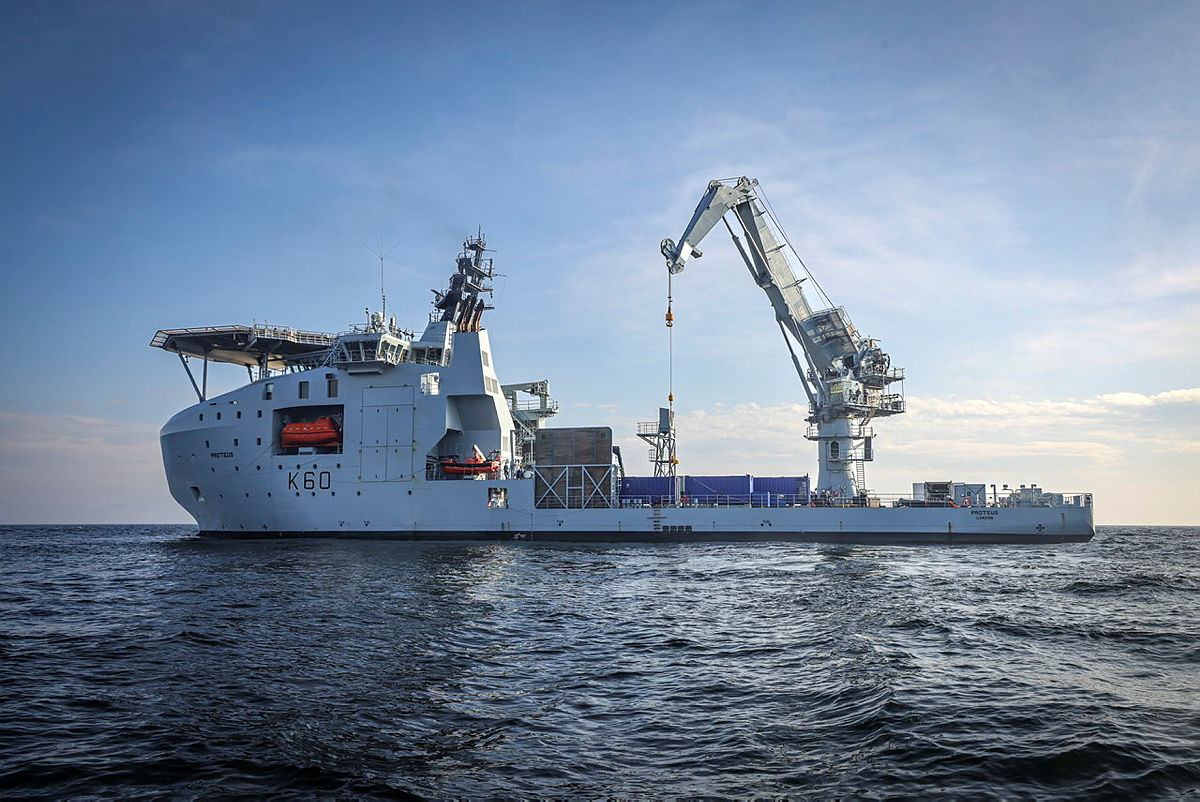
RFA Proteus, the UK’s dedicated seabed warfare and underwater surveillance ship, is to receive upgrades and enhancements as part of a £330 million investment in protecting critical underwater infrastructure, the Ministry of Defence has confirmed.
The detail came in a written answer from Defence Minister Luke Pollard to Conservative MP Stuart Anderson, who asked what systems will be developed with the money allocated to seabed warfare in the Defence Investment Plan.
“The Defence Investment Plan outlined several investments into seabed warfare capabilities, including an additional £330 million critical underwater infrastructure protection capabilities, including upgrades and enhancements for RFA Proteus, and a £90 million investment in the autonomous minehunting programme to procure offshore support vessels (OSVs) in conjunction with Norway,” Pollard said, as quoted in the answer.
The commitment to enhancing Proteus is a notable marker for a ship whose future family has been in doubt. As previously reported by the UK Defence Journal, the vessel was always described as the first of two multi-role ocean surveillance ships, with ministers confirming as recently as last year that a second ship remained in its concept phase while declining to give details, and the decision to invest in upgrading the existing vessel suggests Proteus will carry the mission for some time yet, with the answer making no mention of a second hull.
The future of British seapower lies in ships like RFA Proteus
Proteus began life as the commercial offshore support vessel MV Topaz Tangaroa, built in Romania and fitted out in Norway in 2019, before the MoD bought her for £70 million in early 2023 and converted her at Cammell Laird in Birkenhead, a programme accelerated using funds from the cancelled National Flagship. Entering service in October 2023, the 6,133-tonne ship operates with a core crew of 26 Royal Fleet Auxiliary personnel augmented by around 60 Royal Navy specialists who run her undersea surveillance, survey and warfare systems, deploying remotely operated and autonomous underwater vehicles through a moonpool and a cavernous ROV hangar to inspect and protect the cables and pipelines on which the UK’s communications and energy depend. The ship has been at the sharp end of that mission, having shadowed the Russian research vessel Yantar, suspected of mapping Western undersea infrastructure, during the vessel’s repeated appearances around UK waters.
The answer does not specify what the upgrades to Proteus will involve, though.
The second strand of the seabed investment, £90 million for offshore support vessels procured in conjunction with Norway under the autonomous minehunting programme, points to the mother ships needed to deploy the uncrewed systems taking over the mine countermeasures role, following the retirement of the Royal Navy’s traditional minehunters, most recently HMS Chiddingfold this week.
The Norwegian dimension builds on the deepening bilateral relationship under the Lunna House Agreement, which already spans the Type 26 frigate purchase and cooperation in the North Atlantic, and the answer confirms the two nations will now buy the supporting vessels for autonomous mine warfare together.









Will the “upgrades” will also include a little bit of defensive armaments, if it’s possible to squeeze some in somewhere? Would it be worth removing the helipad and constructing a smaller but more accessible one aft?
Good that George mentions MROSS Number 2, I’ve been wondering where that went.
Nowhere soon, or at all I think. Does it need to be purpose built, can it be another vessel like Proteus to save money?
It was always trailed as the expensive, purpose-built follow up. However, let’s face it, plans have been torn up alongside the DIP and rearrangements made. It could be anything or even nothing. Given the sensitivity and grey-zone nature of the seabed, I’d be surprised if it was nothing.
One suggestion I saw on X which horrified me, but which would be standard HMG, was to “replace” both Protector and Scott with a single vessel, given the newfound importance of the Arctic.
Which would leave the Antarctic bare.
MROSS 2 has surely morphed in to the potential replacement of HMS Scott in the 2030’s? But the replacement of Protector has got interesting. During SDR a very strong argument was made that compliance with the UK’s new Defence Arctic Strategy meant that two Ice Patrol Vessels were essential as it was clearly impossible for one ship to cover both the “High North” and Antarctic on more than an occasional basis – with a c.6 week transit time between one region and the other. Of course this was rejected by the PID due to lack of money. But I have a suspicion that a two vessel plan may yet be adopted as it will be very popular with our nearby NATO allies (Denmark, Norway, Iceland …) in the context of recent events, whilst the sums involved are not huge – probably less than for example just one additional A400M transport aircraft. And in the unlikely event that new build vessels are affordable, it would be a good offset for the much sought after £1 bn Norwegian purchase of 6 Leonardo AW101 Merlin ASW helos.
Good points.
Depth charges,hedgehog rockets & torpedos all proven in combat and quick to fit 👍
Luke Pollard getting very good with all this Smoke and Mirror