

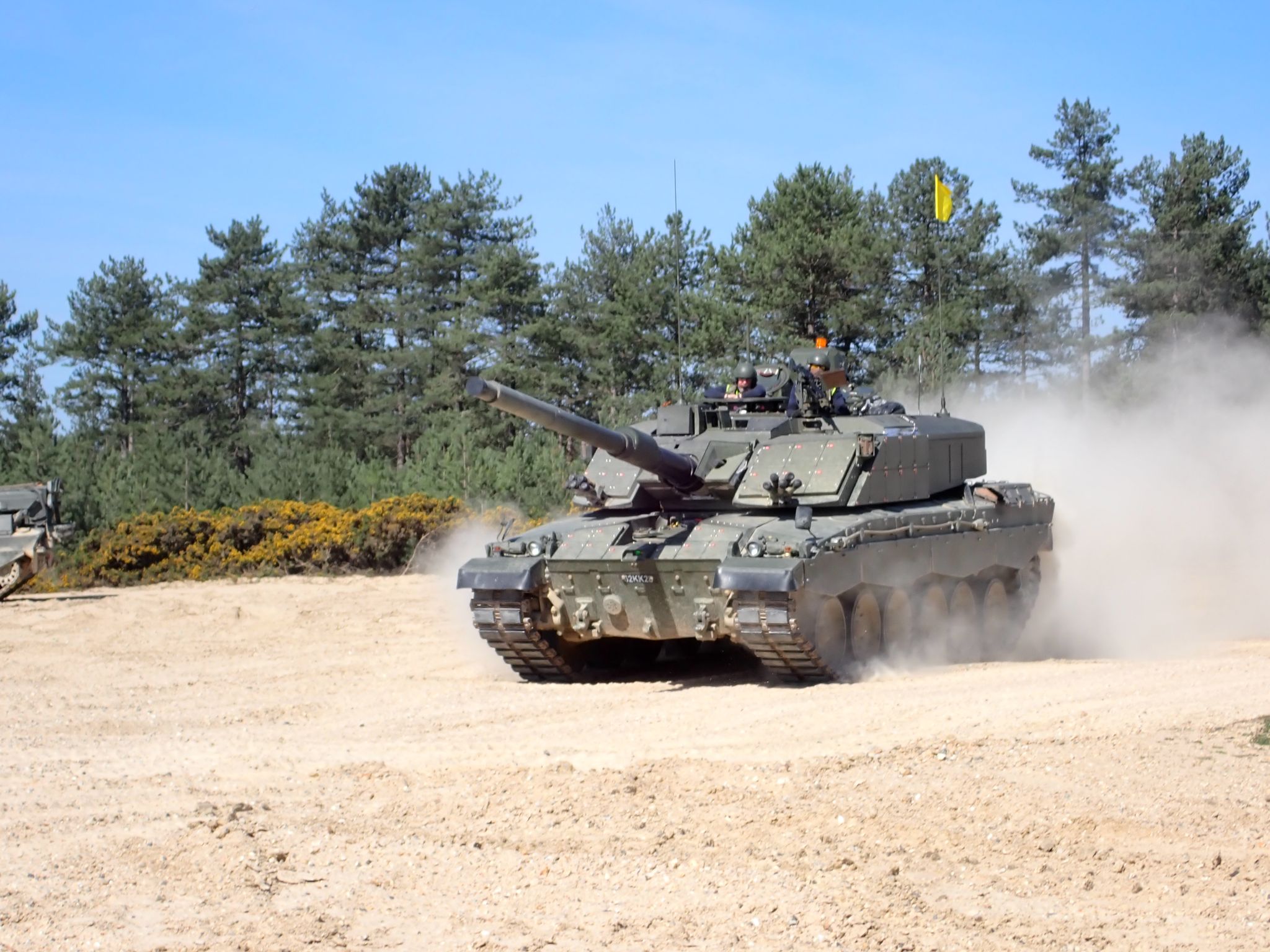
Rheinmetall BAE Systems Land has said its Challenger 3 trial tanks have been put through a fresh batch of Battlefield Mission serials, covering cross-country running, road work, gunnery and full crew drills, in what the company is describing as an important step forward for the British Army’s new main battle tank programme, the company said.
The trials, run in what RBSL has called representative operating conditions, have seen the platforms driven across country and on the road, with the crews exercising the gunnery equipment and working their way through the full set of drills the army will eventually expect on a finished tank.
The company says the serials are designed to build up insight into how the platform performs and to validate the procedures, instrumentation and methods that will be used in the formal trials still to come, with data and observations from the runs being fed back into the engineering baseline as the design continues to mature.
The programme’s verification lead at RBSL, identified only as Nick, said the activity was “generating exactly the kind of learning” the team wants at this stage, with every serial helping to sharpen processes and build confidence as the programme heads towards its formal trials phase.
Challenger 3 is the British Army’s next-generation main battle tank, being delivered by RBSL, the Telford-based joint venture between Rheinmetall and BAE Systems set up in 2019 to handle land vehicles for the United Kingdom. The programme is taking the existing Challenger 2 hulls and rebuilding them around a new turret carrying a 120-millimetre L55A1 smoothbore gun in place of the older rifled L30, bringing the British fleet onto the same ammunition standard as most of NATO and clearing the way for the latest generation of tank rounds.
Beyond the gun, the upgrade brings new optronics, a new fire-control system, modular armour and the Trophy active protection system designed to defeat incoming anti-tank munitions in flight, alongside a host of crew and survivability improvements drawn from operational experience over the past two decades.
The programme is sized at 148 tanks, with initial operating capability targeted for 2027 and full operating capability later in the decade, while the Strategic Defence Review published last year reaffirmed the British Army’s commitment to keeping armoured firepower at the heart of its land force.








I have to say I think it’s very wise to have undertaken this programme to get a present generation MBT for only 5 million a pop.. I get the feeling that at some point in the next decade design paradigms for firepower, armour and mobility are going to shift dramatically and I think they my even move from the old concept of a pyramid that needs balance to something like square that needs balance.. firepower, protection, speed and say awareness.. with massive investment in awareness.
I’ve gained $17,240 only within four weeks by comfortably working part-time from home. Immediately when I had lost my last business, I was very troubled and thankfully I’ve located this project now in this way I’m in a position to receive thousand USD directly from home. Each individual certainly can do this easy work & make more greenbacks online by visiting
following website—.,.,.,.,.—>>> JobatHome1.Com
I’ve gained $17,240 only within four weeks by comfortably working part-time from home. Immediately when I had lost my last business, I was very troubled and thankfully I’ve located this project now in this way I’m in a position to receive thousand USD directly from home. Each individual certainly can do this easy work & make more greenbacks online by visiting
following website—.,.,.,.,.,.,.,——>>> PayAtHome1.Com
Could be good sense to get another 50+ for buffer stock at this price and allow for additional deployment in force if when needed.
Does CR3s GPMG mount have C-UAS ability?
Hi Jonathan, interesting post! Some folk now use the term survivability instead of protection (or ‘armour’ as you call it) but its more interesting to speculate as to whether there is a fourth dimension. If not ‘situational awareness’, then perhaps ‘networked capability’
Hi Graham, yes survivability is probably now the better term than protection, as protection in the old iron triangle was really a description of the ability to defeat the effects of a kinetic, shaped charge ( including pancake) or Blast, where as survivability encompass wider concepts of protection, like stealth, ECM, hard kill active protection systems and soft kill active protection systems as well as the physical ability of armour to defeat kinetic and chemical energy.
When you add in the multiple competing factors and risks in survivability before you even get to balancing firepower, speed and that new Networking/awareness requirement I think the late 21c version of an MBT is going to be as different from a present generation MBT as first generation post war MBTs were to the the light, medium, heavy and infantry tank concepts of early WW.. only 8-10 years difference in time but a vast difference in threat and understanding.
The scope of threat is significant difference and completely omnidirectional as well as omnipresent. With this omnidirectional threat comes a profound problem of balancing armour protection.. meaning greater compromise to frontal protection unless you’re willing to sacrifice omnidirectional protection. Speed or firepower…
Increased shape charge threat, as well as the shape charge threat becoming omnidirectional, it’s also more difficult to defeat.. with larger and larger diameter shaped charges as well as dual charges etc.. but large omni directional shaped charges will be smaller numbers ( big heavy anti tank missiles.. still have the same tactical deployment issues that they always had..even if they are smarter and attack from all angles.. larger loitering munitions are at risk from air defences and are harder to deploy)..so actually is armour really any use for this threat at all or is this threat managed by active defence and awareness/networking
Kinetic rounds.. in the end armoured vehicles are always going to throw kinetic rounds at each other and this threat requires good old fashioned frontal armour.. if you get to clever and designed a vehicle with all the active protection, speed and firepower in the world but sacrifice frontal armour.. some last generation MBT hiding in a wood will put a hole through it at 5000yards.
Mass omi directional omnipresent aimed drone attacks.. lots of light blast and shape charge attacks aimed at your sensitive bits.. essentially this changes a few things.. the vehicle will need to spend the whole time buttoned up so situational awareness will be fundamental to design.. active defence cannot manage mass of attacks.. a few Anti tank missiles yes 100 drones no… so this needs passive active protection or active protection that can deal with mass dross drones as well as omnidirectional armour to defeat smaller shaped charges as well as blast fragments, as well as protection of systems.. senors, comms, locomotion, power plant etc .
On top of all that consider other concepts that can be developed.. say the autonomious anti tank mine.. flies around finds a few vehicles.. predicts their path drops down in front of them, has some basic sensors that are ECM proof.. then bam.. shape charge through the floor.
Designing the next generation of armoured vehicles for direct fire support is going to be hard.
Like the battleship ended because it could not sustain the onslaught of aircraft from all sides, the tank as an heavily armored is inviable because it cannot have heavy armor in all sides.
The investment should be in anti-drone and anti missile technology from ground level to the zenith also it needs an APU to work 24 to 24 hours. For all vehicles that enter the drone zone.
The Battleship did not end because of Aircraft could attack it, in fact one of the primary reasons Battleships remained in service in 1945 was as floating AA batteries to escort carriers, and as a last line of defence against enemy Battleships.
What ended the Battleship’s role was really a combination of guided missiles becoming more commonplace, faster jets making gun air defence less viable and the fact that only Britain, France and the US still had any in the 1950’s, obfuscating the need for them as carrier escorts.
In war you just don’t dump stuff that had some use. Even today a battleship can be useful in some circumstance, in todays battlefield a shield might have some use to.
The point is that huge resources to build a battleship are not justifiable when aircraft from a carrier can sink you from 300miles and your guns have 1/10 that range. Yamato and Musashi could do nothing, they were sunk by swarms of Avengers, Helldivers and Hellcats.
Battleships ended because of aircraft not because of guided missile, that was just another nail in the coffin.
The resources to build battleships where still justifiable in 1945 to 1955. That’s why Vanguard, Kentucky, Illinois and Jean Bart where still under construction in 1945. Aircraft didn’t end them, it was the fact that guided missiles and the lack of enemy battleships ended their role. That’s why the RN and MN moved to put their modern battleships into reserve in the late 1950’s, after the Sovetsky Soyuz class was cancelled and Novorossisk sank in 1955, rather than in 1945. Add the guided missile and faster jet’s as I said, and suddenly you didn’t have to worry about having to fight an enemy battleship, and your big floating AA battery could now more effectively be handled by guided missile cruisers. RIM-2 and RIM-8 entered service in the late 1950’s and SeaCat shortly after in RN service.
“Yamato and Musashi could do nothing” really funny you bring that up, because 11 Aircraft Carriers where used to sink Yamato. That’s not an efficient use of a superior doctrine that’s brute forcing a problem because the force disparity in 1945 was that high. Had the USN chosen to engage her with 11 Battleships there equally would have been nothing Yamato could do. I will also point out that only 5 Battleships where actually sunk by aircraft at sea during the war. Repulse, Prince of Wales, Roma, Musashi, and Yamato. And well, as said, Yamato and Musashi where hit by a such disproportionate force that it really didn’t matter what form that force took, and Roma was sunk by it’s supposed allies as it was sailing to surrender. By comparison 5 Battleships where sunk at sea by other Battleships. The last of those btw also in 1945.
Bismark, Tirpiz?
Bismark was sunk by Battleships, specifically HMS Rodney and HMS King George V.
Tirpitz was in sunk at her moorings, not at sea. Ships sunk at port or at their moorings are a complicated kettle of fish, so I usually discount them.
“really funny you bring that up, because 11 Aircraft Carriers where used to sink Yamato.”
is that your argument? you know very well that 11 carriers were not necessary. Now you will tell me that all torpedos and bombs that hit were necessary to sink it?
I actually made a rather longer more cogent argument, but really knowing you, not surprised you latched on to that bit and ignored the rest.
Technically 15 carriers where necessary, but not all of their aircraft found Yamato, so you know, 4 for contingency. But okay, Musashi only needed 6 aircraft carriers assigned to it to sink it. Still the same argument: If you use an entire fleet to sink a single asset, that doesn’t tell you much about how viable the asset was.
Meanwhile the allies where very appreciative of long range radar directed (reminder that the Japanese did not have radar directed fire btw) AA fire from their own Battleships when their carriers needed protecting and the odds where not 11-1.
Also worth noting that Spruance did not share your about Battleships being obsolete and was planning to vector his shore bombardment group in to intercept Yamato when Mitscher decided to ignore Spruance.
“But okay, Musashi only needed 6 aircraft carriers assigned to it to sink it.”
like i expected you think that all went for Musashi and all bombs and torpedos that hit were necessary to sink it…
Back on my hobbyhorse about remote MBTs working alongside crewed CH3s. What if the remaining CH2 tanks are converted into drones and retain their 120mm rifle guns? The prime use of these vehicles would be to work with crewed units or independently, enabling the manned units to operate in less vulnerable locations yet penetrate hostile theatres using CH2 drones. The idea would be to increase the UK’s MBT footprint without purchasing additional CH3 and utilising the redundant CH2 hulls.
Mmm how are you going to load the three piece ammo the rifled gun uses with no crew?
To be fair if you convert it into a drone you obviously automate everything. Can’t personally see the point in that though as it would be far cheaper and effective to simply create a drone from scratch.
Hate to point of the obvious but things get simpler and easier the more people you remove from the equation and the further the remaining people are from the battle field. Indeed if they had had drone tech in WW1 and WW2 would they have bothered with any protection at all.
Good point, Jacko. Obviously, there would need to be some engineering involved to create a credible weapon, and if possible, an automatic loading breach would be required for the current 120mm-rifled gun. The objective would be to develop a system that required minimum investment, and if a new gun system were necessary, the conversion could still be financially viable. I know remote MBT concepts aren’t new, but technology has moved significantly in remote armoured vehicles to a point where a MBT may be worth considering. Preferably, a brand new vehicle would be my preference, allowing the UK to re-enter the heavy armoured manufacturing, which it once excelled at.
Robots.
There, Robots are the new Drones.
You read It here first 😁
As described by not the nine o’clock news; British Leyland, hand built by Roberts 🤣😂 sorry tough day
I believe Fairey Hydraulics developed an autoloader for the Challenger 2 back in the 80s/90s which could load the three piece ammunition, if you search ” Fairey Hydraulics Challenger 2 autoloader” into google theres a lot more information.
Russian tanks such as the T72 and T80 all load two piece ammunition witth an autoloader, so it is possible. However, developing an unmanned CR2 would be extremely expensive.
It’s one thing having an autoloader. It’s another thing having an autoloader operated using a machine.
Don’t no much about the subject, but what about those Ajax that are causing problems cannot they be converted to remote tanks ? Ambulance version aside. Understand the next batch will have modifications to fix the problems, so it won’t apply to all of them.
That’s a very good point, SC; the machine itself is okay apart from the fact it has to carry a crew. The dilemma facing all nations is manpower and the increasing lack of interest shown by their young folk. Men and women will always want to be part of the armed forces, and they are the cream that must be cherished. As for cannon fodder, they will diminish as robotics and other high tech slowly replace them, and modern battlefields won’t be the inevitable death grounds of youth, thank God.
The remaining C2s are to be run into the ground and then used or sold as scrap basically. I believe that’s the current plan for them.
They are pretty much museum pieces at this point.
Drones should be :
Cheap to make in large numbers.
Expendable on the battlefield.
Heavy expensive MBTs like CH2 are neither.
I’m all for keeping the other CR2 and maybe trying to acquire Omans but I’m not convinced we need them deployable as drones. The logistics of getting a 70 tonne weapon system into theatre probably mean there is a limit to how many we can deploy at one time. However in any form of attritional warfare where almost all crews in a challenger survive and attack we will run out of tanks long before we run out of crews.
Having 100 or so CR2 with a bit of old style two piece ammunition in storage is probably a very affordable solution to fighting world war 3 for the next few decades.
Hi Jim, my proposal is to increase the UK’s MBT force but with fewer trained crews. Heavy armour still has its place on the battlefield by being able to use its brute force. Whether it is equipped with a 120mm gun or multiple drone systems or even anti-aircraft modules, the CH2 platform could still be useful to the Army. At recent defence exhibitions a lot of companies are exhibiting remote systems and bolt-on countermeasure modules, and the concepts are transitioning into service with many nations. The idea of a remote MBT does have a future; it just requires a new mindset.
Still think we need a minimum of 300.
A one for one replacement of the current 227 would suit me fine. I think the RAC have played their cards right this time down sizing from Type 56 Regt to Type 44 ( I for one have been in service long enough to remember the Type 64 lol) in order to retain the current 3 x MBT Regts orbat , KRH, QRH and RTR. Of course the current ‘Micky Mouse’ way we organise our two surviving Armd Bde’s makes no sense at all 20 Bde with 2 x Armd Inf Bns and 1 x MBT while 12 Bde now have 2 x MBT and 2 x Armd Inf , no.one at all seems to have thought it through – or care. Of course we finalised ( until now ) on Type 56 for a reason as it allowed four Squadrons of three Troops each plus 2 x CH2 in Squadron HQ and 2 x CH2 in RHQ , CO and RSM. A Type 44 Regt ( inline with most of NATO and certainly the Germans ) still packs a lot of punch, 3 x Sqn of 14 CH3 and still with 2 x CH3 in RHQ allows us to sit within our 148 CH3 limit and still field 3 x Regt of MBT so I can live with that.
I agree. As a orbats man it annoys me!
I’d read that the 4th Squadron will be Ajax heavy?
That was a wish , three MBT Squadrons and a Recce squadron on AJAX which would form the Recce screen for the Bde but it has now been confirmed that it will now just be the good old Recce troop with 8 x Ajax per MBT Regt . IMHO we should consolidate our loss and either keep on lobbying to get enough CH2 converted to allow us to form another Type 44 which would allow us as Nicholas Drummond and others have been pushing for reform 2 x “square brigades’ of 2 x Armd Regt plus 2 x Armd Inf each , or better IMHO we could reform 2 X more Armd Inf Bns for a total.of six. I say reform because that is what in my time we had before This would then allow us to restore the ‘rule of threes’at Div level giving 3 x Armd Bde’s of 1 x MBT Regt and 2 x Armd Inf Bn each plus the Recce Strike Bde with Ajax etc would still.providd a screen up front . Of course now we have a reasonable number of RCH155 confirmed ( although.we would all want for more )each Bde would also have an RA Medium Regt in direct support and all could be done within the current perceived magic number of 148 Challenger 3 – just .
Indeed it was 6.
2 per Bde, plus MBT Reg, plus Recc Reg.
Further back the era I’m familiar with, there were 9.
6 in 1 UK Div in Germany and 3 more in 3 UK Div in the UK. Those Bdes had 1x MBT, 1x Warrior, 2 x Saxon ( then Bulldog )
Even then, the commentariat thought numbers to low! With 2 Divisions.
And Divisions of 3 manoeuvre Brigades as well, and full CS CSS!
How we have fallen.
What about attrition though?
A very good point and if course a lesson not just of Ukraine ( Slava 🇺🇦👍) but pretty much every war we have ever had and that of course is why we must all keep pushing to convert as many CH2 as are still up and running and viable to CH3 beyond the 148 magic number currently in the plan.
Nothing can be done except buying another tank model.
Sounds very positive, we need some of the new / refurbished hardware in the hands of the British Army so an issues can be addressed.
I think RBSL should just tell us “don’t call us, we’ll call you!”
Why not just top up, with Leopard to make up the numbers, especially now the ammunition is the same it just means extra spares and crew training. In the meantime we must decide whether to go ahead with a design for the next generation battle tank !
Agree about designing next generation MBT but can we please leave the Germans out of it?
No? For 150 MBT’s it’s not worth the squeeze designing our own.
Why top up with a completely different tank with all the problems logistics and spares etc would bring?
Just convert more CR2 to 3 cheaper too and probably quicker instead of joining a queue for Leo!
Depends how many you want really how many challenger 2 chassis are still available? To be realistic I think you would want at least 100 leopards to make it viable !
€2.7-3b approx for 100 A8s compare that with CR3 coming out at £5.5m each I’ll let you do the rest👍
How many Challenger 2 chassis are available ?
There are some C2 hulls available apparently but they are in such bad condition that it makes it not-very-worthwhile upgrading them.
Other countries might have C2 hulls too, but I can’t see the MoD acquiring old hulls from other nation states.
There simply isn’t an abundance of CR2 Hulls in other Countries, Oman was the only true Export success, despite the best efforts of VSEL, they only bought 38,the Ukrainian Army were only given 14.
I’m happy for that to happen but I’m not sure it would !
Tony, We bought 386 CR2 MBTs in two tranches in the early 90s for the new small post-Cold War army, which previously had 900 tanks (CH/CR1 mix).
The first fleet reductions occurred due to Cameron’s 2010 SDR where 35 or 40% were mothballed, but more since then. Until recently MoD declared 213 tanks on the active list having gifted 14 to Ukraine (it had been 227 for years) and didn’t talk about the tanks on the inactive list. Now MoD is declaring 288 tanks on the active list which means that they have switched 75 tanks from the inactive to the active list. A quite ridiculous sleight of hand. Those 75 tanks were on the inactive list from 2010 and will not have had any maintenance at all done to them – they are also likely to be mostly ‘Christmas Trees or ‘Hangar Queens’ ie liberally cannibalised for spare parts snce 2010. Some of the 213 may not be in great shape either, but how are we to know!
No body seem to have a clear answers on the state of the remaining CH2 do they ? they supposedly been ~ 90 from 386 scrapped. The MOD are now saying there are 288 on the active list. Unless we can find anyone on here who works at Ashchurch(assuming they stored there) I don’t think we are going to find out
You can get Satellite footage of Ashchurch and count hulls.
Leo 2 at a price we could spend on other things.
Totally unnecessary.
Buying Leopard 2 does absolutely nothing for UK Plc, we’d be better off just biting the proverbial Bullet and building new Chassis.
Can we really call it new though? Its essentially just an upgraded Challenger 2, not a brand new tank.
Case and point, the Leopard 2 was made from the ground up to be a replacement and not just an upgrade on the existing Leopard 1 chassis.
The Challenger 3 may as well have called the Challenger 2 Mark 2 or something
You have noticed the differences haven’t you? Some really are very obvious others not so,it’s the same as Chally 2 was not an evolution of Chally 1 the similarity was very different same here with2 to 3
A huge problem for DIP must be deciding what the future holds:
More tank investment?
More drone/AI/Other?
Should Ukraine break out of static warfare and into manouvre warfare, does that mean tank investment?
The Institute for the Study of War (ISW) indicates the following:
‘Ukrainian forces notably employed armored vehicles in frontline attacks in the Oleksandrivka direction that managed to project mechanized equipment 19 kilometers behind previously observed Russian positions in March 2026. Ukrainian forces, as of May 24, are currently conducting tactical mechanized counterattacks in the Borova direction that have placed Ukrainian mechanized equipment at least two to five kilometers behind previously observed Russian positions…Ukraine’s ability to bring mechanized equipment close to and into the Russian drone kill zone indicates that Ukrainian forces are experimenting with ways to overcome Russia’s drone defenses and Tactical Reconnaissance and Strike Complex (TRSC). ISW has argued since 2023 that restoring maneuver requires disrupting and suppressing the enemy’s TRSC locally and temporarily to create a moving envelope that lets friendly forces advance’
There is other research available:
‘Rather than eliminating the need for movement and shock, drone warfare has strengthened the find-and-fix functions of the kill chain. Armoured and mechanised forces remain essential for breaching, exploitation, and control of terrain. What has changed is the requirement for dispersion, deception, and integration of armoured capabilities with counter-UAS and electronic warfare (EW). Ukrainian and Russian forces have both adapted by reducing formation density, improving camouflage and concealment, and synchronising manoeuvre with EW and fires to disrupt enemy drone reconnaissance.
Secondly, the Russia-Ukraine War demonstrates that battlefield dominance fluctuates with the balance between sensors and countermeasures. Periods in which drones have appeared decisive on the battlefield have often been followed by phases in which jamming, physical obstacles, and air defence have reduced their effectiveness, enabling renewed manoeuvre’
Dr Oleksandra Molloy March 2026
Battlefield drones are just as slow and vulnerable as the biplanes that provided Close Air Support to the very first decisive combined arms offensives at Hamel and Amiens in 1918. Just as the Sopwith Camel fighter gave British Forces Battlefield air superiority in 1918, so Ukraine’s counter drone interceptors are achieving something similar today against Russian Forces. Combined Arms Manoeuvre operations have relied on air superiority from the very outset. Today’s Battlefield is no different in that regard. Combined Arms including tanks remain vital for capturing or recapturing and holding vital ground, as Dr Molloy points out.
SDR 2025 summed up the likely required mix:
‘Autonomous and uncrewed (land and aerial) systems are now an essential component of land warfare, integrated with core armoured platforms in a dynamic ‘high-low’ mix of capability. A ‘20-40-40’ mix is likely to be necessary: 20% crewed platforms to control 40% ‘reusable’ platforms (such as drones that survive repeated missions), and 40% ‘consumables’ such as rockets, shells, missiles, and ‘one-way effector’ drones.’
Counter drone is making major leaps forward:
‘With the current version, we can stay airborne for 70 minutes in cruise mode if we simply need to patrol the area. At the same time, we can comfortably pursue a target at 200–250 km/h,” the CEO explains. “We even had situations where we chased one target, then switched to another, and still had enough performance left to go after a third one. At the same time, we can accelerate to 300 km/h and maintain that speed for several minutes.”
The interceptor currently has an operational radius of 30 km, aligned with the sector it is designed to cover.
The interceptor is an important part of the MaXon system, but the real breakthrough came not from the drone’s performance characteristics. According to Solntsev, the team managed to automate every stage of the interception process.’
Great post, thank you.
Considering it is effectively a CH2 with addons, why do I think the tests were designed around what the current tank can achieve rather around modern threats and it’s ability to survive them.
Saying that the CH2 in Ukraine seems to be doing relatively ok.
It really isn’t Steve! apart from the hull it is a complete rebuild with electronics and sensors the CR2 can only dream off!
If the tests were designed around the CR2 there would really be no need for tests would there?
It’s ability to cross difficult terrain or survive drones hasn’t really been changed, if anything made worse by the extra weight and lack of engine upgrade.
Come on mate it’s not hard to find out!the engine has been upgraded to the 9A from the 6A in CR2 capable of 1500 bop although it’s being kept at 1200 for now,upgraded suspension giving it a better ride X country and although slower on the road it keeps up with Leo,M1 off road! It’s all there mate you only have to look👍it even says in the article about trophy APS.
And yet Ukraine are reporting issues with the engine not being powerful enough for the weight. So yeah not difficult to find out it’s engine is underpowered and adding more weight isn’t going to help with that. They cut corners on cost by not replacing it
Ok I give up you obviously didn’t read what I said or have not bothered to check out the spec sheet for CR3 so I’ll leave you with it.
I have read, I also read the rival bid spec that was discounted due to cost, which included the engine upgrade. Unless I have missed something.
Depends on what you read/believe Steve.
That’s why I said relatively. Ukraine is having all sorts of issues with them but they are still mainly in one piece so their armour is holding up.
Night and day compared to Ajax. Shows you that collaboration with German industry can work extremely well. I heard the German’s pulled out the next generation fighter jet with the French. We should invite them into the global combat programme.
NO WAY!!
I think it more likely Airbus will do a tie-up with Saab and given the success of the Gripen I think that would be a prudent move on the Germans’ part.
In broad terms, Saab provides the technical know-how; Airbus the manufacturing scale.
I really like the modular and cost-effective approach Saab has taken with Gripenand I hope GCAP takes on board the same approach.
GCAP is on a whole new level
SAAB hasn’t made or designed a jet by themselves for 70 years. The Gripen is only 50% Swedish.
Germany is in a similar problem.
To top it off one of the big contention points between France and Germany was Germany wanted a GCAP sized fighter whilst France didn’t want much of an increase compared to the Rafale. Sweden wants an even smaller fighter than France so how are they possibly going to agree with Germany.
Any news on if the engine power has been increased over the CR2?
I think it really depends on what you class as a C3.
There are numerous improvements, engine is almost certainly one improvement. However, some things can be improved without improving other things if needs be, so say if MoD just wanted the turret upgrading without a full engine replacement, they can definitely do that.
But before we get into conspiracies regarding this, the MoD has mostly chosen to upgrade the engines AFAIA. There are some hulls where the engines haven’t and probably aren’t going to be replaced and this is because the hulls are in bad condition … but on the whole, they can and are doing engine replacements. The newer engines have a much higher HP, possibly w/ more cylinders.
Hope this helps:
‘Prior to undergoing the Challenger 3 upgrade, the Challenger 2s slated to receive the upgrade will have their automotive components overhauled as part of the separate Heavy Armour Automotive Improvement Programme (HAAIP). This refresh involves rebuilding the 1,200 hp Perkins (now Caterpillar) diesel engine to the CV12-9A standard, refreshing the transmission, replacing the existing hydropneumatic suspension units with third-generation Horstmann Hydrogas (also hydropneumatic) suspension, replacing the hydraulic track tensioner, and installing a new cold-start system. However, despite reports in some media outlets to the contrary, this programme does not involve uplifting the powerpack to the 1,500 hp standard found in most other NATO MBTs. This would require an extensive redesign of the cooling system, a risky and costly endeavour that is beyond the scope of the HAAIP.’
I once saw OSD – Out of Service Date – for CR3 stated as 2040 – can’t think where, but almost certainly from MoD. It’s bound to slip of course.
We really need to also be starting on the CR4 project (rather than just being an Observer on the Franco-German project, MGCS) and it needs to be highly innovative rather than developmental!
I’ve gained $17,240 only within four weeks by comfortably working part-time from home. Immediately when I had lost my last business, I was very troubled and thankfully I’ve located this project now in this way I’m in a position to receive thousand USD directly from home. Each individual certainly can do this easy work & make more greenbacks online by visiting
following website—.,.,.,.,.,.,——>>> PayAtHome1.Com