

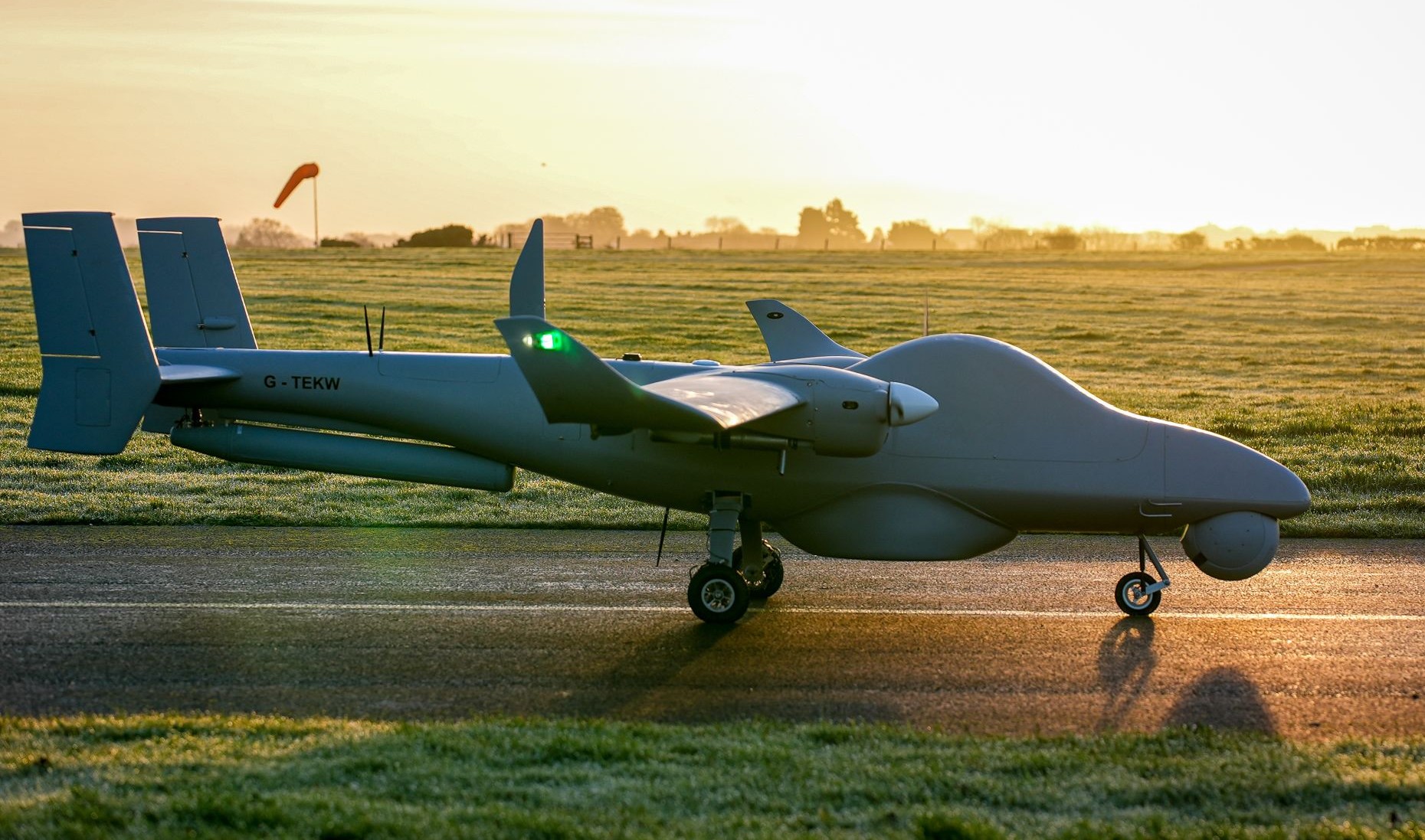
The British Army is to be equipped with Tekever AR5 surveillance drones under an investment of up to £400 million, the Ministry of Defence stated.
The initial order will be for six AR5 drones, with up to 24 delivered by 2029. According to the MOD, the aircraft can carry up to 50kg of surveillance equipment such as cameras and sensors, and offer longer endurance than the systems the Army has used previously, giving commanders real-time intelligence to inform battlefield decisions.
The AR5 has been selected to replace the ageing Watchkeeper drone under a contract worth up to £400 million over the next ten years. The MOD said the aircraft would be built at Tekever’s soon-to-open manufacturing facility in Swindon, and that the full contract would sustain and create hundreds of jobs at the company’s UK sites.
Defence Secretary Wes Streeting was quoted in the press release as saying: “Proven in Ukraine and designed to protect British soldiers globally, we’ve chosen the UK-based Tekever AR5 drone to supply our personnel with kit that will keep them ahead of emerging threats. This investment will support our troops on deployment, while driving re-industrialisation and backing British innovation.”
According to the MOD, Watchkeeper has been in service since 2014 and is reaching the end of its operational life, with the AR5 offering improved endurance, sensor capability and reliability. The department said the AR5 has been used by Ukraine’s armed forces on the battlefield during the country’s defence against Russia’s invasion.
Tekever UK’s Managing Director Karl Brew said: “CORVUS represents a major step change in delivering cutting edge autonomy to the British Army. This isn’t about a platform, it’s about building and sustaining sovereign capability that stays one step ahead of our adversaries. Through CORVUS, TEKEVER aims to create a new type of partnership between government and industry where we will ensure a constant cycle of capability evolution that delivers decisive advantage to our end users.”
Subject to contract signature and final approvals, the MOD said the capability would begin entering service later this year, with support sustained for at least five years and options to extend.
The AR5 is a fixed-wing tactical uncrewed aircraft built by Tekever, a Portuguese-founded company that has established a growing presence in the UK. The type has been used extensively for maritime surveillance, including under contract to the UK for monitoring small-boat crossings in the English Channel, and has seen operational use in Ukraine.
The decision draws a line under the Watchkeeper programme, a system developed by Thales UK based on an Israeli Elbit design that entered service years late and suffered a series of crashes during testing and operations. The Army confirmed in recent years that it intended to retire the fleet, and the AR5 selection marks the route by which its tactical surveillance capability will now be sustained.





Watchkeeper was one of the first assets to be announced as retired by Healey when Labour came to power. Initially reported as a cut, it then transpired that it wouldn’t be immediate, but would serve on.
Further, at the time, both the MoD and some of the defence commentariat were claiming it had to go as it was no longer survivable on the battlefield.
Can someone explain to me please how this is any different in that regard?
And as usual, the magic number 24, replacing the 40 odd Watchkeeper that survived after all the crashes. Also 24 Nyx, 24 Storm Shroud, wonder why that is?
OT, Watchkeeper training flights were once reported to operate out of Boscombe and from the grass strip at Upavon, using the dedicated airspace set aside for the type. Brize is having it’s runway and taxiways resurfaced, the Atlas and C17 fleet has now moved to Boscombe, again demonstrating the importance of keeping strategic assets like Boscombe Down.
All the answers are in the article.
All good questions, plus a lot of money for a small number of drones.
By design any drone supporting artillery is going to need to be operating close to the front line. It doesn’t seem to include any tech that would make it survivable, like stealth or other defensive aids. Kinda feels like the UK has the same problem as the US, only having a handful of defense firms which prefer to sell massively expensive items that make them a load of money Vs lower tech stuff that can be massively produced
Ah, there you are. 👍
We spent near a billion for the Watchkeeper, now 400 million for half the number of assets.
I’ve also read that this is not an actual contract signed just yet, MoD have just confirmed the replacement programme won’t involve a competition, and Tekever are chosen as sole supplier for the requirement.
I guess it depends on the sensor fit out. If it’s optical then these things are going to be a sitting duck on a modern battlefield. If some form of ground search radar then maybe they can out range most man portable air defences.
Well of I remember correctly, Watchkeeper had ground surveillance radar and was queuing targets for Apache not long before it was announced it’d be axed.
This seems a buy contradicting the very reasons given for Watchkeepers demise.
Yep it’s odd. After all it’s just a platform for carrying sensors. If it was just the sensors that were absolute then why not upgrade them rather than starting a fresh.
Plus according to Wikipedia watch keeper had the potential to carry 150kg compared to this at 50kg, seems like a downgrade.
The original requirement was for WK to carry a potential load of 150kg but that was never needed.
The camera was limited at 50kgs as was the Radar.
It isn’t…as an aircraft, the AR5 can fly longer, further, and in much thougher conditions..as far as payload goes, all sensors the Watchkeeper can carry have shrunk (all of them fitting in a 50kg payload, and several of them actually allowing combination of sensors within the 50kg payload)…additionally, and more important, the AR5 can work as both comms relay (for other systems like the AR3 Stormshroud) and as a network (effectively having two AR5 flying together, one carrying a radar while the other carries a electro-optical/IR system), the AI and hardware also enables the use of more advanced sensors…
Initially 6, “up to” 24. So probably 15.
Steve, I think that “tube” at the rear underside of the UAV is an IMSAR NDP-5 https://www.imsar.com/radar-products/nsp-5 it’s a very close visual match. Perhaps this gives it the stand-off to be survivable and all weather. If a Group 3 UAV can be survivable, I think it will bring potential huge targeting benefits for an indirect battle ISTAR reliant type of fight.
It’s just another sign that the British Army is deliberately being equipped and scaled to fight at Brigade levels ‘max’ and probably smaller mate.
If Watchkeeper was obsolete, what’s so different about this, is it because it will be 3d printed and easier/quicker to replace??
At £400m for a handful of drones, I don’t think easier/quick to replace is going to be a thing
Afternoon Steve, so you have to ask, why not just give Watchkeeper an avionics refresh??
What can this do, that Watchkeeper cant?
Your guess is as good as mine.
From what I remember, whenever Watchkeeper was discussed on these pages it wasn’t always very positive, especially compared to what it cost.
Fly without crashing 😀
Had crossed my mind that they had a load of issues with watch keeper early on and that said issues might not be fully fixed. Aka the noise issues with Ajax.
But was that due to the aircraft itself or insufficient training of pilots?
Weather was also an issue which is why they moved firstly to Ascension and then Akrotiri.
These drones fly themselves now. No pilots required so pilot training is no longer an issue. There is a human operator capability but it has autonomous landing and take off.
Watchkeeper became very outdated very quickly.
AR3 is even better for artillery spotting. One solider can loft it into the air using its VTOL Quad fans.
On the modern battlefield having to land something like Watchkeeper on a runway that an enemy could easily track from its emissions would be suicide.
Watchkeeper requires a direct line of sight for radio communications so it can only operate at around 100km from the command centre. AR5 is autonomous and can be operated by satellite so it can use its full 2000km + range.
A Watchkeeper operator needs to be well inside of the danger zone for long range artillery, missiles and drones and is easily detected by the direct radio transmissions for control.
Yes. And this AR5 still needs a runway, albeit a short one. A much longer range is a big plus.
And still for me as vulnerable as the asset it will replace which was the reason for my post.
It does need a runway it’s just that the runway can be out of the range of SRBM and drones and there is no way to track it.
You would think it would be possible to upgrade the processing of watchkeepr to be able to fly itself. To me it’s very odd.
I’m sure it is but watachkeeoer is pretty old and expensive to upgrade. Whats the point in upgrading an old platform when you can buy an existing off the shelf solution.
I don’t really understand why anyone wants to keep Watch-keeper. It’s over a decade in service and it was pretty dated in 2014.
The sensor payload can be ported over t
100% but 400m is a whole lot of cash. Surely cheaper to maintain the existing platform. Sounds to me like serious corruption going on.
😂😂😂😂😂🤣
Interesting observation on the ’24’ of everything, mate.
I can guess at two possible reasons other than the obvious stealth cut option. First, these are initial batches , what we used to call ‘pre’ production units to enable frontline units to get their hands on them and try to break them, also shake out any the production wrinkles and get the support systems up and stress tested before ordering any follow on batches.
There is also the possibility that the MoD may be looking to control their spend profile. You make the point below that these drones are going to cost about £400m for 24 aircraft which ain’t cheap. By buying a small initial batch the MoD can get a lot of fixed up front costs such as the development, training and support packages in place and paid for off the back of the smaller initial batch, it may be possible that subsequent batches can be procured at a lower price lowering and smoothing out the cost profile over the longer term. Plus there is probably more risk involved in buying big straight up front.
Best example of this is the T26. According to Google AI the three batch 1 ships cost £1.31b to £1.46b each, while the second batch of 5 cost of £840m to £860m a reduction of approximately £500m each! In short, perhaps the MoD is trying to front load procurements rather than always being pushed into more expensive back loading option.
OK I might just be having a moment of optimism, but who knows may be there are at a few people in the MoD who can get things done properly.
Cheers CR
Hi mate. One detail regards your initial batch point. I’ve read we are indeed buying an initial batch. 6!!!
As part of the “up to 24” following.
Anyway, someone likes 24 for some reason.
👍
Oh well, so much for the moment of optimism..!
Cheers
To be honest mate. I dont think I ever saw anyone say anything positive about Watchkeeper on these pages over the years. A replacement with a new system is hardly a surprise.
No it is was before it’s time and poorly designed. But tech has moved forward and it is ultimately just a flying frame, I struggle to understand how it costs £400m to fix
Jonathan has provide more details on the cost brakedown if you can find his post.
You’ve hit the nail on the head regarding the batch procurement logic, CR. Front-loading the fixed infrastructure, tooling, and training costs on a smaller initial order to drive down the unit price on subsequent runs is exactly how the MoD has to play it now.
Just a quick flag on the numbers though—I think Google AI did you a bit dirty on those stats! A fleet of 24 AR5s won’t be anywhere near £400m. If they were costing £16m a pop, the Army would be right back in that exquisite Watchkeeper money-pit trap. These are tactical assets meant for affordable mass. The Type 26 Batch 1 numbers the AI gave you are a bit skewed too, as that initial £3.7b figure was for all three ships combined, not per hull.
Your core point is totally right though. Buying 24 lets the frontline units actually get hands-on, shake out the operational wrinkles, and test the support network before the Treasury commits to a massive follow-on contract.
AW 149 are 23 to break the 24?
I’m not sure where you get the number of 24 from. The article I read stated only 6 were being procured.
The threat to these will be shorad close to the edge of the battlefield?
The new AI driven loitering munitions and OWE effectors in the hands of the Royal Artillery should be able to sanitise that threat
The sensors should be a generation more advanced than watchkeeper so will they be able to observe deeper into hostile territory?
Supposedly it has a much smaller radar cross section and thermal signature than watchkeeper.
The 400 million is not really for 24 Tekever drones as these have a fly away cost of about £400,000 each.. so the cost of the 24 drones is about £10 million pounds..
The 400 million is a wider figure for..
1) match funding,as Tekever, iCOMAT’s and the NATO Innovation Fund announced that they were investing £400 million pounds to develop UK manufacturing of the AR5 drone and its capabilities as well as wider UK supply chain.
2) it’s over a decade to 2036, where as the last drone will be delivered in 2029, so it for wider support and development of the capabilities for a further decade.
3) the drone comes without any sensor so part of the £400 million will be sensors and capabilities.
Good details.
The devil is always in the detail. 👍
Massive difference with this and watch keeper is ASGARD. Watchkeeper replaced Phoenix as an artillery spotting drone. With project Asgard every drone (we have 10,000 and counting) is spotting for artillery. However there is still a need for something that’s large, long range with significant loitering time hence a reduced number of AR5. They are already using the VTOL version of AR3 for artillery spotting. No runway required unlike watch keeper.
10,000. 🤔
Most of our Drones I think are small hand held micro types for Infantry Sections, bigger OWE like Modini 250 and Nyan, and Bolt strike Drones.
But yes, Asgard is significant.
Yes agree most of that 10,000 are small but it’s the any sensor any shooter that makes it powerful although your correct to point out most of those drones are not feeding directly into ASGARD but will require their operator to relay the information.
Despite the videos we see of quad copters dropping bombs in Ukraine it still seems the most devastating capability they provide is spotting for artillery fire.
I just hope that this time the MOD/Army don’t overspec it and then spend years developing and integrating the new additions, testing it and gaining approval for use in UK airspace. I realise there is a natural tendancy for UK armed services to max out on specitifations because they only get one chance to purchase a new system. But it is a suprisie that such a larger airframe will be able to survive in the airspace its likely to be used in. Given the advances in drone technology I would have thought a much smaller drone would be sufficient to provide required targeting data and as such more be purchased for the £400M and losses would be more acceptable. Has this requirement been discussed with the Ukrainains who are now the world leaders in drone technology and their operational employment.
It’s already certified to operate in UK air space and it’s already in service with the government providing maritime surveillance in the channel.
Hopefully a far cry from the usual decade long gold parted farce of its two predecessors Watch keeper and Phoenix.
Remember back in the 90’s when Phoenix cost over £500 million and took 15 years to get into service and the cameras don’t work.
Shows how far we have come.
24 delivered by 2029???? Really it should be delivered by 2027 for £40m max.
Clearly no lessons have been learned at all from Ukraine.
Large slow target
If staying 50km back and using synthetic aperture radar to spot targets makes you an easy target, then the entire concept of airborne surveillance is in trouble
50km from the FEBA is suicide closed
A 50km it is suicide and to make it worse these are air vehicles with a performance of a 1920’s aircraft.
85mph, 12,000 ft ceiling
Regular drones will kill it, let alone the new jet powered deep ranging interceptor drones.
You’re treating a MALE surveillance asset like it’s supposed to be a frontline fighter jet. A loitering speed of 85mph is intentional to maximize its 12-hour endurance. At 50km behind the FEBA, it sits outside the envelope of tactical SAMs and MANPADS. If an enemy wants to risk a high-value, long-range SAM or send an interceptor drone 50km deep into our own air defence umbrella just to swat an uncrewed surveillance platform, they are trading a multimillion-pound asset and exposing their positions to our own artillery. That’s a net win for us.
Wrong – this is exactly the battle being fought at depth in Ukraine – blinding the other side is vital and ‘drone fighter sweeps’ to kill observation drones very much the norm.
Taking a SAM shot at a recon drone is absolutely worth the risk – they often direct TBM strikes at HVTs
You are conflating front-line, low-altitude tactical drones like Orlan-10s with a proper MALE asset. The ‘drone fighter sweeps’ in Ukraine happen right over the trenches against low-flying, short-range recon assets. A MALE platform operating at 12,000 feet and 50km back sits entirely inside a heavily jammed, layered strategic air defence umbrella. A cheap interceptor drone lacks the range, altitude ceiling, and guidance to hunt a MALE asset at that depth without running straight into our own SHORAD.
Is that £400m just for the initial 6, or for all 24?
Because if it’s just the 6, what the hell are they made of?
The £400m isn’t the price tag for the drones at all, Jacob. That figure is the total industrial investment package being dropped into the UK supply chain and Swindon manufacturing hub by Tekever, iCOMAT, and the NATO Innovation Fund.
The actual fly-away cost for the 24 airframes is only a tiny fraction of that—around £10m total. The wider funding covers the full tech development, advanced sensors, and a decade of fleet support out to 2036.”
And as you said in your reply to my post above (nice reply by the way, thanks) tooling as well.
I note that Tekever is a Portuguese company, so that is another overseas company investing in the UK and bringing NATO money with it. I believe we can add a new factory to the tooling cost as well as I believe they are setting up in Swindon. Is Tekever planning on exporting from the UK? And why are so money drone companies setting up in the UK? Swindon is rapidly becoming a very significant hub for this technology with about 9 drone and technology companies in or heading to Swindon mostly since the Honda plant closed and freed up the space and workforce it seems.
So I think that £400m will include factory set up costs in Swindon as well as it will represent an increase in NATO wide manufacturing capacity in this key technology area. As such this £400m is starting to look like a much better investment, but we would need to see the true breakdown of who is paying what into the whole, whatever the whole is?
Perhaps the UK buy is a starter for 10, a means to close the deal? If so, and if the overseas investment is reasonably significant then ring it on.
Cheers CR
Spot on, CR. Good shout on the Swindon cluster too—nice to see the old Honda site being repurposed for proper DefTech. You’re exactly right about the NATO link as well. Tekever is backed by the NATO Innovation Fund, so it really is allied money boosting UK sovereign capacity.That £400m isn’t just swallowed up by 24 airframes. It’s anchoring their long-term development program, tooling up Swindon to build the Army’s AR5s, some RAF kit, and export variants for Europe/Ukraine. It’s a clever bit of business for once—MoD gets local, battle-proven tech, and the UK gets a slice of the export pie. Definitely a solid starter for ten.