

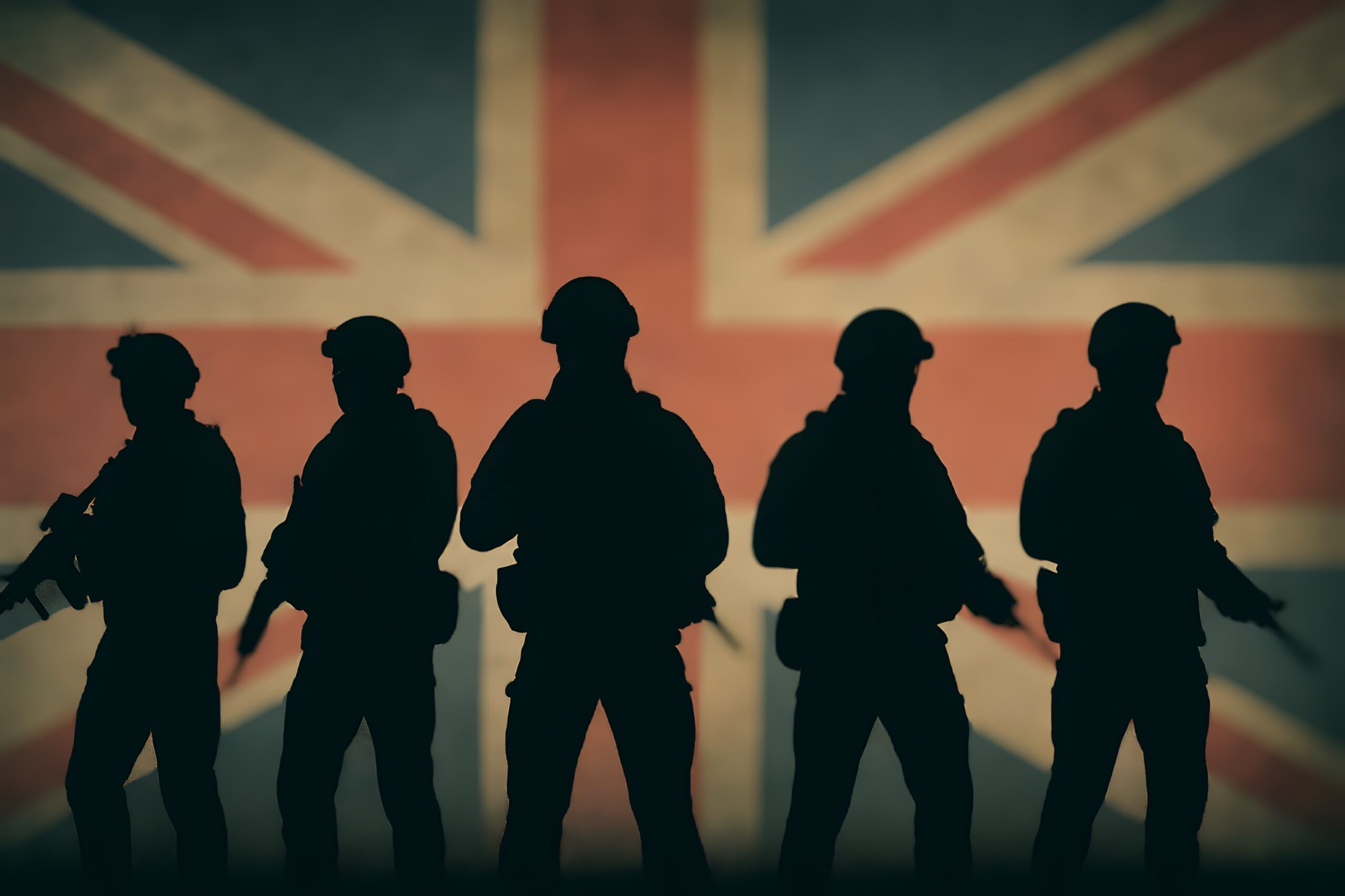
UK Armed Forces recruitment has overtaken personnel outflow for the first time in almost four years, according to figures released by the Ministry of Defence in a written parliamentary answer.
Responding to a question from Conservative MP Matt Vickers, Parliamentary Under-Secretary of State Louise Sandher-Jones said that “for the first time since early 2021, Armed Forces intake is now greater than outflow”.
She told Parliament that in the 12 months to 1 October 2025, “there was an increase of 13% in people joining the Armed Forces compared to the previous 12-month period”, while at the same time “there was a decrease of 8% in people leaving the Armed Forces”.
The minister added that application levels are also rising, saying the Armed Forces “continue to see increased numbers of applications”.
While welcoming the figures, Sandher-Jones cautioned that challenges remain. “These trends are very welcome, but we recognise that there is still more to do,” she said.
She said the government remains focused on workforce stability across defence, adding: “We are committed to improving recruitment and retention through a range of targets, initiatives and measures and we are making a positive impact.”
The figures come amid wider efforts by the Ministry of Defence to address long-standing recruitment and retention pressures, as defence leaders warn that personnel numbers are critical to sustaining readiness.








This is good news. The pay rise and the serious attempt to solve Armed Forces housing seems to be having the desired effect. There is no point expanding numbers until we have full manning for the numbers we have. Hopefully that point can be reached quite quickly and we can get back to a 100k army as soon as possible.
There are zero plans to increase the regular army back up to 100k. Not so bad if we had enough IFV, artillery and tanks
Which we don’t.
Meh, make sure the RAF and RN have enough manpower and equipment, the army can be a distant third for all I care
You’re correct, there aren’t. The 100k that Rob references has been stated clearly as including the Army Reserve.
Agree on the RN, RAF first doctrine, though that doesn’t mean I want the Army degraded further, it’s too small and needs more mass just like the other services.
The thing is army recruitment and the navy and airforce are very different.. the army needs lots of fit young people to run around in basic grade jobs.. and has less need of middle aged duffers with lots of experience and expertise.. the navy and airforce actually runs on expertise and really does not need as many youngsters running around in basic jobs.. and it’s only going to go more that way.. lean crewed platforms don’t removed the need for expertise they remove the need for muscle power.
So the army really wants lots of 20 something’s most of which it probably wants to see popping off to do something else in their 30s where as the navy and airforce wants to keep all those hard to train specialists until they ossify…
A very good point.
Jonathan, I have not heard this phrase ‘basic grade jobs’ before regarding army jobs.
If you mean the Infantry… that is not as basic as you might imagine. The Combat Infantry Course for the Line Infantry is 28 weeks and that for The Foot Guards and PARAs course takes 2 weeks longer than that. In contrast, Gurkha training lasts for 37 weeks.
The Infantry only makes up 25% of the army anyway. The rest of the army (75%) is arguably in non-basic, specialist jobs.
I was thinking more rank Graham as well as pure physical need.. at the end of the day the army needs to keep a balance within its infantry that is heavy on junior ranks who are young and fit sort of limits longevity in careers in many cases.. after all you have a lot of privates, less JNCOs and very few Senior NCOs.. it’s not saying the jobs are basic 👍
I believe that the average age of personnel in the army is lower than the navy and you obviously have the different Lower maximum age for joining army vs the navy..
But the rank comment also doesn’t apply. The NCO corps, typically in their thirties, is the backbone of the Army. Even a Rifle Coy will have something like 30 NCO’s in it’s structure vs about 80 privates, and that’s the most “private heavy” version of the army, once you start looking at HQ and Support Coy’s and that NCO proportion goes up sharply, let alone once you look at a technical trade; a Tank will often have 2/4 NCO/Private Rate, an Ambulance a 1/3 or 2/3, and that’s before you factor in Squadron roles like SQ’s that won’t be in the tank or ambulance. At the very far end of this scale you have Ranger SOTG’s that have something like 9 NCO’s for every Private.
I think a noteable difference is the Army, at least the teeth arms, expects the NCO’s in their thirties to physically keep up with the 18-25 year old Privates.
True, but that does mean you still want probably 50% of your workforce to not transition into senior roles and be in their late 30-40s and even those that do need to keep up with the younger ones. That does really mean retention means something different in the army to a lot of other places.. if you consider my last role as an emergency services workforce lead…I was essentially trying for 100% retention of my workforce across their entire working life. I wanted those Drs, nurses, paramedics and healthcare assistants to stay working into their 60s… so that need to keep 50% of your workforce under 30 ( and I believe the average age of the army is 30) is one hell of a nasty recruitment problem..because retention essentially is less of an answer and in a way more of a problem as you don’t want the average age of your army to be the same as many other workforces ( the average age of the nurse workforce even with a historically retirement age of 55-60 is still 44).
We weren’t comparing to “a lot of other places” we where comparing to the Navy and Airforce that also have a higher turnover rate for Able Seamen and Air Specialists than the civilian sector.
Comparison’s to the civilian market aren’t particularly useful, especially as the maximum age for an enlisted Solider is 46, after which you either have to commission, take a FTRS contract, or leave. If you remember that the minimum recruitment age is 16 then mid point of the career span would be 31. (Your assumption of 50% of the workforce not transitioning into senior roles is also flawed btw, as I only listed the NCO jobs within units. There remain E-1 and E-2 Postings, specialist units such as JCTATT, HQ jobs such, etc). There’s also the phenomenon of the “Senior Private” who has done a decade and not promoted (or has been promoted and been subsequently demoted), which is very common in certain units (*cough* Gurkhas *cough*) Does the Army aim for 100% retention? No. But the turn over aim isn’t as drastic as you think it is.
And the RFA. Or merge the RFA in the RN. Given how small the former now is, and how militarised it has become (e.g. Tidesurge escorting a Russian submarine through the English Channel!), that should be seriously considered. Stirling Castle showed that the limitations of RFA manning, and Proetus is not far behind – her crew has 2.5 RN personnel for every 1 RFA, may as well just commission her. Stick a 30 mm cannon on her (admittedly I’m not sure where!) and she would be more credible than a tanker for escorting Russian warships!
Clunker, you are at one with Daniele on prioritising the RAF and RN over a distant 3rd place army. Could you explain your logic, especialy in the ‘NATO first’ era?
The army actually has been used at some scale in kinetic conflict and peacekeeping/peace support/COIN/C-Terr operations numerous times. The RAF and RN…less often and at less scale. When did the RN last sink an enemy warship or submarine? When did the RAF last dogfight against enemy aircraft?
It is clear that Europe’s greatest threat is from Russia which has (and also include the USSR in this) a terrible track record of crossing multiple times into eastern European countries with strong land forces and waging aggression (from sending the tanks into East Germany in 1953 to invading Afghanistan in 2014 and 2022, with a lot of naked aggression in between).
The greatest problem for us in Europe would be if Russia seriously attacked or invaded a NATO country with land and air forces, triggering Article 5 response. We would then need to deploy a very strong army, mainly armoured and mechanised with considerable BCRs and Attrition Reserve equipment not to mention vast stocks of munitions, spare parts etc.
How active would the Navy be in all this? Would they be in the Mediterranean guarding NATOs southern flank or would we have a CSG or a ‘wolf pack’ of Astute submarines in the North Atlantic hunting down a large Russian fleet?
I can understand a strong RAF presence on NATO operations.
But it is odd to relegate the army to a distant third place for funding when war in the NATO area is far more likely to be a land war, the army being supported by the RAF.
It’s the old “We can sit back and let other people do the heavy lifting while we pootle about keeping the anemic russian fleet at bay.” Argument.
The view or expectation that the U.K. doesn’t need to do any heavy lifting whilst talking about its global ambitions and leadership position in NATO is pretty desperate and has only arisen due to none of the branches of the armed forces being sufficiently resourced or equipped, so rather than fix the issues, they try to justify only needing to resource one, ignoring the reality of meeting commitments like NATO.
This thinking has led to an over reliance on the US, with the U.K and other European countries trying to placate the U.S to keep its land forces based and committed to defending Europe, highlighting their importance but not resourcing their own sufficiently for a European land war.
Rob, in today’s political jargon, the 100k army refers to the 73k regulars (the Established, funded figure) plus about 30k (the Established, funded figure) volunteer reservists (TA in ‘old money’). The army today is not far off that 100k figure. However that part of the army which could actually deploy operationally is nothing like that figure for all sorts of reasons.
I served in the regular army 1975-2009. I joined with the regular army at 180k but that was the Cold War. By the end of the Cold War the reg numbers had reduced to 160k due to unjustified defence cuts.
The ‘Options for Change’ SDR in summer 1990 reset the armed forces for the post-Cold War world – the army was to be reduced from that 160k to 120k regular…and 50k TA ie total of 170k. These figures were arrived at after a considerable amount of analysis as to what a post-Cold War army was to do. It did not however envisage the ‘sandbox wars’ in the Gulf (Gulf War 1 in 1991, Gulf War 2 in 2003-2011) and then the Global War on Terror after 9/11 (Op HERRICK 2001-2014). So arguably that 170k figure was too low.
Fast forward to today after many further defence cuts, none of which had any link to diminished Threat, and we arrive at the 73 + 30 k army.
The surviving logic is that we should really still have a post-Cold War army of 120k regulars + 50k volunteer reservists.
Of course that will never happen. I am a realist.
I have trust in the Government to somehow increase the army’s lethality by 10x, so this 35 years of further unjustified cuts since summer 1990 can be tolerated or offset…haha! I have also total faith in Mr Healey to edge regular numbers up to 76k in the next Parliament, as he once fleetingly (never repeated) said. haha again.
I hope this is a genuine desire to join the services and not, as is not uncommon, a recation to falling vacancies and the biggest increase in unemployment in nearly five years. Good luck to them all.
The unfortunate reality is that hard times tend to see an uptick in armed forces recruitment. There’s a good reason most armed forces recruits are from the more deprived areas of the UK. Stable, secure work is the main appeal, especially when it comes with discount schemes and accommodation.
It’s arguably the main reason the US government doesn’t want universal healthcare or free university – I can’t remember the exact numbers, but the reasons given for joining up by most of their recruits were tuition fees and insurance. The lesson here is that in peacetime, the armed forces need to offer a compelling enough package to make the sacrifices worthwhile; patriotism without a clear and present threat isn’t enough.
I think you’re on to something there. Historically, joining the armed forces was seen as a route out of poverty and destitution. Over the years, monies previously allocated to the military has been sapped away into the welfare state to help resolve the very problems that encouraged people to join up in the first place.
That is by no means a criticism of this fact, just an observation. It’s good that fewer people are forced to do things because of poverty! On the other hand, as a country that has relied entirely on volunteers, except in the direst of circumstances, it is a bit of a conundrum.
Yes, I agree. We have always relied on people wanting to do things. Whilst that’s not wrong we don’t look at incentives which would help with recruitment and give service families a better life. Education,health care and housing assist with mortgages would syrely all create a better climate.
In reality that is not such a bad thing… we often move to something we do because of circumstance and where the wind blows us and then excel.. I’ve never planned really and just seen where the world takes me and by most measures I’ve had a most interesting and rewarding set of careers.. that has been of service to the great good all at the same time.
Very true. I had a conversation only the other day with my grandson about when I decided what I wanted to do when I left school. I had a vague idea come thr fourth year, whent on into the sixth, passed and then did something completetly different! So, yes, the world of work is in the end what you make it, sometimes by accident.
Indeed I have may conversations with people about not sweating the future.. take care of the present as it is the only place we live.
Nicely put. There is an old saying in my part of the world…Today is the tomorrow you worried abour yeaterday.
Another great little saying one someone told me, there are three days that matter but only one you should actually worry about.. yesterday, today and tomorrow.. and today is the only day you actually need to worry about.
I support a lot of people with cancer and that concept of today can be life changing.. today we are living.
Live for the day. I have lost three friends to cancer in three years. Another, a doctor and old friend called Chris, has been fighting for four years and his bravery and determination never fails to amaze me.
Same story as the other week, does the MOD re release this type of stuff to make look like they are on top of things. Will we get a story about better accommodation soon?. All it means is any joining the Artillery can stand around more waiting for some 155mm guns to train on and to man/women the only two working MLRS A2’s we have. Which are not yet even in the UK they were at White Sands. Its good news though but the military do well in hard times which when the nations un employment etc is up.
A positive report at least.
Now are there more detailed breakdowns as in which service and what trades? Probably not?
In the end the highly technical trades ( where it’s easier to leave) will take a long time to rebuild.. you don’t create a marine engineer, aircraft technician or deck officer in a year or two.
and that is often were rounds of redundancies have caused the greatest damage in the past