

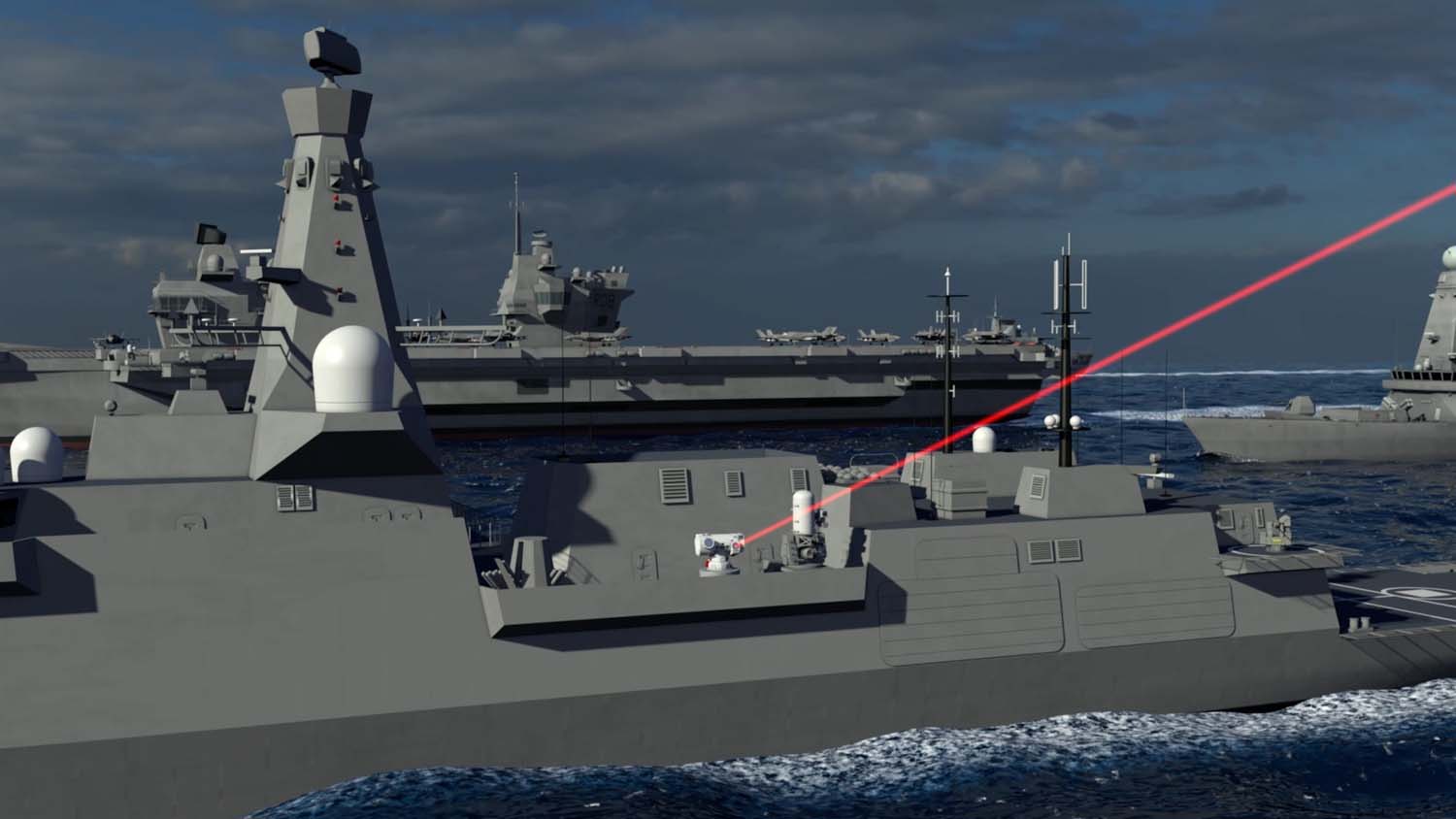
The Ministry of Defence has indicated that the Royal Navy’s DragonFire laser weapon may be deployed across a wider range of warships than previously confirmed, with Type 26 and Type 31 frigates now explicitly referenced as potential hosts for the system.
In a written parliamentary answer published on 27 January, Defence Minister Luke Pollard confirmed that DragonFire remains on schedule to begin delivery from 2027, but declined to name specific ships that will receive the weapon beyond the first installation. He said the system’s modular design means it can be moved between platforms as operational requirements change.
“DRAGONFIRE is a modular capability providing the Royal Navy agility as to when and where it is deployed, therefore it is not possible to list specific ships into which the capability will be installed,” Pollard said.
While the Ministry of Defence has previously confirmed that the first DragonFire system will be installed on a Type 45 destroyer in 2027, the latest response goes further by linking the weapon directly to the Navy’s evolving mission module approach. Pollard stated that “the inclusion of the mission modules concept across the Hybrid Navy, which is already being delivered in the Type 26 and Type 31 Frigates, provides maximum tactical flexibility as to where the Navy could deploy this weapon.”
That language, in my view at least, marks the clearest indication yet that the laser system is not being treated solely as a Type 45 capability, but as one that could be integrated across multiple surface combatant classes as the Hybrid Navy concept matures.
Earlier parliamentary answers had focused narrowly on the destroyer fleet. In November, Pollard told MPs that “initially, DragonFire, a state-of-the-art laser weapon, will enhance the capabilities of the Type 45 fleet with the first DragonFire unit being delivered in 2027.” A further response in December confirmed only that “the Ministry of Defence plans to install the first DragonFire system on a Royal Navy vessel in 2027,” with additional systems dependent on the Defence Investment Plan.
The answers to the written questions suggest a phased approach, with initial deployment on a Type 45 followed by wider availability across ships equipped to support modular payloads. Type 26 and Type 31 frigates are already being designed around flexible mission bays and containerised systems, making them structurally better suited to rapid integration of emerging technologies such as directed-energy weapons.
The DragonFire system, developed by a UK industry consortium led by MBDA, Leonardo and QinetiQ, is intended to provide close-range air defence against threats including drones and small airborne targets. The Royal Navy has previously described the weapon as offering extremely low cost per shot and the ability to complement missile-based air defence rather than replace it, and the repeated emphasis on modular deployment and the explicit reference to Type 26 and Type 31 frigates signals a broader ambition than earlier statements suggested.









Pssst, don’t mention “subject to the DIP” I mentioned It earlier but think I got away with it. 👀👀👀
Nope, they did plus lets break down some statements
“DRAGONFIRE is a modular capability providing the Royal Navy agility as to when and where it is deployed”
Translation – we won’t buy enough for all ships, just those not in maintenance or refit
“Navy’s evolving mission module approach”
Translation – they do not know what they can do because Rachel in accounts won’t fully fund the service
“Hybrid Navy concept matures”
Translation – when we know how much Rachel from accounts will give us then we know how many row boats to build
” suggest a phased approach”
Translation – it will take a veerrryyy long time
“signals a broader ambition than earlier statements suggested”
Translation – we need more but again depends on Rachel from accounts
No chatGPT required, just decipher civil service ways of speaking
Or ships designed for asw in the North Atlantic don’t actually need additional point defences.
You have it in one Malcolm.
Absolutely spot on! Exactly what I was thinking. It will be done on the cheap with not enough for all the escorts we will have. Same as the ECR Mk2 radar for Typhoon – only 40 sets for Tranche 3 jets and Challenger 3 with Trophy APS for only 60 tanks out of the 148 ordered.
Typical UK defence – done on the cheap!
This is just the usual waffle. I don’t think there’s been a policy change. The previous policy was two lasers ordered, the first installed by 2027 on a Type 45. The contracts were awarded two months ago, one of the few things not awaiting the DIP. The decision trajectory of dragonfire has been for faster delivery not slower. Having already contracted for two lasers, do we honestly think that the second laser will be dependent on the DIP? Possible, but vanishingly unlikely. The DIP mention in the article was not in quotes. It was George’s interpretation.
I should have said the policy was for four ship fits with two of them ordered under a contract of £316m. As for laser three and four, they were just talk then and they are just talk now. Saying dependent on the DIP for anything more than 18 months away is meaningless, as the DIP plans are likely to change annually.
Just shows how this waffle is designed to confuse because I had assumed that we were fielding up to 4 units concentrating on T-45 initially which makes sense as they are the only in service vessels that can realistically support it. But I had presumed despite my inbuilt Cynicism that assuming all went well with these early installations, that T-26 would be getting them too and perhaps even T-31 further down the line. Seems one can read into whatever they say whatever you do or don’t want to imagine (or refuse to imagine) with the next variation on the theme just adding to your notions. As such we spend more time deciphering and arguing over any given statement than discussing what any given statement is providing and whether it’s the right choice.
I believe they are a good fit for the carriers as well.
ha ha ha ha. About as much chance of the treasury paying for that as funding all new anti air systems for the army
Could….but probably won’t.
Gives ministers something to say and a carrot to dangle.
in other words we are only buying 12 units so it a lottery who’s going to get one.
Only got 6 Frigates left mate…..pretty much sorted…..sadly!
How many Dragonfire units will be fitted to each ship – 1 or 2?
George Allison may i ask why you block my comments.
Frigates, what Frigates, all 6 of them left?