

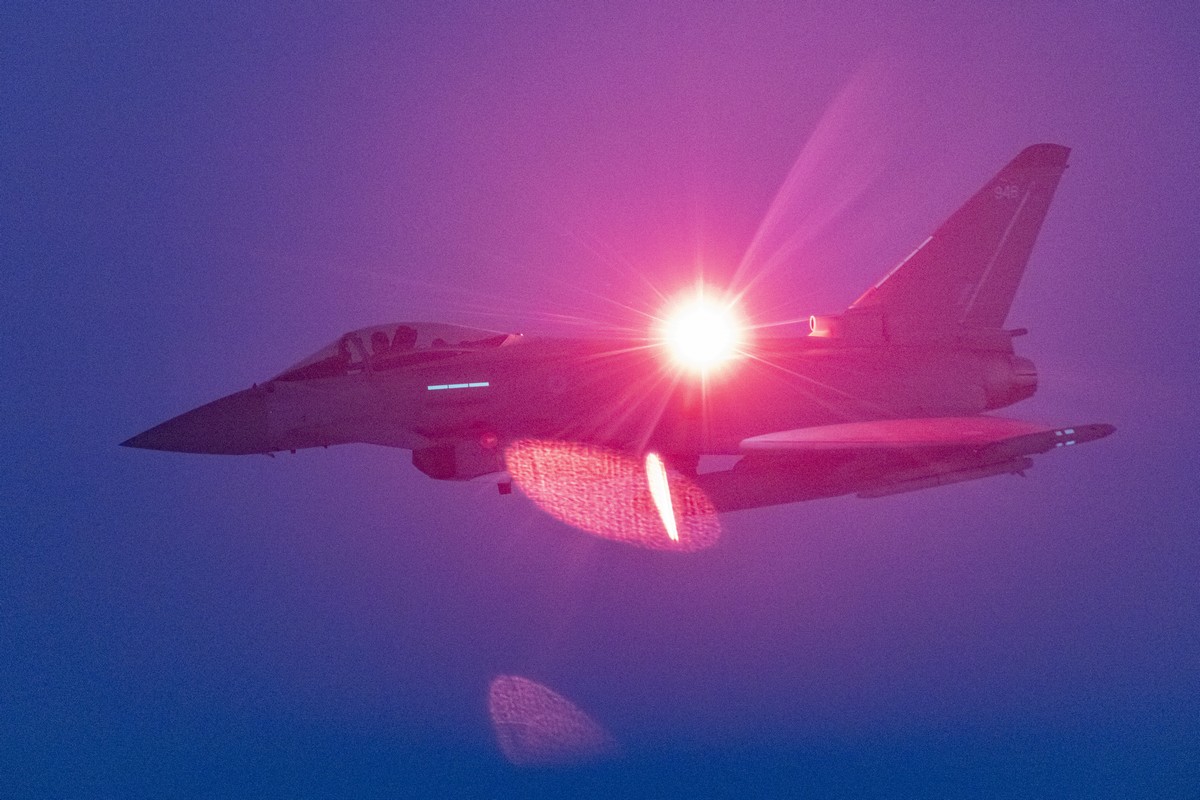
Two RAF Typhoon jets were scrambled from Borcea Air Base in Romania in the early hours of Saturday and authorised to engage Russian drones operating near the Romanian border, though both aircraft returned to base without firing, according to accounts from both the UK Ministry of Defence and Romanian military officials.
Romania’s Ministry of National Defence confirmed that Romanian radars detected drones operating close to Romania’s airspace on the morning of Saturday 25 April, with the Typhoons, assigned to NATO’s Enhanced Air Policing mission, taking off at 02:00 and establishing radar contact with a target located 1.5 kilometres from Reni, above Ukrainian territory. The pilots were authorised to engage, though Colonel Cristian Popovici, head of the Information Directorate of Romania’s Ministry of National Defence, subsequently confirmed in an interview with Digi24 that the British pilots did not fire.
The UK Ministry of Defence confirmed both aircraft returned to base without engaging any Russian assets and did not enter Ukrainian airspace, a position consistent with Colonel Popovici’s account and with Reuters reporting that described the scramble as standard monitoring procedure, noting that Romania has not yet exercised its legal right to shoot down drones during peacetime despite having the authority to do so if lives or property are at risk.
A drone from the wider Russian attack on Ukrainian targets in the area subsequently went off course and crashed in the Bariera Traian area of Galați, with drone fragments identified in several locations and Romanian police and military personnel securing the scene. Preliminary assessments indicated that an outbuilding within a household and an electricity pole were affected, with no casualties reported.
The incident generated significant confusion in the early hours of Saturday morning, with multiple major outlets reporting that the Typhoons had shot down Russian drones. Romania’s Ministry of National Defence press release presented a sequence of events in which pilots were authorised to engage, radar tracked targets to a specific location, and explosions were then reported at that location, followed by drone fragments found on the ground. This structure follows what most would call a narrative sequence, in which events presented in chronological order are understood by readers to be causally connected unless explicitly stated otherwise, meaning the release’s progression from authorisation to engage, to explosions at the target location, to debris on the ground, would be read by most readers as a connected chain of cause and effect rather than a series of coincidental events. The release contained nothing to break that assumed causal chain or to indicate the explosions were part of the wider Russian attack rather than a consequence of the engagement.
It was only through subsequent clarification from Colonel Cristian Popovici of Romania’s Ministry of National Defence Information Directorate, speaking on Digi24, and a separate statement from the UK MoD, that it became clear the jets had not fired and the explosions were part of the wider Russian drone attack on Ukrainian territory. Reuters, citing Romanian sources, subsequently described the scramble as standard monitoring procedure, also noting that Romania has not yet exercised its legal right to shoot down drones during peacetime despite having the authority to do so if lives or property are at risk.
Romania’s Ministry of National Defence said it “strongly condemns the irresponsible actions of the Russian Federation”, describing the incident as “a new challenge to regional security and stability in the Black Sea area” and noting that “such incidents demonstrate the Russian Federation’s disregard for international law and endanger not only the safety of Romanian citizens but also NATO’s collective security.”





Just pull the trigger, literally. All this Peacock strutting is boring.
Well, looks like my comment was shot down too !!!! 🤔
I’ve gained $17,240 only within four weeks by comfortably working part-time from home. Immediately when I had lost my last business, I was very troubled and thankfully I’ve located this project now in this way I’m in a position to receive thousand USD directly from home. Each individual certainly can do this easy work & make more greenbacks online by visiting
following website—.,.,.,.,.—>>> JobatHome1.Com