

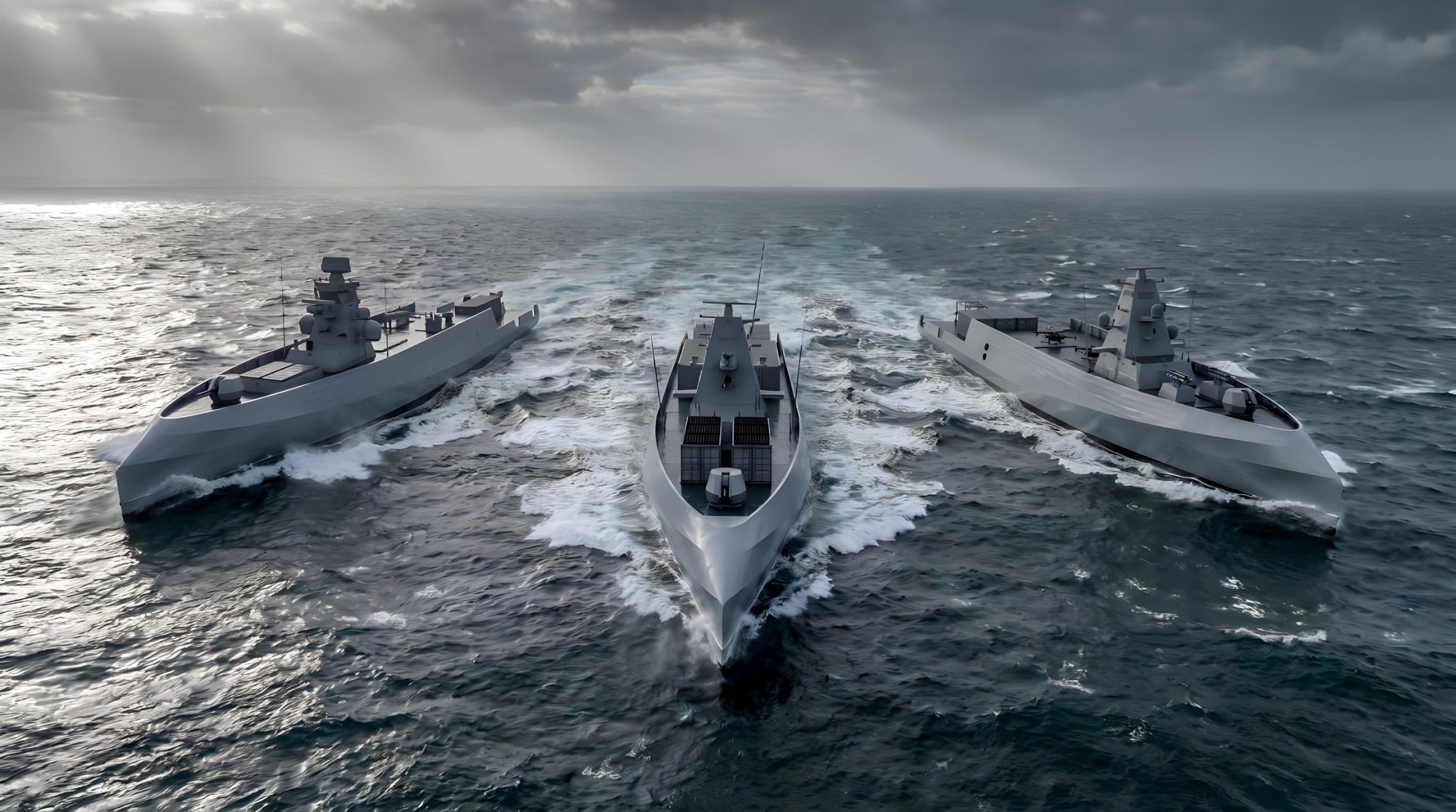
Navantia UK’s Appledore shipyard is capable of constructing two of the company’s LASV75 large autonomous surface vessels concurrently and delivering two a year, the company has said, setting out its build capacity as Rear Admiral Matthew Stratton, Director Naval Acquisition, visited the North Devon yard.
According to the company, its production and build strategy engineers have established a manufacturing plan at Appledore for delivering large autonomous vessels at pace and scale in support of the Royal Navy’s hybrid fleet, bringing together digital design, modular construction and advanced production methods with the industrial capacity being established across its four UK yards, and providing what it described as persistent, cost-effective capability compared to comparable crewed platforms.
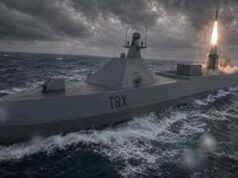
The LASV75 is Navantia UK’s UK-designed large autonomous surface vessel, designed from the keel up as an uncrewed platform and combining size, range and speed with a modular, open-architecture design. Since its launch at the Combined Naval Event, the company says it has matured the concept and demonstrated the platform’s modularity, with configurations developed spanning anti-air warfare, anti-submarine warfare, naval fires against land-based threats, and sensing, operational or combined roles, with the open architecture allowing a single vessel to be re-roled, even at sea, as operational demands change.
The company states the vessel has been designed to provide persistent capability while being built at significantly lower cost than comparable crewed platforms.
The capacity claim positions Appledore squarely for the uncrewed elements of the fleet the Defence Investment Plan describes, in which the Royal Navy transitions to a hybrid force mixing crewed warships with autonomous platforms, backed by £1.3 billion for the hybrid navy, six Common Combat Vessels coordinating uncrewed systems, and ministers describing missile barges and sensor platforms sailing alongside crewed ships. An anti-air warfare configuration of a large uncrewed vessel is precisely the class of platform for which the department has asked industry to develop missile silos able to remain ready to fire for 30 days without human interaction, under the request for information issued in May.
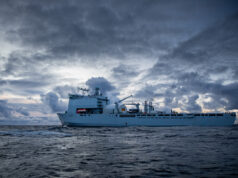
During the visit, Stratton was briefed on the Fleet Solid Support programme, under which Navantia UK is building three new supply ships for the Royal Fleet Auxiliary, with Appledore constructing the bow sections of all three vessels and final assembly, systems integration and testing taking place at the company’s Harland and Wolff yard in Belfast. Steel was cut at Appledore for the first ship in December 2025, and the admiral toured recently upgraded facilities including the yard’s new pipe shop and plasma-cutting equipment, part of the company’s £157 million programme to modernise its four UK yards.
Donato Martinez, CEO of Navantia UK, said: “The work underway here demonstrates how FSS is supporting investment not only in new ships, but also in the people, technology and industrial capability needed to sustain UK shipbuilding over the long term. Our immediate priority remains the successful delivery of the three FSS vessels. At the same time, the capabilities we are developing across Appledore, and our wider UK yards will put us in a strong position to support the Royal Navy as it considers the future balance between crewed ships, autonomous platforms and new technologies.”
Stratton said it was a pleasure to experience first-hand the capabilities the yard offers and the investment in people and equipment taking place under Navantia ownership, adding: “The modernisation of the Navantia UK yards is a critical enabler to the successful delivery of the FSS programme as the UK modernises its RFA Solid Support capabilities in support of Carrier Strike capability. The importance of the FSS programme has been reconfirmed through the DIP and I was delighted to be updated on progress of the programme.”


Luke Pollard:
“I want a thousand-ship navy, but I want most of those ships to be uncrewed. We have been locked into a narrative of how many crewed platforms we have for too long: I want us to expand our thinking.”
2 a year? We’ll have LP’s fleet by 2526 then? 🤔
My dear father always used to say “He who wants does not get.”
👍
Except they won’t be the only ones building them… so 2332 is more realistic I think.
Excellent! We’ve gone from 2526 to 2332. That’s what happens when you ‘expand your thinking’.
It’s not two a year, we bought more than twenty this year alone.
The K3 Scout is a boat, not a ship. Anyway, I was just having a bit of ‘fun’.
It is just a power point…
Gearing up to build what? Have any specs or requirements been made for what is wanted? This is still an idea in someone’s head that probably have NO experience whatsoever in naval warfare! Even the 1SL is a commando with no ship command experience is he listening to people who have?
The whole thing is ridiculous, there is no software/AI yet to make this work autonomously or semi-autonomouly in combat. You cant just replace a navy overnight with a drone navy. First you simulate virtually ,then you build prototypes and experiment for a couple years.
The USN is experimenting with large and medium UVs. The RAN and Marine Nationale are also looking at uncrewed surface and subsurface systems.
The difference is the RN is going all in on the idea, making uncrewed systems a core part of the future fleet rather than just an extra capability. The question is whether we’re doing it too soon, before the technology has really matured.
As you already said previously, the RN has been backed into a corner.
I’m actually very excited by it. Manned escorts remain at the benchmark low of 19, though, I’d have liked to see a T31b2.
They’ve just renamed it CCV and merged it with T83.
I think they are taking a leaf out of Musks book here long on promises with sci fi tech, short on anything proven that works. I hope it comes off but I am concerned if we are putting all our eggs in this basket, it smacks of the Lightning will be the last manned fighter.
There is plenty of autonomy systems already doing this that we and others have been working on for years.
Remote operations via, satellite and radio control have already been under way for several years.
So why the merchant navy don’t have drone cargoes, container ships yet? Whose functions are much more simplified just going from A to B to C…than a warship, which instead main functions(plural) are while at the sea.,,
Drones as envisaged will generallynot be autonomous…they will initially be unmanned. There is a difference.
Oil and gas industry has been operating complex unmanned assets and vehicles in difficult environments remotely for decades using a vaiety of communication methods…but also with elements of autonomy.
60 days at sea means 1440 maintenance free and no break down hours for engines, gearboxes, linkages, shafts and power generation on a ship at least 1000 tonnes. Bilge pumps. Rotating sensors and gun mounts.
Nothing can fail. Has anyone in the world demonstrated that?
Yes.
“The Flying Dutchman”… It never needs to visit a port.
Worthy successors to the Flower class. We should call them the Bluebell class.
‘I want us to expand our thinking.’
You’ve definitely expanded our thinking, Paul 😀
Nice idea, that.
Surely these LUSV need to have accom for a skeleton crew as and when required.
Cruise ships require a pilot man from the port they’re visiting to come out and join the vessel, wouldn’t that be the case for inbound and outbound from Pompey, Devonport, pulling alongside, and so on? Incase of a navigation fault?
And what of wider faults, or light repairs? And if there’s no heli deck crew or no Wildcat how do personnel board if they need to?RIB?
How does RAS work with nobody on the LUSV?
What’s actually changed between FADS and CCV? The core concept is still the same, a crewed platform working with uncrewed systems. The difference is the ambition has been scaled back, replacing the T83 with a T31+?
Can the T31 derevitive carry the radar needed? Does it even need to if radar is also on the T94s?
Even as a backup incase the T94s are negated?
‘Can the T31 derevitive carry the radar needed? Does it even need to if radar is also on the T94s? Even as a backup incase the T94s are negated?’
This is all above my pay grade, although I do like reading the arguments here.
My point though is that FADS was already about UVs and ‘distributed lethality’. The concept hasn’t really changed, it’s just that we’re now looking at a much smaller and cheaper main ship.
Yep, got that mate. I can do orbat, the rest is over my head as well.
I think that is rather insightful, certainly if one has an understandably cynical outlook on defence decisions. Starmer has always been about pr projection that twists or obscures realities, just been very bad at it.
I find you lack of faith troubling!
Your faith in your friends is yours….. 😆
That is a concern of mine, there is no example of how this could work reliably without at the very least that sort of back up. Even basic maintenance and system checks would logically require a few people aboard for a few days minimum, if these are going to operate far from ports. Otherwise you are going to have to have accompanying tugs or the frigates towing them back to the nearest port on a regular basis. Not a good look and totally debilitating as an effective force. This as is, or unless convincing answers can be provided, smacks of server farms in orbit. Even using the Govt’s request for launch cells that can operate untouched reliably for a week, how far does a week get you in the standard operations of a fleet. What do you do after a week if there is no facility for skilled personnel to even land upon let alone stay aboard for a period.
And can we trust totally unmanned systems in less than favourable marine environments or passing through the South China Sea? How about moving through the Suez or Panama Canal, would these things even be allowed? Optionally crewed vessels I can fully understand, ones that seem to exclude them even part time strikes me as unworkable in practice unless it can be explained how it will work operationally. Personally I think now that the wow factor has been presented to minimise the loss of new destroyers the whole autonomous concept will become increasingly less ambitious in nature. In the end that may be a better more reliable bet but only if their overall effectiveness in terms of weapon fit, sensors and thus capability to do their job as a replacement for an actual destroyer doesn’t decline alongside that
You put things better than I did. Maybe they’ve been hyped up for effect and there is every intention to have minimal crew as required.
My concern is having a large chunk of your fleet built by a UK subsidiary of a foreign state owned company.. who owns/integrates/maintains/has access to the software?
If they did that would be using all of Appledores capacity, they wouldn’t be able to make sections there for assembly in Belfast as they have been doing on the FSS.
Not sure about that, It’s a big old shed and the sections being built are not massive. 🤔
Yet to be designed automated ships featuring untested technology operating in a harsh maritime environment for days at a time. What could possibly go wrong.
🤔😁👍🤞😉