

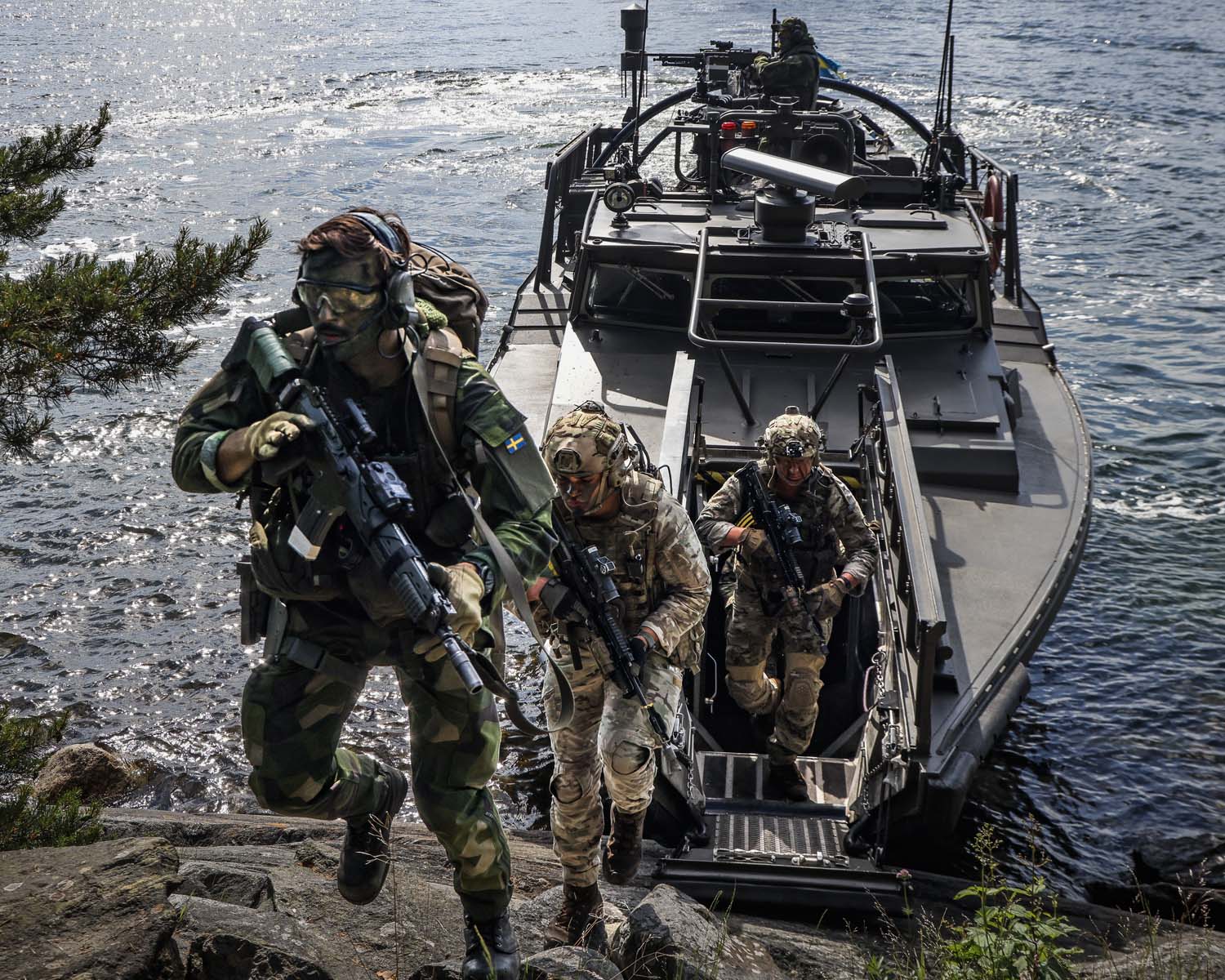
Prime Minister Andy Burnham spoke to his Swedish counterpart Ulf Kristersson on the morning of Sunday 7 September, with the two leaders discussing the importance of the relationship between the two countries both bilaterally and through the Joint Expeditionary Force and NATO in order to protect shared interests, according to a readout issued by Downing Street.
The leaders agreed that Russian aggression, both in Ukraine and through hybrid attacks in Europe, emphasised the importance of that close relationship. Burnham reflected on his recent visit to Ukraine and thanked Prime Minister Kristersson for Sweden’s strong support, particularly as Russia has stepped up what the readout described as egregious attacks.
The Joint Expeditionary Force is a British-led grouping of ten northern European nations, bringing together the United Kingdom with Denmark, Estonia, Finland, Iceland, Latvia, Lithuania, the Netherlands, Norway and Sweden. It is designed to operate either independently or alongside NATO and other partners, with a focus on the High North, the North Atlantic and the Baltic Sea region, and it has been used in recent years to coordinate activity around the protection of undersea cables and pipelines and the monitoring of shadow fleet tanker movements.
Sweden’s participation in that grouping predates its accession to NATO, which it completed in March 2024 after abandoning a policy of military non-alignment that had held for two centuries. Swedish membership, alongside that of Finland, has substantially altered the alliance’s position in the Baltic and has drawn Stockholm into closer planning arrangements with London on questions of northern European security.
The call also covered economic matters with a defence and energy dimension. The leaders discussed opportunities to drive growth between the two countries, including through Rolls-Royce’s delivery of Swedish small modular reactors. The Prime Minister said the programme was a good example of how both countries could work together to deliver highly skilled jobs and support Sweden’s plans to deliver clean, reliable and secure power.
Rolls-Royce SMR, the company established to develop and build the British small modular reactor design, has been selected by the Swedish state-owned utility Vattenfall to supply reactors at the Ringhals site on the country’s west coast. The same design has been chosen for the British small modular reactor programme, and the company has pursued export orders on the basis of a factory-built approach intended to reduce the cost and construction time associated with conventional nuclear plants.
Turning to Europe more broadly, the leaders discussed the British ambition to move closer to the European Union. The Prime Minister said he was focused on driving a closer relationship that delivered for people in both the United Kingdom and Europe, increasing security, boosting opportunity and supporting growth. The two leaders said they looked forward to meeting soon.






So long as there’s No training involved..??
So how many SMRs is UK commissioning? The could be up and running in short order and at least alleviate the lack of electricity supply we’re suffering, from Ed’s daft decisions.
To be fair the government ordered 3 Rolls Royce SMR’s for a new station (on an old site I believe) on Anglesey on Ed’s watch. The site could take up to 8 eventually and there are plans for more sites.
The main problem, as always, is our ridiculous plan system that is a NIMY’s charter to slow very thing and anything down until costs spiral to stupid levels. Our planning laws are a major brake on our economic growth IMO. There was a affordable housing develop finish with some fanfare in my area recently – planning applications went in about 10 years ago..! Houses…! Bonkers.
Cheers CR
Thanks CR – spot on, as always. The planning thing always has two sides, of course. ‘We need more electrical generation’; anyone would concur with this statement. Same for affordable housing (never understood exactly what that means. in reality). But if an SMR, or more housing, was going to be on the outskirts of my small town I’d be concerned and possibly be minded to object. On the other hand, if the decision was referred (there’s special word for it, I think) up to the SecState for Environment for a final decision, we’d be up in arms about the loss of local democracy. An on-going no-win situation!
Yes, mate, I agree with what you say. I suppose there is a bit of the NIMBY in all of us.
Where we live there is an old factory site that they have been arguing over developing for years now. The number of homes being proposed has gone down but because the development doesn’t allow for extra community infrastructure such as a new shop there are still objections (there are other silly issues as well..!). I agree with the need for a new shop as the current village store is actually too small, but apparently the operator won’t agree to move – not sure why, probably cost. As the developer will likely need a client signed up before building the new shop, to avoid being left with an unwanted asset on their books, I can see their reluctance to provide it. Result – a three way stalemate. My feeling is it is time to get something built as the factory is falling apart and is a mess, but stalemate situations are very difficult to deal with and more housing in our village would really increase the pressure on the local infrastructure and services.
There is now talk of a green field site being developed near me. I am not happy about that to be sure, not when there is a brownfield site to be developed, but the greenfield site will be a lot cheaper to develop as the costs of removing industrial waste from the brownfield site is huge!
It is a complicated and difficult situation to solve and I can see the politician’s problem when considering whole sale change to the planning laws. No matter what they do to change things, they’ll take a kicking..! Why? Well we need change, so we need growth, so we need enabling change. In other words, the enabling change comes well before anyone sees any benefits from the growth, and they will not see the linkages even when the growth and its benefits do start coming along. So who ever makes the initial changes will be the very devil himself!
Hence, they’ll kick the can down the street… Can’t blame them really.
Cheers CR
‘Lack of electricity supply’, can you elaborate?
Perhaps you mean a lack of future electricity supply (and by association the lack of the grid to exploit it). If so this is down to shortsighted decisions having been made tracing back as far as the nineties, arguably even back to privatisation when what was proposed as competition became pretty quickly a foreign dominated cartel still demanding public money to seriously invest certainly in anything other than shortsighted now expensive and increasingly end of life gas production. Ed’s influence is negligible by comparison.
Put out a press release, that’ll deter um!
Just don’t do any exercises, to bloody expensive.
With Sweden and Finland in NATO, what is the point of JEF?
Other than a format to raise British visibility, it is pointless other than if NATO is so overblown and unfocused, at which point NATO needs reforming.
NATO Command apparently like the JEF construct because it allows allies to respond to the grey zone attacks that Russia is doing at the moment without the red tape of the NATO treaty, Article structure. Although, JEF is not an alliance in the same sense that NATO is it’s flexibility is proving useful it seems. If it ever gets to the level of Article 5 then the extra levels of cooperation and training between JEF nations will likely prove very useful to NATO as well, I would suggest.
Anything that beefs up the West’s response to Russia’s aggression is a good thing in my book and the North Sea, Western Approaches, High North and Baltic regions appear to be a favourite play area for the Russians when it comes to grey zone warfare. Even the Irish are starting to respond to the threat and appear to be getting closer to the JEF..!
Cheers CR
Thanks CR for spending the time to be so informative.
Your explanation is gold.
Yes spot on, I should have read this before commenting myself.
I think a useful example actually took place in the gulf this week when the Houthis made a sudden and unexpected advance in Yemen taking islands in the Red Sea complicating the tactical regional situation, scaring Saudi Arabia and the Gulf States witless to the point UAE supported forces in Aden were firing on retreating Saudi sponsored forces not to mention the potentially disastrous effect of the very related Saudi pipeline strike. The US supreme commander busy dealing with Iran and the Straight of Hormuz had to rush to Saudi to try to shore up Saudi resolve, determine responses and calm fears. Hardly an ideal situation when focus had been elsewhere. There was simply no other structure to handle it however. So best to be prepared for the unexpected from left field.
Thanks Spyinthesky,
I current situation in the Middle East is a mess, the worst it has been for many years. With the UAE and Saudi at on opposing sides in Yemen and on the same side against Iran one wonders at just how complicated and two faced their relationships really are. I know Geopolitics is seen as the ‘great game’ by many by games have rules and the it is being played in the Middle East right now suggests that the few rules that might have existed are being torn up and thrown up in the air. Once again the Middle East, with no little help from Trump, causing far greater chaos than it’s size warrants and millions across every corner of the world are paying and will continue to pay a price that could take years to play out. Some may end up paying the ultimate price given the current global geopolitical situation.
I bet Putin is really grateful to Trump as his drone and missile strikes have been helped by the expenditure of Patriot missiles in the Middle East. Trump doesn’t seem to understand the concept of unforeseen consequences and that is a very dangerous gap in understanding.
Cheers CR
The main NATO focus will always be in Central Europe first. However the northern flank is a vital and potentially very vulnerable area of responsibility that Russia is very tempted to exploit on many levels no doubt as the recent Lithuanian scenario displays. Seems to me to have a united group of like minded nations organised to respond quickly and in a focused regional manner (because they are vitally placed there) strikes me as an extremely sensible solution. My only worry is whether Britain is capable of giving it the focus and mass required in an emergency. Talk is one thing…
CR did make an excellent comment.
I don’t think Britain does have the mass to lead such an organisation and I have a feeling that pollies and Braid believe their own BS and let’s be honest, braid will be needed to lead this organisation; as an example of braid that was good at jaw jaw, nick carter comes to mind, however, the damage that was done to the military was appalling.
Britain needs to stop thinking that it can lead and let others take the point and allow us to slim down our top brass.