


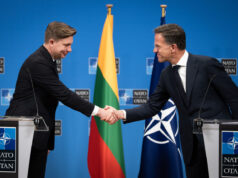
Speaking in Riga, Armed Forces Minister Al Carns argued that drones have become the dominant weapons system on the modern battlefield and that the implications for how Western militaries organise, equip and supply themselves are profound. “It’s not about integration, it’s about redesigning, restructuring around the most effective killing weapons system that you have in the battlefield today,” he said.
Carns offered a series of statistics to illustrate the scale of the shift. He said that during a recent battle in the war, there were 12,000 drones in the air in a 24-hour period, and that in December and January Russia issued one million drones to the front line. Drawing on his own analysis, he argued that a single drone equates to 22 artillery rounds in terms of lethality and accuracy.
Even taking that figure down by 50 percent, he said, 1,637 drones would be needed to generate the battlefield effect of 57 truckloads of artillery shells, but those drones would require only two truckloads to deliver. “Follow that logic across every part of the battlefield, and you begin to grasp the scale of the challenge that is now required, not tomorrow, but today,” he said.
He warned that Russia has already adapted, noting that in the past fortnight it launched one of the largest drone attacks of the war, deploying over 1,500 drones and missiles and using new high-density, high-trajectory tactics that brought strikes close to the NATO border. Adding that if Putin sees a force that has not adapted to the lessons of Ukraine, “he will not perceive it as a lack of deterrence, but he will see it as an opportunity.”
On the UK’s contribution to the drone coalition, Carns said the UK delivered £600 million worth of drones to Ukrainian forces last year, increasing numbers by a factor of ten from 10,000 in 2024 to 100,000 in 2025. Through Project Archangel, the coalition has delivered 150,000 drone interceptors. He said the UK is investing £4 billion in uncrewed systems and building an integrated targeting network, and is developing a drone centre of excellence strategy with Latvia, binding industry, educators and warfighters into a combined enterprise, alongside introducing a drone degree to train forces for the future.
Carns closed with a direct challenge to the alliance, saying “I ask you to know whether you have enough infantry tanks and planes, but do you have enough drone operators, data experts, AI engineers, EW experts, unmanned surface vessels, unmanned ground vessels, and unmanned aerial systems to sustain the rate of conflict that is going on with Ukraine. If the answer is no, then we have a problem. So we must be ready.”







A British politician lecturing Europe on anything defence always amuses me.
We don’t have enough of either category, where’s several ENATO countries have expanded their numbers.
Maybe some will turn around and say “wait for the DIP” 🙄
Paragraph 4
Morning Spock.
Yes yes, I read paragraph 4. I’d counter by saying my comment was in the context of paragraph 5!
I’ve gained $17,240 only within four weeks by comfortably working part-time from home. Immediately when I had lost my last business, I was very troubled and thankfully I’ve located this project now in this way I’m in a position to receive thousand USD directly from home. Each individual certainly can do this easy work & make more greenbacks online by visiting
following website—.,.,.,.,.—>>> JobatHome1.Com
DIP heavily rumoured to be out next week, supposedly on Monday. We can finally see what all of the fuss was about.
Don’t get too hopeful, would be my advice.
I expect a lot of reannouncements, with lots of Drones on top, which are not yet accurately detailed, Cyber, which again as it’s classified is unquantifiable, and a few headline “carrots.”
Now, if they say here’s a coherent plan to expand this or that niche area of the military ( both conventional, in personnel, and in Drone ) by x amount over x years, then we might be getting somewhere.
Examples.
Each of the 8 T26 will have 3 USV. We will buy 24.
We will buy 2 more E7.
We will buy 3 more P8.
Personnel will be recruited to make 4 Brigade deployable rather than a paper Brigade.
MRAD will be expanded by x number of x.
SHORAD likewise.
Tangible, actual enhancements.
The NCF has vanished into the ether despite billions planned for it and supposedly an HQ being built ( which still doesn’t show on street view ) so I expect a grand announcement of the opening of that as well.
Ministers love that, as it’ll be along the lines of “12 SSN” to detract from so much else. Might well be wrong, but I’ve been waiting for it so maybe it’ll be thrown into the DIP as well for filling out!
Evening Daniele. Saw your MRAD and SHORAD comments. With all the focus on drones we can’t afford to take our eyes off all the “non-drone” stuff thst might fly over in our direction. Lack of GBAD on airbases, naval ports, other critical facilities with large concentrations of valuable assets and personnel.
Wonder if any more P8s anf E7s on the DIP list?
*Ignore my P8 &E7 comment as you’ve listed it.
Doubt it.
All very late homework. Hope its a masterpiece.
He’s definitely being more high-profile of late, maybe he is planning a run at the Labour leadership.
We could do worse….a lot worse.
Yes, your preferred candidate. I don’t think he has a chance.
Maybe not this time around….
Labour MPs thought the same about some bloke called Corbyn, and decided to give him some sympathy votes so that he didn’t get humiliated with a Eurovision style “null points”…
That’s true. But isn’t it also the case that he had a groundswell of support anyway in the Labour Party membership, not MPs, who made him their leader? The far left of Labour that I so fear.
Does Carns have that support? I doubt it, delighted if I’m wrong!
I see Burnham becoming PM. Labour will think it’s all then ok, that the issue is just Starmer. I think the issues are as much their policies than their leader, and if Labour lurch left, they’ll still be losing support.
Yes the problem is that party memberships are always more radical than the electorate: hence Truss, Kemi, Corbyn. (Though at least Labour and Tory parties elect their leaders rather than have an owner/ cult-leader.)
The big question for Labour is whether they realise they are losing more voters to Reform than to the Greens and take the logical action, or stand up on its soapbox and follows ideology instead 🤷🏻♂️
Unfortunately the common sense approach wasn’t helped by war-criminal Blair’s intervention yesterday.
But if Labour MPs self-preservation instinct kicks in, maybe they’ll come up with a method to blind-side the membership and get Carns. (Though the Tories tried that to get Cleverly, and utterly balls it up, so 🤷🏻♂️)
With the current press focus on drones, I hope UK politicians don’t start thinking that solves their Defence problem – just buy more cheap drones and fund them thro more cuts to our existing conventional forces to make the numbers add up and then we don’t need to cut welfare and can increase handouts to our ‘hard working’ families – problem solved!
They are bound to highlight areas of growth and obscure areas of decline, such as our conventional capabilities.
Drones give that.
Minister Pollard wants a 1,000 ship navy. Let’s see the orders and the categories then.
Yet, they talk of 12 SSN as well. Conventional, if SSN are that in thos case, is never redundant.
Both are needed.
I’d disagree, the press seem to enjoy publishing stories of decline and cock-ups rather than positive stories about the military.
As for submarines… I wonder how much longer we can rely on the oceans to hide our submarines as technology advances. Biggest concern in this respect would be the SSBNs…
I agree there regards the gutter media.
We see the phenomenon here too, put downs almost for the sake of it.
I could be accused of that, but I really don’t think that way, I will happily highlight our many positives as a country, and as a military, as well as the political disinterest I so despise and our lack of numbers.
On your second para, yes, that’s what I had in mind! We’re spending on the SSN regardless.
I don’t know the answers.
We have a SME here on that, Deep32, who now but rarely posts.
I still recall his dismissal of some know it all saying the SSN could soon be replaced by an unmanned of same size and capability.
So regards the deterrent? The oceans were the safest to lose yourself in? Russia and the US have space and land to vanish into, we don’t.
I don’t know?
It’s like Spock and Jim (Kirk) are in some kind of Vulcan Mind Lock at times !
🤔😁
It is a mistake to characterise drones as a cheap ( and by implication less effective) alternative to conventional forces – they have become mainstream and therefore, conventional; and they have greater lethal effect. The deployment of drones by both sides in the Ukraine war clearly indicates a need to adapt both defensive and offensive weapons priorities. For the UK, a shift from armoured vehicles and artillery to offensive drones looks sensible to me.
Russian war ‘ethics’ include civilian population and infrastructure as legitimate targets. An effective UK Chain Home GBAD is a priority.
I wish people would stop giving this man the benefit of the doubt because of his service background. He is a member of the Government that is stalling on any defence spending commitments because they cannot make savings elsewhere to fund military expansion to even a tenth of what is needed yesterday let alone 100% of what is needed tomorrow. He is as much to blame for this as Starmer Reeves and Healey, benefits are a priority as that way lay votes simple as. He knows the truth so his integrity is even more threadbare than the other comedians in the cabinet.
Must admit to give up a high flying career in the RM to become a politician raises more than a few questions for me! Especially for a party that’s not exactly known for its wanton defence spending.
Stick to SDR 2025: ‘Autonomous and uncrewed (land and aerial) systems are now an essential component of land warfare, integrated with core armoured platforms in a dynamic ‘high-low’ mix of capability. A ‘20-40-40’ mix is likely to be necessary: 20% crewed platforms to control 40% ‘reusable’ platforms (such as drones that survive repeated missions), and 40% ‘consumables’ such as rockets, shells, missiles, and ‘one-way effector’ drones. Investment in attack and surveillance drones should be prioritised, along with counter-drone systems.’
Because that is what current operational intelligence appears to support. Ukraine has recently achieved a measure of localised battlefield air superiority once more permitting combined arms manoeuvre operations.
‘ISW has argued since 2023 that restoring maneuver requires disrupting and suppressing the enemy’s TRSC (Tactical Reconnaissance and Strike Complex) locally and temporarily to create a moving envelope that lets friendly forces advance.’
‘Ukrainian forces, as of May 24, are currently conducting tactical mechanized counterattacks in the Borova direction that have placed Ukrainian mechanized equipment at least two to five kilometers behind previously observed Russian positions. The Ukrainian counterattacks in the Borova direction are still ongoing as of May 24, 2026, and it is too early to assess their effectiveness. All the same, the employment of mechanized equipment within the kill zone is a significant feat given that deploying mechanized equipment this close to the Russian drone kill zone was categorically impossible in 2025. Ukraine’s ability to bring mechanized equipment close to and into the Russian drone kill zone indicates that Ukrainian forces are experimenting with ways to overcome Russia’s drone defenses and TSRC.
There is no single reason why Ukraine has managed to achieve these successes, but rather a combination of mutually supporting factors. Ukraine’s operational art has matured. Ukrainian commanders are achieving positive results by employing a more sophisticated campaign design that includes better shaping operations; intensifying Ukraine’s intermediate-range strike campaign to degrade Russian forces at operational depth; and achieving tactical drone supremacy in space and time to support tactical maneuvers.’
Institute for the Study of War 25 May 2026