

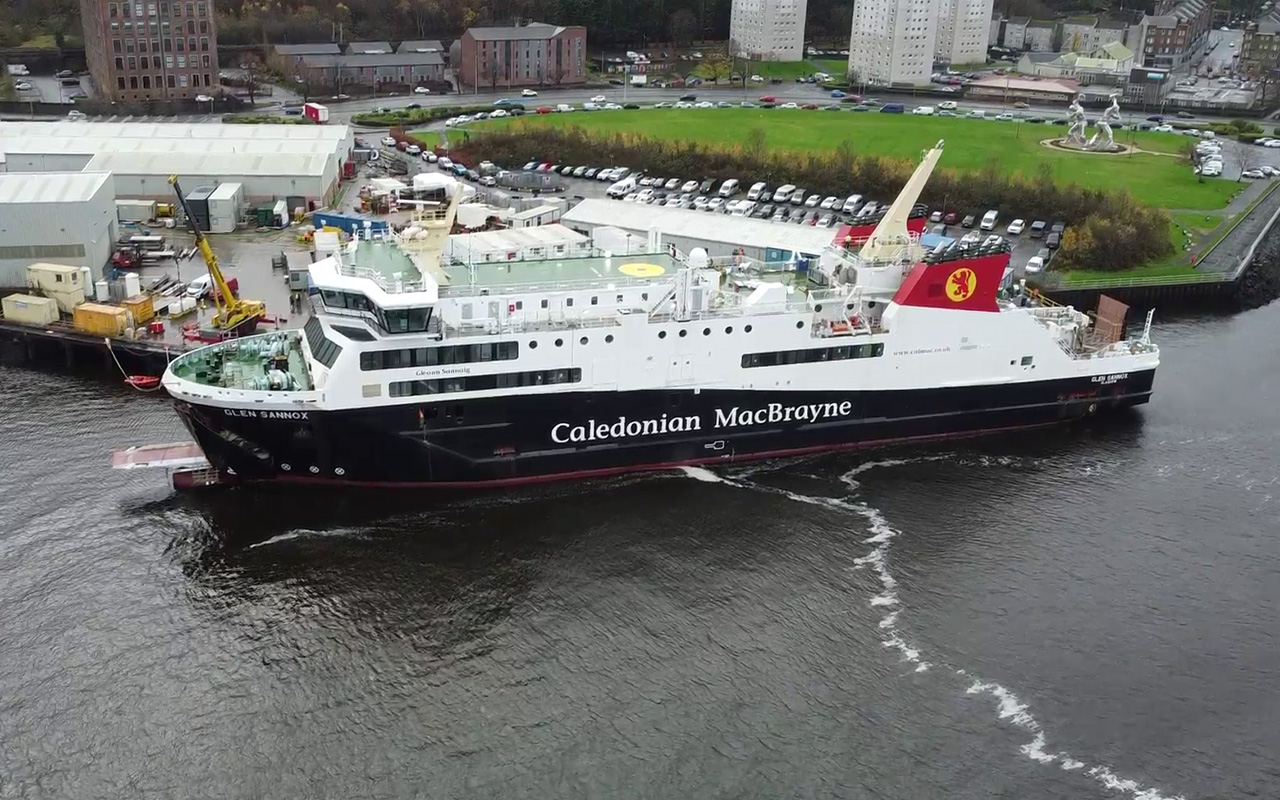
Ferguson Marine has detailed the cause of hull cracking on the ferry MV Glen Sannox and the engineering changes being implemented to prevent the issue recurring, while applying the same lessons to the sister vessel MV Glen Rosa.
Speaking before Holyrood’s Net Zero, Energy and Transport Committee, executives from the Port Glasgow yard said the problem had been traced to propeller cavitation and that both structural reinforcement and redesigned propellers would address the issue.
Chief executive Graeme Thomson explained that the cracking occurred due to vibration generated when the vessel operated astern. “The crack that was identified was a 20mm crack that manifested itself through vibration through the hull, which was caused by cavitation when the ship went astern,” he told MSPs.
Propeller cavitation occurs when bubbles form around the blades and collapse as they move through the water, creating vibration and pressure on the surrounding structure. Thomson said the yard moved quickly to repair the vessel and investigate the root cause.
“As soon as that was identified, the right thing to do was bring the vessel into dry dock and repair the crack in the first instance,” he said. Subsequent analysis identified excessive cavitation as the underlying problem and led to a two-part solution.
The first step involved installing additional steel reinforcement to dampen vibration and prevent further cracking while a longer-term solution was developed.
“The first step of the solution was to add additional steel to offset the vibration issue in order to prevent any further cracks in the hull,” Thomson said, adding that the work had already been carried out when the vessel entered dry dock over Christmas.
The second step involves redesigning the propellers themselves to reduce cavitation. According to Thomson, the new design has already been independently validated and tested.
“In the past week we have concluded that work on how we can optimise that design,” he said.
The revised propellers were tested in a model basin in Austria to confirm the changes would reduce cavitation during astern operations. “Between the steel that we have installed and the updated propellers, we will have a solution whereby this will not happen again,” Thomson told the committee.
The redesigned propellers are now expected to take several months to manufacture. “At the moment, it looks like approximately six months, but that is our guide—it is the typical time that propellers take,” he said.
While the replacement propellers are being produced, the structural reinforcement already installed is intended to allow the ship to return to service safely.
“The additional steel has taken away the vibration in the hull, which should negate any recurrence of the crack that was seen previously,” Thomson explained.
The lessons from Glen Sannox are also being incorporated into work on MV Glen Rosa, which remains under construction at Ferguson Marine. “We have now commenced fitting that steel work on Glen Rosa as well, in preparation for the mitigation of the steel and to give us the opportunity to get the propellers installed when they are available,” Thomson said.
Committee members were also told that the cost of the recent repair work on Glen Sannox exceeded £1 million. Chief financial officer David Dishon said: “The recent dry dock costs for propellers and steel strengthening is just over £1 million.”
Despite the additional work, Ferguson Marine said the investigation had produced a clear understanding of the issue and a validated technical fix. The shipyard now expects the combined approach of structural reinforcement and redesigned propellers to eliminate the cavitation-related vibration that caused the original crack.





Isn’t the obvious lesson, ‘focus on core competencies?’
Do they have any?….