

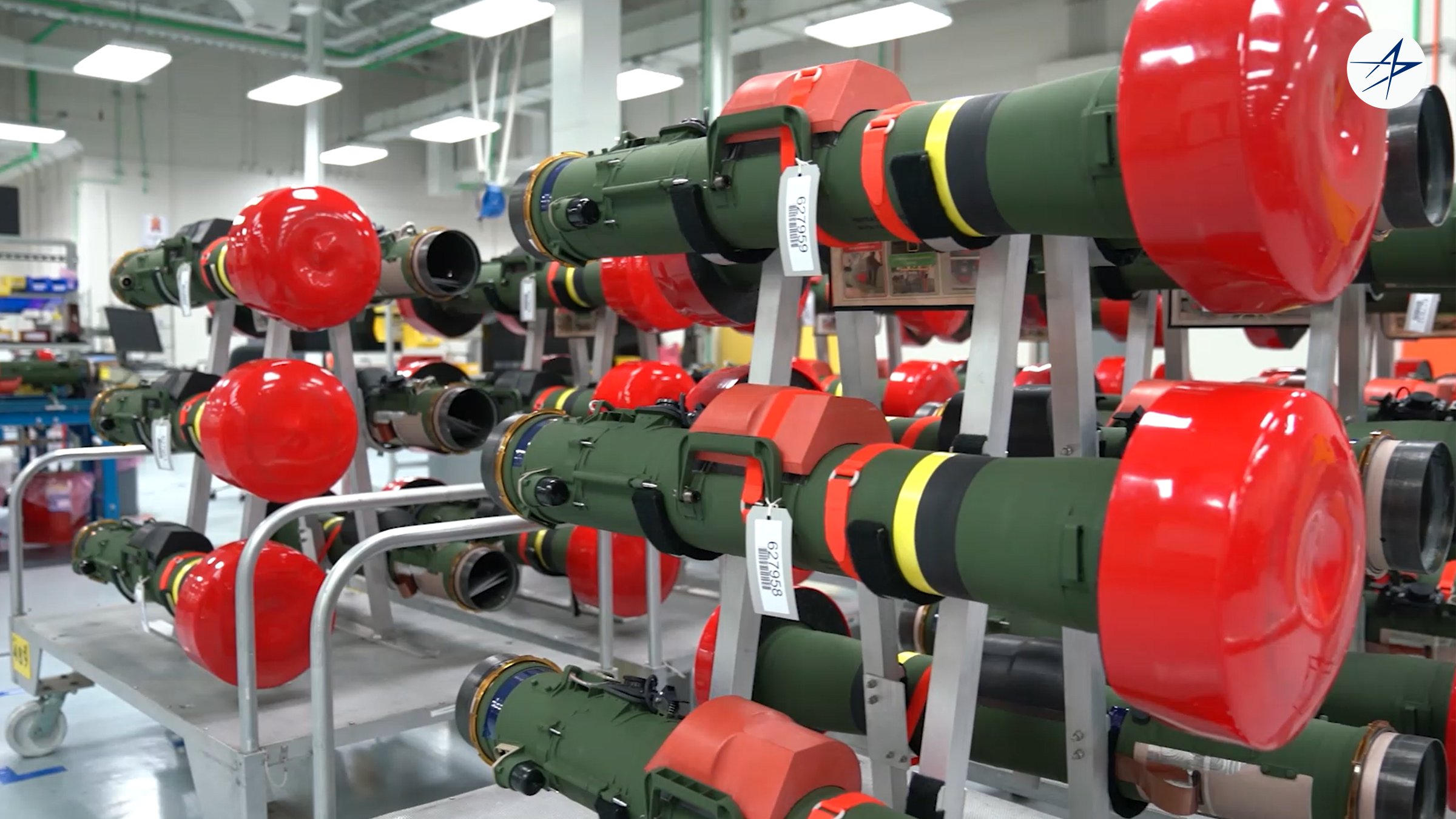
Lockheed Martin and Raytheon are scaling up the Javelin missile supply chain as global demand continues to rise, with suppliers investing in capacity, tooling and infrastructure to support higher production rates, according to the companies.
The effort centres on preparing a network of nearly 100 part-level suppliers and 25 major subcontractors, covering components ranging from propulsion systems to guidance electronics. Over the past year, suppliers have completed non-recurring engineering work, including new tooling, test equipment and expanded floor space, to enable increased output.
According to the programme, each supplier has spent between eight and ten months implementing upgrades to support the planned production ramp, with increased deliveries of subcomponents expected to feed higher assembly rates later this year.
Rich Liccion, vice president of the Javelin Joint Venture at Lockheed Martin, said “by engaging our suppliers early and investing strategically in capacity, we’ve been able to increase production while maintaining the quality standards our global customers expect.” He added that the approach provides confidence the supply chain can sustain an accelerated production tempo.
The ramp comes amid wider pressure on defence supply chains, with many suppliers supporting multiple high-volume programmes simultaneously. The companies say collaboration across the supplier base has been a key factor in managing capacity constraints and maintaining delivery schedules.
Jenna Hunt Frazier, president of the Javelin Joint Venture at Raytheon, said “by adopting advanced technologies like automation and AI-driven forecasting, we’re enhancing efficiency and building a resilient, future-ready supply chain.”
The programme has also introduced changes aimed at improving long-term resilience, including greater use of automation, upgraded forecasting tools to provide suppliers with real-time demand visibility, and investment in production line improvements to increase throughput.
Future plans include qualifying second sources for high-risk components to reduce reliance on single suppliers, maintaining stockpiles of critical materials, and keeping lead times for key parts below 52 weeks. The Javelin Joint Venture, a partnership between Lockheed Martin and Raytheon, is positioning the supply chain to support sustained high-rate production and potential future variants of the missile, as demand remains elevated.










“ and keeping lead times for key parts below 52 weeks”
Hmme that isn’t particularly ambitious…..can do better C-
A lead time of 52 weeks sounds crazy. Hopefully this might be a company builds a part in batches then focuses on supplying other batches of other parts so there is always parts available . Definitely more suppliers required
With a supply chain that long you would have thought there would be more competitors. Good product but if it takes a long time to source perhaps a home grown one needs to be on our shelves.
That is the main problem with defence companies. They are polictically too connected and buy up anyone that vaguely looks competitive ending up with a handful of companies, that you end up with 52 weeks.
Are they now obsolete in the age of more effective and cheaper drone warfare? Perhaps a good backup if jamming prevents drone use.
I think AT weapons are much more effective and not hugely more costly than drones (certainly NLAW, less so Javelin). So I think there is still a place for them. Drone and anti-drone technology is still relatively immature and developing rapidly, so having an alternative also helps keep enemies on their toes.
I think both have their place, ATGMs require less skill to operate and have a far shorter time to target. It’s hard to judge the success rate of drones versus ATGMs, soldiers rarely share footage of unsuccessful drone strikes.
Not sure that is true. Drones aren’t difficult to learn to fly. I suspect however the tech to move forward again in the near to mid future, as counters drone tech advance and military move back to missiles and tanks until the next thing arrives.