

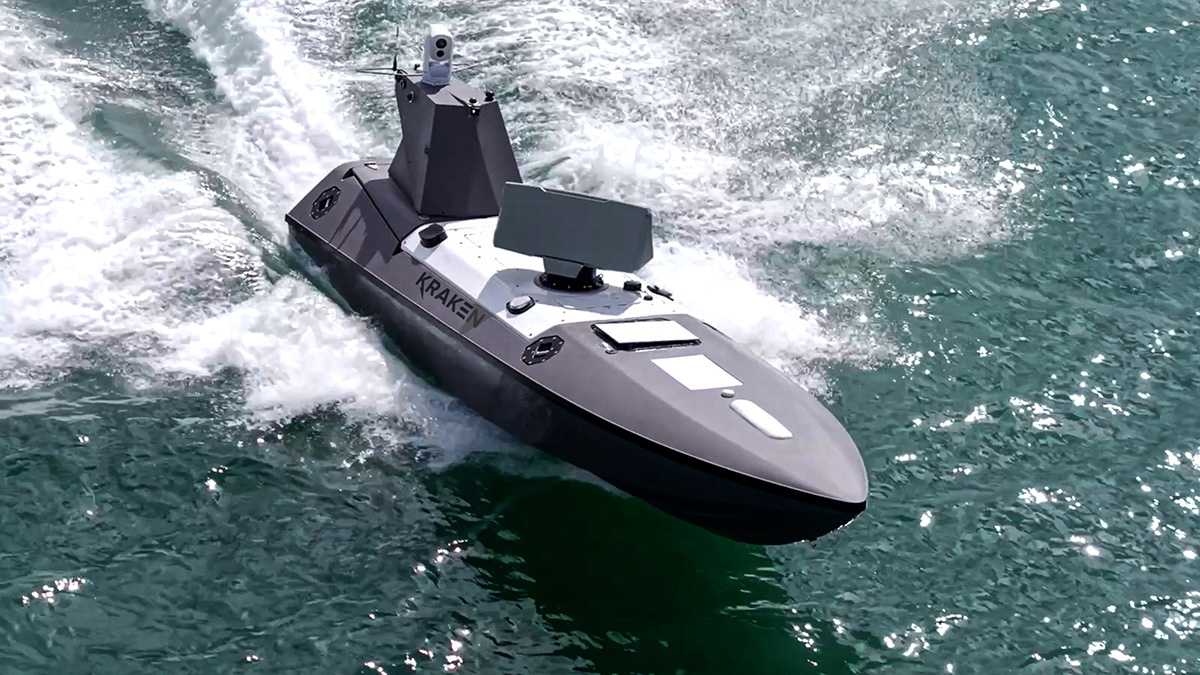
Kraken Technology Group and Saab UK have developed and tested an autonomous vessel carrying an air-surveillance radar, intended to provide a rapidly deployable counter-drone sensing capability at sea, the companies stated.
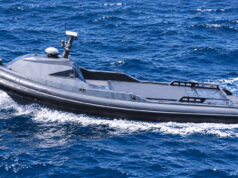
The prototype combines Kraken’s K3 SCOUT uncrewed surface vessel with Saab’s Giraffe 1X radar, placing the lightweight three-dimensional sensor inside the vessel’s modular payload bay to detect and track airborne targets from an uncrewed platform.
Kraken and Saab said the system was taken from concept to a working prototype in less than seven months, with sea trials subsequently carried out to assess the radar while operating in a maritime environment.
The concept is intended to extend air surveillance away from crewed warships by placing radar sensors aboard autonomous vessels which can operate independently or as part of a wider naval force. According to the companies, the configuration could provide early warning against drones and other airborne threats around shipping, ports, offshore energy infrastructure and other maritime sites.
Giraffe 1X is a compact radar from Saab’s wider Giraffe family of air-surveillance systems. Saab describes the radar as capable of detecting and tracking small airborne targets, while its size and weight allow it to be installed on a range of fixed and mobile platforms.
The K3 SCOUT is designed around a modular payload architecture, allowing different sensors and mission equipment to be fitted depending on the task. The latest trials use that payload space to turn the vessel into what Kraken and Saab describe as an autonomous “drone seeker”.
According to a joint news update from Kraken and Saab UK, Mal Crease, CEO and Founder of Kraken Technology Group, said: “Kraken and Saab UK’s prototype ‘drone seeker’ vessel is exactly what the K3 SCOUT was designed to do: integrate with mission-relevant payloads to then operate in austere maritime environments.”
The approach reflects growing interest in so-called hybrid fleets, where crewed warships operate with uncrewed vessels carrying sensors, weapons or other mission systems. In this case, the prototype is focused on sensing and early warning rather than carrying an effector to engage the targets it detects.
Moving radar coverage onto an uncrewed surface vessel could allow sensors to be positioned away from larger ships or fixed installations, although the companies have not presented the prototype as a replacement for conventional shipborne air-defence sensors.
Andy Fraser, Managing Director of Saab UK, said: “This is a pioneering, UK manufactured, deployable capability, that together with Kraken we’ve developed in less than seven months. This reflects the strength of our partnership, the maturity and flexibility of our respective technologies, and our ability to respond at pace to the evolving threat landscape and needs of our customers.”
Both systems involved in the prototype are produced in Fareham. Kraken manufactures the K3 SCOUT there, while Saab UK also produces the Giraffe 1X radar at its facilities in the area.
Kraken is expanding production following a $175 million Series B fundraising round which valued the company at $1 billion. The company says its new 35,000 sq ft manufacturing facility is being developed to support production of up to 1,000 vessels per year as demand for uncrewed maritime systems grows among allied armed forces.
The British company was founded in 2020 and produces a family of uncrewed maritime platforms including the K3 SCOUT, K5 KRAKEN and K7 SABRE surface vessels, along with the K4 MANTA surface and subsurface platform.
Saab UK employs more than 600 people across eight major UK facilities, with its activities ranging from radar and underwater systems to training, simulation and software development.
The K3 SCOUT and Giraffe 1X integration remains an experimental prototype, with the recent sea trials used to demonstrate that the radar could be fitted to the vessel and operated in maritime conditions while exploring how an autonomous surface platform could contribute to wider air-surveillance and counter-UAS networks.




Pittt we didn’t get a chance to use these in Hormuz. Would have been interesting to see their effect on Iranian drones.
Wouldn’t have thought that it would be up high enough to be able to cover any great distance.
This has to be only a proof of concept, it is fools errand to think this is a prototype leading to a production version! It would be absolutely pointless using such a small vessel in the North Sea let alone the Atlantic. Especially when you consider the vessel will disappear into a trough during heavy swell, thereby masking the very low set radar. Thereby negating its value as a “forward sensor”. The Kraken’s K3 SCOUT is 8.4m long, so it could be carried in the mission bays of the T26 and T31. However, if it was deployed in heavy seas, its capability as a forward presence to detect low flying sea skimming missiles or drones, would be next to useless. Unless the seas were like a mill pond, the swell of the waves would mask the very low set radar.
I see this concept as a complete waste of money for going into production. You are significantly restricting yourself to the vessel’s radar horizon. Even when using a larger vessel and with the radar on a mast. It is still too small to generate a decent radar horizon. You really need a much bigger vessel, that has the stability margin to place the radar as high as possible, ala Sampson on the T45. If the RN were actually being serious about significantly extending the radar horizon so they can better detect sea skimming missiles and low flying drones, then they’d mount a radar on a VTOL drone. As this will allow for a significantly greater radar horizon, plus you won’t require as many drone surface vessels regardless of them being networked together.
If you really do want to go down the sensor drone surface vessel route, you really need something closer to a Batch 1 River class in size. As the radar can be placed around 15m above mean sea level, which will give a radar horizon of 16km (10 miles). The Kraken’s radar is at best 2m above mean sea level, meaning its radar horizon on a mill pond like sea is less than 6km (less than 3.7 miles). Put in a few waves and swell, its radar horizon can easily be cut in half if not less.
This is surely a concept aimed at Bab-el-Mandeb or Hormuz missions in much calmer seas, the Atlantic is far too big for something like this to be useful.
You have summed up my thought nicely there Davey,
However, TorpedoJ does make a good point about it’s potential usefulness in calm climes although I agree with you that a bigger drone would be a better bet. Perhaps the K3 Scout is a platform of convenience and being small makes the point the if the K3 can carry the radar so can a bigger drone. A kind of confidence setting trial setting the lowest possible vessel size..?
I have found the Kraken Technology Group website (confusingly there is a similarly named company owned by Ovo Energy!) but it does not list the K7. However, the K5 is over 3 times the size of the K3 but still only 6tons so still going to be too small to put any kind of mast on it…
Cheers CR
Might have utility for RM and JEF raiding forces as a concept. Future small insertion craft could have this .
Also allows some form of ambush capability if armed with IR missiles, possibly a threat to other surveillance drones trying to get a track on manned vessels.
A slightly larger and robust platform means it could provide a radar picket function.
I think you have pointed out a lot of shortcomings in their design, but you haven’t asked yourself how could these shortcomings be mitigated.
If you think about what JTIDS achieved in the 90’s it was very useful. Extrapolate from their and you could overcome most of the limitations of a small surface vessel bobbing around in a rough sea state.
You haven’t compared the shortcomings of our current radar systems to the emerging tactic of overwhelming an expensive anti-aircraft defence with cheap drones/missiles.
I’m 30 years out of date but I don’t think your analysis is fair until address the new tactics which are becoming very effective.
I don’t know how accurate it is but I read CIWS ammo is running very short.
K.
Hi K, I think my logic is sound. Radar physics hasn’t changed since the 1940’s, yes we now have a better understanding, and can manipulate the transmission in a plethora of different ways compared to even the late 1990’s. Not to mention how today’s signal processing would appear magic like to our 1940’s forefathers. The fundamental problem of using such a small boat and mounting the radar so low, is firstly the distance of its radar horizon, secondly the area of the coverage and thirdly the shape of the coverage.
As I mentioned above, I fully expect the vessel’s radar horizon to be around 6km, which means the surface area it can cover is only 113km squared. The overall shape of the coverage will start from the radar horizon, elevating upwards in a semi-hemispherical shape, ending at an elevation angle roughly 65 to 70 degrees. If we now use 4 of these vessels networked together, do you place them so that their radar horizons overlap or do space them wider apart to take advantage of the elevation coverage? If you place them so their horizons overlap, they will either be very close together in a tight knit group clover leaf style, or in a row fronting the expected direction of an attack. What they can’t do is circle the mother ship, and significantly expand the radar horizon. As the Kraken uses the Saab 1X radar, which operates in the X-band (8 to 12GHz) its overall instrumented range varies depending on the version. So can vary between 70km and 200km. If the “mothership” has a decent medium or even long range radar, these usually start at 200km (Artisan and NS100) and up to 2000km for the Smart-L MM. So the 4 vessels can expand the overall coverage, if the mothership (T26/T31) only has a medium range radar.
There is already a solution to the radar horizon problem, which is airborne mounted radar. As an example, Leonardo’s Osprey 50 X-band AESA radar, has a published instrumented range of 370km. If you placed this radar on a VTOL drone at 500ft (152m), it will give you a radar horizon of 54km (34 miles), at 1000ft (305m), the radar horizon will be 72km (305m) and at 5000ft, the radar horizon will be 170km (106 miles). The area covered at each height will be 9852km squared, 16,286km squared and 90,790km squared. Which significantly trumps what can be achieved from a radar operating from the surface. This is a capability from only one airborne radar, if we introduced two or three drones. The area covered would be substantially greater than what can be achieved with 50 Krakens.
Sea skimming missiles are still the greatest above surface threat to a ship, as you can only detect them (if they’re passive) when they pop over the radar horizon. Ballistic missiles and high diving missiles will be detected significantly further away. Which means if you have a supersonic anti-ship missile like the Russian P800 Oniks, which can reach published speeds of Mach 2.9 (3580kph / 995m/s) at low level. The T45 with its 40m high mounted Sampson, only has a radar horizon of 26km. If the missile approaching the T45 5m above the deck, it should be detected at around 35km. Which means, as its travelling at 995m/s, it will hit the ship in just over 35 seconds. The ship’s combat management system, must take the feed from the radar, determine if its a threat, determine if it can plot an intercept solution, then if automated, select and fire the missile to intercept it, whilst also giving positional updates via data link, before the interceptor (Aster/CAMM) goes active. Which all has to be done within the 35 second window. To make life for the ship more complicated, you can add more anti-ship missiles as well as a few drones. The priority targets will be the anti-ship missiles, as they are the greatest threat to the ship and life. Whereas the drones can mission kill the ship, but are unlikely to sink it.
If we now put a Kraken up-threat of the mothership, the radar will detect the Oniks at 5.8km. If the Oniks passes directly over the Kraken, the missile will be illuminated for around 11 seconds before it disappears beyond the vessel’s radar horizon again. Which will obviously alert the mothership, but the mothership can only use the information to generate a predicted track, not an actual live track. Whereas, if a VTOL drone carried the Leonardo radar at 1000ft and was hovering directly above the mothership, the missile will be detected around 81km away. Giving the ship just over 81 seconds to track the threat and work out an interception. But perhaps more crucially, the mothership can now work out an interception beyond its own radar horizon as its getting a continuous feed from the airborne radar. Which becomes increasingly important when the number and types of threat significantly increase.
Using an airborne radar, allows you to see much further and gives you more time to react and plan a response to threats. A surface vessel, even when a large number are networked together, will always suffer the issue of the radar horizon being too close, irrespective of the radar’s height above sea level, see the T45 example I gave above. Another advantage for the airborne radar, is that it can stay much further away from the threat whilst still providing coverage. The recent operations in the Red Sea and the Gulf have been mentioned as where the Kraken could be employed. But again people fail to see the significant handicap the vessel has, as it looks like a nice new shiny solution. But in reality it is only a sticking plaster. Instead, a better solution would be something like Leonardo’s Proteus drone, which could easily carry and power the Osprey radar. Which would have given warships operating in these two areas a significant advantage. Firstly it can cruise higher than 5000ft giving a radar horizon of at least 170km, plus it has a duration of over 8 hours. If fitted with the Osprey radar, it would be able to provide not only a greater radar horizon, but also see further inland. The radar has a synthetic aperture mode, meaning it produces near photo realistic images of the ground. Not only would it be able to detect an incoming threat, such as drones or anti-ship missiles. But would also be able to map out the launch point. Thereby giving the ship the option of neutralizing the launch point, whilst also being able to protect the drone.
I can see no value or benefit of using a Kraken like drone to mount a radar, that can then act as picket ship for a mothership! I find the idea a bit mickey mouse, as it does not and can not, answer the fundamental requirement of extending the ship’s radar horizon!
I can’t be negative about a concept demonstrator specially focussed on a counter drone, and I assume counter Shaheed, mission. Likely designed to operate with other similar USVs carrying low cost interceptors and able to operate in contested offshore or littoral environments. You need to be able to protect against low and high tech threats. If this can strip out some of the low tech at range it allows the more capable AD weapons to focus on what gets through.
A G1X is expensive enough that’s it’s not a throwaway platform, but certainly better than putting a manned AD ship in the SoH right now.
Of course height is better, but getting there isn’t easy. A G1X is around 150kg, I think without generator etc, so not light. You could go fixed face and give up 360 coverage but to get any decent range there are limits to how light you can make it. If you need to add power generation/storage and comms kit the weight goes even further.
Current UAS with 150kg payload don’t have great flight times. So do you go tethered and off board the power and data transfer? Works but then limits you to the cable length, not to mention there are plenty of weather limitations for UAS.
Airs problem of impermanence isn’t going away for the majority of projects.
I think you need both, I can see value in always having some of these around as well as airborne systems.