

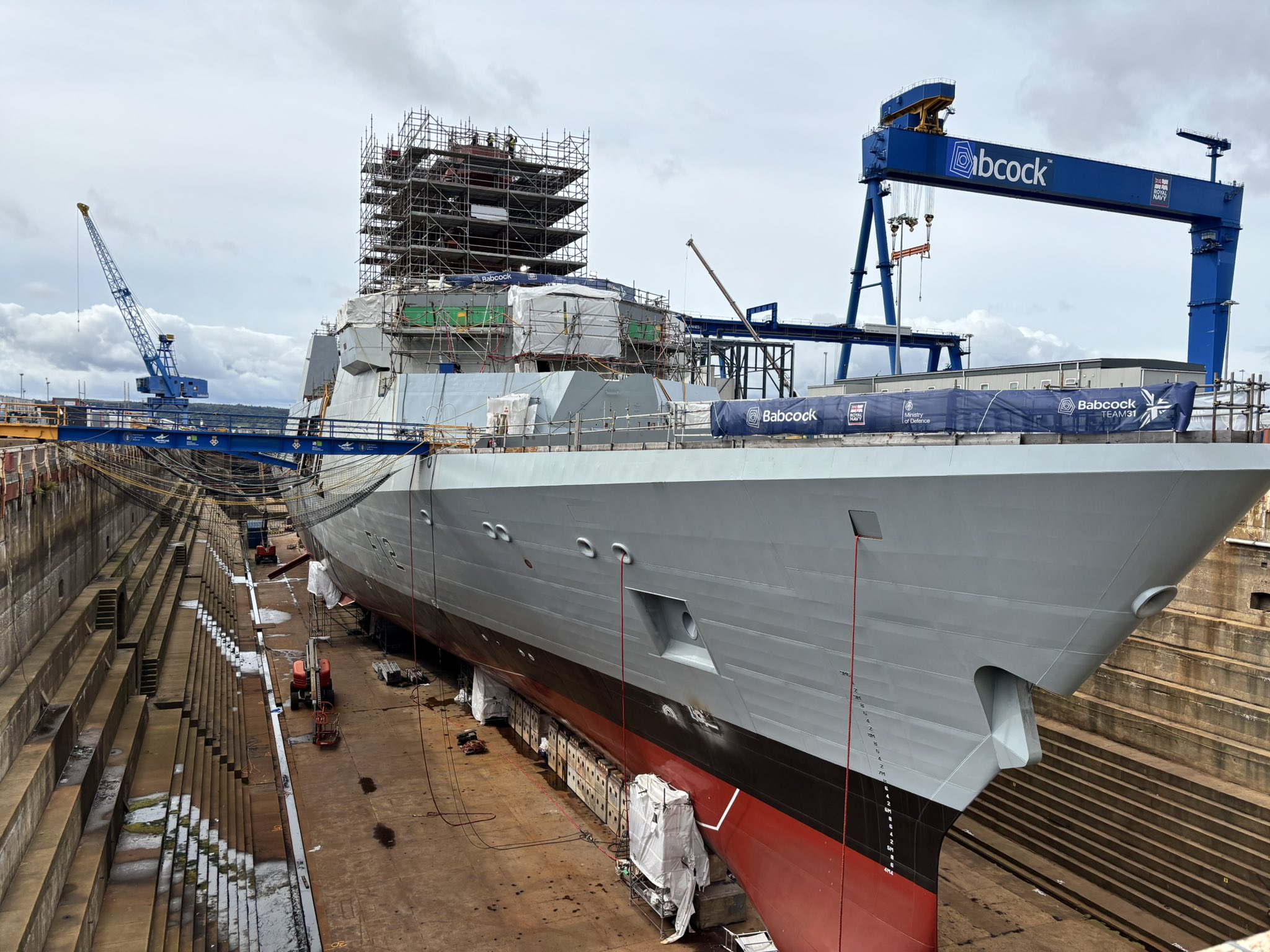
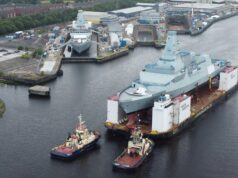
Work is under way on the Royal Navy’s five Type 31 frigates at Babcock’s Rosyth yard, with two ships fitting out in the drydocks and two more at earlier stages of construction inside the assembly hall, according to imagery.
Vice Admiral Steve Moorhouse, Fleet Commander of the Royal Navy, visited the yard on Tuesday 18 August and posted photographs of the ships. He said: “A fantastic opportunity to see @Babcockplc T31 hulls inc @HMSVenturerRN taking shape. Brilliant to see the future of the @RoyalNavy coming to life, built for the challenges ahead and ready to deliver at the heart of our hybrid navy for decades to come.”
HMS Venturer and HMS Active are both fitting out in the drydocks. Venturer, the first of class, carries her pennant number F12 on the bow and appears externally complete along the hull, with scaffolding still in place around the mast and superstructure and equipment under wraps on the upper decks.
Inside the Venturer Hall, the covered assembly building at the yard, HMS Formidable is further along with a bow block sitting adjacent to the ship awaiting joining. Bulldog, the fourth ship, is in the early stages of construction. The fifth, Campbeltown, has not yet been laid down.
The five ships are being built under a £1.25 billion contract placed in 2019, derived from Denmark’s Iver Huitfeldt class through Babcock’s Arrowhead 140 design. They are intended as general purpose frigates, freeing the anti-submarine Type 26s for task group and deterrent protection work, and will be armed with a 57mm main gun, 40mm secondary guns and Mk 41 vertical launch cells added to the design after the original contract was signed.
Delivery has run behind the original schedule, but the Ministry of Defence now expects the first ship to be handed over by the end of the decade, and Babcock has set aside around £140 million against design changes and rework on the programme.
Ships are assembled under cover in the Venturer Hall, a facility built specifically for the programme and sized to allow two hulls side by side, before being moved out to the drydocks for fitting out. Babcock has invested roughly £200 million in the site.
The programme sustains around 2,500 skilled jobs across Scotland and the UK supply chain, along with 400 apprenticeships established through partnerships with colleges in Fife and elsewhere in Scotland.
What follows the current batch remains unsettled. Babcock has pitched the design abroad, with Poland and Indonesia selecting Arrowhead 140 variants, and the local MP Graeme Downie has been pressing the Ministry of Defence to confirm that the planned Common Combat Vessel will use the Type 31 hull and be built at Rosyth.
Imagery was published by Vice Admiral Moorhouse.


Timelines have slipped. Venturer had been slated to enter service alongside her cousin Glasgow next year, but recent statements instead push the entry to service back to the nebulous ‘before the end of the decade’. Various outlets make unverified claims as to the readiness of certain systems, but the government and Babcock remain tight-lipped. Meanwhile, in Poland and Indonesia, foreign shipyards are rapidly catching up to Rosyth, despite beginning their programmes later.
The RN meanwhile sees its cheap, rapidly procurable frigate slip to the right. For a while the frigate has been the source of controversy surrounding its armament and sensors, with promised improvements committed to without firm timelines.
Babcock and its political advocates declare that it is the only available shipyard to construct the RN’s next generation of air defence warships after the Type 31 frigates are finished. But with Babcock also bringing a catalogue of delayed promises, industrial mismanagement and nebulous timelines, it is hard to trust them with the replacement for the T45.
I wouldn’t be surprised if the delays to Venturer were a direct contributor to Swedish choice of the FDI in its recent frigate competition.
I guess it’s possible that adding the mk41 silos slowed things down. Altough 4 years seems excessive for ordering and adding them. Saying that most large procurement projects get delayed, not just in the public sector so maybe a combo of the two.
Except the silo isn’t being added to at least the first two ships.
The picture of Voyager shown yesterday on Naval Lookout Twitter taken by Admiral Moorehouse shows that externally it’s way behind the Polish frigate that has just been launched 😒
Hard to compare. We don’t know if under the surface the RN has spec for better redundancy etc. Too many unknowns. However do agree it’s odd that it’s taking longer.
I wonder whether the RN are thinking to skip NSM and fit the T31 Mk41s with Stratus from the get go? Reports today that ‘full scale’ tests of the missile are planned for 2028. And maybe Aster too; what’s the news on Aster – Mk41 compatibility?
Expects first ship by the end of the decade . Surely not that is still 4 years away ?
And just yobadd i read Poland is already way ahead on fitting out and they started later. Maybe UK should get Poland to build some T26 or zT31 to bump up RN size or just outsource export builds. The US Navy is outsourcing frigate builds to intetnational contenders . Both the T26 and T31 would be great for US Navy but yet again because UK is half asleep on anything manufacturing will most likely be a hige oppertunity missed . The uk should alreasy be commetted to building at least two ships a year for next 20 years and would easily find a buyer for these ships on international market
You should not be so negative about build time as this is a result of destroying the shipbuilding industry over decades and loosing those skills and no doubt the MOD changing their mind on additions and deletions or as we call them variation orders. I agree that Poland can build faster but they still have a manufacturing base and anyway most of the welders in the UK are Polish as to are the painters and plumbers!!! Maybe if we had invested in industry rather than out sourcing we would be in a better place now??
We have family in Poland, they have told us a lot of Poles are leaving the UK due to the cost of living here and better pay and conditions now being available back home. So I totally agree with your comment that we should have invested more in industry.
UK media, cultural education establishment including universities taken over by the Left prefer to invest in “progressive” courses.
After defeat in Cold War the left retired from physical reality. Everyone is to be an intellectual or progressive high tech.
Being welders, plumbers, painters are beneath their ivory tower.
Do you really believe the decline of manufacturing from the 1980s was due to the Left? Can I assume you are too young to have lived through the period?
You maybe correct but unless our political classes start thinking about all types of manufacturing we will never be in control of our density nor be able to build a robust economy to counter not only the obvious military threats facing the UK but also the economic ones from both the east and west.
A grown up just entered the room. The lack of a ship building capacity is the result of historic decisions well aired on these pages; no one has found a way to turn back a clock. The best, fairest, assessment of the Type 31 as I have seen is an in depth overview on an American website; on balance, they were impressed. Last century a competition to ‘find our national bird’ chose the Robin Redbreast. Someone suggested, given our national penchant for moaning, it ought to have been the Grouse.
Well there’s still trials to go through, and first in class trials usually take over a year. So even if Venturer gets fitting out completed by the end of this year, it’ll be 28-29 by the time she’s ready to hand over at this rate.
Perhaps we should have called the t31 the ACHILLIES class. ? Their Anti submarine capabilities is Woeful..!
They are not designed as ASW platforms. That’s the role of the T26
Well, I hope any hostile sub agrees to avoid them then…
And if the intelligence tells us a hostile sub is operating in the same area of Operstions of a T31, then a Merlin will be on the back end. Not every warship has advanced ASW capabilities. We have a range of capabilities to counter threats. But a T31 isn’t going to be deployed in the North Sea to hunt Russian boats on its own. With future drones, very possibly. But not without. 8 T23s had 2087 sonar capability. The remaining vessels didn’t.
And the likelihood that they’d find a Type-31 considering there’s 5 of them and 8 Type-26s, stacks any Sub encounter to be more the latter.
Alas, they might be embarking a littler USV with a Sonar if they need it in the water for period’s longer than a Merlin can cover or be nearby the ship.
Just to point out that Polish A140 will have captas2.
How often does the Royal Navy deploy warships in pairs? Having no ASW capability on a modern frigate is horrendous.
Yet even though not in the same class as the T26’s they could still have some form of ASW to ensure some competence. The WW2 Flower class did that as their primary role and they were far from what you would say quiet today. A sonar fit and ability to fire off some torps would be a relatively easy fit whilst in build. Lots of cheap options out there…………..
And I’m sure some type of ASW kit will be added in future capability upgrades. They have lots of space and capacity. If more kit was added for day 1, then they would be even more expensive. They have already added Mk41 which is a major enhancement.
Yes, but having a hull sonar to detect threats should be a must.
It does not mean that the ship is going to be used in an ASW role,
but it would at least be able to determine if it is under a subsurface attack and take appropriate action
It would. But foreign nations subs don’t just start attacking RN Escorts out of the blue. That’s a article 5 triggering event. RN warships have a huge amount of intel available, and build up a air picture of what is happening around them, above and below the surface from many sources. Senors, networks, offboard and onboard sensors.
“subs don’t just start attacking RN Escorts out of the blue”
Daft comment.
I’m talking about a possible scenario when hostilities have already broken out, Article 5 would not matter then.
And I dont Believe we know where all potentially hostile submarines are at all times either.
My comment is accurate. And yours is even dafter. Unless it has a Merlin on the back end, and a couple of T92s, then a T31 isn’t going to be solo facing down enemy subs.
Does a hostile nation get a say in this? It’s daft to make such a sweeping statement.
Not really. Generally a whole lot of politics has to go pretty wrong before people start shooting at major warships of a NATO nation.
Don’t think that goes for the likes of China or other similar states. No one plays by the rules these days so why should we? The kit was there on the T23’s that are leaving service so although added cost it was would not be that much really with a state of the art bit of kit as the T26’s so same training/maintenance line too, saving money.
Out of the deep blue sea is exactly where Subs come from. Also, RN mission means not all potential hostilities are Article 5 issues. (Falklands, Gulf, South China Sea etc).
Putting a Type 31 into waters such as the Gulf or the Black Sea, where serious mine threats exist, without a mine detection capability, would be negligence.
It has a towed systems to detect torpedo’s and a towed decoy and deck mounted decoys, so would have limited detection capability.
Its boat bays could fit a USV with some form of sub detection system and a helo or drone system to drop bouys.
The hull isn’t designed for silent ops, the engines aren’t mounted or rafts so adding a higher end hull sonar at that price point would mean they wouldn’t have been built. It is what it is.
In NATO context there are lots of ASW frigates and sub hunting assets.
They are sensible enough to add MK41 at some point. So as surface and land attack it will add some decent capability.
Or in a mine field
Show me a single proper frigate without a sonar.
Yes, it’s not an ASW frigate, but that just means it’s not specialised in ASW.
But with no sonar it will have to be escorted everywhere that has a sub threat. Which is the entire planet.
See David’s explanation.
Wont know its approaching or in a minefield
True but in reality any none specialist ASW ship is essentially prey to an SSN unless it’s part of a task group with specialist ASW capabilities..
You could put a good hull sonar on it and it would still be little to no use.
It’s probably better to have a pair of T9x ASW TAS tugs and a Merlin on the back.
A warship with ASW capability has a good chance of detecting and defeating an enemy submarine. The big majority of our adversaries’ subs are diesel-electric SSKs, not SSNs. A warship with no ASW is just a sitting duck.
The whole concept of T31 as a patrol frigate, operating solo in far-away waters without ASW, is a bit absurd really.
A parallel is a main battle tank, which has to balance defence, mobility and firepower, each of which is essential to its survival. Every major warship needs to be able to look after itself in all three domains, air defence, surface-to-surface combat and ASW. It may specialise in one domain, but cannot be deficient in the others. If it is lacking, then it ceases to be an escort and itself needs to be escorted – which we do not have the hulls to do. This applies as much to the T45 as the T31, the only capable all-rounders we have are the remaining T23s and the T26.
Sure, every T31 will need to be accompanied by a couple of T92 ASW sloops to provide at least some semblance of ASW capability, but that is some years away and a hopeful, rather than proven, solution.
diesel-electric are far harder to track them nuclear when they are running on battery (due to the nuclear reactor not being able to be completely shut down), as proven by multiple war games were they have got through US carrier protection nets. Altough that would be limited to near shore risk.
Yes I agree. To be honest, lauding the T31 without any organic ASW capability or detection isn’t the flex Steve Moorhouse reckons. It’s armament harks back to a world that no longer exists. The idea that a frigate has to withdraw because an adversary submarine is in the area is not a good look. We’ve seen how the Iranian warship returning from an exercise in India was targeted and sunk by the US, even though the warship was not conducting combat operations. Currently, the T31 would be a nice target for an enemy sub lurking in the ocean.
Remember what the T31 is actually for; it’s meant to fill the gap between the high-end warfighting capability of the T26 and T45, and the purely constabulary work of the OPVs. T31 is for the hazards and combat that the RN is most likely to see:
– air defence against terrorists and developing nations firing lower-end and improvised weapons at friendlies or merchants.
– striking land targets with cruise missiles
– anti-piracy ops, which functionally means being a base for a helicopter and boarding team
– deterring or destroying enemy vessels, which might include frigates but in 90+% of situations means small craft and possibly corvettes
It’s the modern third class cruiser; trade protection and keeping local problems in check, not serving with the fleet or hunting enemy units.
Up to a point yes, but real life scenarios may not be so forgiving. Looking back to the Falklands war, many RN ships found themselves in a combat situation that they weren’t necessarily designed for, and were sunk or damaged with many casualties. War doesn’t allow the luxury of bespoke ships in the right area at the right time. It’s not inconceivable that a Russian SSN could tail a T31 into the far Pacific and launch an attack if Putin wanted to make a point . Taking into account what you’ve said, not having some kind of ASW sonar is a serious concern, especially when the ship is supposed to be a stand alone patrol vessel. There could well be a plethora of underwater drones and SSK in the oceans within the next 5 years, all operated by hostile actors, which would amount to effective sea denial to the RN. Not a good look for a blue water navy.
“Up to a point yes, but real life scenarios may not be so forgiving. Looking back to the Falklands war, many RN ships found themselves in a combat situation that they weren’t necessarily designed for, and were sunk or damaged with many casualties”
True, but the deficiencies ships deployed to the Falklands had aren’t directly analogous to T31. Ships like the T42 and T21 were lightly built and lacked layered defences against likely threats – T31 is big, built to better standards of DC, and has layers of missiles, guns, and decoys. The new HMS Active is far better equipped against modern threats than her predecessor was against the dangers of her time.
“War doesn’t allow the luxury of bespoke ships in the right area at the right time. It’s not inconceivable that a Russian SSN could tail a T31 into the far Pacific and launch an attack if Putin wanted to make a point”
There’s nothing that could be done about that anyway. An SSN trailing a cruising surface ship is like a lion hunting a lone cow; every advantage lies with the predator. However, the counter argument then becomes “what stops the UK/NATO retaliating and sinking the Russian fleet?”
Ultimately, the T31 has defences against underwater threats, it just lacks the ability to fight back beyond deploying a helicopter (currently the same response our actual ASW frigates can muster, but that’s a separate issue). You can make a case about an increasing number of underwater threats within the next few years, but they haven’t materialised yet, and may not do so for many years if at all. The threats the T31 is designed to deal with are real, present, and have been increasing for decades.
Even the RN at the height of it’s pre-war knew every ship couldn’t be a battleship or armoured cruiser; there is always a point you need a middleweight option to bulk out numbers
“You could put a good hull sonar on it and it would still be little to no use”
How about detecting incoming torpedoes or a subsurface drone attack?
Having no hull sonar is a big vulnerability.
It has a sonar for that as it’s equipped with Sonar 2170 Surface Ship Torpedo Defence (SSTD), that includes a passive towed array that can detect incoming torpedoes and subsurface weapons, track, type and attack them using soft kill decoys.
It’s far better at managing a torpedo attack than a standard hull sonar.
SSTD just distracts incoming torpedo’s. Well as long as they are acoustically guided otherwise the system does nothing.
Apparently it also has a set of decoys for wake homing as well..
It also gives the crew a best evasion option.
Good luck with that!
In the end it’s always going to be a problem.. there are very few surface combatants that are anything other than prey when it comes to attack submarines..
You have to detect the attack first before you can deploy decoys
It’s got a towed array sonar for that purpose..
It doesn’t, unless you are counting the torpedo defence system which is towed
That’s what we are discussing the torpedo defence sonar.
There was a report in the telegraph ( not the most reliable paper I admit) that there is serious consideration going on about mounting an Australian radar on a future RN ship.. does this mean CCV will get a CEAFAR2 AESA sensor set ? Or is the RN planning to build a version of the hunter class in the 2040s after the T26s have finished..
We were debating this over on the Secret Projects forum a couple of days ago. The Telegraph report is reading a little more into the story than actually exists as of yet; Pollard travelled to Australia and signed an MoU-type thingy to introduce CEAFAR2 into the UK. However, he did not confirm where it would be used. CEA offer land and naval applications, and the UK needs both, so it could be either.
What Pollard did say is that CEAFAR2 could ‘augment’ UK radar technology. That suggests the vision is a combined UK/Australia-sourced radar infrastructure. Unfortunately, we just don’t know anything beyond this yet.
Now, the CEAFAR2 is a very good system, surpassed really only by the American naval radars. It would give any future RN air warfare combatant world-class surveillance capability.
However, any purchase of CEAFAR2 would make it very hard for BAE to pursue their current radar demonstrator set-up. We’d lose the established British radar industry.
Secret Projects Forum?
Excellent forum to research stuff that was not build and even those that were.
Shhhh secret
Hmmmm. So secret they’re discussed on a forum with the secret name.
Assume black project aircraft and the like.
I think that’s where it started, but since then it’s become a forum for historical projects (stuff like the T43 destroyer) and for modern programmes as well.
Was it even CEAFAR 2? I thought it was just ‘CEA’s radar technology’ which covers a multitude of things, whereas CEAFAR is specifically for naval air defence.
The Australians seem to think that it’s with regards to a direct CEAFAR export, whilst the UK is playing it a little more coy, basically saying we ‘might’ buy ‘something’ from CEA. Even then, it might not be anything more than the outer casing from the system to house BAE technology. On the other extreme, it could be a set of 20 radars or so.
My comment was based on the assumption of a naval export radar, though, as Jonathan was asking about the CCV.
@Leh
Glad to see your views on CEAFAR have moved on from those you posted in the UKDJ’s “New British warship project awaiting delayed DIP” article, dated April 27, 2026.
In the comments section regarding the Royal Navy’s then proposed upcoming Type 83 Destroyer and future warship projects, you flatly rejected the system writing “…CEAFAR2 was never a credible option. There’s no way in hell the MoD will import a more expensive, foreign system, with less capability, and most importantly, no British industrial benefits.”
You explicitly dismissed the idea of the UK adopting the Australian radar.
You argued the MoD would never bypass British industry for a foreign import.
You argued CEAFAR 2 had “less capability” than what British defence giant BAE Systems was cooking up, specifically favouring BAE’s development of the Artisan radar and next-gen transmit/receive modules. Because of a lack of British industrial benefits, you pushed the narrative that local BAE projects were the only serious path forward.
The threat of cheap drone swarms and sea-skimming missiles are TODAYS problem, so, the UK is exploring using CEA’s scaled, “plug-and-play” GaN tiles as a rapid, lower cost middle tier stopgap. It allows them to quickly upgrade smaller platforms, like the Type 31 general purpose frigates or land based air defence trailers; without derailing BAE’s multi-decade, high-end radar research.
The MoD is playing a delicate strategic game, the UK wants to keep funding BAE Systems’ sovereign radar base to protect high skilled British engineering jobs and keep all the IP completely domestic. Yet, the reality is, BAE’s high-end projects, like Hyperion and the Type 83 radars were/are exquisite, highly complex and expensive, no doubt they will continue research; though, elements will be redefined with a steady eye on distributed networks … still, years away from full operational deployment.
Looking at the actual text of the August ‘Statement of Intent’, the MoD is deliberately structuring this deal to ensure BAE’s Next Generation Radar Demonstrator (NGRD) survives, rather than killing off the British radar industry.
The deal is an IP harvesting mission, not a direct purchase, a common misinterpretation of the $10 billion headline figure, that the UK is buying complete Australian radar masts. The MoD’s goal is to buy the underlying Gallium Nitride (GaN) tile hardware technology from CEA, bring it to the UK, and have QinetiQ map it. This allows British engineers to study how Australia successfully solved cooling, scaling, and digital beamforming algorithms of the GaN tiles over the last decade. The hardware IP can then be directly fed back into BAE’s ‘software loops’, potentially accelerating BAE’s own domestic development rather than replacing it.
The Royal Navy’s sudden pivot to the Common Combat Vessel aka “Hybrid Navy” through a distributed network, means the military needs hundreds of tiny, cheap, modular radar arrays to fit onto small drone vessels. BAE’s Cowes site is world-class at building massive, high end, complex air-defence sensors, like Sampson … but, they do not currently possess an active, mass-production line for tiny, scalable “LEGO brick” AESA tiles.
The MoD is using CEA technology to fill this immediate mass drone tracking gap while allowing BAE to focus its NGRD research on high end electronic warfare and hypersonic missile tracking, like Project Theia/Hyperion. The long term vision under AUKUS Pillar 2 is not about the UK losing an industry, but creating an interoperable bilateral supply chain. If a global conflict breaks out and British semiconductor facilities are disrupted, the Royal Navy will be able to pull into an allied port and swap out radar modules using Australian manufactured tiles … vice versa for the RAN.
Rather than BAE losing out, the expected end state is a co-production model where BAE Systems builds the high end software defined command networks, while leveraging shared, standardised AUKUS hardware components to reduce development costs for the British taxpayer.
Yeah, my original view partly stands. I do think that whatever happens, it will not be a full transition to a foreign-built system. BAE did something similar with the Dutch SMART-L, which was brought in house, renamed and tweaked for RN usage, becoming the S1850M.
I also still believe that BAE could create something more capable than CEAFAR2 if asked. I agree that we don’t currently have a modular option, but then again, that it the purpose of the NGT/RM, to be a modular unit.
But on the whole, my view there was reactionary and not particularly well-worded or nuanced.
@Leh,
Your point about the S1850M is spot on. When the RN wanted long-range radar for the T45s, it didn’t just buy Thales Nederland’s SMART-L. BAE Systems brought the technology in-house, heavily tweaked the antenna design, injected British signal processing algorithms, and fully integrated it into the localised combat system.
BAE Systems plc can not rely on building a massive, heavy static face for a giant hull anymore. BAE is pivoting its marketing heavily toward its integrated mast test environment and cognitive software processing. They are arguing that by combining the NGTRM with ultra-sensitive digital beamforming and machine-learning noise management, a smaller, modular panel can achieve the same tracking performance as an older, massive radar array. This makes the NGTRM explicitly tailored for the smaller, less stable topside profiles of the CCV fleet.
They are pushing the modular nature of the NGTRM hard, the tiles must be configured into much smaller, lighter arrays that can fit onto the CCV or smaller automated platforms. The RN’s pivot to a hybrid, modular fleet plays right into what CEAFAR2 is already built for. CEA’s radar was designed from day one to be scaled down into tiny, four-faced blocks for smaller frigates and corvettes.
The death of the T83 means BAE Systems is racing to prove that its NGTRM modules can be packaged into smaller “drone-era” arrays before the MoD decides it is cheaper to buy existing scalable tiles from Australia.
Very interesting comment 👍👍👍
If the CCV has CEAFAR 2 then for stability it’ll have to be a minimum of 8000 tonnes, at which point you’ve got a destroyer anyway.
I don’t think so. The Australian Anzac-class frigates carry all three CEA naval radars – the CEAMOUNT illuminator (not needed for the RN), the CEAFAR1 and the CEAFAR2. Those ships displace just 3600t, less than a Type 23 frigate, and so you could definitely fit a Anzac-class radar mast onto a future AH140 hull (those are about 6000t).
Now, that’s not the same as the mast going on the Australian Hunter-class frigates. That’s larger, and has more power throughput, and is consequently more capable. That said, the mast on the Anzac-class frigate is capable of tracking MRBMs and providing targeting data. Trials in 2024 conducted with the USN verified that.
Only five? How about a few more T31s while production is rolling on?! More ships of substance that can be in more places. Any news on the B1 replacements?
You keep saying this Quentin, but do not factor in that the RN procurement budget is completely maxed out for the next decade: there is no more money for additional escorts or anything else, it is all committed to a very ambitious and probably unaffordable ship building programme.
The RN already has 16 surface ships on order (T26, T31, FSSS) plus 5 subs (Astute, Dreadnought).
This will increase with the 3 Norwegian MHC offshore supply vessels.
While simultaneously building 4 classes of these unmanned little – or maybe not so little – unmanned ships.
To be followed in the next decade by 4 amphibious transport ships to replace the Bays, 6 CCVs to replace the T45s and 10-12 SSN-As to replace the Astutes.
That mega programme, however commendable and necessary, looks on paper to exceed considerably the RN’s procurement budget over the next ten years. There is certainly no slack to build more T31s, introduce a T32 class, switch to a full fat T83 destroyer etc, it will be the feat of a magician just to get these 41 hulls into service, let alone the fleet of unmanned vessels.
Yes I do keep mentioning it and i will saying it as will others. I’m a Brit (based in Aus) and want to see the UK strong, get out of it “19 ship” boxed in thinking. Okay, not enough money, well redirect some from the excessive talk and investment on all these drones. Cut down on waste, mismanagement, seek value. These ships are relatively cheap so why only 5 upfront, its a ridiculous quantity. Does the UK want its global presence or not as other countries certainly do! Three or more in around the Gulf Indo Pacific will leaves only 2 elsewhere. They’re a good step up from the B2 Rivers. There seems to be an over reliance on B1 Rivers engaging Russian warships in the channel and not to mention the lack of active subs. Why no SSKs in the mix? A few more T31s or even AH120 or B3 OPV types might help do an even better job.
*keep
The UK has dropped its 19 ship mentality but it’s to build large numbers of smaller autonomous vessels rather than large surface combatants. The entire concept of surface combatant will soon be gone and all there will be are drones and command ships on the surface supporting aircraft carriers with OPV’s providing the bulk of the presence and global policing roles.
Nuclear submarines are the future of high intensity warfare as every other platform will be too vulnerable to ballistic missiles and hypersonic weapons. SSK’s are too vulnerable and most of the tasks they are good at are readily replaceable even today by UUV’s.
The Royal Navy actually employs alot of smart people who spent all day thinking about this stuff and despite what nonsense the talking heads spout in the media the government is massively increasing the budget.
The RN has chosen to spend this on the biggest fleet of 10,000 tonne SSGN’s it can get and an array of autonomous vehicles. The USA, Russia, China are all doing much the same.
China are still building destoyers, frigates, amphibious vessels and carriers to a level never before seen..
Yes but most of all they appear to be preparing to build SSN’s on mass. That’s their major current ramp up.
Yes but they will also be invading Taiwan so different needs
Sea control…
At the end of the day an SSN can support sea control, but it cannot do sea control, it can do sea denial, but that’s only part of sea control…
To do full sea control you need the air, surface and subsurface capabilities….
Keep on saying it. It’s not just a sensible point; continuous production should be a no brainer. How many times do we have to learn this lesson? Do we really have to learn it once for submarines, once for frigates, and then again for destroyers? And what happens after that? Time to screw it up with subs all over again?
It can easily last for two generations and the cost of regenerating capability is always greater than the piffling amounts saved in the short run. The submarine dip in the 2040s will be directly caused by the bad decisions of the 1990s. Do we really need to deepen the frigate dip even further by vacillation?
hear hear, well said Sir. Please keep saying hat !(see Jon’s comment above).
IMHO – not fitting an ASW suite on the Type 31 is penny wise and pound foolisjh . With only 19 surface warships , the 31 will have to take up solo ASW duties in a war scenario
Bty – how can they label Type 31 a “general purpose” frigate without AWS capability – nothing general about that .
Mate- interesting to note AUS can afford an expansion to 20 surface warship with a much smaller defence budget than the UK. Not to mention a commitenmt to AUKUS SSNs !
I would say it’s maxed out until 2030.. in the end the DIP only funded until 2030 so we don’t now what the budget settlements will be for 2030-2035 and the 2035-2040.. we hope that that promise to move to 3% around 2030 and 3.5% for 2035….
This should free up some funding for capital expenditure.
The hybrid Navy could use a larger base of conventional vessels.
Ordering another 3 would be sensible, as would ordering a few more T26.
T31 does seem the obvious choice for the new CCV, it has the mass and space for the necessary systems, basing it on T26 would be a waste of money in my opinion.
These unmanned vessels had better be impressive and work as advertised!!
Yes exactly. Even as a backdrop or forefront of a drobe/ccv fleet. Port visits, flying the flag, humanitarian relief, general patrol all which may not be appropriate or even able to do with a few drone ships tagging along. Are UK and foreign ports set up for this, let alone the security of these assets? There may well be a need for the for a tender type mother ship to refuel, rearm, repair a paired drone ship or ships – I’m not sure the CCV is designed for that? And with the Army ridding itself of Wildcats there’s an opportunity to expand the RN asw helo fleet with a radar/sonar upgrade which would give a good rapidly deployable fleet in more number’s right now(ish) before the “drones of everything” will take over.
@QuentinD63
The Wildcat is physically ill suited for high end ASW and a massive compromise for the North Atlantic. Fitting a heavy, active dipping sonar system like Thales FLASH and acoustic processing racks inside a small Wildcat cabin takes up almost all available space and payload capacity. The weight issue leads to abysmal endurance as Wildcats equipped with a dipping sonar and a single torpedo only have an operational endurance of only 2 hours … if that. The cost of tearing down the airframes to rebuild them with maritime marinisation, maritime radar and sonar would cost millions of pounds per airframe.
The ROKN quickly realised that the Wildcat was entirely inadequate for deep, open-ocean operations, when North Korea began building larger, ocean-going ballistic missile submarines (SSBs). South Korea’s maritime strategy had to shift to deep-water, long-endurance hunting. As a result, South Korea officially halted further Wildcat procurement, they cancelled initial plans to order 12 more Wildcats and spent billions to pivot to a split high-end fleet, acquiring six Boeing P-8A Poseidon long-range maritime patrol aircraft and 12 heavy-duty American MH-60R Seahawks.
Besides … The Royal Navy is relieving itself of Wildcats, the DIP states that the Royal Navy will entirely divest itself of the Wildcat helicopter by 2035 in favour of uncrewed autonomous aircraft. The reality of the “Hybrid Navy” is that rather than expanding its ‘crewed’ helicopter fleet, the RN is pivoting to cheaper, long endurance autonomous rotorcraft. As seen in the recent Dragon Rider and Eagles Eye trials, the RN’s current focus is using its existing Wildcats merely as temporary digital motherships to control swarms of aerial drones, before phasing the crewed airframe out completely.
Germany also realised that Lynx/Wildcat is no good for ASW work, they’re replacing their lynx on F123 with NH90’s, even though the they don’t fit onto F123.
Also pretty sure it’s the Army that’s divesting Wildcat, but it’s staying in service with the navy. But not 100%.
I’m afraid not Dern, its being binned across the board.
A politically forced, eyewateringly expensive procurement, a literal chocolate teapot, is heading for scrap heap, I cant think any country that actually wants them.
That needs clarifying.
The Army is getting rid next year.
The RN is getting rid once a replacement Drone is available, but remains for now.
The Army Wildcat ( replaced by Drones ) statement is vague enough to make me suspect they’ll be “replaced” by in use small ISTAR Drones and thus no replacement at all, actually the usual cuts dressed up as progress.
Well when everyone in this country suffers under the delusion that we can abandon our allies and let them fight ground wars in Europe on their own, the army gets the cuts.
There is no budget to order more warships, the money is stretched to the horizon already. There is a difference between seeing the need, we all see that, to fantasy fleets, which is just tilting at windmills a la Don Quixote.
To be fair, having a manned surface Combat fleet of 30 really isn’t fantasy, its the bare minimum to run an effective Navy.
We have a government that simply considers welfare is more important than Warfare, if they actually woke up and smelt the coffee, they would have Defence at 3.5% by 2030 and as a result ordering additional T26/31 now, plus the new Combat ship.
They simply won’t pay the bill because protecting their core vote for the next general election, is more important to them.
Remind us John what their predecessors left us with after their 14-year reign.
The smallest armed forces ever, vastly under-equipped and with a heap of clapped-out kit long overdue for replacement. A nice legacy for the incoming government… not.
We at least have a good bit more money for defence now and an uptick in new equipment being ordered and built. Ref the RN, we have 21 ships and subs ordered and underway, another 23 announced for the future and 4 classes of unmanned vessels getting underway. That is about 80% of the current fleet. How much more do we expect the taxpayer to cough up for???
Afternoon Cripes, you seem to be suggesting everything was tip top before 2010??
News flash, Tony and Gordon took a wrecking ball to defence before the usless Tories came along and set fire to what was left….
Tony Blairs Sandbox wars and the enormous Chamberlain style ‘ peace in our time’ monumental error, where they confidently predicted that peer warfare was over and it was all hands across the sea against the mutual evil of international terrorism…
No need for 30 frigates and destroyers, 25 is fine, then 21, then 19 under the bloody Tories.
SSN’s, 7 is plenty…
Defence spending slipped below 2%.
Yep, what could possibly go wrong with this picture!!
Fast forward, Cold Wars back, like it never went away, a Defence review that’s been ignored, downgraded and underfunded. Experts are predicting a strong liklihood of Mad Vlad having a pop by 2030, whats the Government doing, pretty much sod all, its bloody obvious where Defence spending needs to be 3.5% and right now too.
2.9% by 2030 ish, possibly, aspiration too, maybe, one day etc,etc political horse shite…
I stand by welfare not warfare is absolutely hardwired , they will fiddle while Rome burns and blame the previous government while the Red Army have a victory parade down the Mall.
It’s a common phenomenon here, most focus on 2010 on and either forget, choose to forget, or are just unaware of what went before.
I’ve been around Defence sites ( but not this one as it didn’t exist ) long enough to remember the same moans, the same despair, the desperation to get Labour out and a “pro Defence” party in.
And we know how that turned out.
Thus, I vote for neither, and certainly never Labour.
Morning mate, yep, absolutely spot on.
Same here, I won’t vote for either brand of shite sandwich either.
A commitment to 3.5% by 2030 with real terms increases year on year is not only desirable, its critical.
That would allow funds to accelerate T26/31 construction, funds to place additional orders across the board, funds to allow tax brakes, bonuses and targeted pay rises, to increase retention and recruitment. Extensive Infrastructure modernisation across all three services
(something often overlooked) .
It’s not rocket science, it requires a real terms significant injection of cash.
This bunch of clowns simply won’t, attempting to get re elected in 2029 is ‘everything’ to Burnham and Co.
They won’t even commit to 3% for God’s sake….
I agree John, Command ships need to be large, lean crewed and cheap. The T31 is perfect.
Gucci specialised very expensive ships like T26 or T45 are not the future of manned surface combatants. Their roles will increasingly be performed by off board sensors negating much of the need for onboard power or signature reduction.
If we followed through on the T32 options presented by Babcock with a crew of 50 to 60 and a build cost of a few hundred million we could see the RN back at 30 manned surface combatants and using various flavours of drones along side the ship depending on the mission requirements.
Evening Jim, it seems obvious to us my friend…..
Yes, the idea is to use vessels of opportunity to get those uses out to the area of operations, whilst dedicated vessels will conduct c&c functions. The 2 are separate entities, the first will be hired to deliver and collect whereas the ccvs will be a dedicated design and build. What will determine the numbers of ccvs apart from price, will be how many and at what distance they can control/receive info from the uncrewed vessels.
Also in reality how far you can leave an uncrewed vessel on its own on the high seas before someone does some grey warfare nastiness to it…the other simple truth is an uncrewed vessel will never be able to do the full spectrum of sea control tasks, simply because is does not have a crew, does not have a commanding officer and is not a commissioned warship… sea control will for a long time to come need crewed warships.
Yes indeed, tha problem of interference from 3rd parties is an issue that will need addressing, so some form of self protection will be required for those vessels that operate on the water. Their size will determine how far we go down that route, as size will equate to cost, which will equate to mass (numbers), thus how readily can we afford to lose them?
They are not being designed to conduct the full range of tasks that a crewed vessel can, but to fill niche roles, highly AI dependant operating 24/7, obviously limited by power source, while keeping humans out of harms way.
It is a quicker and cheaper way to build mass while ultimately reducing costs in the long term. Where there are gaps in their capabilities, something else will need to plug it, which is another issue that needs thinking about.
Much of this technology is very untested an in its infancy, we are betting a lot on it succeeding, which will only become apparent over time.
I think in the end they are going to find the larger ocean going autonomous vessels in the end because shackled to a crewed vessel.. essentially becoming a capability addition.. not a mass replacement, essentially as a modern frigate or destroyers small ship flight is a significant part of its capabilities so the companion drones become a part of its capability..
So as we discuss the T31 ASW issues.. and any GP or patrol frigates issues.. if it’s got a couple of T9x ASW vessels.. that are quiet and as a pair dash then loiter… that’s going to be a deadly trap for the SSN to have to try and unpick.. add in a couple of ASW rotors..
But at the core of that you still need the frigate.. so for every deployment you still need a frigate.. it just becomes a hell of a lot more lethal..
What will be interesting is how much of that crewed warship can you pair down.. if you put the correct C and C in a day rivers 2 or a new long range OPV..with a couple of Type 9x ASW vessels just how deadly would that be or how good at area and sea denial re SSNs… could we see a world in which a low cost OPV with a crew of 50 or so becomes a very significant sea denial asset ?
What I don’t think we will see is drones popping off on ocean going independent patrols.. I think for the foreseeable they are adjuncts.. they may become the core of a crewed ships capabilities.. but the crew will be there..
The T9x vessels be it ASW, AAW, or indeed UW variant are being developed for the Atlantic Net concept where a as yet to be determined CCV will have several attached to it to conduct those operations. To survive in the Atlantic 2/7/365 they are not going to be small or cheap. They will be cheaper then the CCV or a WS be it a T31/26. What they won’t be is as capable, hence the numbers required.
It is v unlikely that any will be assigned to accompany a lone T31, its not what they are for. Far cheaper and more cost effective/ efficient just to have equipped the T31 with a sonar system in the first place. The T31s could have had a bow sonar at no extra cost – ST 2050 from the decommissioning T23s, there are even spare ST2087 sets available, we even have qualified operators sitting in shore bases to man them. T31s won’t have any T9X vessels following them.
Actually the previous post is slightly wrong/misleading, in so far that the CCV and T9x programme is designed as a replacement for for future air dominance roles to protect CSGs etc. They are also looking at if there is any cross over with Atlantic Net requirements wrt unscrewed systems, where C&C functions may well reside elsewhere, but the basic role for ASW variant is the same.
But the type 92 will be a specific ASW autonomous vessel.. so you could see that working with any of the RN escorts..
I very much suspect there is a good chance the Various T9X platforms will be crewed vessel agnostic.. and essentially the mix of autonomous vessels dictates the capabilities of the crewed surface combatants..
This comparison of T31 with the Polish Miecznik may be of academic interest but in reality is comparing apples and pears.
The Miecznik is costing £1bn per ship. The T31 under half of that at £400m (£250m basic construction, another £150 m in government-furnished weapons, sensors and equipment (GFE) plus infrastructure, modifications, trials, logistics).
The difference is that the Miecznik is configured as a full general purpose warship, with hull-mounted and towed array sonars giving good ASW capability and Mk 41 VLS installed at the outset. The T31, being built without any ASW capability and minus Mk 41 VLS, is only a large, under-gunned corvette, which would be of limited value in any shooting war. The Miecznik has been built up to meet the need, the T31 has been cut down to fit the price.
The fact that the Miecznik, a larger ship, has gone from keel laying to launch in 2.5 years and hit the water with sensors, propellers and rudders, compared to Venturer’s 3 years, bare-bones fit out, is not that big a deal. This is Babcock’s first full solo warship build, so it is understandable, if not ideal.
The reality here is that the RN doesn’t have the money to build a general purpose warship at the same time as the T26, so it is a poor man’s light frigate, built to a minimalist budget.
We blame the yards management, workers, processes etc.for the slow build of both T31 and T26. It is equally likely that speed of build is dictated and slowed down by how much the RN can afford to spend in any one year. We like to say that this is down to the Treasury or MOD beancounters, but the reality is that the RN procurement budget does not run to building two classes of warships at the same time, so the yards’ build schedule will be dictated by how much dosh the RN can provide each year.
The difference between UK and Polish defence is that they don’t have defence nuclear gobbling 40% of the defence procurement budget, which f***s everything else we need to build.
I don’t know the history of this but why isn’t the “Nuclear budget” kept completely separately from the general defence buget then? Its distorting the picture. What does the US or France do with theirs? Can it be capped, though thsts probably hard to do especially in an ongoing investment and new build phase?
The short answer is George Osbourne back in the ill fated defence review of 2010. Prior to 2010 the Nuclear budget was a direct treasury “ring fenced” funded project. However in the 2010 defence review the SSNB and Trident missile budget was moved in to the core MOD defence budget with no corresponding uplift in the budget for everything else ie;- warships, combat aircraft, and pay/conditions, hence the situation we have with UK defence today. Never put accountants in complete control of a project.
Politics, and attempts to hide austerity, as explained by Ian L.
Current issues all arriving together have been in part over several decades, and particularly since the GFC, when we have had a Government philosophy of “live off the past, do not maintain the present, and leave investment for the future.”
The perfect storm arrived, and that Governing Party – the Conservatives – went down to the biggest defeat in their 200 year history. Unfortunately they are still a punch drunk clown show, with nothing serious to say beyond wibble and driving division.
Plus like everyone we have Trump’s Wars, his collapse of the USA, his Government’s attempts to interfere in European politics including ours, and all the rest.
The upshot is that it will take a decade for UK to be on the front foot, despite the need to cope, and we still have to walk a tightrope domestically.
Sorry did you just say “attempt to hide Austerity?” What austerity ? Since 2010 spending and the national debt has gone through the roof to now over 3 Trillion sterling. It took 10 years since 2010 and the age of austerity to double. Amazing when you think it took 300 yrs to reach the 1st Trillion .We’ve never had any austerity that’s just another repeated lie until it’s said enough times everyone believes it ………. Austerity lol
Austerity lasted about 6 weeks
Absolutely, it was the greatest lie, repeated as a mantra by the Labour opposition so much, it became accepted fact.
The reality is that since the dawn of Tony Blair and his brainless idea of ‘ borrow and spend repeat’ based on a stable economy and continuous real terms groth to pay for it.
Labour and the Tories have between then grown vast debt with their reckless spiral of borrowing and spending.
Well the big difference is Poland are building 3 major warships and that’s it.. where as the RN need to support the fleet of 19.. in the end the whole point of the T31 was a patrol frigate concept..
It’s worth remembering at present the RN has OPVs with 30mm cannon doing what the T31 was meant to do..
It’s very well suited for the job it was built for acting as a patrol frigate..
In the end it was designed to be a Floréal-class frigate or type 21 frigate modern analogue but with the tonnage and growth to be turned into something else..
In the end giving it a hull mounted sonar would have not done much.. a hull sonar is only really any good as a way to increase mass in an ASW screen or to sanitise an area.. it’s not really going to protect the frigate against a submarine hunting it… it’s a loud diesel hull, a hull sonar is not much cope.. yes they could and maybe should have given it a TAS but that’s a whole different level and if it’s going to end up as part of an escort in a surface ground a hull sonar would have been useful.. but on its own, stilling a Merlin on it is far more effective than a hull sonar.. because even with a hull sonar it will not hear the sub that kills it…
Unfortunately your last para is a tad incorrect. Nothing is going to detect or save a vessel, specialist ASW unit or otherwise unless its got its sonar systems turning and burning. This includes sensors like Totpedo detection systems, which aren’t always deployed for various reasons.
Helicopters or drones cannot and do not conduct wide area search functions. They don’t have the endurance or capabilities. Their role is to prosecute the datum (location) of a SM and kill it. The search and location function is conducted by mainframe and towed systems. You need a start search point to dispatch a helo/drone to a position, then localised the target to have a chance of killing it. So yes, any organic sonar system is better than none.
People often fail to understand that vessels such as T31s are built to a NATO standard, which includes an element of hull/machinery quietning. US ABs are GT units, are noisier then a T31, and which carry both bow and towed arrays systems. This constant ‘they’re to noisy because they have diesel engines’ is frankly a load of boll**as and shows a complete lack of understanding of warship construction. T31s contain raft mounted engines and machinery, they are simply not as quiet as a T26 because they are not built to the same quietnig standards. The T26 is a GP frigate which is a specialist ASW unit so has all the bells and whistles for its role. It is also vastly more expensive to construct.
I always thought a Merlin with its dipper, could manage a reasonable level of search and locate ?.. agree the noise is not the issue on the T31 it’s simply a frigate with a hull sonar plodding along doing normal frigate things is always going to be a victim.. as you say the only frigate that can save itself is the ASW frigate that is has a full sensor set.. including a TAS and is specifically loitering with its sensors looking for a submarine.. and the only frigate doing that is going to be a frigate that is part of an ASW screen.. and as the T31s were never built to be part of an ASW screen they are not going to be doing that.. in the end they were built to be patrol frigates on single deployments… if the RN wants to use them as part of the escort screen of a surface group then maybe the should stick a TAS on them…
Back in the later part of the 50’s the Navy realised that despite having lots of single role vessels (ie radar picket, asw or air defence vessel) it couldn’t guarantee having the right mix of hulls for every occasion. Thus they came up with the idea of a general purpose frigate, able to conduct the broad spectrum of functions with the ability to fight in all 3 domains – asw, air and surface and were thus accordingly equipped. The first real gp frigates were the T81 Tribal class out in the middle East, followed closely after by the Leanders. They eventually went onto become specialist gp frigates still able to fight in all 3 domains.
Fast forward to T31s, their closest predecessor is probably the T21s, but even these had a good hull sonar able to contest the underwater environment, despite having a GT propulsion fit. T31s can’t do this as it doesn’t have a sonar, its that simple. Having an embarked helo/ drone with a basic asw fit doesn’t really help if the ship is operating by itself. It needs to know where in the ocean to start searching, before it can attempt to kill the SM.
Disregarding the fact that we don’t have enough Merlins to put on a T31, endurance is the issue for any ASW helo. Strap 2 light weight torpedos to one and watch the available flight time come down rapidly. Thats nearly an extra ton in weight that the cab has to lug about, it doesn’t have enough time to go pinging across the ocean in an attempt to find a SM, it needs queuing onto a position to do its job with a reasonable amount of success.
@Cripes
“The fact that the Miecznik, a larger ship,….”
Well you got the first “fact” dead wrong so kinda discredits the rest of your remarks.
It depends on how you define larger. Reported figures for full displacement are
Miecznik: 7,000 tonnes
T31, RN: 5,700 tonnes
(Naval Technology, August 14 2026)
The Miecznik 7,000 tonne figure is widely reported in the technical press.
The T31 5,700 tonne figure is also given in Navy Lookout, July 24 2026, they are generally on the money.
They may have the same hull spec and LOA, but the extra equipment on the Miecznik makes it the larger displacement.
There is no one measurement for displacement. There’s at least half a dozen.
The discrepancy in the figures you quote is that the Type 31 standard displacement is quoted as 5,700 tonnes and the full load displacement as approximately 7,000 tonnes.
And not the dumbass reason you made up.
Oi, nothing made up there mate.
We all know the difference between standard displacement and full displacement. There is a good reason why the naval technical press cites the former (5700 t) for the T31 but the latter (7000t) for the Miecznik. Care to tell us why you think that is? Could it maybe be something to do with the fact that the Miecznik will have a heavier fitout with its TAS, Mk 41 VLS, etc??
Let’s see how much you really know.
If you think that the weight of installed systems explain the difference between standard and full load displacement, then clearly you do NOT know the definition of either term.
BTW, the British type 31 has standard/full load displacements of 5,700/7,000.
Amazing because at least Cripes can quote a source.
Thank you for the article Craig, is there any link where we can go to see the other most recent photos posted by V-Adm Moorhouse? Don’t have twitter/X here. Good to see the new ships progressing.
Absolutely. Last time Active was alongside fitting out not in drydock as stated in the article. It would be good to see this confirmation of the progress.
Agreed, more pictures please, including inside the build hall.
I’ve only seen the one picture from Adm Moorehouse’s visit.
Delays? What a surprise.
OT – not only does Trump want the carriers to revert back to steam powered catapults, but he also wants the island to be moved forward for aesthetic reasons.
the guy is a muppet
So, on the subject of RN ships in build, the Dreadnought has been under construction for TEN years now and the question must be asked-is there any sign of an even recognisably partly built sub in existence. Obviously these are hugely complex machines but even so, what kind of an in-service date could anyone predict for this one of HM’s ships-ten years from now?? None of it makes any sense to me. Surely a design that will be more than tewnty years old at time of delivery comes with some huge risks even given for the nature of its role?
The glacial build of the Astutes meant every boat was effective a different ‘class’ with limited commonality, and many of the systems obsolete by the time the boat entered service,
In the end the big question will be CCV, come 2030 what budget will be set for the main contract, who will build it and what core capabilities will it have…
Very slowly taking shape, no rush.
Stop calling them ‘Frigates’.
At best a corvette, but literally large OPVs
They are frigates.. as a baseline they are patrol frigates, but still frigates.
I can’t think of any OPV’s that have CAMM and NSM on board. But then again, Just Me needs to grasp at straws to rubbish the RN I guess.
There are plenty of corvettes with short range AA and antiship missiles.
Did I mention Corvettes?
Did I mention you?
Yes, you did. That’s what replying to someone is.
Sorry to break it but everything is not always about you.
It is when you literally reply to me, maybe take a minute to understand how replying works.
I see Babcock have signed a Letter of Collaboration with a Danish industrial group with a goal of bidding for future Danish frigates.