

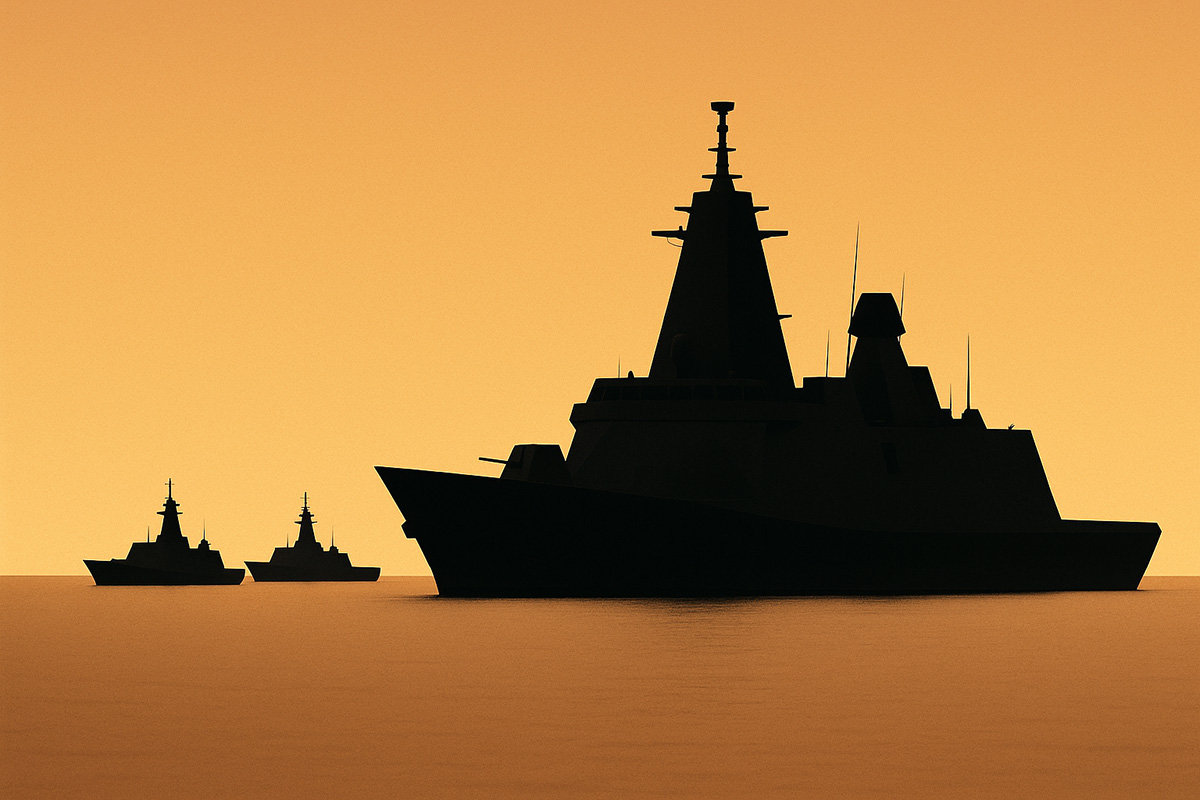
Only around GBP 1 million has been spent on platform-specific design work for the Royal Navy’s planned Type 83 destroyer over the past three financial years, with the Ministry of Defence admitting it inherited the programme as an underdeveloped concept on entering office, the department stated in a written answer to a parliamentary question.
Conservative MP Sir Alec Shelbrooke had asked the Secretary of State for Defence to set out the total spend to date on the Type 83 project, including pre-concept and early concept phases. Minister for Defence Readiness and Industry Luke Pollard’s response indicated that the figures are difficult to disaggregate because Type 83 sits within a wider capability framework.
Pollard said: “We inherited an underdeveloped concept for Type 83 when we took office. The Type 83 Destroyer forms part of a wider Future Air Dominance System (FADS) capability concept, making specific costs for the Type 83 element hard to differentiate from the wider whole.” He continued: “Over the last three financial years, c.£1 million has been spent on platform-specific design for the Type 83. This forms part of c.£6.9 million which is the broader notional spend for Type 83 work as a part of FADS.”
The figures show a programme still very much in its earliest stages, despite the Type 83 having been publicly identified as the future replacement for the Royal Navy’s Type 45 air defence destroyer fleet for several years. The Type 45s entered service from 2009 onward and currently provide the area air defence capability for the carrier strike group, with the class subject to its own significant modernisation programme through the Sea Viper Evolution and Power Improvement Project upgrades. The original timeline indicated Type 83 would begin replacing the six-ship Type 45 force in the late 2030s.
The Future Air Dominance System framework under which Type 83 is being developed is intended to capture not just the next-generation surface combatant but the broader mix of sensors, weapons and command and control capabilities required to deliver fleet air defence in the 2040s and beyond.
The strategic defence review published in June 2025 retained the requirement for a successor to Type 45 within the Royal Navy’s force structure but did not provide a detailed timeline for the Type 83. Royal Navy and industry sources have for some time expressed concern publicly about the pace at which Type 83 has been progressing through its early concept stages, with the relative scale of investment to date offering a measure of how much remains to be done before the programme can move into demonstration.




I’m increasingly coming round to the idea of a T45 batch 2 with all the lessons learnt applied from the start. The hull is big enough to incorporate new tech such as Dragonfire and unscrewed additions. Saves a lot of time and money on a brand new design.
I know the budget is tight but I’d rather we found the cash for screws. I’d hate for a piece of expensive kit to fall overboard just to save the cost of screws.
Don’t you trust Velcro?
Gaffer tape
Out of our price range.
This is the 21c we can use virtual screws.. or special fluids called glue, BAE have been experimenting with this concept of “ a bit of old glue” on Rivers2 boats.
Should be able to build the GRP hull in two parts which can then be joined up with bulkheads and epoxy. I started experimenting with this back in the 60’s. If I remember there was a process called Airfix that worked for me. Maybe the T83’s could be named after Tribes like Chelsea or Tottenham.
I agree. Makes far more sense to build on a known hull, albeit with some inherent faults, but we should know what the problems are surely. Obviously nothing has been done on the T83 and by the time the programme progresses we’ll have managed to waste more money and time as usual.
The Type 45 design process started in 85, its a bit long in the tooth to expect that it can remain competitive in the 2050s. The power requirements for new radars and laser weapons needed to allow the ship to do its job in 30 years time means a bigger hull. The various versions that the USN came up with for the DDX came in around 13000 tons.
The design might be old but everything that goes into it will be new. It will basically be a new ship but far quicker and cheaper to design.
Once more. You can’t physically fit the radars and missiles on the current hull
Which is why the proposed replacement for the Type 45 is a Type 83 and not a Type 46.
Its a design formulated in the 1990s , and even if there was yard space for it, it would be easier to adapt a T26. Bae proposed a VLS array instead of the mission bay. The french added a could of Freda AAW versions of the Fremm line so a small build of T26 enhanced with AAW spec would make more sense and stretch the T45 out as to the latest date possible.
That will leave you zero tonnage to upgrade or add new systems over a projected 30 year life.
I would imagine the T26 would be the most expensive ship to redesign. It is built head to toe to be as quiet as possible, which an air defence destroyer doesn’t need to be. So a lot of extra expense for something it doesn’t need. Whereas the T45 was built to be strong enough for the tall radar masts.
Re starting a 30 year old T45 line would be an even more expensive, still only give 64 cells ( 48 plus the original option of 16 more) and is as some say as noisy as a bag of spanners. At least squeezing 2-4 more T26 plus would get VLS at sea quickly.
You can physically fit a next generation anti ballistic missile radar on a type 26, its not big enough to take that top weight high up.
T45 size don’t work for big ABM’s, you need larger radars and missiles. Need to be 1 bigger or MAYBE you split into 2 ships.
Inclined to agree.
Yes that seems a far better idea. The Type 91 Arsenal ship has come into the frame recently. Multiple manned and unmanned ships seems the way forward.
In plain English,it is just a Concept,nothing more ?.
Well people keep saying conventional stuff is obsolete ( I’m sure it’s not ) so lets make our minds up.
I also keep reading that T45 can carry on for longer as they’ve seen less use than planned? Is that fair? Or falling into the T23 trap?
Even if the FADS is distributed around the T91s or whatever they are called, assume the costs still add up to same as a single manned vessel?
I’m sceptical of the low milage claim. Corrosion happens regardless of how many miles are travelled. The type23s are the lesson in what happens in extending a ship way past it’s design life.
The T23 issue is metal fatigue not corrosion.
Not correct.
It is both.
Metal fatigue because of reduced scantlings due to cheapness.
Corrosion due to the 18yr design life and the lack of early interventions and mid life strip out and blasting of internals which is not possible due to inaccessible spaces due to design and the maintenance manual they were commissioned with.
Both co-add to produce a superbly toxic cocktail.
Possibly and that the integrated radar on quite a few T23s are obsolete and non-functional.
Difficult to fix the corrosion/wear on the T23.
The T45s are much more modular, which helps. As you know, bits can be easily swapped out and replaced upon failure or obsolescence which goes some way to extending service life of the T45s.
The majority of T23s as you have mentioned are flimsy whereas the T45s are built like brick of s’ houses.
The T45 was designed for at least a 30 year service life compared to the T23s original 18 years. So they should be good well into the 2040s.
Building on what Robert says above, the T45s were built for a 30 year service life, compared to an 18 year service life for the T23s. Now, the T23s are making it some 30 years in service, suggesting that similar degrees of LIFEX work ‘could’ extend T45 lifespans past 30-40 years.
Delaying T83 makes some sense.
Yes, seems like an easy saving to make.
The hulls will be ok in 30 years time, the radars less so. There’s only so much extra top weight you can put on the hull.
Is it really so hard to add beam and scale up the T45? This has kind of thing has been going on for centuries; I don’t see a problem. If there is let me know!
Yes seems appropriate. Especially with the upgrades that are planned for T45 in the next few years.
…but we don’t have enough T45s as it is. The RN needs larger cruiser-size ASM-totting ship-killers that can go up against threats in many locations at the same time, and can defend themselves and the fleet when needed.
It would make sense if you trusted T83 to be delivered on the new schedule, but even if they keep the T83 schedule as is, it’ll still run late like all current shipbuilding programs, so what ever they move the new target to, it’ll still be beyond that and that could be problematic with there only being 6 T45, it’s been bad with the T23 when there was atleast 13 to start with.
Daniele, we both know the talk of obsolescence is political, It’s odd they talk about Drones so much but don’t seem to be doing much to introduce them into the Armed Forces or expand GBAD in particular for the Army in particular to defend against them. The options for countering drones are increasing rapidly (if they actually get bought) in the land domain and will likely have the same impact in the Naval domain.
You also have to consider the rules for something like T91 and its equivalents will mean less, no one is going to war with a country for sinking or taking control of an unmanned vessel even in international waters, wouldn’t be the same as if they sunk a manned warship, attrition could be higher due to this.
Hi mate.
Yes, that had occurred to me, some pretext to requisition? Or what happens if the data/comms links get jammed.
It is political, but I read plenty of that crap on websites as well, sadly.
Threshold for taking action lower as well.
Exactly, the technology isn’t there to go to the lengths that would be needed to replace major warships, it’s suitable for using alongside to complement fleets and replace some roles but thinking that we’re in a position to go with unmanned fleets is unrealistic.
Even if you focus fleets on a few key ships with wingmen style drones that travel with it, an enemy will still target the main vessel as priority, then what ?
Once the technology is there those major unmanned ships will be extremely expensive as tech has only increased the cost of vessels, if we were using ww2 era technology still it would be considerably cheaper to rebuild the Navy and add mass, high tech typically has led to less.
The type 45s hull platting is I believe 10-15 mm and the type 23 was 8-12mm.. so that’s about an extra 2-3mm of hull plating. Does not sound a lot but if you think a well looked after steel hulled ocean going vessel losses about 1mm of steel plate thickness every decade.. that 2-3 mm is an extra 20 years of life over a T23 hull, it’s unlikely the T45 hull will become a problem in the 30 or even possibly stretch out to 40 years.
The issue will be systems obsolescence, but the fact the T45s will have all had their power systems ripped out and essentially replaced in the mid 2020s and are all getting a major systems update between 2024-2030 means they will probably be reasonably current until the early to mid 2040s… and those hulls are going to be good for 35 years
Essentially even HMS Daring should have no problem operating out to 2044 and Duncan out to 2048… yes they will cost a bit, but it will be more in line with the US keeping keep the USS Arleigh Burke running till 2031.. 40 years after she was commissioned.
Indeed.
The whole point of upgrading the power systems on the T45s was because they are still useful assets that, with the upgrades, should remain current well into the future.
Have they admitted that the pre 2040 target is never going to happen yet? The better priority in the short term would be to get the existing destroyer fleet into best condition and integrate the latest ASTER variant. If CAMM-MR does make it into RN VLS cells (twin packed?) it would provide some amount of area defence, but not on the same level as ASTER of course. If the mythical Type 32 does end up being a revised Type 31 it will need improved air defence. the iver huitfeldt-class has a long range search radar similar to S1850M, there’s little reason why an Arrowhead 140 family ship couldn’t have it as well.
And if they’re going to keep the T45s going for longer why didn’t they spend a few more quid and put in a pair of mk41s instead of a 24 CAMM farm or, a hybrid mix of both or, even find space for another 24 CAMM in side silos or, on the hangar roof? And add the NSMs instead of wanting to stuff all these extras onto drone ships.
The current and any additional T31s could have their radar and an additional search radar added to increase their AAW abilities. The foward B 40mm could be replaced with 2 mk41s so there’s potential there for a hybrid CAMM farm mk41 mix.
Babcock actually said the front 40mm could fit 3 modules for 24 cells of Mk.41, so even better. That said, with the prevalence of drones a 40mm is such a good way of cheaply destroying them I wonder if it’s worth it
Agree the ship would significantly benefit from having Mk41 fitted in the current B position 40 mount. Fitting MK41 here wouldn’t stop the ship from still having a pair of 40mm guns say amidships. The problem will be if they have a lower deck magazine feed. As this will likely impinge on the boat deck.
Let’s just get this out of the way first, the decision to cut the T45 class from 8 down to 6 was nothing short of incompetence and negligence.
As for T83 Everyone wants more of everything and wants it now, however everyone understands that you can’t do that anytime soon as projects take about 10 years (minimum) to get from concept, to plan, to main gate, build and enter the water.
It all comes down to NEED, WANT and NICE TO HAVE.
Yes we will need a replacement for the T45’s but they are only now getting towards being truly effective AAW assets and TBH they don’t have many miles on the clock.
There are higher priorities right now than additional Naval AAW and that in terms of the Surface Navy means ASW Frigates, GP Frigates, FSS, MROSS and MRSS (an effective CAG for the QE’s).
Which along with the T26 exports, Drones, Dreadnought and SSN(A) in the pipeline means all the Budget is being spent, the suitable yards are all full and the supply chain is ramping up to get everything built.
So unless someone waves a magic wand and expands resource we (A) Can’t physically build any extra AAW vessels, (B) Can’t afford an extra £6/8 Billion to pay for them without cuts elsewhere and (C) once T45 start getting through all the updates we couldn’t crew them and don’t really need them yet anyway.
And although I hate to say this but the other services probably have a higher need for extra resources than the Navy right now. Top of the list has got to be UK GBAD capability, 2 more AEW, 5 P8’s some extra F35 or Typhoons (preferably both) and just about everything in Green for the Army.
But that doesn’t stop a small team working out the concepts and preparing for the eventual need to replace the T45 but please no fewer than 8.
Nothing more needs saying. 👍
Thanks for the summation ABC, I very much agree especially on the need for the airforce and GBAD assets to get priority.
Yup common sense assessment within the limitations we are currently playing with.
I hope you get your 8 fully equipped and ready to go. This fitted for, but not equipped with nonsense has got to stop.
Did’nt realise that biscuits cost so much. 1million could’nt have designed a lot prehaps a fancy acornim.
Seems like a bit of a non-story. £1m spent on the central T83 itself, with a broader £5m spent on FADS concepts.
It disregards the money spent by BAE, Babcock and their associates on developing concepts.
This Dash for Drones will backfire on Us…!
They have their Place but it’s No Replacment for Solid Global Presence…! We Sent The t45 HMS DRAGON ‘Eventually’ to Eastern Med / Gulf … FRANCE And ITALY a fleet Well before us …Can’t Imagine a Drone/s Having Anything like that Impact…!
We’ll just build More Problems for Ourselves Without T83..
Can Someone Please Fix The Caps-Lock Key On NIG’s Keyboard??
SPOCK…! JUST DOING IT FOR THE SHORT SIGHTED VULCAN COMMUNITY..!
And while they’re fixing his keyboard, can they arrange a sense of humour transplant as his current one doesn’t appear to function at all.
How would a vulcanised person Know. What a sense of humour is…??
You can Never get ‘Tyred’ of the old ones..!!
Nothing wrong with the T45 as it has so much wasted internal space for anything it needs to do the job. Poor power train that any future build should have replaced with fleet common gas turbine that we see in Carriers and T26. So as steel is cheap then its what its fitted with that costs the real money. Anyway the T45 have delivered so little to the service to date they could easily continue on into the 40’s allowing time to sort out it’s replacement (if there is still a Navy?).
Could they place MT30s into a t45…??
Yes
My instinct is forget new designs and increase numbers NOW
We spend a lot of the time of warships reinventing themselves – I will not reiterate the many RN escort type ships have been expensively remodelled since the successful Leander class 60’s 70’s
New build Type 31++ which is a large GP adapatable platform if Babcocks can deliver. Also less costly
It would be right to give them on order for 2 now and more later a give continuity of build to Rosyth and hopefully Denmark may place an order
As regards BAE on the Clyde The type 26 is a specialist quiet AS platform and BAE need orders to fill the new Jan Harvey Hall We are still waiting for the official Norwegian order for 5 so maybe less pressure than Rosyth However BAE need continuity
We are also acting like a nation who is losing credibility with their allies and friends leaving our enemies smirking
And wheres the yard space for this coming from?
Babcock have planning permission for a second hall at Rosyth so there is room for more T31s. Glasgow is much tighter.
Yeah because they have work for the new hall, the contract with HHI for the Virginia class. They aren’t going to build new yards unless theres 30 years of work involved to make the investment worthwhile. You can’t handwave away capital costs and the need for a trained workforce.
The new hall is intended to be 149m long, 65m wide and with doors 35m tall. You don’t build that for submarine parts.
It also lines up with the Venturer hall so that modules can be delivered between the two. The planning application statement is at
docs(.)planning(.)org(.)uk/20251218/194/T7DDXKHFFIE00/xuublm2bi0q6ngt2(.)pdf
Guess where RN submarines are fuelled
Look at the document. The new hall is intended to sit on the landward side of the existing Venturer building and Dry Dock no.1. There’s no way it could have anything to do with in-service support of submarines due to its location away from the water and it’s oversized to build new components, which is all Babcock do at Rosyth for submarine construction.
Hint Wikipedia isn’t actually reliable
Have you actually followed the link, with the description of the hall, its location and what it will be used for?
Devonport !
Crikey if only Ministers had your breadth of information, insight and the confidence to deliver it.
I do my best! I’m not as direct in person as over the written word, I tend to think of the best thing to say just after the opportunity passes.
How this T45+ will intercept Iranian anti ship ballistic missiles with 3000km range with several guided warheads in 15 years time?
Just got to hope for more T31+ orders for Rosyth, then they might build the new hall. Got to hope because we need the hull mass no matter what else is said.
Type 31 has good very nice potentials, if given sonar and the 32 mk.41 will make a wonderful frigate. Radar can be upgraded to Thales NS 200 without much issue or maybe FDI sized fixed panels. But it lacks power generation capability for proper destroyer radar.
Still though, I’d like to see another 5 properly equipped ships ordered even if still with NS110
The new first sea lord has spoken against ever more expensive large platforms, stressing a need for distributed systems.
Buying 10000 ton air defence destroyers would seem to have been ruled out.
To regain mass, we need a lean manned mothership commanding unmanned vessels.
Could aT31 derivative be part of the solution? If we are going to fund the unmanned vessels T91, then the core mothership must also be affordable. Buying bigger destroyers plus accompanying optionally manned vessels is going to cost more than replacing T45 on a one for one basis.
The laws of physics dont disappear. You need big heavy radars high up for the ABM role. To take that top weight you need a bigger ship than the type 45 to keep the ship stable. The US DDX comes in at 13,000 tons and the CGX comes in at 20,000 -22,000 tons. There’s no point building a fleet defence AAW ship that can’t defend the fleet
Not going to happen. Totally unaffordable even without accompanying T91s. The idea is to distribute missiles and sensors across connected platforms. How good the sensors on a 2000ton T91 might be, I have no idea.
Perhaps not surprising that the FADS programme remains underdeveloped.
Then there’s no point in building a ship that can’t do its mission. Its either 10,000 tons + or mission incapable
That’s always been said but OTT costs lots and isnt always better. Look at history. We had 4 classes of Line of Battle ships. We had County Class and Cathedral Class Cruisers. all doing essentially the same job in their era.
If you cut out the onboard weapons systems, so are systems, et cetera, and just operate as a radar/C2 asset, you could cut out much of that displacement.
By which point it’s now a defenceless expensive target.
Go the opposite way, the radar and sonar, because let’s face it so now we’ll be required unless we want the type of 26 escorting this thing wherever it goes, will be expensive regardless, so just give it the VLS on the ship to defend itself. It’ll be cheaper than way than sticking everything on separate ships with separate engines and so on.
Then for the supporting vessels something with just some more VLS and maybe a tiny radar to use a 40mm. It’s what Australia is planning on, and Navantia has unveiled a similar ship, though theirs had an optional mid range radar system.
Not at all, because the thing you keep refusing to acknowledge are the presence of those offboard, disaggregated weapons systems and sensors.
Your missiles are still there, they’re just not in the same hull, and are so more response and survivable.
People are practically foaming at the mouth to bankrupt the service building 15,000t super cruisers.
As I’ve said multiple times, a 10,000t hull, with a large radar and small VLS complement, maybe 24, operating with four-five additional LUSVs, achieves the same air defence capability as a cruiser, whilst being far more survivable and responsive.
Not if you have the radar (or rather multiple radars) at 30,000ft using unmanned drones providing 24×7 coverage. Which means the AAW destroyer requires a flat-top and hanger, plus lots of missiles.
CGX was cancelled in 2010 and DDX in 2025.
The drone focus is just Government and Senior Military party line talk to justify not funding defence properly, it’s the current fad to distract people from the funding reality, but as discussed on here so many times, new systems come, they get countered. Consider the level of air defence assets in the Cold War compared to now, if militaries were back at those levels it could be quite a different time for drones considering today’s technology with things like Skyranger, lasers, missiles etc.
If you look at major military nations, most are developing larger Naval assets, the US, Italy, Germany, France, China, others will follow as fleets need replaced. Whilst drones will play a part they’re not the only answer, China and the US in particular are building much bigger ships and want larger numbers and are ahead in terms of drone tech and implementing them, yet still choose to push ahead with these major platforms. T83 will end up being a larger ship once the government is forced to actually commit to the program down the road.
Isn’t a distributed force of drones also going to cost millions and once any mothership is destroyed could they then continue to operate independently and if so how long?
Is the UK just being a bit too overly focused on sea drones at this moment? They don’t do Port visits, humanitarian relief, carry a drcent helo or fly the flag very well. Other navies seem to be adding to their manned fleets now and into the near future and if the UK wants to have to its presence globally it mght be simply “out-shipped” as well as “out-armed” by others in various places if it doesn’t increase it fleet size to fit its ambitions.
This is a false argument. If the conventional cruiser takes a missile, not only do you lose your radar, but all your launch capability as well.
If your mother ship takes a missile, you only lose your radar.
That’s not really retaining mass though.
1 big ship with all its VLS is functional the same in terms of deployable locations as 1 still pretty big ship with the radar and a few smaller ships with the VLS. In fact the latter is probably more expensive as you’ll need multiple engines and so on. The mother ship will need to be pretty large in order to power and mount a good high end radar, and at that point why not just stick on the extra VLS.
Right now there are 2 T26 designs that have a larger emphasis on AAW, the Canadian River class and the Hunter class. Problem seems to be we spend too much time and money on trying to come up with wonder weapons of the future, so by they time they are delivered they are so expensive they are too few and the future we thought we were hedging is the now and concepts have already moved on. You only need to have something better then your adversary or more then them, preferably both. The Sherman and T34 weren’t better then the Tiger but there were more of them they did a reasonable job and were easier to fix. Give Bae the job of delivering 6-8 Hunter/River class T26 then we can use them either to bolster our destroyer numbers back up to 12 or use them to hunt subs or part of a carrier escort, place the orders now then you have time to worry and think about the next gen.
It’s hard to see the government logic in doing so little with T83 now considering we’ve seen this story before with most recent naval projects. Even starting the program properly now, it’s unlikely such large complex ships will be delivered on time, even if T45 can be extended, the new target dates will still be missed looking at T26 and 31 programs. MRSS isn’t even properly on the board and ships are leaving service like with T23, MRSS replacement is barely discussed let alone being designed fully.
At this point it seems it would be smart to work more closely with the Italians, they have a strong and sensible ship building industry and successfully iterate designs and get good value for money. They prepare programs at the necessary rate to deliver and keep capacity for foreign orders, which further benefits the industry without costing their navy, unlike T26 program which will have a cost to the navy in terms of delivery schedules.
Currently the Italians are working on a new destroyer hull (14000T range) design which they believe is the size necessary now, they typically don’t go for excess so this seems reasonable and after all the messing around it is where T83 will end up. They’re also working a smaller LPD/LXD which seems to be inline what the MOD had originally been looking for when 6x MRSS were announced a few years ago, this could fit the MRSS need and actually get that project moving again and allow for six for the Royal Navy if procurement between the U.K. and Italy can keep costs down.
Whilst the U.K. is capable of designing ships itself, the government approach to keep pushing projects to the right, ends up leaving us with no ships. At this rate the ship yards will also be without work again and T83 will be to far behind to start build when needed by the yards. Working with other countries who get on with design and work out the issues could benefit the U.K. when design work isn’t funded properly. The U.K. Government approach to defence isn’t changing much beyond rhetoric and having partners is likely the only reason GCAP is continuing at the moment.
Let’s seriously look at what is really needed.
First Numbers, what does the RN and UK need a high end AAW assets for missions wise
1) it should really have 2 T45 equivalent ships for a carrier battle group.. 2 is the minimum even with modern systems.. in the 1960s the RN wanted 4 T82s per carrier battle group.. the T45 is more than 4 times more effective than a T82, but it’s only got the same number of missiles as a T82 and if it suffers a failure or damage and you only have 1 your fucked.
2) any amphibious group should have 1 T45 for its air defence.. sticking 1000 troops in a couple of MRSS and not giving them a AAW destroyer and sending them in harms way would be insane.
3) the RN probably wants to be able to generate a single deployment of an AAW destroyer.. for things like the Middle East etc
That means the RN needs to be able to regularly generate 3 T45s and 4 at surge.. so six AAW ships was always stupid.. on the rule of three it should have had 9
So that’s what it needs a final AAW destroyer total of 9
It needs to be able to defend the carrier and an amphibious group against ballistic missiles and have a depth of missiles… but do all 9 ships have to be very high end high capacity platforms ? After all the new very high end AAW platforms are coming out at 13-15,000 tons. Could it say have a CBG with 1 very high end 13-15,000 ton destroyer and 1 T45 analog… so maybe 3 very large “heavy” destoyers and 6 T45 direct replacements ( 6000-7000 ton AAW frigates/destoyers)
As for the T45s they can probably keep going as that second line AAW destroyer into the late 2040s because:
The type 45s hull platting is I believe 10-15 mm, when you consider the type 23 was only 8-12mm.. so that’s about an extra 2-3mm of hull plating. Does not sound a lot but if you think a well looked after steel hulled ocean going vessel losses about 1mm of steel plate thickness every decade.. that 2-3 mm is an extra 20 years of life over a T23 hull, it’s unlikely the T45 hull will become a problem in the 35 or even possibly stretch out to 40 years.
The issue will be systems obsolescence, but the fact the T45s will have all had their power systems ripped out and essentially replaced in the mid 2020s and are all getting a major systems update between 2024-2030, there are even plans to update them to Aster 30 NT in the 2032-35 period this means they will probably be reasonably current until the mid 2040s… and those hulls are going to be good for 35 years
Essentially even HMS Daring should have no problem operating out to 2044 or even a bit longer and Duncan out to 2048-2050… yes they will cost a bit, but it will be more in line with the US keeping keep the USS Arleigh Burke running till 2031.. 40 years after she was commissioned.
So for me build 3 T83s the biggest and best AAW platforms we can.. the equivalent to the new planned Italian and Japanese heavy destroyers.. get them for the early 2040s…then in the mid 2040s replace the 6 T45s with 6 more moderate 6000-7000 ton AAW frigates
Do you need two T83 to a CSG, if you operate a swarm of LUSVs, and ensure that your carrier has a back-up radar suite in case of failure onboard the T83?
Major amphibious ship deployments are probably not going to be a regular thing going forward, and will probably be expected to bounce between clusters of forward deployed platforms, rather than having their own manned escorts, during peacetime.
Expanded LUSV operations could attach air defence depth to any ship in the fleet if required.
Suddenly, a requirement for nine destroyers drops back to six. We have to make do with what is available. Money for expanded manned fleets isn’t.
At the end of the day even if you have an LUSV swarm.. you need a back up to your AAW screen command and control and major radar… distributed sensors can or replace the very high end, high power large aperture radar.. and you still really want 2 ships that can do that.. any old swarm missile can put a hole in your single very high end radar.
In the end this is where the LUSV concept hits its limits.. it great for mass it cannot replace very high end capability..
So yes building a shed load of 2000-3000 ton LUSVs and manybe give them a command and constabulary crew of 10-20.. allows you to replace and remove all your patrol frigates, patrol boats, mine warfare ships and even some of you mid capability escorts.. but you still must have appropriate numbers of high end AAW and high end ASW… they can make those AAW assets and ASW assests far more effective.. but more effective cannot reduce numbers below a minimum threshold..
Now you can look at what the Italians are doing.. Trieste as a carrier/amphib has an ultra high end sensor set up that puts most high end AAW destroyers to shame and will probably at some point be equipped with 16 Aster 30 NT missiles… also every single one of its total planned 21 high end escorts will have aster 30 or NT with about 14 of those escorts having radars that can Track and engage ballistic missiles and would not shame a AAW destroyer.. so because of this the Italians only need their 2 horizons and 2 new heavy destroyers.. essentially their 17 frigates and 2 carriers can all act as AAW destroyer replacements.. but with low munition counts.. 16 missiles each instead of 48+ but each and every Italian warship has a 76mm or 2 armed with Dart guided munitions… which replaces the need for short range air defence missiles…
The problem is the RN has not build for that… it’s frigates have self defence or at best short range area defence and no ballistic missile defence and limited radar.. so essentially the planned 13 frigates don’t add anything beyond within 25km anti air breathing capability. The carriers and amphibious vessel are not even really able to proved limited self defence. This means everything from high end sensors and all long range effector’s for air breathers and ballistic missiles have to come from AAW destroyers.. yes some of the effectors could be spread to LUSVs.. but present and for t foreseeable all high end long range effectors ( Aster and standards ) are very maintainence heavy and need to be on crewed platforms..
Also the RN are not going to be in a position retro fit RN frigates with the level of sensors Italy has on its frigates, even if it can put long range effectors ( Aster 30) in their mark 41 silos.. this means the RN must have more AAW destroyers than Italy or even France for the same effect.
So I think it’s going to have to build itself 9 AAW ships.. even if only 3 are very high end… as for money.. we are not talking to about starting the second 6 smaller vessels until the late 2030s early 2040s and there is no reason they could not be based around say T31 hulls for cheap ( the T31s mummy was an AAW vessel and it has the plumbing for a second radar)…
Of course, and I go into a little more detail in a large post below, but the carrier itself is well-equipped to support air defence operations controlled by its own radar suite. If the T83 enters service and replaces the T45, replacing the radar suite onboard the carriers is a smart choice that increases capability, and increases the order for the respective T83 radars.
You’re definitely correct in saying that you’ll want a back-up, and that disaggregated sensors cannot compete with centralised sensors for power, range and resolution at distance. But, with a single destroyer, and a second radar set on your carrier itself, you now have equivalent sensor depth to the current UKCSG ‘ideal composition’.
I think this is where my personal vision differs from the drone purists, in that I acknowledge the need for high-end manned sensor capability. But, at the same time, high-end shooter capability is not large-hull reliant. You mention maintenance standards, but that’s a far more tackleable issue.
I mention it a little more below, if you’ve got a spare minute or two perhaps you could take a look at that comment? If not dw.
My critique with that attitude however will be that it makes the carriers even more of a focus point. With 2 Type 83 in a CSG even if a hole is put in the flight deck or through one of the islands the group as a whole still has two very capable ships with large magazines and excellent systems.
If you remove one of those and something happens to the carrier then you are now solely relying on a single destroyer to provide all of the defense against any high-end missiles because let’s be completely real here, Artisan and NS110 are not doing anything against a good ballistic or hypersonic missile.
And on the flipside if something happens to that one destroyer then the remaining escorts will likely be frigates which given our attitude of frigates will only be carrying some CAMM and maybe CAMM-MR which are completely inadequate against ballistic missiles and hypersonic missiles and so the carrier will now easily be sunk and we’ve lost both of them.
The carrier will always be the focus point of an attack against a CSG, because without the carrier, every other asset becomes exponentially less dangerous and less capable of self-defence.
As it stands, the established UKCSG – one carrier, two destroyers, two frigates – operates the same amount of main air defence radars (SAMPSON) as the proposed future CSG does. This idea just shifts one of those radars of a destroyer and onto the carrier, replacing the Artisan and S1850M there currently.
So now, you actually have the same amount of radars as before.
Also, you ignore that advances in radar that will occur.
This is approximately my line of thought too. We need at an absolute minimum 4 BMD-capable, high capability ‘cruisers’ (to distinguish from direct T45 replacement) to rotate two through each CSG (assuming design and infrastructure allows the same availability as the carriers). That can be backed up with as many T31 AAW as we can afford with greatly uprated diesel generators, or even an MT30 genset if Babcock can rearrange the intakes, and a downscaled version of the same radar.
But your point around the relative weakness of RN frigates in AAW may not be valid for the period in which T83 will serve. BAE are working on their Next-Gen Transmit Receive Module as a scalable radar, and indeed the only detailed concept we have that is based on it is the Artisan NG demonstrator, which will fit on a T26 mast but be vastly more capable. So around the time T83 enters service RN frigates will gain the ability to effectively use longer-ranged missiles like CAMM-MR or Aster-30 just as Italian and French escorts can.
There is also work being done on the ability of USVs to carry large missiles. I can’t speak for Aster itself but there is an RFI out for missile silos (VLS) designed for air defence which can be left unattended aboard USVs for extended periods of time and can fire on successive occasions without needing checks in between. It’s the first result if you search “IAMD RFI MoD”, at least for me.
Running 2 destroyer programs concurrently will be more expensive than just picking one.
The lesser destroyer won’t be providing any benefit beyond just having extra VLS cells as it’s weaker radar will be surpassed by the Type 83, and if just doing that cheaper frigates or a VLS only “slave ship” to the destroyer will be cheaper.
We now have 2 warship lines so production of 2 ship types is actually easy.. we are producing 2 frigate types.
As for having a lesser AAW ship, A lot of nations run multiple types of AAW escorts at high and lower capabilities, for instance the Japanese running the Akizuki-class as a basic 6000-7000 anti air breathing defence destroyer.. that is actually designed to go down the threat axis and protect the larger and more capable Konga class destroyers.. which are designed to manage the ABM and hypersonic threats.
The Chinese have two levels of AAW destroyers as well..
Italy runs two levels of AAW destroyers..
Hi Jonathan, As usual a well thought out and informative post, I do however wonder if the longevity of the T45, T26 and T31 won’t be so finite if the repair / maintenance facilities were fit for purpose.
Right now we are spending the “Kings Ransom” on renewing pretty well the entire DNE from supply chain to decommissioning and all parts in between, it’s way overdue and quite frankly we wouldn’t. Be in the mess we are if it had been kept updated on a rolling schedule.
IMHO once the present projects are completed we should give very serious thought to building 2 covered Triple Frigate Destroyer Maintenance Facilities one at Pompey and one at Guzz.
The other unknown and I’d post this as a question is “now that RN ships post T45 are all CAD designed, steelwork done on automated lines and assembled into modules / block builds what could upgrades and major hull work look like in 10 years time ?”
Could it be as simple as replanting the relevant section again and replacing ir ?
To me this is just Dan Jarvis saying I just got here – this is everyone else’s fault.
Trouble is that what is important is the decisions we make now. We need additional destroyers now. It doesn’t matter that we should have had them decades ago.
We need to be able to the build ships (and drones) rapidly to bulk up the Royal Navy. If insufficient work has been done – get on with it now. Today.
No point in talking about what we might need in twenty years. Build now as fast as practically possible.
And where are these ships going to be built given the current demands of two active frigate lines and the submarine, let alone the question of what design, or the fact that the RN still has issues with crewing numbers.
We are where we are.
There are as you suggest many issues but the whole point of the UK investing again in the military is that we resolve those issues.
Can’t isn’t really an options.
Okay, T83 is an odd one.
Modern air defence combatants are ever larger. The Chinese are operating 11,000t cruiser, the Italians are building 14,000t destroyers, the Americans are proceeding with both a 11,000-15000t destroyer and a 25,000-28,000t cruiser and the Indians are designing 13,000t destroyers. The Japanese are building 15,000-20,000t cruisers. The impression that many now have is that air defence ships must be ever larger, more expensive and more concentrated manifestations of fleet air defence.
Yet, this is not the only case. The Dutch and the Germans as also pursuing next-generation air defence assets. The Germans are pushing for a 12,000t frigate, and the Dutch have shown off a roughly 10,000t concept. The Royal Navy has suggested that T83 will be roughly 10,000t.
Now, these three nations are all openly pursuing the large unmanned surface vessel (LUSV) as a method of bolstering air defence capacity. The only disaggregated part of a modern air defence ship that requires a large hull is the radar. Missile launch systems can be disaggregated, and attached to a fleet of escorts-for-escorts (LUSV). Similarly, sonar systems can also be disaggregated and distributed amongst LUSVs.
Imagine the central T83 that would result from a strong investment in LUSV fleets. A medium-large hull, equipped with a significant radar system and equivalent power generation capability, but lacking sonar and extensive weapons systems. A good analogue might be something akin to the Canadian River-class destroyer, though without the HMS and TAS/VDS, and without extensive sonic hygiene measures. A small 24-cell VLS for self-defence, a 127mm or better, a 57mm, main gun, SPY-7 or Artisan NG fixed-face variants.
Now, this option is cheaper, easier to build, easier to man than larger cruisers. It also makes use of FFBNW practices (yes, I know it’s a forbidden phrase) as a fall-back. By losing the mission module in the centre, the space can be reserved for additional ‘drop-in’ VLS modules if the LUSV model is ultimately a failure, whilst being cheaper to build.
By disaggregating firepower, you also gain the ability to rapidly boost the air defence mass of any individual warship or auxiliary if required. For example, a fleet of 30 LUSV, assuming maybe 15 active at any one time, could attach four to a CSG, and two each to five frigates, and one to an amphibious ship if required. A T31 in the Gulf or Red Sea is now no longer limited in the amount of time it can spend defending merchant shipping. Should your LUSV run dry, your T31 simply attaches to a reserve LUSV and continues the fight.
The ‘grey zone’ issues of the Hybrid Navy are not particularly relevant here, because air defence assets of this type naturally remain close to the ‘escortee’, and are therefore shielded by the presence of that warship.
God I love this site. 😁
The decision that needs to be made is whether we want a BMD radar. If we do then, going by the example of the Arleigh Burke FltIIIs being grossly overweight, we will struggle to keep T83 below 12,000t unless BAE pull off some wizardry with the miniaturisation and power density of their new radar panels.
If we are willing to accept less sensitive radar, or rotating rather than fixed panels, we will be able to have a smaller ship but CSG defence will be a lot more difficult as radar power is inseparable from platform size.
I think that to decide what kind of radar you want to operate, you first need to decide what calibre of BMD you want to be able to do. Comparisons to the American ABs (and future ships) are a little scuffed, because those ships are intended for homeland ballistic missile defence in the terminal phase, and therefore need to be able to cope with ICBM warheads and the like.
Now, the T45 is pushed into the homeland defence role, mostly because we have nothing else to do the job, but at its core, it’s a fleet-level air defence asset. That’s to say, it was designed to throw a 30km air defence bubble around the carrier, auxiliaries and the two frigates.
If the RN acknowledges that the T83 does not need to be a homeland defence asset, and is instead dedicated to fleet-level BMD/HMD, then your radar needs to be big, but not so big as to require a cruiser sized solution.
I’d also add that the ABs have a full sonar suite, dual helicopter hangar and a 96-cell VLS. You could lose all of those on a T83 if required (save maybe some 24 VLS cells).
Dual helicopter hangar might be handy for ASaC Proteus in future, you never know. Not worth eliminating from the design as they can usually fit around VLS silos amidships, or perhaps a large central hangar with a split silo on either side.
I’ve never understood references to T45 as a homeland defence asset, the government occasionally disingenuously refers to them when an MP asks about missile defences but as far as I know they have never served in that role even in exercises. The RN would do well to push whichever CMS, missile and radar are chosen for FADS as a homeland defence asset as well to spread costs, that’s the sort of thing that gets prevented by pointless infighting.
As per the RAN fitting CEFAR to the Hunter Class – the weight ballooned to nigh on 10,000 tonnes, and here’s the RN casting eyes at CEFAR as the T83 radar de jour on a small hull. 🤔
Big radars need power, lots if power, as will the next geberation ig directed energy weapons – many megawatts – lots if power = big ship.
A baseline for propulsion to get the numbers to add up? The propulsion system of CVF carrier in a cruiser sized hull.
We will have to accept BMD radar, even the most expensive ballistic missiles or hypersonic missiles are still vastly cheaper than even a mid-range ship. If we don’t give it the good right up then it will just be sunk quickly in combat and we will then have to cope with rebuilding the entire thing over again which we far more expensive than if we just gave it the BMD radar to start with.
Please do explain to me how building all of the same equipment, weapons, radar, sonar, the lot, but now having to stick it across multiple ships with multiple engines is cheaper than just one engine. Just because it’s got the fancy drone tag on it doesn’t make it automatically cheaper.
Now I do support a small arsenal ship, 32 VLS, but it should be there to bolster the ships defences, not to bring it up to the bare minimum because we couldn’t be bothered to stick the required VLS on it to begin with.
It’s not in total. It is individually though, and the Treasury functions on individual funding units.
If you want a massive, all-singing, all-dancing cruiser, you’re not getting six of them. You might get two, three if you’re lucky.
Given how both warfare and technology have changed so dramatically over the last-four years the chances of correctly guessing what the main AAW warship of the mid-2030s look slim. While it’s tempting to just build a bigger and better Type 45 Mark 2, it might be the historical equivalent of building battleships at the end of WW2…
Will it be a single big ship?
Or will it be medium sized with a flotilla of supporting drone vessels encircling its horizon to extend its sensor range?
Will it feature an even taller radar mast to increase its range? Or will it feature a large aviation deck to accommodate large autonomous drones giving 7×24 airborne radar coverage from 30,000ft?
Will it have a modest weapons fit-out with it firing air-defence missiles from accompanying arsenal ships? Or will it be electrically overpowered to drive large numbers of EM, DE, and laser weapons?
I don’t envy anyone the task of getting this right…
Yeah, it’s a tough one. The only two certainties are that it’ll need loads of space, and loads of power generation.
Where would these fit in a “1000 Ship Navy” ?
How do they fit with the latest “Everything needs to be a Drone” thinking ?
Where will all the money come from ?
Do the powers that be ever read this comments section and take notice ?
We’ll get one and have a 1.000 ship navy 🙂
The powers that be can read!!?
😀
There is no Type 83, it has never moved beyond some BAE power points and some very broad brush scoping RN documents.
The RN doesn’t know what it wants, refuses to accept that the next generation Air Defense ships will need to be 12,000 tonne Cruisers, and keeps on fiddling with talking shop sheet of A4 paper conceptualization documents to avoid this harsh truth.
It’ll need to be at least 10,000t, but whether cruiser-level armament is required is less clear. FFBNW could the RN’s friend going forward.
The lesson of the last 50 years is FFBNW invariable means – never gets fitted, or when it does, it costs 2-3x more than building it in from the start.
At a basic baseline, I’d want a 57mm gun, 120 missiles, a big phased array radar, a proper sonar, twin hanger – and lots of spare generation capacity. That’s going to need the CVF power plant fitted into a surface combatant hull, it’s gotta be big.
The DDX programme is running into problems with legislators concerned about rising costs. At $4.4b per ship,twice that of the latest AB, the USN ambition for increased hull numbers can’t be met.
The RN has been rightly criticized for lack of numbers. Replacing T45 with something far larger and more expensive is more likely to reduce numbers than increase them.
Correction DDX is the Italian one, USN one is DDG(X)
Google ‘Rogue, unmanned Rattler’ to see how well the ‘Hybrid navy’ concpet is developing, we are ‘screwed’.
Perhaps we dont need a replacement for T45 in its current format, if we break down the requirements for an AAD I would suggest virtually any big ship could do it
1. Great radar for BMD AAD (this needs height, mass and loads of energy)
2. Lots of VLS (really 128 now – containerised?)
3. Ability to keep up with a carrier group (unto 28 knots)
4. advanced CnC /5CISTAR capabilities inc CEC or similar (containerised?)
5. Ability to defend itself (2-4 Bofors 57mm, CTA40 and /or lasers)
We dont actually need it to be in a destroyer format – if we use the proposed MRSS as a base platform and scope it properly I am sure it would be fit for purpose, especially if we have unmanned picket ships with VLS – we could reduce the VLS in the mother vessel.
Just steal the hunter class designs. Put the VLS plug, amidships the Bae showcased and take out the silencers/ vibration stuff. Type 32 should be modernised Absolom for strike ship concept. Done and Fanny’s your aunt, etc
T45 can’t be ‘upgraded’ with a new radar.
SAMPSON was a clever fix to get a scanning array without the topweight and power draw of multiple panels, but there’s only so much power you can push through two small back to back arrays. SAMSON isn’t a terribly high power radar. It’s clever for it’s time, but modern radars are leaving it long behind.
SPY-6, were it’s at, requires 10MW of power to do its stuff – that’s the entire generation capacity of a PIP T45, and even an Arleigh Burke had to fit cut down arrays to deal with the ferocious topweight.
So how do the AB’s generate the 10MW needed ?.
Larger generation capacity overall.
And now they are properly maxed out.
Worth noting DDG(X) would be able to generate 50% of excess power over that its systems use.
Yep the reason Italy is building a 14,000 ton hull for its next AAW destroyer is that for the very best next generation radar..
I honestly think HMG are trying to kid themselves if they think they are getting an all singing all dancing Destroyer that can manage hypersonic as well as medium range Ballistic missiles without breaching the 10,000 ton mark…
Yes you can get a great anti a
Air breather platform that can manage short range ballistics in the 7000 ton range…
So I honestly think the RN is going to need to go 2 tier with its AAW fleet.. a very small number of bigger very high end manage everything platforms and another set focused on Air breathe AAW.
The RNs current ‘distributed lethality’ fantasy only works if the other side plays too.
If your small ‘off board weapons systems’ warship meets a real warship packing hundreds of anti ship and anti air missiles – hilarity does not ensue.
The current 1SL is a Royal Marine – he thinks small units making a whole, but that not how navies fight.
All too often actions are two ships slugging it out to the death – a game were ships need to be lethal abd able to stand and fight, not say ‘ no, not today, my USVs are busy elsewhere’.
Can’t help thinking MARCAP is just waiting him out so they can get a new naval 1SL not peddling land fantasies, and real thinking will start then.
Hang on, you’re distorting the concept.
The small missile ship (LUSV) is not independently slugging it out with a T055, it’s performing that mission in concert with a central manned vessel and multiple other drones.
So, if your central ship (CCV) has 24 cells, and each of your four LUSVs have 24-32 cells, then you have firepower greater than that of the T055 and similar to a Tico, in a more survivable package, that degrades more gracefully under pressure.
Additionally, if you receive intelligence that the threat requires a greater defensive depth, you can then task a further two or three LASVs to the group to immediately boost firepower, which is of course not an option on a conventional combatant.
After all, it takes one missile to flatten combat capability on a large cruiser. If that one missile is directed at a hybrid air defence group, there’s no guarantee of damage on the CCV.
The small missile ship (LUSV) – you can’t get big ABM missiles in a typical LUSV, you probably need 3000t including CAMM and guns for self defence.
And about ASW?
You absolutely can get strike length cells on an LUSV. That’s a silly argument.
As for ASW, in a CSG, it’s the same as usual – the two T26 cover the other ships in the group with the assistance of their own dedicated LUSVs.
In a solo deployment, the T83 would bring with it its own ASW-orientated LUSVs.
HMG are trying to kid themselves if they think they are getting an all singing all dancing Destroyer that can manage hypersonic as well as medium range Ballistic missiles without breaching the 10,000 ton mark…
Bot.