

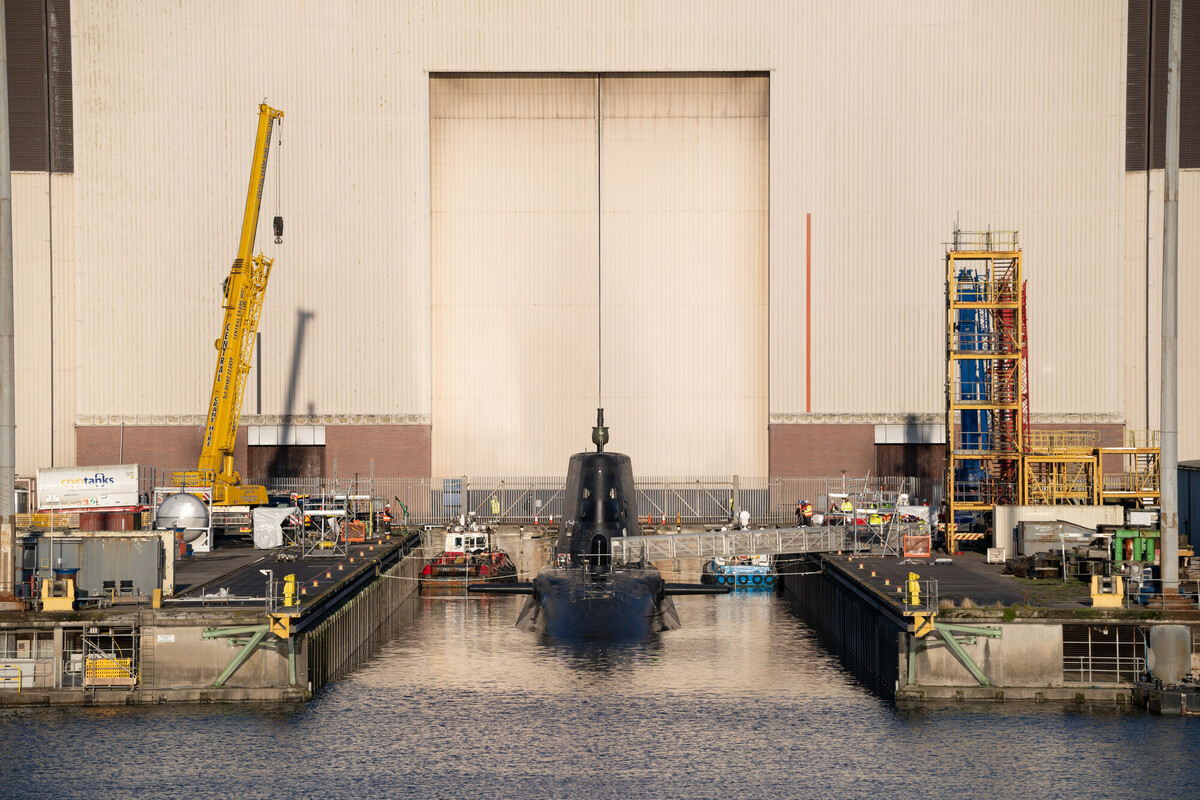
Cumbria Police closed Michaelson Road Bridge in Barrow-in-Furness on Thursday morning, working in collaboration with BAE Systems, and told residents a further message would be published once the crossing reopened.
The force confirmed the closure at 9am and said the bridge would remain shut while the operation was carried out. An updated statement issued later said: “Michaelson Road Bridge has now reopened. Thank you for your patience.” The closure ran until around 11.40am.
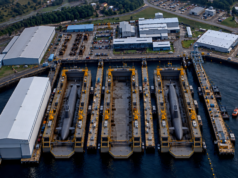
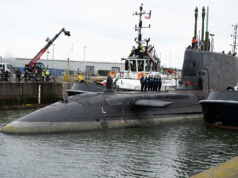
The UK Defence Journal understands that the operation covered the departure of a submarine from the yard, and that the boat involved was HMS Agamemnon, the sixth of the Astute class, with people gathering along the dockside to watch her leave.
Agamemnon was commissioned into the Royal Navy on 22 September last year at a ceremony in Devonshire Dock Hall attended by the King. Around 500 guests were present, and on the same day the King conferred Royal Port status on the town while steel was cut for HMS King George VI, the fourth and final Dreadnought-class submarine.
She completed a three-day trim dive shortly after commissioning, submerging to around 15 metres to confirm the integrity of the pressure hull and to establish her centre of gravity, with crew and engineers moving 16 tonnes of lead weights around the boat to simulate different loading conditions.
Steel was cut for Agamemnon in July 2013 and she was launched in October 2024, making her construction the longest of any nuclear submarine built for the Royal Navy, a delay attributed variously to the pandemic, the diversion of resources to begin the Dreadnought programme and the complexity of the Astute design.
Michaelson Road Bridge carries traffic across the entrance to Devonshire Dock, and closures of this kind are a familiar feature of submarine movements at the yard, with the bridge having to be swung clear before a boat of that size can pass out into Walney Channel.
At 7,400 tonnes and 97 metres, the Astute class carries Spearfish heavyweight torpedoes and Tomahawk Block IV land attack missiles, and the boats protect the deterrent submarines and the carrier strike group while also conducting surveillance and intelligence work. Seven were ordered, with the final submarine still under construction in the same hall.
Barrow remains the only facility in the United Kingdom with the infrastructure, site licence and resources to design and build British nuclear submarines, and the Defence Nuclear Enterprise annual update to Parliament published this month recorded that the workforce there has grown by more than 1,800 under the current government.
The yard is also preparing for the programmes that follow, with steel due to be cut on the first British SSN-AUKUS submarine in 2027 and the concept design completed earlier this year for SMITE2, a new submarine propulsion testing facility at the site.



Good news now get her out to sea for commission and get her ready for tasking.
She’s already commissioned, over a year ago. Mental how long it took her to get to sea trials.
Got to speed up this process of building, commissioning and getting through sea trials. If not then radical rethink required.
Nuclear submarines are the most complex engineering projects on the planet. More complex than anything that has been put into space. It has to be done properly. A change in manufacturing pace is coming with AUKUS, but getting a nuclear submarine ready for sea is not something to be rushed.
It’s fine- expediently cutting corners when building and testing a nuclear-powered metal tin that needs to withstand 1400 ft of seawater pressure. What could possibly go wrong?
Trafalgar Class 25 April 1979 laid 27 May 1983 commissioned. 4 years and first in the class boat.
Maybe its the modern computers that delay everything…
it is but its also the modern computers that make everything so capable.
Oh, you took seriously my boutade…
UK is now a society of processes not of results.
While they have the bridge up couldn’t they move in a couple of the existing Astutes fix them up and get them back to sea.
Over simplified but I’m sure people get my meaning.
Nah, they can’t get the boats safely back into Barrow.
As someone once explained it either here or on Navy Lookout, the site is only allowed to have one live nuclear reactor on site at a time. Even beyond what the fire did, Agamemnon would have been delaying Achilles getting out the door because her reactor couldn’t be fueled/made live until Agamemnon was gone.
Ok. That makes sense.
Real question, what’s the logic behind that? The reactor is either safe, or it’s not surely?
You have the Swiss Cheese model of safety protocols, which basically involves acknowledging that there will always be potential holes in safety precautions. As a result, you attempt to ensure that those holes never line up (thus leading to an accident).
In this example, one way of preventing those holes from lining up is to not have multiple reactors in the facility.
Yup. Additionally, there is the issue raised in the drydock thread. You want to have safety equipment to maintain the reactor once it goes critical—diesel generators to spin the cooling pumps, etc. Does Barrow-in-Furness have multiple sets of that equipment? Do they have multiple shoreside ‘hookups’ to tie in multiple subs? That would also be a reason not to allow more than one reactor on the cert—not enough emergency equipment to keep the reactors safe.
Local Water Temperatures I’m Informed..
One more to go. Unbelievable how long the Astute programme has taken. First steel cut in 2001, almost 30 years when the last boat is operational.
Much of the time has been spent reconstituting the workforce. This is the result of letting thousands of experienced hands walk out the door. You don’t get them back, and the new hands have to relearn all the unpleasant lessons the old farts figured out.
13 years for an SSN.
Hi Daniele,
Most likely contractual / spend rate.
It was pointed out on the equivalent Navy Lookout thread that the early boats took 7 years and the later boats that were ordered during austerity took 13 years… Not all of that can be explained by COVID.
A while ago I caught a clip of an interview, I think by the BBC, with a retired Treasury mandarin who quite bluntly admitted that the Treasury ‘resented’ anything spent on the defence. It still gets my blood pressure rising when I think about now!
So throw in Cameron and Osbourne and their austerity drive and I sense the Treasury gleefully exploited the opportunity to slash and burn the MoD’s budget and with the MoD providing ample excuses for with their over optimistic assessments, poor project management and inability to make their b****y minds up and you get the perfect set of conditions for some clever Treasury maneuvers to slow down spend rates. Set out the spend rate in the contract which you lock down in as much detail as possible and its job done.
Obviously, more to it than that but I am increasingly convinced that the delays we have experienced are as much by design as misfortune especially as the first boats were completed in about half the time!
Cheers CR
Thanks mate. Agree, much is by design! HMG are all words and excuses, I despise the lot of them when it comes to Defence.
The work had to be spread out as boat 8 was cancelled.
The design has been changed as well – there are really three different models Astute – next three – last three. All a bit different.
If she’d and here Sisters been built in say 6 yrs there would be an Enormous skills Gap until the Dreadnoughts were begun..!
Problem of having only 7 SSNs and 4 SSBNs9..!
Barrow really does need 16 nuke Navy to maintain the Skills properly and Efficiently…!
They did have a pretty enormous problem from the financial crisis to sort out. People forget the problems of the day and are just quick to blame the treasury as all evil. People on here have harsh words, but have never had any experience of what’s involved in running the state. Balancing the books, and making incredibly difficult calls that affect millions of people.
13 years… not what you would call good…
Well that’s one of our SSN’s at sea I suppose. Maybe someone can give an update on the languishing rest.
Sure, I can 🙂
Astute won’t be back for a couple of years (MLU).
Ambush will take the best part of a decade to return to sea (stripped for parts).
Artful is supposed to be back this year/early next year (end of a maintenance period).
Audacious is likely the next one back, probably later this year (out of drydock, preparing for work-up).
Anson might be back soon, but I’d guess next year (maintenance following 5 month deployment).
Agamemnon will be ready for operations in late 2027 (sea trials).
Achilles will be ready for operations in 2028/29 (construction).
Thanks Leh. Informative.
And somewhat depressing. The ‘stripped for parts’ thing drives me straight up the wall. Navies/militaries of the world, stop doing this!
But on the bright side it does mean the nose is essentially factory fresh even though it’s over 10 years old.. it does mean a lot of the astutes reactors will still be good in the late 40s
The Iran war has highlighted the issue for the US also. Not having proper supplies in storage to be used when a war breaks out heavily limits your ability to fight said war.
I highly doubt we could rush repairs and fully arm the fleet if needed and even if we could we would be out of stocks to do any reload / mid conflict repairs.
That cant be right, I listened to Trumps one man comedy act at the UN on Tuesday.
“The Iranians say we have run out of missiles, they are wrong, we have many thousands more, so many we could never use them all, were going to utterly destroy Iran”, repeat twice and add long Cuba rant.
Yep and everything trump says is true. They were just letting missiles /drones hit the US bases without firing counter battery fire because they didn’t want to.
Thats right Steve, but it never actually happened, CNN lies, America has never been so well off, never had lower unemployment and been more powerful etc, etc,etc, something about eradicating Cuba rant, rant, rant..
Yes this is a man who thought he could simply ban the ‘bad press’ from the WH because the new woman in his life riles him up about their negativity only to find the disaster that happens when you try to replace them with a hastily gurgitated Trump TV or is it Trumpton, difficult to tell the difference, only to find in 3 days a barely discernible audience shrinks by three quarters and a judge tells you it’s illegal under the 1st Amendment having prepared no evidence to support otherwise and as you need them to cover your ‘biggest ever’ red carpet visit by a Chinese leader you have to taco and let them back in.
So as we see everything is under control and going swimmingly across the pond and the President as usual totally up to speed with his focused decision making and we are safe in assuming everything he says is clearly well thought out and undeniably believable.
I came back from my office on Tuesday and ended up sitting and watching all of Trump’s UN rant, I was like a moth drawn to the flame, oddly compulsive viewing.
Imagine bringing President Bush Senior (the last true gentleman President and real Statesman) to watch this comedy act, he would be both appalled and horrified in equal measure.
The man is single handedly turning America into a laughing stock.
Note, Militaries/navies of the world does include the US. Not sure why you had to call that out.
Just the US is a special case, everyone assumes with their massive budget that they have endless resource /capability.
As I once said on a thread involving the Chinese Navy (PLAN), money isn’t infinite. Even the richest man has a budget.
Got to hope ( fat chance) that lessons have been learnt from stripping Ambush of parts that lead to reassessed spare parts lists required for the remaining fleet to be maintained going forward. Manufacturing should be contracted or legally required to maintain a parts stock production line for the lifetime of the vessel.
Hi Leh, what parts do they strip from a nuclear submarine that still has an active reactor? How do they get the parts of a boat with small hatches if they haven’t cut a hole in the side?
There is a LOT that can be stripped off a boat that will render her unseaworthy and unable to participate in active combat without getting anywhere near the reactor. If I take the anchor from your boat and put it on mine, would you go to sea in that boat? The engine is still there, but if you need to park the boat, you can’t.
Typical things to have removed: Electronic components of the combat/weapon system. This is seen a lot across the world. Steal the radar transmitter. Steal the signal processor. Steal the displays. All of these things will make the ship/plane/tank unable to be effective in combat. The only thing a nuke boat has going for it, is they can’t steal her engine. If it was a gas-turbine or diesel boat, they could/would take those too.
The workforce has grown by more than 1,800 since July 2024 to to approximately 16,000 personnel, the previous high was 35,000 workers in 1917 (building more than just subs though).
13,000 workers in the late 1980s and early 1990s. Then the Barrow workforce collapsed down to roughly 3,000 occurred progressively, its nadir being 2003 when the active shipyard headcount bottomed out at just 2,900 workers.
The biggest driver of delays across the entire Astute class was the gap in UK submarine manufacturing after the previous Vanguard and Trafalgar classes were finished in the 1990s. Because the then gov. didn’t maintain a continuous building cycle, specialist design and engineering skills vanished. Much of the Astute program’s timeline has been spent reconstituting and retraining the workforce from scratch.
To prevent the workforce from running out of work before the Dreadnought and future SSN-AUKUS programs were fully ready, production was intentionally paced (slowed down). If the Treasury had funded BAE Systems to build at maximum capacity, the shipyard would have faced a “cliff edge” of unemployment, forcing mass layoffs of the very shipbuilders they had just spent a decade training. You can only fit so many people inside to work on the sub, and everything needs to happen in a step by step order.
Also … during Agamemnon’s build, the UK MoD prioritised the new Dreadnought-class ballistic missile submarines, which carry the UK’s strategic nuclear deterrent. Human resources, engineering focus, and shipyard capacity at Barrow were actively diverted away from Agamemnon to ensure the Dreadnought program remained on track.
Covid also had an effect on production.
Lets hope all the investment in equipment and manpower drives down the build time of Dreadnaught and SSNAUKUS. A boat every 18 months does sound incredibly optimistic.
@ Joe,
First off, I would like to correct a mistake in my above post, the current workforce is around 13,500, the goal is 16,500 by some time in 2027.
–
It does sound incredibly optimistic, from what I read the majority of independent naval experts see the 18 month drumbeat as an ideal ‘target capacity’ rather than a guaranteed baseline.
Realistically, the first few SSN-AUKUS hulls which are intended for steel cutting in 2027 and delivery in the late 2030’s will take longer, representing a massive 10-12 year manufacturing marathon for a single vessel. So actual compression of the build schedule to 18 months will only be sometime in the early 2040’s once the workforce matures and the supply chains achieve full industrial velocity.
Barrow it self is under the pump, with so many new inhabitants putting pressure on schools, medical, housing … general infrasructure etc. Barrow is hardly on the main road, it’s reasonably isolated out on the peninsular. I walked/bus/train the Cumbrian coastal way / line from Barrow to Carlisle back in 2016, prior to my C2C walk; St Bee’s to Robin Hood’s Bay, and it’s very beautiful once past the industrial and nuclear settings.
… an 18 month turnaround is a long-term aspiration rather than a near-term reality.
You mean the gap between the 1st boat and 2nd boat of SSN-AUKUS to start construction, will be at least 2 years initially, or in the worst case, 3 years?
@Merion X
As you know, first in class always take longer as a rule, this is where any issues in the design are discovered and the amelioration process causes delays, however, once resolved and the blueprints are updated, other builds can speed up.
To put it another way, an initial gap of 2 to 3 years between starting construction on Hull 1 and Hull 2 is a realistic baseline expectation, as structural and design modifications found during the early build stages of Hull 1 need time to be engineered and applied to Hull 2, and a tight 18-month gap doesn’t allow enough time to absorb the lessons.
The Astute program’s massive 9/10-year builds for the first three boats were an anomaly driven by 3D CAD disaster/failures … the software tools used at the time were rudimentary, unoptimised, and poorly understood by the workforce. Compounded by an industrial base that had suffered institutional memory loss and an ice cold production line.
For SSN-AUKUS, Barrow’s workforce will be highly experienced and utilising mature design software. However, the yard will be so intensely crowded by the Dreadnought class that a 2-year initial gap between Hull 1 and Hull 2 remains highly probable … not because BAE doesn’t know how to build them, but because the physical infrastructure and sub-tier suppliers will be pushed past their limits.
Plus, Barrow is heavily prioritising the Dreadnought class, those strategic nuclear deterrent (CASD) boats have absolute priority for resources, skilled labour … and physical space.
One small step to building the SSNs back up.
Hopefully it seems the HMG are getting one thing very right and that is future SSN production.. (after hashing it up in the 1990s and the astute programmer).
SSNs are so important we should never have gone below 12. Russia does not really give two hoots about most of our other capabilities. But British SSNs really do play on Russias mind… and the thought of the Uk having the full 7 Astutes as well as building 12 new SSNs straight away, will have them in conniptions…more than anything else the UK does… our SSNs will be a true conventional deterrent to Russia unilaterally attacking the UK to see if it can get a sneaky one in before NATO can or will react. But we need more and we need them active and at Readiness.
So it’s important to say historically HMG really dropped the ball on this one big time and of all our capability losses this is the one that leads us most open to attack. The fact we only got 7 very delayed astutes left us open. It’s very likely Russia would be stepping more carefully around a UK with 12 A boats in the water and 6 of them either deployed or at readiness, infact everything else being as shite as it is would not matter as much geostrategically if we had 12 active SSNs..
So how did we get here, rot really set in during the very early 1990s, the 1980s had seen the design of the SSN-20 or W class develop, this was to use the PWR2 reactor, be a lot bigger and wider diameter than a Trafalgar to house the reactor and have an integrated sensor set…if this has been laid down in 91 it would have been very different. But it was cancelled in 1990 due to the fall of the wall in 89.. if it had not been cancelled all would have all been fine.. instead that last Trafalgar was launched in 1991 with no follow on boat.. in 1992 the MOD outlined the need for a Trafalgar batch 2 for pretty imminent construction and in 1993 VSEL outlined the plan for the Trafalgar batch 2.. essentially a longer and Beamer Trafalgar with a PWR2 an upgraded BAeSEMA submarine command system and a fully integrated type 2076 sensor suite as well as a none acoustic sensor system ( whispers say stolen from the Russians and related to wake following ). 3 batch 2 Trafalgars were put on the funding line ( with a possible 6 total for 13 Batch one and batch 2) invitation to tender for design was issues in mid 1994 with production contracts planned for 1996.. almost a decade after the last batch 1 Trafalgar was laid down and 5 years after launch.. it was planned the production contract would be for 3 boats with options on 2 more for a fleet of 12..in the end it was realised that you could not fit a PWR2 and all the systems into a cheap Trafalgar batch 2 redesign and essentially the 2 assessment phase designers from GEC-Marconi/BMT and VSEL/Rolls-Royce solutions were closer to the Original cancelled SSN 20… in the meantime problems mounted, the MOD in 1997 finally chose the GEC Marconi\ BMT concept and signed for final design and build on 3 boats, at the same Time VSEL were taken over by GEC Marconi who acquired Barrow.. the big problem was the last boat to from design to production that the UK had designed and built was the vanguards and that design had been about 15 years ago.. as the design matured they realised more and more there had to be a Complete redesign as the size of the PWR2 required a completely new and complex class ( essentially what the SSN-20 had been all about) in 1999 BAE took over the company and did not lay down the first keel unto 2001.. a decade after the launch of the last Trafalgar.. due to skill loss by 2002 both BAE and the MOD reckoned Asute would be delayed by 3 years and the programme for the three boats would be 430million over.. with a cost share.
By 2007 Asute was launched 16 years after that last Trafalgar and Ambush and Artful were being constructed. Boat four was contracted in 2007, boats 5 and 6 in 2010 and boat 7 in 2012.. at which point first 3 boat programme was 50% over budgets and almost 3 years late… the MOD was then forced to move to the Vanguard replacement programme for which first steel was cut in 2016..
Now that was a shite show of epic proportions and probably the biggest defence fuck up of John majors premiership.. as our SSN issues were essentially baked in by the time of Blair in 1997 and for all Cameroon deserves a lot of stick he cannot be Blamed for the SSN mess. So we can all thank John major for the fact we have 6 SSNs at the moment.. although it’s not his fault little investment was but in the dry docks to keep those five running.
But it looks like HMG learned a big hard lesson and we can give pats out to all the PMs from 2018 for not fucking up in the same way.. since May in 2018 and the Maritime Underwater Future Capability, HMG has generally got on with it, with all PMs pushing it forward. This means that with the delay to the Astute programme we will be building 2 classes of SSN at the same time and not a decade later, so we will get the first steel cut on SSN AUKUS before that last Astute is launched, this is really closer to Cold War level intensity, it’s worth remembering the first Trafalgar was laid down 6 months before the last swiftsure was launched ( that’s how you do SSN programmes).
Also because of the dynamic interaction of three things it may be that the RN can get to over seven boats quicker than maybe thought and that 12 SSN AUKUS boats are a real possibility… so why
Skills and industrial capacity
1) SSN AUKUS is being designed quickly off the back of of Dreadnought.. no decades long delay.. they started the design work on SSN AUKUS as they are building the first Dreadnought..so design skills are current
2) hot production.. both Asutes and Dreadnoughts are still being build as SSN AUKUS is coming on line..with increasing capacity.. not a starting with a non existent workforce after years of no work.
So this means design or production delays are less baked in as they were for Astute.
Time to build
1) the Dreadnoughts will be build concurrently with the first batches of SSN AUKUS
2) the Dreadnoughts are being built last 35-40 years
3) the first dreadnought will not need replacement until say early 2070.. so it’s replacement will not need steel cut until 2055 and its keel laid until early 2060..by 2066 they will have 3 keel laid and will probably not have capacity for new SSN production that gives AUKUS SSN a possible production run of almost 40 years from first steel cut for first boat..
4) if they are planning first boat to be in services for late 2030s that’s ambitious as it’s going to be only 10 or so years from cutting steel to commissioning and a production run of 1 boat every 18 months that will be 12 boats by about 2055/56 so there should be time before the new SSBNs take over the production capacity.. but it’s worth noting the the batch 2 astutes have been painful at 13 to 15 years from first steel to commissioning.. and only 1 every 3-4 years if they built them at Asute rates by the mid 2060s they would only squeeze in about 9/10 boats
How can numbers go up more quickly
1) the Asutes have been very very late so they will decommission later..
2) they have 25-30 years of Reactor fuel.. but some of the boats have not been active with hot reactors for many years due to dry dock issues, this means their reactors may have fuel for a lot longer..
So when might we loss each boat due to running low on Reactor fuel ( this is the optimistic 30 years and including time out of service), with this I’m assuming a Normal long mid life refit and standard maintenance periods within the 30 year life, as well as assuming it will now free up and we will not see boat laid up as long moving forward.
1) Astute: no significant periods not in service and been active since 2010 so probably decommissioned around 2040.
2) Ambush: not been to sea for 4 years and probably will not until around 2029/30 ( storerobbod).. so although active from 2012, will have had 8 years inactive so extending reactor fuel for 8 years: decommissioning around 2050
3) Artful, not at sea for 3 years, but probably going soon. Active from 2015 so decommissioning around 2048
4) Audacious, not at sea for 3 years, will not return to until probably 2028 so 5 years out of service.. active from 2020 so decommissioning around 2055
5) Anson, active from 2023, decommissioning around 2053
6) Agamemnon, active from 2026 decommissioning around 2056
7) Achilles, probably active from 2032, decommissioning 2062
Because of being so late or so little dry dock capabilities a good five of the astute fleet could be capable of being run into the 2050-2060 period.
So let’s make an assumption that BAE can come close to do as they say with the AUKUS boat.. although I’m going to say 18 months is to tight and go for a two year drum beat ( the maths is easier ) we start from 2038
2038 7 astute 1 Aukus =8 boats
2040 6 astute 2 Aukus =8 boats
2042 6 astute 3 Aukus = 9 boats
2044 6 astute 4 Aukus =10 boats
2046 6 astute 5 Aukus =11 boats
2048 5 astute 6 Aukus = 11 boats
2050 4 astute 7 Aukus =11 boats
2052 4 astute 8 Aukus = 12 boats
2053 3 astute 8 Aukus =11 boats
2054 3 astute 9 Aukus = 12 boats
2055 2 astute 9 Aukus =11 boats
2056 1 astute 10 Aukus =11 boats
2057 1 astute 10 Aukus 11 boats
2058 1 astute 11 Aukus 12 boats
2060 12 Aukus
So possibly from 2038-40 they could have 8 boats, moving to 10 by 2044 and 11 by 2046 in 20 years. If they do get it down to an 18 month drum beat it will be 10 boats for 2042 and 11 boats for 2044.
Just some thoughts and a play around with possible outcomes.
But even with the best possible outcome it’s going to take another 18 -20 years to repair the damage started by the major government over 30 years ago…
This beggars the question how do we stop individual governments screwing not the next parliament but actually the next generations..
Maybe it is time that the elements of defence that are measured in programmes spanning human generations are set in law with supermajority requirements to change them
The ones that come to mind:
1) SSBN and nuclear deterrence ( as well as industrial capacity)
2) SSN fleet ( as well as industrial capacity)
3) carrier fleet
4) surface warship production capacity ( not the numbers because if industry is healthy that matters here.. Japan and China can knock out major combatants in 3 years flat)
5) fast jet production capacity
It would seem to me that if you have the will most other things can be built or regenerated quickly ( within a decade).. but you loss the above you lose them for a generation if you can even get them back.
I’m sure new things are coming on line that will be the same, quantum computing and AI may be the same, but I suspect you can piggyback those onto a commercial civilian structure.
Let’s hope the Greens don’t get into power or indeed keep another Party in power.
We saw with the carriers how to stop future governments screwing with it. Use contracts that include penalty clauses if broken – on both sides. So it’s as cheap to keep building than to cancel over any one year (as the Treasury can’t think in multiple years other than viewing multi-year as a generic “bad thing”).
@ Jonathan,
At least your timeline is a more transparent representation of defence procurement than official targets. You are factoring in the reality of industrial momentum … the supply chain, the workforce training cycles, and the physical constraints of the Barrow peninsula simply cannot hit top speed instantly.
The assembly lines will not reach their ‘fully matured’ unhindered potential until the Dreadnought hulls clear the yard.
When the Ministry of Defence states a goal to roll out a submarine every 18 months, they do not mean it will take 18 months to build a submarine. They are referring to the delivery interval, the “drumbeat” meaning that once the assembly line is ‘fully matured’ (some time around 2035) a completed submarine will roll out of the Devonshire Dock Hall doors every 18/24 months. However … the actual physical manufacturing time for each individual submarine inside the hall will still take roughly 10 to 12 years from start to finish.
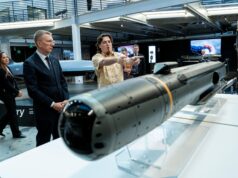
On another important front EVERYONE please look at a video on BFBS Forces News about Tiberius Aeospace Inc in CA run by a Brit called Andy Baynes titled
“Former Apple engineer develops world’s first liquid-fuel ramjet-powered artillery munition for UK” It will be produced in UK
This is about being quick on your feet not like the big boys and hopefully BAE RR Babock etc should look at his way of doing this with their incubator start ups and developments
After Apple he then developed NEST designing thermostats and security cameras sold to Google for $3 billion now Tiberius with SCEPTRE and INVICTUS missiles also trhe GRAIL system of doing things
Was an insight of how to get PRODUCS DONE AT REAL PACE
Brillianr stuff
Very impressive! Let’s hope the costs can be kept low.
Yes Jon
That is the question! (Also MOD slowness because of Treasury constraints cause extended timeframes and increases cost)
I was impressed by Andy and his quick adaptation to defence and Ukraine (Frontal range and extension of front lines way beyond present norms)
These gun missiles are a real gamechanger and already proven by US DOD tests and the MOD is at the forefront if the opportunity if grasped
(Quickly please for Ukraine and UK exports)
How depressing for a captain of a SSN the supposed panicle of his career and he never gets the chance to take his boat to sea!not to mention the deteriorating skills happening with the crews etc!
Pinnacle🙄
It’s a bit unexpected that the HMS Agamemnon is heading for Scotland instead of Port Hamilton or Troy. Are they short-handed or something?
Shame that the austerity didn’t actually help, the books were not balanced at all. The figures begore COVID show this.
The national debt went up and up from 1194 billion 75 percent of GDP in 2010 to 1838 billion 87 percent in 2018.