

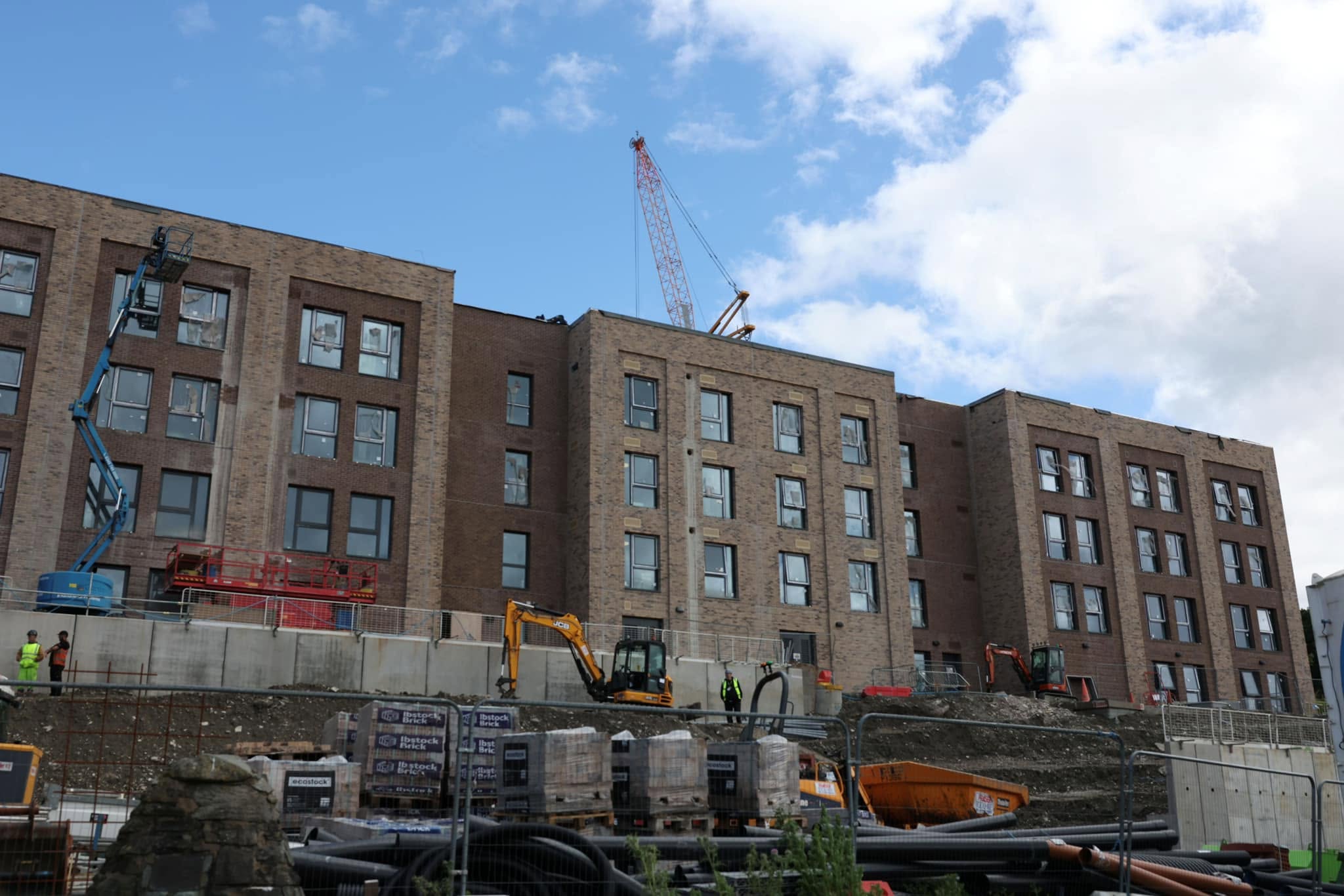
Construction of new accommodation for submariners at HM Naval Base Clyde has reached a milestone with the placement of the final parapet and prefabricated concrete panel on the fourth of four new blocks, the Royal Navy has said.
The panels, weighing between 10 and 18 tonnes and spanning three to five metres wide, have been used to build the four blocks, two of which are designed specifically for submariner trainees, under a £166 million project delivered for the Royal Navy by the Defence Infrastructure Organisation and its industry partner, Kier Graham Defence. The work forms part of the Clyde Infrastructure Programme, the wider effort to prepare the base to operate and maintain the Dreadnought class submarines that will succeed the Vanguard class as the platform for the UK’s continuous at-sea nuclear deterrent.
Captain Elaine Boyd, Captain of HMS Neptune, attended the placement of the final panel alongside Base Executive Officer Commander Nick Stewart and First Lieutenant Commander Phil Nicholson. “Reaching this stage of construction is a significant step in delivering modern accommodation at HM Naval Base Clyde,” she said. “The new blocks will provide high-quality living spaces for Service personnel, including the submariner trainees who represent the future of the Submarine Service. As the home of the Royal Navy’s submarine fleet, these facilities will support the wellbeing of our people and the continued development of the Naval Base.”
The Royal Navy said the prefabricated panel method delivers a traditional style of construction while allowing faster installation, reducing the workforce required on site, cutting cost and material waste, and supporting sustainability goals. Dan Ross, DIO’s Director of Nuclear Infrastructure, said: “Working with our supply chain we have demonstrated what can be achieved at pace, without compromising on quality, to provide our submariner trainees with the modern, safe accommodation they deserve. The use of prefabricated sections helps us deliver the new accommodation more quickly so our sailors can benefit from it as soon as possible.”
The first two submariner trainee blocks are due to be completed and brought into use later this year, with the remaining two single living accommodation blocks scheduled to open in early 2027.
The housing project sits within a much larger construction effort at the base, where the Clyde Infrastructure Programme is delivering the multi-decade upgrade the Defence Investment Plan has committed to funding, including new floating docks to enable out-of-water engineering across the submarine fleet, in preparation for the arrival of Dreadnought and the future SSN-AUKUS attack submarines.









Are those fake windows ?
I would Imagine Submarine Acclimatisation would be part of the trainees curriculum….
Maybe they’ll get locked away for 200 days ?
How many cans of Beans and Sausages will they be able to store ?
So many questions.
who knows they might even open the bedding store for more than 2 hours a day, & EVEN organise some transport instead of having HM sailors trudging ” up the hill” like medieval peasants.
I know nothing of build costs, £166 million for 4 blocks.
Reasonable, or fleeced again?
I think this was on here a while back and it was explained that the total cost was split between accommodation and the wider infrastructure development.
Either way you can bet It will be costly.
Difficult to say truth be told with the info provided. How many bed spaces, what standards applied. How much was taken on risk and what Counter Terrorism Measures were included. Presume the basics are done such as standard level blast glazing etc. Would need a fair bit of info to garner a Rough order of costs. Inclusive to the base build would be the connection to utilities et al. Add on Design and Planning.
630 beds. You pay a premium but not a vast uplift for an off site manufactured system (MMC) like precast and they will utilise bathroom pods. Rooms are circa 22m2 and all buildings will have small communal facilities for laundry, kitchenette style living – think decent student accommodation. MOD pay a premium for an all electric building, DREAM accreditation so no gas boilers and these buildings in Scotland will have sprinklers but the price quoted may well include all design costs and possibly DIO costs as well.
If the costs for these projects were to escalate it would be for unforeseen ground conditions or the cost of extensive below ground service diversions, which contractors will rarely take on the risks in full.
Overall if built well they will provide decent, energy efficient accommodation for several decades with minimal maintenance.
I hope they’ve factored in plenty of drying rooms – constantly trying to dry clothes on a daily basis thanks to the “sub-tropical” conditions was a pain in the arse (to add to many!)
My main memory from 86 – 87 when I was there was the peaty water that left brown marks on anything white. As for some odd reason the rig in the office was half blues and therefore white fronts, this was a constant problem which the bosses could not understand or more likely did not care about. Could never understand why the office rig at Rosyth was No 8s, a place which I always thought was less “front line” than Faslane, yet Faslane insisted on fancy dress, should have been the other way round.