

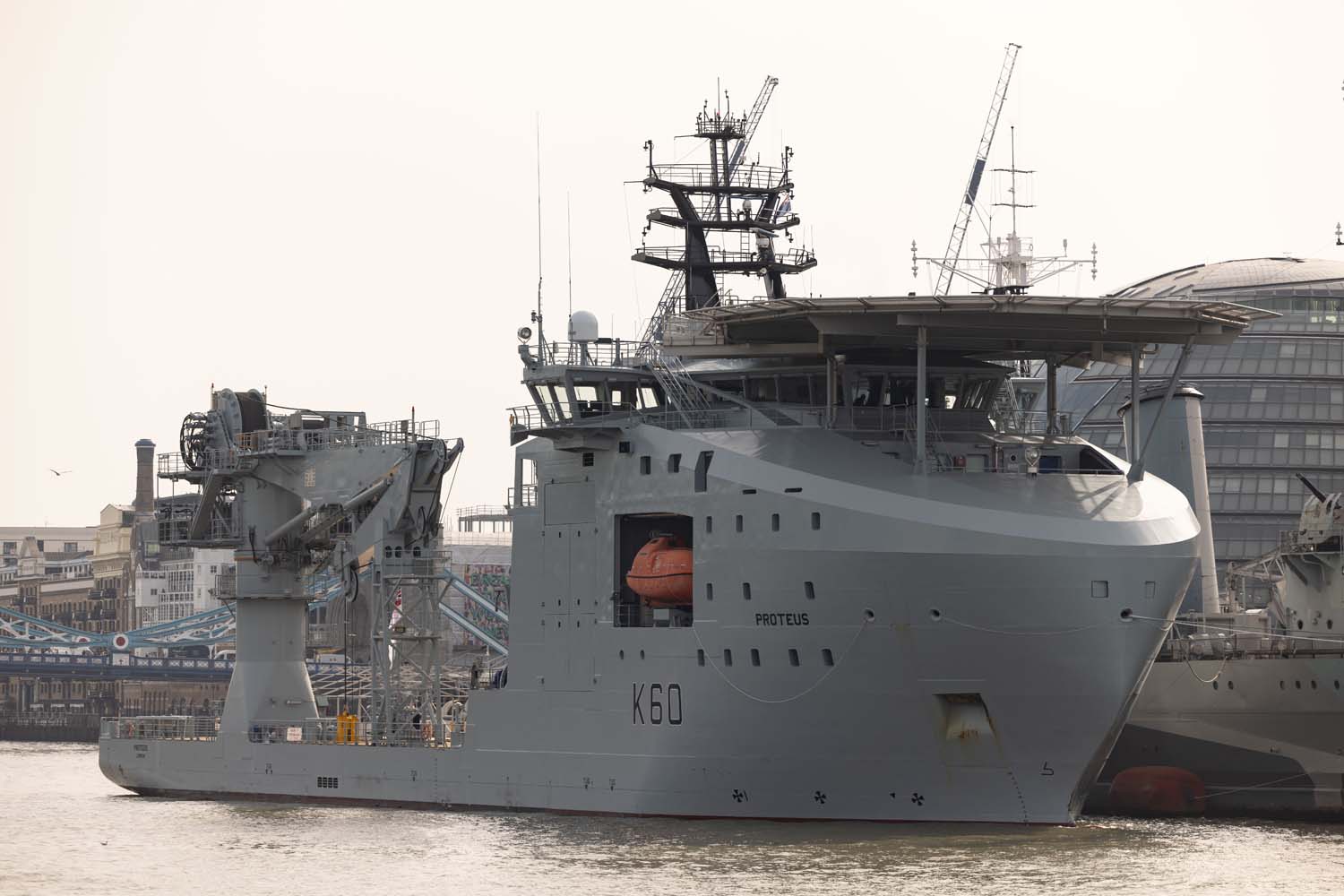
The Ministry of Defence has declined to give a date for the introduction of additional specialist shipping for underwater infrastructure protection, pointing instead to upgrades for RFA Proteus and to commercially provided solutions, in response to parliamentary questions.
Ben Obese-Jecty, Conservative MP for Huntingdon, tabled two questions on paragraph 49 of the Defence Investment Plan, published on 30 June 2026, asking what novel funding mechanisms would be used to increase the resilience and protection of critical underwater infrastructure, and by what date additional specialist shipping would be introduced. Minister of State Luke Pollard returned an identical answer to both.
“As set out in the Defence Investment Plan, the Ministry of Defence will invest £330 million over the next four years in critical underwater infrastructure protection, including enhanced capabilities for RFA PROTEUS,” Pollard said. On the funding approach, he added: “We will also explore opportunities to partner with industry and investors on commercially provided solutions to increase the resilience and protection of associated capabilities.”
Asked when additional shipping would arrive, the minister gave no date, stating: “The timelines associated with programme delivery remain will be determined as specific capability solutions are down selected.” The answer makes no reference to a second purpose-built vessel.
Proteus was always described as the first of two Multi-Role Ocean Surveillance Ships. The programme was announced in October 2022 by then Defence Secretary Ben Wallace in the aftermath of the Nord Stream pipeline sabotage, with the first ship to be bought as a ready-built commercial vessel and converted, and the second potentially built in the UK. Proteus began life as the offshore support vessel MV Topaz Tangaroa, purchased by the MOD for £70 million in early 2023 and converted at Cammell Laird in Birkenhead, a programme accelerated using funds freed by the cancellation of the National Flagship. She entered service in October 2023.
The second hull has not progressed at the same pace, though, as a ministerial letter dated 28 January 2025 reaffirmed that Proteus was the first of two such ships and stated that the second remained in its concept phase, with the Strategic Defence Review to consider how best to augment the existing vessel. It appears that funding originally associated with the second ship has been directed toward extending the service life of the survey vessel HMS Scott, keeping her in use into the early 2030s.
As previously reported by the UK Defence Journal, the decision to invest in upgrading the existing vessel suggests Proteus will carry the mission alone for some time yet. The reference to commercially provided solutions leaves open the possibility that additional capacity is sought through chartered or industry-operated platforms rather than a second purpose-built naval hull, an approach that would mirror arrangements used elsewhere for survey and support tasks.
Proteus operates with a core Royal Fleet Auxiliary crew augmented by Royal Navy specialists, and is fitted with a moonpool, heavy-lift crane and remotely operated vehicles for work on the seabed. The ship has been used as a testbed for underwater systems, including trials of a containerised towed survey vehicle off Portland, as the Royal Navy develops its seabed warfare capability against a backdrop of damage to cables and pipelines in the Baltic and North Sea.



Oh, what a surprise 😏
They will probably move to continuous monitoring of pipelines and cables as well as monitoring of shipping. Checkout Optics11.
To acquire or build ships that have no crews to operate them would clearly be most embarrassing.
Maybe we should do what Canada does and gets a commercial company to own and operate the vessel and do away with the RFA staffing issues.
Robert, I guess that’s the only way to man these vessels, but time is not on our side. The Russians are determined to test our mettle on the issue of seabed security. Manning is going to be an issue across the globe as military life appeals to fewer of our youth, hence the dawn of crewless weapon platforms.
Can’t understand why manning is such an issue for RN and RFA unless its the pay and conditions and the lifestyle choices of people There’s got to be enough youngish people on the unemployment queues to source to fill all the spaces and more?
Does this bloke ever do any actual work ?
🙂
A friend of mine works for a windfall support company. He worked with a design team over six months and then placed an order that will arrive within 18 months. 24 months total from idea to going to work!
I accept not a complex warship, but make a decision and get on with it !!!
Not sure if this is a similar role for Proteus but if the drone fleet gets largish there might also be s need for a drone salvage-tender-mothership type vessel. For at sea repair, refuelling or even rearming? If these sea drones/LUSVs go awol at sea who’s going to looilk after it? It’s a huge waste to just let it all go. Might be a role for the Bays for now but for later on?