

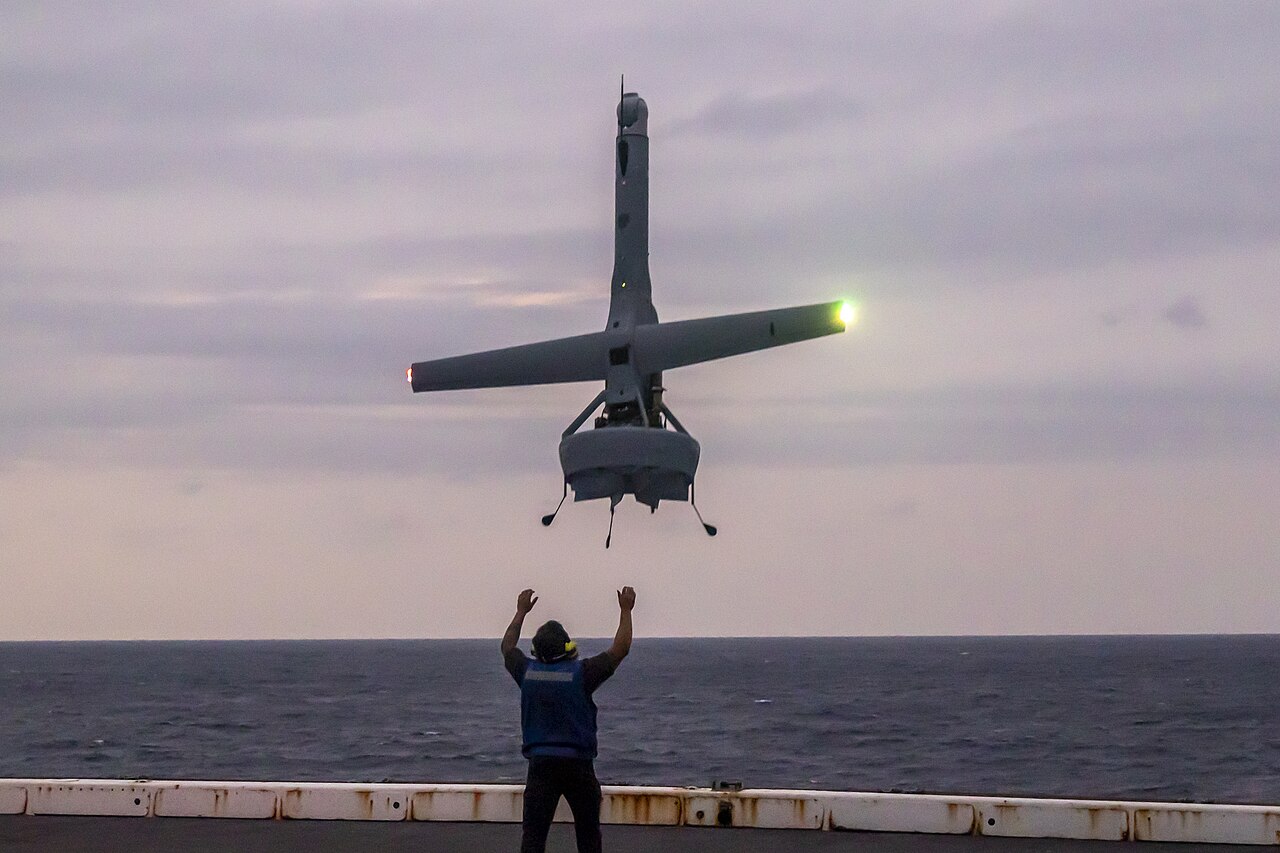
A Romanian Navy official lost two fingers and fractured a third when her hand was caught in the propeller of a Shield AI V-BAT drone during a training exercise on a boat off the Texas coast last month, in an incident that has come to light only as part of a broader investigation into safety problems at the American firm behind the drone, Reuters has reported.
The injury, sustained on 12 May, was confirmed to the news agency by Romania’s Ministry of National Defence and reported alongside the wider findings on Thursday, having not been publicly disclosed until then, with neither the Romanian ministry nor Shield AI placing the injured official’s name into the public domain.
Reuters, drawing on interviews with 21 former employees, industry executives and investors, alongside a previously unreported whistleblower complaint, a separate lawsuit relating to a hostile work environment, and internal company presentations, reported that the V-BAT had crashed more than fifty times in the past eighteen months, that several members of staff who had raised concerns about safety had been dismissed, and that on one occasion a Cessna carrying a Shield AI employee and his child had been forced to take evasive action to avoid colliding in mid-air with one of the drones. The agency also reported that the whistleblower complaint, filed to the United States Department of Labor’s Office of Administrative Law Judges in May, alleges that Shield AI obscured technical flaws in the aircraft, which costs around a million dollars per unit, in order to secure military sales.
Shield AI rejected the broader characterisation in a statement to Reuters, defending the V-BAT’s performance and what it called its strong safety record. The company said that “operational mishaps are common” for a drone of the V-BAT’s kind, that the platform “remains one of the most operationally proven VTOL aircraft in service today,” and that it had clocked up some 18,000 flight hours since 2019. On the 12 May incident specifically, Shield AI said the cause had been “a violation of established safety procedures, not from a product defect,” though it did not disclose the nature of the violation.
The V-BAT is a vertical-takeoff-and-landing reconnaissance drone built around a patented ducted-fan tailsitter design and powered by Shield AI’s Hivemind autonomy software, sized to launch and recover from the small flight decks, urban clearings and boat decks where a more conventional aircraft cannot easily be put down.
According to the company, the aircraft can fly for up to eleven hours, carry a payload of up to roughly eighteen kilograms and operate in jammed or GPS-denied environments without an external pilot, and Shield AI points to its track record on operations in Ukraine and the Black Sea, where it has logged more than 130 sorties in support of Ukrainian forces, as evidence of its battlefield credentials.





I’ve gained $17,240 only within four weeks by comfortably working part-time from home. Immediately when I had lost my last business, I was very troubled and thankfully I’ve located this project now in this way I’m in a position to receive thousand USD directly from home. Each individual certainly can do this easy work & make more greenbacks online by visiting
following website—.,.,.,.,.—>>> JobatHome1.Com
Scrub this SPAM CRAP