

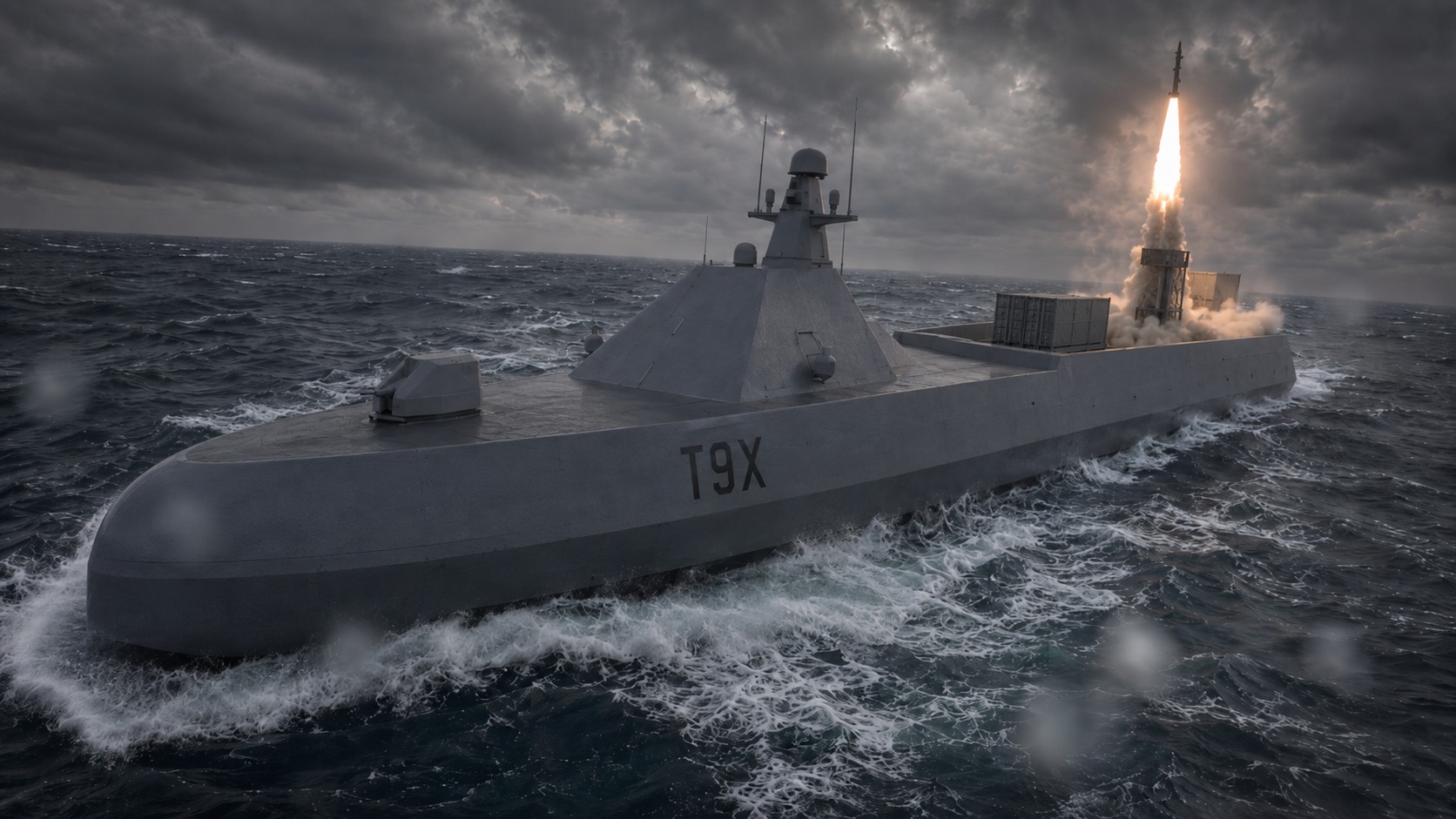
The development timelines for its Type 91 uncrewed missile vessel, Type 94 uncrewed radar platform and new Common Combat Vessel remain unknown, despite all three forming the core of the future system intended to replace the Type 45 destroyers.
Three separate parliamentary questions from Conservative MP Ben Obese-Jecty asked when the Type 91 and Type 94 concept phases would begin and end, and when the initial design stage of the Common Combat Vessel would be completed.
In each case, Defence Readiness and Industry Minister Luke Pollard gave the same answer: “Work on the Type 91-94 and Common Combat Vessel continues. Further detail will be released as appropriate as these programmes develop.”
The answers leave the detailed development schedule unclear, although broader milestones for the Royal Navy’s Hybrid Navy programme have previously been set out.
Current planning assumptions envisage Hybrid Navy capabilities being introduced progressively from the early 2030s, while the Navy has previously said it wants the Common Combat Vessel and wider maritime air defence system to arrive in step with the retirement of the Type 45 fleet from the mid-2030s onwards.
The Government has committed to procuring at least six Common Combat Vessels, which will act as the crewed command and control element of the future distributed air defence force. The ships will work with Type 91 uncrewed missile platforms and Type 94 uncrewed sensor vessels, separating functions currently concentrated aboard a Type 45 destroyer across a network of crewed and autonomous ships.
The Type 91 is intended to contribute missile capacity to the future maritime Integrated Air and Missile Defence system, while the Type 94 will provide distributed sensing. Defence has said the intention is for the Type 91 and Type 94 platforms to operate without crews rather than as lean-crewed or optionally crewed vessels. The Common Combat Vessel would sit at the centre of that network, coordinating the autonomous elements while also carrying personnel responsible for support and maintenance.
There is already an ambition to have a prototype uncrewed missile platform in service by 2030 as part of the first large autonomous vessels entering the fleet. That does not amount to a confirmed service-entry date for the operational Type 91 fleet, with ministers subsequently saying detailed requirements and delivery timelines remain subject to concept and assessment work.
The Common Combat Vessel itself remains at an early stage. In July, Pollard said it was still in the initial stages of design and that different hull forms were being explored.
The programme is intended to replace the earlier plan for a conventional Type 83 destroyer with a more distributed approach to maritime air defence. Rather than putting sensors, weapons and command systems aboard a small number of large warships, the Navy plans to distribute them across a larger mix of crewed and uncrewed vessels.
Further uncertainty also remains over where the Common Combat Vessels will be built. Asked separately this month whether a lead shipyard had been identified, Pollard again said: “Work on the Type 91-94 and Common Combat Vessel continues. Further detail will be released as appropriate as these programmes develop.”





Absolute bullshit from a government that couldn’t care less about defence as long as they can tax and pay benefits.
298bn is being spent on defence over the next 4 years, and in the spring spending round it will be planned out how we get to 3.5%. 3 years ago it would have been beyond our widest dreams to have a 3.5% defence budget. And it has to be a staggered increase over the coming years. Not 2.7 in 2034 then 3.5 in 2035. So i don’t see how it’s bullshit. The hybrid Navy concept is the way to go in this modern era and will greatly increase the RNs fire power and sensor reach. R&D has been going into this for years. The RN has T26, T31, two more Astute boats coming, and Dreadnought. Extensive T45 weapons upgrades, expanding carrier strike and the new hybrid fleet . If you don’t like this government, thats your choice. I’m no Labour supporter/voters, but i want them to do well, because I want the country to do well.
Open your eyes and take a look at the state of the UK’s forces. Your staggering increase hasn’t happened yet and hasn’t got anywhere near the guys n the front line.
Pure propaganda from Labour party central.
Yeah, ok pal. Whatever you say.
Building the QE carriers might just be the second silliest thing the Royal Navy has done this century.
The carriers emerged from a defence review that had wide spread backing across all the major political parties. For very good reasons that still stand today.
“There is already an ambition to have a prototype uncrewed missile platform in service by 2030”
Somewhat different from this time last year at DSEI when the First Sea Lord said they’d be sailing in two years. We all said the timeline was unlikely, well those less charitable may has used harsher language. So now the prototype has shifted from 2 years to 5 years. I think this is a little more likely. However, where would it be built? What do others think?
If it is a real prototype for Atlantic all seasons – the only that matters – then no chance looking at the past and present it will be in service in 5 years.
How will the RN recover one of these unmanned vessels if it breaks down 800miles out in the Atlantic? Or is the intended operation only to be close inshore and/or escorted by a manned vessel with a few miles? Serious question what is the anticipated operating policy?
I guess they will have to be designed to have the reliability that they simply don’t break down, or at least have sufficient redundancy of propulsion/control systems that they can always “limp home”. In an extreme situation, I imagine sending a manned ship with a helicopter to land some repair crew would be necessary. It’s no small technical feat that they’re looking at.
I wonder if we won’t see more than one unmanned ‘missile barge’ platform – different sizes and maybe different missiles. I Have a mental image of a sort of ‘wifi mesh’ but with radars. Tough challenge, I imagine to construct an architecture that handle different radars distances and ships. They will adopt an iterative approach to development.
I’m under the impression that this government have not the slightest intention of doing anything about the unmanned fleet, they will simply shove everything to the right of 2029.
They won’t finance defence, Burnham has clearly stated welfare is the priority, the extra money allocated so far is simply filling the black hole.
Our armed forces are in a state of underfunded managed decline.
Votes, and placating the far left loons on Labours back benches, are the priority.
So is growing the economy, but I don’t see how that works by taxing everyone to death. We need to encourage wealth and encourage rich people to live here, employ people, invest.
But I’ve fallen foul of the far left there in their class war which is threatening to make the rich up and leave to a friendlier country. Bye bye their tax contributions.
Yep, spot on….
I am not sure exactly how many of these things are going to work and I am not sure anyone else does either hence it is difficult to be firm about dates.
Don’t worry too much about dates just get people working on the project solving problems as they go and see what we end up with. Next iteration might include a few tweaks or a complete revamp. Need to start somewhere.
What a surprise. How is a defence budget already stretched to breaking point going to cover the cost of
* at least 6 CCAs
* a minimum of 12 T 9 variants for missile load and sensors for each CCA
They are going to be more expensive than a one for one replacement of T45.
Excluding lean/optionally manned platforms has ruled out the simplest way of delivering the concept.
Meanwhile, Netherlands have ordered 2 lean manned arsenal ships to be operational by 2027.
How do we afford it? Good question. There is someone in the MOD with a spreadsheet identifying expensive to run (obsolete?) equipment etc. which can be scrapped at low risk to fund new initiatives. Hence scrapping T1 Typhoons, older Chinooks, Army Wildcats, army training cuts, slowing down T31 and CR3. It’s all in aid of being able to fund key future capabilities.
Ahh, of course, the “sunset” supposedly obsolete kit that suddenly isn’t when you need it, when other nations still have it, and whe jam tomorrow cuts now thing….which is quietly watered down further along while the cuts remain.
Seen it all before, the same old tricks.
I’m more optimistic about the LUSV types, it occurs to me no one has speculated on their effective range? Do we see them sailing to the South Atlantic, for example? Or just for GIUK Bastion presence?
As if so, the RN is still required elsewhere and will need escorts if its QEC and amphibs ( oh, I remember those) are used.
Constrained by inadequate penny pinching funding and government procrastination one gets the sinking feeling this hybrid navy plan will end up an utter mess. I would be more than happy to be proved wrong.
Yep. I think they’re actually completely correct with the premise and intention, but I suspect that the execution will be fumbled.
This has disaster written all over it and with the parasitic and incompetent Labour Party involved it’s extremely likely it will be an utter disaster which in turn is very likely get British infrastructure/assets destroyed and British people killed.
This is new territory for the RN, there are many unknowns going forward.
Taking humans out of the system raises risks.
Some of the challenges to overcome are:
Communication links data reliability and Latency Bottlenecks
Communication links signal attenuation (especially on high seas)
Seaworthiness and sailing as a large flotilla
Maintenance, fault detection and mitigation.
Battle damage detection and control
Rearming refueling at sea
Risk of Boarding and Sabotage or electronic hijacking