


The Royal Navy will continue to deploy warships globally and to exercise navigational rights, including innocent passage, the Ministry of Defence has confirmed, following a question about visits such as that made by HMS Medway to Punta Arenas in Chile.
The assurance came in a written answer to Lord West of Spithead, the former First Sea Lord, who asked whether the government intended occasional visits by warships exercising their right of innocent passage to continue.
Answering for the department, Minister of State Lord Coaker said: “The Royal Navy will continue to deploy warships globally in support of the United Kingdom’s defence, security and international engagement objectives.”
He added: “Royal Navy vessels routinely exercise their navigational rights in accordance with international law, including the right of innocent passage where applicable, and undertake port visits and defence engagement activities with allies and partners around the world.”
Setting out where those deployments currently stand, Coaker pointed to four examples. “Recent examples of Royal Navy global deployments include HMS Medway operating in the South Atlantic, HMS Trent conducting security and defence engagement activity in the United States and the Caribbean, HMS Spey and HMS Tamar maintaining the United Kingdom’s persistent Indo-Pacific presence, and the UK Carrier Strike Group led by HMS Prince of Wales undertaking operations with NATO Allies in the North Atlantic and High North,” he said.
Those activities, the minister said, “demonstrate the routine global nature of Royal Navy deployments in support of defence, security and international engagement objectives.”
The right of innocent passage is set out in the United Nations Convention on the Law of the Sea, under which ships of all states may transit the territorial sea of another provided the passage is not prejudicial to the peace, good order or security of the coastal state. Warships are covered by the provision, though some states, including Chile, require or request prior notification for foreign warships entering their territorial waters, a position the UK and others do not accept as consistent with the convention.
HMS Medway is a Batch 2 River-class offshore patrol vessel. Following several years forward-deployed in the Caribbean, she has been operating in the South Atlantic, where the Royal Navy maintains a standing commitment covering the Falkland Islands, South Georgia and the wider region. Punta Arenas, on the Strait of Magellan, is Chile’s principal port for access to Antarctica and the far south, and a regular stop for vessels operating in those waters.



Doesn’t mean much. The only remaining forward deployed ships are the River class Batch 2’s. It’s likely that Tamar and Spey will return to the UK at the end of this year for much needed refits, before replacing the B1s on patrol duties around the UK. Forth, Medway and Trent are kept all too busy trying to cover the South Atlantic Patrol Ship tasking (aka Falkland’s); Atlantic Patrol Tasking (North) – including the Caribbean hurricane season; de facto Gibraltar Guard Ship; anti-smuggling assignments; and providing a nominal presence in the Med. With just 4-6 operational escorts (destroyers and frigates) likely to be the norm for next five years, the RN simply has no capacity to continue meaningful ports outside of the NATO region. As for the exercising of transit rights, on the rare occasions a RN/RFA ship will do that, an essential prerequisite will be the USA, or perhaps France, providing cover.
Didn’t HMS Tamar and Spey undergo refits in Singapore last year, including Lloyds recertification?
Both ships have had several assisted maintenance periods since being forward deployed, this included short dry docking periods in Singapore early last year. But the ships have had no upgrades or major repairs since their completion 5-6 year ago. They have been very hard worked and need an extended refit to service machinery and propulsion systems, fix wear and tear, refurbish accommodation spaces, and upgrade combat and other systems such as the crews wi-fi! The refit doesn’t HAVE to be done in the UK, as HMS Trent proved by becoming the first RN warship to have a refit in Malta since the 1970’s.
Wonder if the B2s will ever get an upgunning upgrade to 40mm or an upspeccing of 30mm to improve counter drone capabilities. And fitting of of LMM-STARSTREAK mounts? Even a FFBNW Sea Venom/NSM 2×2 ashm capability?
there Not fighting ships as such..if they ran into.Any sort of opposition in a Conflict there toast..you could Argue for improvements against hostile merchant ships but would that be cost effective..?
Were trying to make these ships into something there Not…They are simply long Ranged patrol boats..
Its not about abilty to attack…its about ability to reasonably defend. Even narcos are increadingly using FPV drones to ward off threats
I think the world is changing.. grey warfare is everywhere and the a vast numbers of non state actors our enemies can now use for deniable grey strikes.. link this with cheap as chips drones and I don’t think a single 30mm and a 2D radar cuts it even for a constabulary vessels.. give it a few years and drug runners will be throwing drones at warships ( especially now the US has essentially turned to summarily executing drug runners)
3D radar, 40mm with smart munitions and some form of short range missile out to the 10km mark is now really the minimum if your deployment is outside of your EEZ.
As always it will come down to cost. Upgrading to a 40mm MK4 mount with manual resupply to the reserve from below deck sounds good in theory but would that be cost effective against using the funds towards another T31?
Definitely go for the LMM mount(s), it would be a quick fix compared to the 40mm upgrade.
LMM and containerised Peregrine UAV ISR would enhance the constabulary role, which you could argue is what fleet ready escort is really. Beyond that is harder to justify.
It’s a real pity we never followed through on the C3 Global Corvette program. The B2 Rivers have shown what is possible with forward basing and at £250 million they cost more than the C3 would have. However having a more fighty ship like the C3 with organic aviation facilities could have greatly increased their utility.
In addition to a few more OPVs and few more T31s might help with spreading visits, flag-waving and general “soft to medium” presence around the globe. Shouldn’t “cost the earth”, pun intended. Drones won’t do it!
Agreed..I would suggest that it’s one of the great unsung cabilities of the Navy to wave the flag.. Great for the Foreign Office and shows a lot to our Allies in a Hard power/soft power sort of way..!
The rivers can get to ports bigger vessels can’t reach, show the flag and gain information exchange around the world. can be serviced in foreign ports. It’s a bright side of a fairly impoverished navy, currently. Hey those crew have to come from somewhere when we get t26 t31 eventually.
The first three cost £115m each. You are probably recalling the T31 price. The cost of the latter two B2s was wrapped up with maintenance and logistics for all 5, so there is no easy way to price the B2s without the TOBA overhead. I really don’t think you’d have a C3 frigate for the price. The Venator 110 was pitched at the same £250m level as the A140.
What capabilities would you want from a patrol spec vessel before it became a Corvette/ Frigate ..
A Corvette would likely Sacrifice Range for Weapons ..
A Frigate you would almost certainly Sacrifice Numbers..
Built to full military spec, even if not fully gunned. Warships are, OPVs and cutters aren’t. I know there are cheap export OPVs that call themselves corvettes because they have some guns and missiles, but that’s not enough for me. Warships need survivability.
And yet the B2s are very much OPVs built with the survivability standards of warships in mind and not commercial standard OPVs.. OPVs don’t have improved water tight compartmentalisation and flood management, improved shock protection, warship standard fire fighting and DC capacity, armoured magazine etc… B2 rivers do.
All true, but let me ask you, given that the first in class of a warship is supposed to pass a shock test, do you think that HMS Forth, the ship sent back to BAE because its rivets were glued on, would have passed a shock test?
The RB2s were built to a better standard than the Amazonas. Nevertheless, a compromise.
I suppose the question would be was the rivet head in question meant to be glued on.. you can spec a ship to any survival standard but if the builder makes an error you will have an issue.
Dare I say only prolonging the inevitable in most Cases..?
The thing that’s often forgotten about the B2s is the Navy insisted on the B2s being closer to warship standards than commercial standards.. so they have
Improved watertight compartments and management of flooding.
Armoured magazine
Frigate level fire control and firefighting capability
Improved all round DC
Shock resistance more to the standard of a surface command
Full warship combat management systems.
Infact it’s got 29 survivability enhancements over its standard commercial designed cousins.
Essentially the RN built a 2000 pocket frigate.. but only put a 30mm on it leaving a significant level of growth.
To me one of the defining differences between a frigate and a corvette is that corvettes are warships designed with limited range/endurance in mind. I never took to the idea of a global corvette, which to me have been really been either a light frigate or an upgunned OPV (like the Khareefs). There are some real corvettes popping up like the Al Zubarahs and the Turkish Adas that might be called global, but their range and endurance is still barely enough to go from Southampton to New York and I doubt we’ll ever see them make the trip. I suppose I generalise. Why do you like global corvettes? What are they for?
The thing is there is a balance..
At one end you have the German Braunschweig class, 1800 tons of pocket mean…76mm cannon, 2 27mm cannons, 2 RAM launchers for 42 missiles, 4 heavyweight anti ship missiles and 24 sea mines in racks… as well as a UAV hanger and pad… but it’s only got 7 days endurance.. but for its size it’s a nasty as you like regional combatant.
Then at the other end you have the Rivers 2s 1 30mm cannon… but 26 days endurance…
Something in the middle is what the RN could do with.. something that can spend a month in the north or mess around in the Indian occean or even Pacific.. make its way to the south Atlantic etc… but it needs a bit more self protection than 1 30mm cannons
Maybe a 40mm and 6 CAMM….
If you want longer endurance, you either have to reduce the number of systems and the number of crew or build a bigger, more expensive ship. I think the 127m Legend class cutters have an endurance of 3 months to the RB2’s 35 days. It has a lot of systems, a lot of crew, and these days you wouldn’t get much change from $850m (if the production line were still open).
If it were built to warship standards it would be a light frigate, and that’s exactly what the USN is trying to do, or so they say. However, they are also claiming that the follow-on FF(X) frigates after the lead one would come in at $950m. I wonder what they will cut off the spec to achieve that. Shock/blast hardening may be dropped and the original USCG level 1 survivability standard kept. Internal systems will be USCG level (which admittedly are not to be sniffed at) rather than the full Aegis. No VLS. No ASW. In fact it may well be built to a similar intermediate standard to the RB2s! No gold plating in sight.
The USN? Colour me a little sceptical.
USN should have considered the Two Frigate class HIGH/LOW Option..! And gone full out with both..
By my calculations both Daring and Defender should be available before long which by my calculation at a push we could have 6 destroyers available if necessary. OK, there is a little more work to be done yet so that might reduce by a couple for a period as more work needs doing.
The T23s are not completely gone – I’m sure we have a few there.
Plus over the next 4-5 years I would anticipate that we should have a couple of T26s plus several T31s.
Please correct me if I’m wrong – I just feel we are getting a little over pessimistic.
Sorry your baseline of acceptable has been screwed..
26 years ago it was accepted the RN needed 30-32 escorts
Due to the sand wars this slipped to 23 escorts.. much to many people’s alarm.
16 years ago we were mortified that the navy was dropping to 19 escorts as this was essentially 11-13 less than the last non finance bases review said we needed..
Now as we look to 2029/30 we are likely to have 2 T26s 2 T31s, 6 T45s and the last T23 as its bottom gets eaten out.. so maybe 11 escorts only 2-3 of which will be capable of any meaningful ASW… yes we have a reason to be pessimistic.. the next 5-8 years is going to be a shitshow for the RN even if war does not kick off.. post 2035 it’s looking like we will stabilise.. at a level we were horrified about in 2010.
Sorry Jonathon I should have been more specific as to which comment I was replying to.
!st Comment from RB which I feel is far too negative.
“With just 4-6 operational escorts (destroyers and frigates) likely to be the norm for next five years”.
Personally I was querying these figures which you actually are suggesting is going to be closer to 11 not 4-6.
To answer your point my personal objective would be to have somewhere between 30-50 escorts at this time. That said I do accept the argument that drones at this point could be simpler to produce and increase the lethality to something closer to what is required.
British Droes or t83 protecting QEC Carriers in the South China eas..???
All OPV navy it seems
70% of the earth’s surface is ocean. Patrolling is a growth industry 😂
Showboating – literally
Corvette – Big enough to get into trouble, not big enough to fight its way out of it.
Frigate – Big enough to get into trouble, big enough to fight its way out of it.
Destroyer – Big enough to go looking for trouble, big enough to pick a fight when it finds it.
At end of the day the sea is vast with huge ways to cause trouble and if you have more ships that can cause some trouble than your enemy has large ships to end the trouble.. you start to win by default..
The corvette wins if there are no destroyers to react to it.. and in the moder n world if a couple of corvettes have the right capabilities and the right tactical advantage.. the destroyer dies.
In the end a lot of a warships weigh is taken the requirements of distance and endurance.. if you don’t need your ship to go very far to fight.. then your mental to not build corvettes.. If you need to travel distances beyond your region then you need frigates and destroyers…
It’s why Germany is going to have a 10 stronge corvette.. because those corvette will be standing and fighting in the Baltic.. so they only need 7 days endurance…. It’s why China knocked out 70 ASW corvette’s and loads of missile boats.. to fight in the China seas.. while it’s blue water navy pisses off into the Pacific.
Nope, size buys you survivability and silo depth.
Even a small helicopter launched missile will destroy a corvette, the Destroyer will simply swat away the helicopter at distance.
Sorry destroyers don’t overwhelm physics.. it’s still got radar horizon.. and it’s emissions can still be seen further than it can detect a target..
That means a few things..
the corvette is just as able to launch an attack as the destroyer..infact two corvettes can attack down different axis.
The rotor if it has a ASM with a range of greater than 25km it can probably sneak under the radar horizon and launch…
And if you have say 5 corvettes to that 1 destroyer, the one destroyer cannot be in the 5 places those corvettes can…
Rubbish – You are spouting the same nonsense as the fighter mafia that resulted in a generation of useless lightweight fighters swatted from the skies by proper air superiority fighters.
Sorry you are talking apples and pears.. utterly different.. and anyway I did not see RAF jaguars getting swatted from the skys…
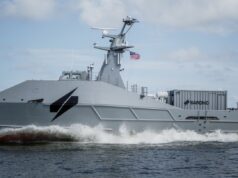
Sadly, these drone command ships are unlikely to do port visits because :
a) One wouldn’t want a “fleet” of unmanned ships in port for obvious reasons.
b) Mother won’t want to leave her pups at sea while she goes into port, again for obvious reasons.
As the days past, I’m less an less convinced about this new setup, for loitering in a bastion area, yeah ok. But for blue sea deployments, no, one needs classic manned frigates, destroyers and subs to accompany a carrier.
Presumably mother ships would have Retrieval and Towing Capabilites if ‘TECHNICAL ISSUES’ Were to Occure…! Replenishment on long Deployments will be intresting ..A real point of weakness..!
Perfectly valid, I was thinking more along the range of threats from harbour crime to spec. ops. boardings at sea.
Foreign policy nostalgia on an over stretched defense budget.
Nonsense. We have global trade and global commitments, and that requires a global Navy.
We don’t have anywhere near the ship numbers to maintain the pretence of being a ‘global navy’.
On the long-established basis of one-third.of the fleet being operational, one-third alongside for leave and training, one-third in maintenance/refit, we can only currently deploy 7 escorts and subs at sea – 2 T45s, 2 T23s and 3 Astutes (assuming that any of the latter are actually able to go to sea). That is barely enough to fulfill the UK’s NATO Atlantic role, let alone provide a T23 escort for CASD Vanguard transit, form the Carrier Strike Group or provide out-of-area patrol ships around the globe. (Let alone Farage’s dangerously daft Channel plan).
Numbers will not change over the next 10 years, we will still be at 7 escorts and subs at sea – 2 T26, 2 T31 and 3 Astutes. Basically, the navy reflects that we are in reality a smallish, middleweight power, without the capability to project.power on the global stage. If we deploy the CSG east of Suez, we can only do so by robbing the escorts from the North Atlantic.Which is wholly at odds with the expectations of NATO and our NATO/JEF allies.
The naval outrage at this sorry state of affairs needs to be tempered by the facts that (a) we will eventually have about the same number of escorts as the leading ENATO navies, France and Italy, so we are pulling our weight in NATO, and (b) our shortage of combat aircraft and army combat manoeuvre brigades is even more deleterious and arguably of a higher strategic priority.
The RN’s devout underlying desire to return to the world of the 1960s is no longer practical or affordable.
It’s practical, it’s affordable, it’s just not a priority.
Loads of ways to do it. Burnham says he wants to get rid of Neoliberalism. If he simply put a block on QT for the rest of this year, that would pay for Defence getting to 3% by 29/30. No double counting. No “efficiency savings” across Whitehall required. That doesn’t even include the half a billion pounds per annum savings on the differential costs between paying for bond yields (at around 5%) over reserve debt (at 3.75%). Why is the Bank of England acting to increase our cost of debt? Stopping QT until rates come down is a gift that keeps on giving.
Even if money could fe freed up as you propose, which is doubtful, only a small proportion would end up in the defence budget. There are 18 spending departments around the cabinet table, each with a long list of priorities that have been seriously underfunded for at leat 14 years. Prisons, school repairs, housing, infrastructure, subsidies to farmers, social care, courts etc, etc. They and most other areas of government expenditure are important and often critical to large sections of the British public. We can argue that defence is the first responsibility of government until we are blue in the face but HMG has to balance society’s competing demands.
If we can get up to 3.5% for defence over the next 10 years, that is really the maximum we can expect and hope for.
If it were so easy the Conservatives would have surely done it over their 14 years in power. Instead, they cut public expenditure to the bone and slashed the armed forces to ribbons.