

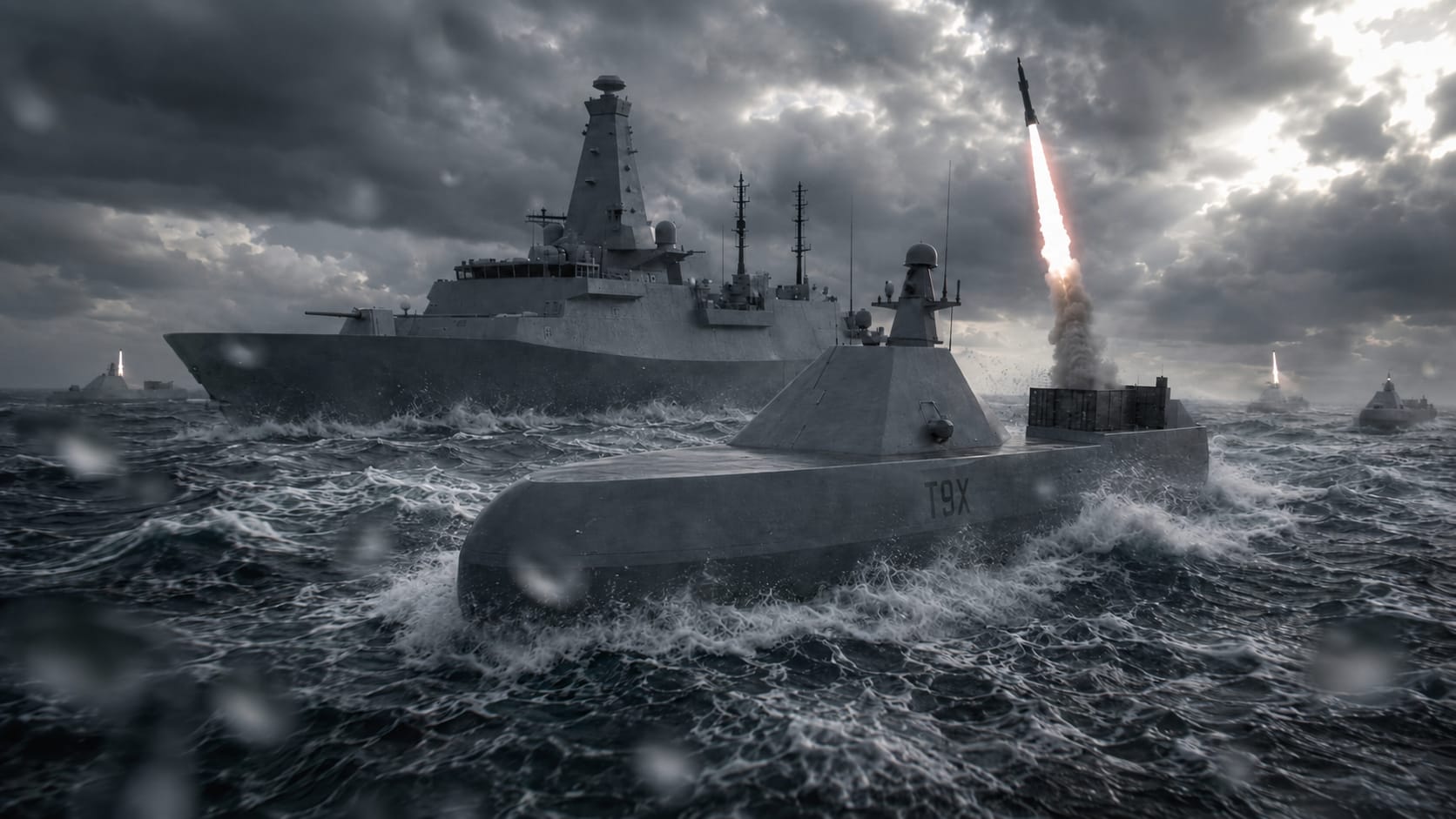
A former Royal Navy commodore has warned that the Hybrid Navy will not succeed simply by buying autonomous ships and drones, arguing that communications, software, command systems and logistics must become the core of the programme.
The Royal Navy risks turning its Hybrid Navy concept into another collection of separately procured platforms unless it builds the digital, command and logistics architecture needed to connect them, according to a new analysis by a former senior naval officer, the UK Defence Journal understands.
Writing for the Royal United Services Institute, Commodore (Ret’d) Steve Prest argues that the emphasis on autonomous surface vessels, large uncrewed underwater vehicles and drones risks obscuring the more difficult task of creating the infrastructure that allows those systems to operate as an integrated fighting force. Prest, a RUSI Associate Fellow in Military Sciences, describes the Hybrid Navy as an ecosystem rather than a programme for replacing crewed warships with robotic equivalents.
He writes: “The temptation is to see Hybrid Navy as a programme to deliver autonomous ships. That would be a profound misunderstanding. Autonomous vessels are not the point; they are simply the most visible applications of a much bigger idea.”
The distinction matters because the Royal Navy’s emerging Hybrid Navy concept envisages crewed warships operating alongside increasing numbers of autonomous and remotely operated systems. Prest argues that simply procuring each new platform through separate programmes could reproduce the same organisational boundaries found in the existing Fleet, only with a different mix of hardware. Separate architectures, proprietary interfaces and isolated support arrangements could leave individual systems unable to generate the combined operational effect envisaged by the concept.
Prest writes: “There is a real danger that Hybrid Navy simply recreates the traditional acquisition model using different platforms.” He argues that replacing independently procured frigates, submarines and helicopters with independently procured surface drones, underwater vehicles and artificial intelligence would amount to a digital version of the existing fleet rather than a fundamentally different force.
At the centre of his proposal is what he describes as a maritime operating system. Rather than a single software package, this would encompass digital infrastructure, resilient communications, command and control, cloud services, cyber resilience, common data standards, artificial intelligence, software deployment, digital engineering and logistics. In this model, individual crewed and uncrewed platforms become nodes connected through a wider fighting architecture.
Prest argues that the Maritime Fighting Web, already identified as a central element of the Royal Navy’s future force, should form part of that architecture but requires greater clarity and resources. He writes that discussion about future ship classes risks becoming a distraction from what he describes as the “cognitive architecture” governing where decisions are made, what information is available and how weapons, sensors and autonomous systems interact.
He states: “Uncrewed, or even Autonomous, systems are not the operating system. They are applications running on it.” Prest argues that an autonomous vessel provides little additional combat power by itself, with its value instead depending on connectivity to communications networks, edge computing, artificial intelligence, mission data, logistics and command systems.
The commentary also proposes a practical test of whether the Royal Navy is developing that architecture quickly enough. Prest suggests demonstrating a disaggregated air-defence engagement in which a Sea Ceptor missile is fired by one ship against a target detected and tracked solely by the sensors of another platform, rather than by the firing ship itself.
He asks: “So, when is the first demonstration of, say, a Sea Ceptor missile engaging a target tracked only by an accompanying Type 45 destroyer and not from its ship’s own onboard sensors?” Prest argues that Britain should demonstrate such an engagement by the end of 2026, noting that it would test a fundamental assumption behind a distributed combat system without requiring an entirely new class of ship.







Should go without saying that we need to avoid being locked into an ‘armed services as a service’ model at all costs but there you go.
😒I think the good commodore is stating the patently obvious – at least to those who understand the communications which will be needed to make all this work. If there were no ‘Operating System’, as he calls it, then nothing would work which you are sort of going to notice in the concept stage. Therefore if he is suggesting their techies are that stupid I am worried already.
I sort of think the problem is wider than the Royal Navy this has to work with the other services and our allies (when they are actually acting as our allies obviously).
Whilst there are some serious challenges I suspect it shouldn’t be that tricky. The commodore needs to remember that his role is as a user (or was) and he should perhaps to to stating what a user will need to be able to do (requirements specification) and leave the techie stuff to those who perhaps can do that sort of thing.
Yep commented halfway through reading before it took an unexpected turn.
Could do with an edit/delete button, or some impulse control.
Used to have Edit and Delete as I recall. I guessing they have been removed because they were causing issues or some were attempting to use it as a method to hack the site maybe. Good software behind this. UKDJ chose well.
Edit, delete, user data and unlimited threads where lost due to bandwidth issues that George said where costing a fortune, in addition to the lack of stability, so he switched to a slimmed down version of the comments.
How are these drone ships going to dock, especially if visiting overseas? Will they be tied up separately against the mother vessel or independently? There could be a a need for an accompanying and assisting tender type mothership for these LUSV/drones? We’re not sure of the CCV layout and drones carried on-board but for the larger drones, maybe a repurposing of the Elliade Strike MRSS that could be a dock-at-sea for LUSVs and other drones where they can be refuelked, repaired or rearmed?
All part of the “Unknown” territory we are entering
My concerns are: how will these drone vessels interact robustly in heavy combat, and how vulnerable are their data links?
Kill the mothership or disable the comm link ….. lose the fleet?
Or trust AI to correctly identify and engage targets without a human confirming?
I would go much further and suggest a layered, fully-integrated system that covered: sea surface, sub-sea, land, air, exo-atmosphere, space, Intelligence, and cyber for the defence of the UK. Many lessons to be learnt from WWII and Ukraine so the Dowding-type system of sectors and multiple redundancies. This would include underground facilities – especially for command nodes – with at least two main command battle hubs that integrated everything. (e.g. High Wycombe, Corsham etc.) This would be a UK stand-alone thing and not reliant on NATO – especially the US – but obviously feed to NATO if needed.
Realistically, I suppose uncle Andy will just have a couple of blokes with a laptop in a tent at Marham.
I think you’ve hit the nail on the head with the comparison with the Dowding-system. Spitfires, Hurricanes, radars, control stations, observer corps posts, the lot, all inter-depended and relied on each other. The fighter planes, like the LUSVs of the hybrid navy, are just the front-of-shop window item.
Well, we already have most of what you explained. And have done for decades.
…I really hope you are right Robert.
Please excuse my sceptisism though.
Lol. Is this a realisation that you can’t just buy any old random autonomous vessels from chummy suppliers and expect to intergrate them without spending significant time + resources on the actual act of intergration?
… So much modern tech is a flop and deserves the dustbin due to propietary interfaces that age faster than warm milk. It also causes issues with decommisioning. Fine if you are happy regularly spending fortunes on what becomes landfill. Not fine if you have a budget and want a lasting product with good shelf life.
.
Very very true.
There are NATO and MoD standards that have stood the test of time and been updated to keep up with technology thus far, but… I worry that AI and hybrid forces across all domains will be such a huge step forward and will develop so quickly from here on in that these standards will quickly become obsolete or at least inadequate in so respects.
However, another serious issue is as you describe the procurement process. Proprietary interfaces could seriously trash the workings of a complex network as currently envisaged. My sense of it is that the procurement system will struggle with a range of new requirments driven by the nature of the technology being procured. It took years to realise that commuter technology has a half life measured in the months to a couple of years, not decades as for a ship or tank, etc… Just ask some NHS doctors what that issue can and still does mean in practice..!
Any procurement system is going to have to deal with new systems and capabilities coming into service on almost a monthly basis, especially software based capabilities and upgrades that come with significant price tags, new operational concepts potentially impacting force structuring and equipment requirements, right up to big hulls that will still take years to build (hopefully way less than the current 10 or so years!) and require upgrades themselves.
Then there are the physical limits and here I am including things like bandwidth which will have a major impact on the network infrastructure. One escort with a few drones around it could find itself and the center of a very crowded electromagnetic spectrum. Single system designers and planners in my experience rarely have the bandwidth to think about the needs of others equipment programs and have a tendency to assume that any issues beyond that boundaries of their brief are someone else’s issue. That does not always follow. It is the edge of program briefs where major problems can arise and this is where the Hybrid navy could come unstuck if traditional procurement systems are used…
Cheers CR
More to the point who is going to give the engage order? Someone is going to carry the can if mr cock up is available.
I was in the simulators in Collingwood not so long ago during CDTT weeks the staff captain asked one of the fresh out of the box PWO’s explain your actions and why and what do I say in the courts when your act was deemed illegal?
Weapons malfunction?
Generator failures?
Cooling plant failures.]?
RAS?
After a few more years of planning this programme will be determined to be unfeasable. The T83 will be resurrected, but years later. Leading to an air defence gap in the fleet as the older T45s start to retire
I can tell you with near certainty that a T31 design as a replacement for the T45s will all end in tears.
A T26 as a replacement is closer to the goal but still wouldn’t be very practical.
A T83 or cheaper design based off the T45s are really the only feasible/realistic option, due to the targetting systems required.
Not to say a T26 or T31 can’t be used as a CCV. It’s just that they don’t provide the same capabilities as the T45s…
Well the current plan looks to be to replace the T45 with a T31 and some remote controlled boats. If the hunter class works out and gets through its weight concerns. Just buy that design and call it a T84.
Justvl on the mother ship…
How much maintenance and Refueling capabilities will the mother ships have….? ..
The mother ship must have some sort of control Centre one presumes..?
And towage capability just in case..?
Will hostile missiles pickup on mothership/Drone Communications..?
So many questions..!
.
I think we all realise t83 was ditched on cost grounds by the Starmer Goverment …!
Tough to see such a complicated system as currently proposed working to far from British shores… Hardly worth saying QEC carriers East of Gibraltar will need something of Air Defence capability…Expect t83 to remain a talking point..
Hopeful HEALEY will find a way…!
It’s abundantly clear that a whole bunch of this concept hasn’t been thought through. But talking about a new hybrid Navy and buying a few remote control boats from Drones Direct looks impressive on paper and costs a hell of a lot less than building ships.
Let’s think about this…A Drone in peace time is sunk by say Russia in the channel OR China of Taiwan for Example…
No ones been killed .! They could trump up a number of tedious reasons for doing so ..!!
What exactly would we do About it…??
A multi million pounds Weapons system and its cargo gone..!
After all the media outrage…
Basically a call to the Ambassador for Tea and Sandwiches at the Foreign office.is about all that will happen… Seriously!
Practicalities to think about:
Are the drone vessels dependent on a functioning ‘motherhip’ getting commands and feeding back info via a comms link (that may be a grave weakness)
How does that flotilla sail as a fleet formation or in convoy?
Is there a maximum distance they can stray from the mothership?
The other scenario is that the drone vessels are fully autonomous, using a combination of pre-programmed orders and AI.
How could you guarantee this vessel would correctly identify and target potential threats, or not fire on friendlies or neutrals?
I still think manned ships with a well trained crew will do a better job right now.
Yea but that costs money. I am fervently of the belief that all the current talk of hybrid and drones is a smokescreen to excuse not building real ships, which, as an asides, we don’t have the numbers to crew anyway due to cuts and recruiting.
Agreed, but all the same, the proposed drone fleet will require a lot of designing and testing.
The control software/comms will be hugely complicated even before you think about hulls and weapons, and that will take time to develop and refine.
The whole concept is unknown and untried, so no doubt there will be many teething troubles and ‘back to the drawing board’ moments.
If the MOD thinks this is going to be a quick and cheap solution, then they are clueless fools
The only way to mitigate the huge risk here is to build those T83s
its not just the mother ship that needs this ability – its every vessel in the RN + several shore stations. that’s the tricky bit
The article actually suggests developing a dedicated Operating System, which makes sense as you would need the speed and process pre-emption of a real-time system (which you do not get in a popular commercial OS).
But that Task in itself is complicated and will take time to test and refine.
So many potential weak links in this model of Navy.. failure in just one could be Catastrophic…!
To many risks to go headlong without any real trial…but the 1SL appears intent…
“How does that flotilla sail as a fleet formation or in convoy?”
I’d assume just a boids algorithm keeping them in the flock and then a mesh network to issue targets which should be fairly EW resistant considering they’d be right next to eachother.
Operating away from the mothership would be something else though.
As for robots making the call didn’t a US CIWS operating on automatic unload into the side of another US ship because it got confused by chaff back in the first Gulf War?
We need some Flo Flos to make this all a reality
nothing too fancy – dont gold plate it – just buy 2-4 Flo Flo’s and get on with it
Pedalos, with a robot pedaller, that’s the future
I was also wondering how this setup would work if you have..say
.a Dutch ship in the flotilla…or a French one..or.
They presumably won’t be able to network with all tne broken down…sorry…fully equipped drone ships.
Having your own “cloud” of drones is one thing.. introducing allied warships, or other assets into the mix?
AA
New designs for several new classes of ship new technology to seamlessly link them all from the drawing board to active service in a decade or so. What could possibly go wrong?
Why can’t the RN take a less risky path even have a mixed fleet of T83 and CCVs? Why the need for even the sensor only T94 platform? Wouldn’t it be safer and more useful to put all that radar and tech onto an actual ship like an enhanced T31/T32.l? And with the T91 trimaran, put in a lean crew, remove the 2x40mm, add a hangar for a helo/uav combo, rearrange the vls to add a forward 57mm, add non deck piercing rear 40mm and you’ve got yourself a rapid deployment multi-role type patrol platform like the Independence class in the USN, if that’s what the RN wants.