

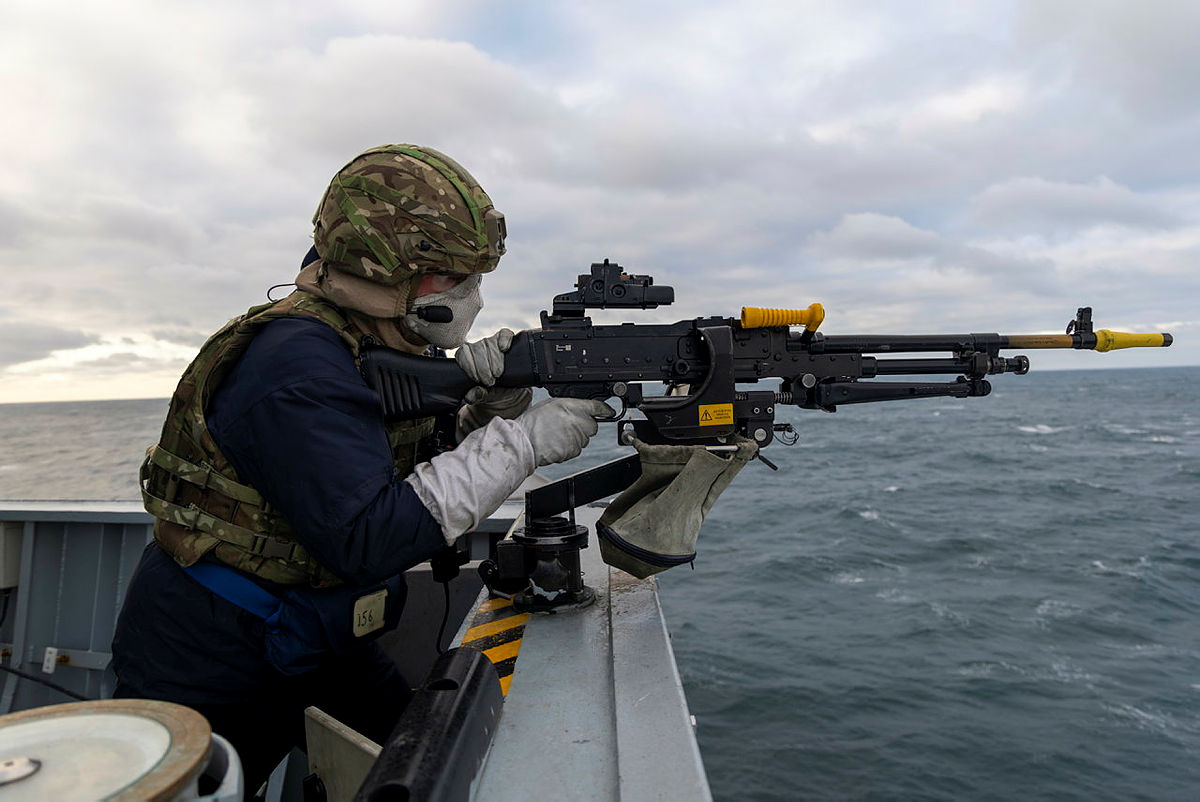
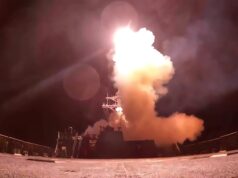
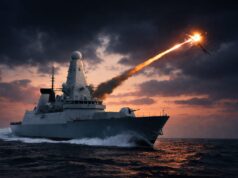
Royal Navy destroyer HMS Duncan has taken part in a live-firing training exercise off the Welsh coast that simulated multiple drone and missile attacks.
The four-day event, known as Exercise Sharpshooter, was delivered by QinetiQ in collaboration with Fleet Operational Standards and Training. The scenario placed the Type 45 destroyer in a complex threat environment designed to test its ability to detect, track and neutralise simultaneous aerial and surface threats.
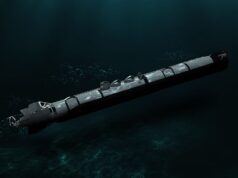
The exercise combined live and simulated targets, including QinetiQ’s Banshee Whirlwind aerial drones and Hammerhead uncrewed surface vessels. Additional synthetic threats such as cruise missiles, anti-ship ballistic missiles and hostile aircraft were incorporated to increase the intensity of the scenario.
The training environment at MOD Aberporth was designed to replicate operational conditions at sea, with HMS Duncan required to respond to attacks during both day and night phases of the exercise.
During the event, the ship’s company successfully tracked and neutralised five aerial targets and destroyed two Hammerhead surface drones.
The scenario itself was developed by Inzpire, a QinetiQ-owned company focused on creating military training environments.
Will Blamey, Chief Executive, UK Defence at QinetiQ, said the exercise was intended to replicate the evolving challenges faced by modern naval forces.
“We are proud to deliver dynamic, real-life scenarios that best prepare our armed forces for the complex warfare challenges of today and tomorrow.”
“Our combination of live and synthetic threats mean we can deliver training scenarios that provide the very latest in threat representation, helping our warfighters to achieve mission-readiness at pace.”
Commander Dan Lee of the Royal Navy said the exercise provided an opportunity for the ship’s crew to test operational procedures in a realistic environment.
“The realism of Sharpshooter, particularly the engagement of dynamic moving targets using operational procedures, gave my Ship’s Company the opportunity to prove they are ready to defend, ready to fight and ready to win.”
“My team fully embraced the challenge and leave this exercise more confident, more capable and better prepared.”
QinetiQ regularly designs and delivers test and training exercises for the UK armed forces across land, air, maritime and cyber domains.
The company said similar multinational training activity took place in December when the Royal Netherlands Navy frigate HNLMS Evertsen participated in a QinetiQ-run exercise aimed at improving operational alignment across NATO forces.


Ssshh don’t tell trumpy he will demand we send her to the straits of Hormuz!
The US Navy escort fleet:
18 Cruisers
78 Destroyers
21 Littoral combat ships
Royal Navy escort fleet :
6 Destroyers (2 available AFAIK)
7 Frigates (5 available AFAIK)
So why is the US holding out for other countries to provide escorts ?
Why risk your own ships if someone else is dumb enough to do the job for you!
The US could afford to lose a few ships we can’t.
Even if the RN destroyed every drone, speed boat, and missile aimed at it, our ammo would probably run out
long before Iran’s, such would be the intensity of the battle.
The US is far better equipped to deal with attritional swarm attacks.
I think their one mistake though, was decommissioning the Cyclone class
When I think of defence of military KPs against Drones, I often visualise the Troubles in Northern Ireland.
What would be the issues with constructing a tall tower, much like those seen on bases, so a Sangar.
Is it really beyind the skill of DSTL to join a lightweight sensor to an automated machine gun or 3, or even a cannon of some sort, and plonk them atop the Sangar to take down Drones?
They would be manually controlled daily until attacks were happening, like a ships CIWS, at which point they could go auto.
Apart from kinetic defence, what about the other feature of Sangars, screens to prematurely detonate RPG and such, much like seen on some Armoured vehicles.
Could key buildings, radar, and such be surrounded by such screens to counter Drones?
The ships already have 30mm canon, Phalanx, and Machine guns. They have radars. What planet are you on?
I think you’ve mis-read this one.
Planet? A different universe to you….with that comment.
I was referring to defence of land based KPs, while we’re on the subject of Drones.
Learn to read and comprehend?
You’ve just described the Paladin Terrahawk, options for both radar and optical targeting all self contained on a single palate. The mount can take numerous autocannons ranging from various 30mm mounts up to an L/70 Bofors 40mm – including 3P ammunition – and is built entirely from existing off the shelf components meaning it doesn’t require a new supply chain to be formed.
I believe Ukraine use lots of old fishing nets to cover FOBs etc. Which is probably enough against quadcopter types of drone, against the heavier Shahed type, I’m not so sure. Shahed and the Russian spin off versions that now mount a small jet engine are hitting speeds from 300 to 400km/h. Which along with the mass, might be enough to tear through a net. Mind you if nets were layered with a lot of stand-off distance between each layer, perhaps they could catch the heavier drones.
Ah, just the man to comment.
Thank you, it’s always seemed to me that there must be a simple solution if the wills there without breaking the bank.
But at those sorts of speeds, hmmmm.
I’m always been a firm favorite of keep it simple stupid. The father of radar, Robert Watson Watt once said: Give them the third-best to go on with; the second-best comes too late, the best never comes”. Which is something I’ve also kept in mind, as 80% is usually good enough. Whilst anything above 95% usually has diminishing returns of cost vs performance.
Fishing nets are lot more robust than scrim nets. Which is probably why Ukraine is using them. They’ll definitely stop a quadcopter, but they have been known to snag a sub or two. I guess you have to ask Ukraine?
Didn’t Duncan do this about 4 weeks ago?
Yes, this article has been posted several times, I think there’s some sort of problem with their system.
Its regular exercise run by Qinetiq. Not only RN but Dutch ships have been through it.
I know; that wasn’t my query. Duncan did this weeks ago and it was widely reported.
https://en.wikipedia.org/wiki/Thursday_War
Its the Thursday war scenario for that weak
This was posted a couple of weeks back ,as I wrote on the thread ,about Duncan doing a task that Dragon was plastered across the media about failings in preparedness for .Why couldn’t Duncan have been retasked for the job of taking out Iranian Drones fired by Hezbollah?. .The Duncan was evidently ready too fulfil the task in hand .
Because deploying a ship to protect an airbase which has aircraft and SAMs is waste of time and money.
She could have been positioned between the Lebanese coast and Cyprus to intercept ALL drones heading towards Cyprus! That way she could have protected both the island and Akrotiri.
Or you do the same with a helicopter at the fraction of the price
So now you have gone from fighters and SAMs to helicopters with missiles👍
The drone that hit the hanger in Akrotiri was apparently spotted at 30 Kms,how long to launch any aircraft to intercept?
Now if said helicopter was on a ship on the predicted flight path that drone would not have got anywhere near Cyprus!
Not forgetting the other SBAs as well of course!
Quite, Akrotiri isn’t necessarily the most important site we have there.
Duncan hasn’t been through PiP yet. Making Dragon (which has) the more capable/reliable ship to deploy.
As i have said before,Duncan not having PIP is irrelevant in this case,she has spent more time around the Med and Red Sea than the other Type 45’s without issues.She was deferred for her Prior Commitments later on this year,and she needs her own Maintainance Period before then.If they sent her out there she would have had limited time on Station.Dragon too has previous commitments but these can be changed more easily,and she can spend longer there if needs be.
Tommo, I asked a similar question a few weeks ago and was told that Duncan hadn’t had the PIP. I assume the person who said that was inferring that she might struggle in the warm water. However, I saw someone post elsewhere that Duncan has been to the Med twice, without incident. Not talked about much is that alongside PIP, there was an EIP (Equipment Improvement Plan) for the Type 45s as it wasn’t just the GTs that were suffering. I think the EIP made a significant difference but, who knows? Need a comment from an anonymous and current ME…….
Old News. Re-running story.
Real story. Why was Duncan not dedployed to protect Cyprus after the work-up?
Its a Thursday war training scenario