

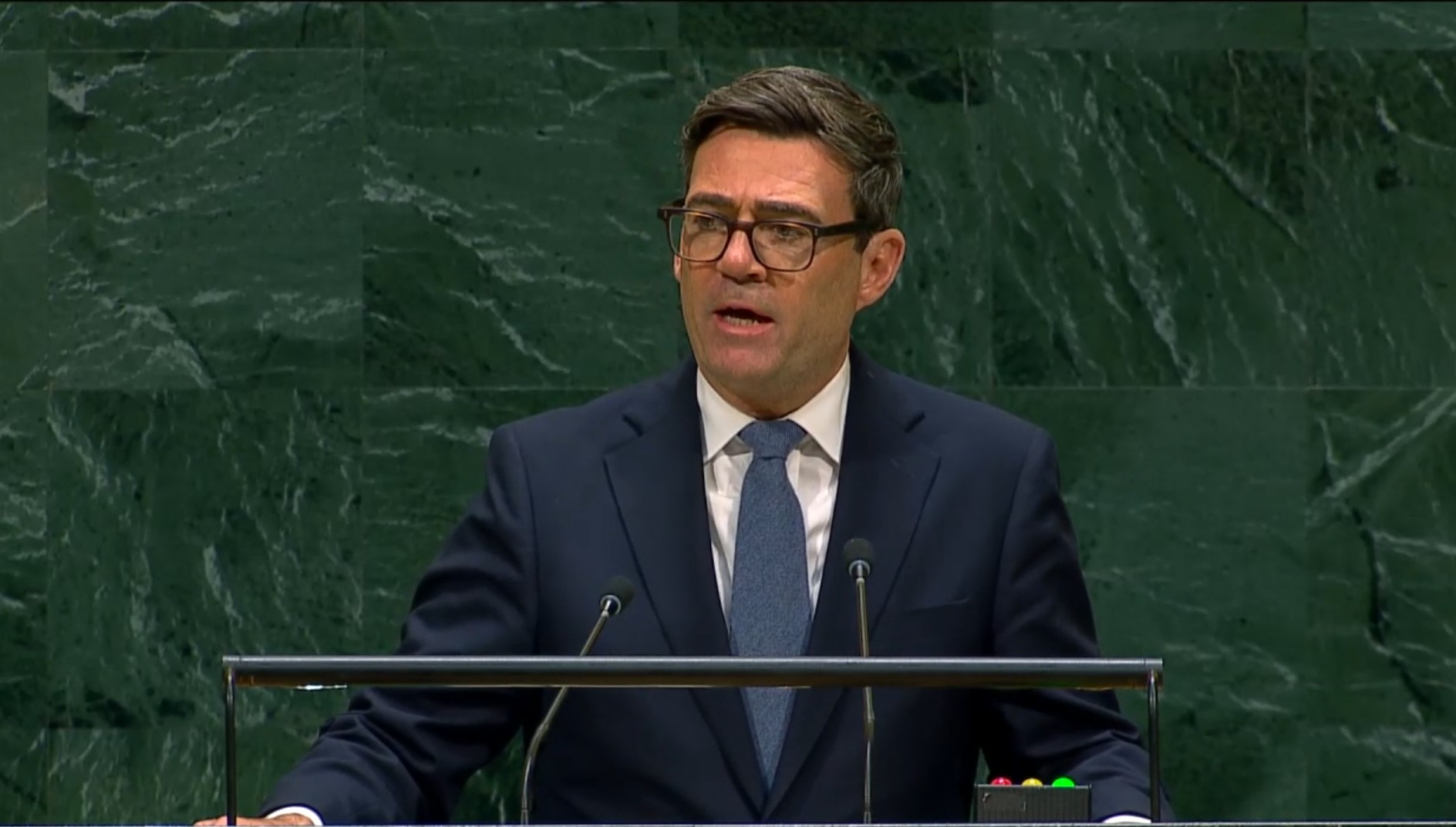
Britain has evidence that Russian agencies tried to interfere in the 2019 general election, the Prime Minister has told the United Nations General Assembly, as he tasked the country’s security chiefs with building a new National Centre for Information Defence.
Andy Burnham used his first address to the assembly, delivered in New York on Monday evening, to set out what he described as an industrial-scale assault by hostile actors on the information environment in Britain and among its allies.
He said: “Russian agencies have used every means at their disposal to spread lies and disinformation and prey on people’s fears. They’ve used bots and fake websites. Falsified newspaper articles. Forged the branding of 28 British organisations, including universities and the BBC. They’ve amplified far right narratives. And we have evidence that they tried to interfere with the 2019 General Election.”
He added that Russian agencies had also tried to stoke tensions and unrest in the wake of what he called horrific events, saying the idea that anyone would use such things to their advantage is repulsive but is what they do.
Putting a figure on the effort, the Prime Minister said the Kremlin spends around £1.3 billion each year on manipulating information, describing “an insidious campaign that reaches into people’s homes and twists what they feel about their own country and community, creating a narrative of decline, stoking division and sowing despair. We have tiptoed around this for too long. Over the last decade we have given too much ground to those who want to run a negative, corrosive narrative about life in Britain, which bears no resemblance to reality. Well, no more.”
He then announced a new body, to be built by the security services, with three functions attached to it. “Today I am tasking our security chiefs to begin work on a new National Centre for Information Defence, to detect, attribute and disrupt these kinds of hostile state information attacks. To support and defend our democracy,” he said.
Governments have generally been slower to name the source of an information operation than to acknowledge a cyber intrusion, partly because the evidence is circumstantial and partly because saying so publicly invites a demand to act on it.
Mr Burnham linked the threat directly to conditions at home, saying that someone struggling with the cost of living, or a young person not in employment, education or training, would be more vulnerable to that kind of influence, and that “faced with this information warfare, security starts in every home”.
Britain intends to share what it has learned with others facing the same problem, and the Prime Minister said the country had already supported Moldova in protecting its elections from Russian interference, and that with more elections approaching across Europe it stands ready to share its understanding of how these actors work and how they can be countered.
Cyber attacks on British companies and institutions were cited alongside the information campaign, with Mr Burnham warning that artificial intelligence will multiply the threat.
The commitment is part of a considerable body of work already under way across government, with ministers having committed to rewriting the War Books by the end of the year under an accelerated Home Defence Programme, and a national resilience public awareness campaign is due to launch later this year, while the Defence Secretary told the Commons this month that he would report back to Parliament with plans for a national conversation about the threats the country faces.










We are always going to have autocratic regimes willing to spend big disinformation operations, what we need to do is regulate and ban the American platforms that allow the filth to be spread in the first place.
When the CCP dictatorship has the Great Firewall of China, it is reasonable for Western Democracies to regulate traffic too. Every route to the greater Internet has to pass through a perimeter of nodes and interconnections where control is possible.
Telehouse London being a well known interconnection, and of course there are many others around the world.
Openness and network neutrality are founding principles of the Internet but that doesn’t mean that with good national security interest reasons some regulations isn’t appropriate.
Sanctions would seem like a good place to start since the geographical basis of the Internet is documented. So blocking interactions from sanctioned states is feasible. Equally VPN providers can implement rules to ensure that state funded cybercriminals aren’t able to impersonate ordinary people from the countries where their nodes are hosted.
Just as the RF Max app has a whitelist of crimlin allowed sites, western countries can blacklist orcZ and their cybercrime. The pron site blocks that many ISPs implement are much of what is needed..
Let’s do it.
unsure where younger people get their news these days, less from traditional mainstream media
At this point I have zero confidence in the main stream media, they very rarely print the news, rather they publish opinion pieces that are aimed to drive a narrative. They are all owned by people living abroad, so not sure any better than Russia interfering. Same with reform taking huge amounts of money from people living abroad. If you don’t live here and are interfering in our politics it means your doing it for purposes not aligned with the interests of the people that do live here.
Thats nonsense. Reform have only taken money from British citizens. Nothing at all.wrong with that. Nobody seems to kick up a fuss when Left Wing organisations take billions from George Soros, a guy that said on camera that working for the Nazis as a child was the best time of his life. The same George Soros that caused Black Wednesday and brought down the Bank of England. Why is is ok for Left wing parties to receive 300 million over decades but not Reform? You only like democracy when its your side winning.
British citizens that don’t live here and don’t pay tax here. How can they possibly have the interests of people that do in mind. Of course they don’t, they are trying to change the rules on crypto investments so they can make billions. Plus we don’t actually know the money has really come from them as they have both been convicted of money laundering and passing funds as coming from other sources.
Thats total horeshit. They just don’t align with your intetests so you don’t like it. You don’t care about democracy at all, if you did you’d be writing about the Left taking billions over decades. Soros and Gates aren’t British and nobody complains about them. You’re a hypocrite.
And you are another example of providing disinformation. Fitting for the article.
So true. Allegations without independant verification are barely a credible opinion.
All people and parties in political discourse should be held to the highest standards of openness and transparency.
In the UK, I suppose the Electoral Commission and Parliament should set those standards nationally for local and national government.
Anything less means corruption and foreign interference have a free hand, just as FSB prefer..
How is that vaguely democratc? You have two people throwing money at a party for their own personal profit at the expense of the millions of voters.
Why dont you talk about the contracts that are worth hundreds of millioms Labour has dished out on the bavk of donations?
There nothing undemocratic about British citizens supporting theur chosen parties. Your just pissed off they aren’t your parties.
What hundreds of millions, labour doesn’t earn that in a full election circle.
Labour and the Tories have had over 200 million each over the last ten years. You can’t cry now theres a new kid in town.
Firstly over 10 years and combined, more than 10 years and not from 2 people. Even the conservatives get most of their money from individual small donations. It’s insane the money and anyone that believes it’s not to buy tax breaks is very nieve.
I thought we were talking about massive cash donations to a far right party promising tax cuts to the rich from billionaires who have fled Britain to avoid tax while making all their money from ‘crpto’. i.e. helping money laundering and tax evasion.
I am unaware of George Soros giving any money to the Labour party or any group to the left of it. He does support lots of charities, indeed he us one of the greatest living philantropists.
George Soros is a vile man that supports any and every organisation that campaigns to ruin the west. Theres nothing philanthropic about him. He also was a Nazi collaborator at the age of 14. Hes on film himself saying as much.
Soros is Jewish. Are you thick?
You might want to look online at the video.
No. I don’t judge the things Jews had to do to survive under Nazi occupation. Especially when they were only children.
Cretin.
One of the British citizens has been resident of china for a decade.. just saying.
And convicted for helping people hide the true source of funds. Neither is rich enough to be throwing this much money at a bet that reform might win. The money is almost certainly coming from elsewhere. The police have open investigations into at least part of this as the funds were funneled through their mother
Just saying wrong. Thailand is not China
Ben Delo One of the guys who pledged 36 million have lived in Hong Kong for over a decade.
So what? Hes a British citizen.The Left have been taking money from Soros for decades.
I personally think large sums like that corrupt our politics and any money should be as clean as a whistle and have an auditable clean source..
Then union donations are tainted!
There have been quite a few police investigations into dodgy real estate investments by unions.
Don’t disagree.
I think it should be party dues as well a limited individual or organisation donations ( I would put all donation at a £100,000 a year cap)
I don’t really give a shit if you cannot have massive nationwide campaigns.. it should be all about the MP anyway.. it would do our political system good to have less campaign money.
Looking at the American democratic process and all the lobbying by companies and private interests, it’s clear that they can be bought which is a massive conflict of interest against the citizens they are said to represent.
What is different in the UK to make it any clearer?
All political parties that get donations should have a public register of that, including the identity of the donor, and their citizenship.
Ideally their reason for donation too…
The only way to protect the democratic process is for elections to be publicly funded with party political broadcasts in voter accessible media.
The alternative is a race to the ethical bottom with parties that represent companies and private interests, not voters.
Good news is young people don’t vote, it’s older people that believe every tweet or Facebook post they see that the problem.
I disagree, I think older people who grew up without internet/social media are more likely to spot misinformation.
Older generations listened to teachers, they read books, they read peer-reviewed research.
The younger generations are more vulnerable to cyber influence.
Revisionism, identity, and grievance politics shape much of their world view.
Yes I agree with that. Although this Burnham speech is political so is biased in itself. He say’s Russia interfered in the 2019 election but he does not tell us to what extent. Instead it’s all implied. Labour lost in 2019 because of Corbyn and brexit. Russia had very little to do with the outcome, I suspect. He does not mention the last election, why? Labour won, that’s why. So Russia did not interfere in that? Or he’s not telling.
I have tended to find that older people believe every single thing they see on YouTube & Facebook etc for the exact reason they have no understanding of the technology
YouTube & Facebook don’t require any skilled or special technical knowledge to watch or read.
It is no different from watching TV or reading a book, so I think that is a flawed argument.
I think that older generations are less likely to be impressed by online content and more likely to be influenced by tangible evidence.
Age is no factor. Impressionable people are easily led, not matter the medium or generation.
Dame Shirley Williams identified this problem in the eighties. It is a warning to democracy when generations of voters feel disenfranchised.
Seems to me tried is an incorrect statement, they did interfere with it. Tried indicates their attempts were countered, it doesn’t sound like they were. How much impact it had is another question but concerning either way.
The biggest disinformation peddler i see online is the BBC. We’ve had thirty years of British governments selling out the people with mass immigration, that nobody ever voted for, and im meant to be concerned about Russian disinformation? What a joke.
I think we have found one of Russias stooges right here 😂
“I don’t trust the BBC because it’s government propaganda , I get all my news off the back of a toilet door/ Twitter” 🤣
You’re such a strange man Jim. I’ve done alot more for this country than you have and i’ve got the Telic and Herrick medals to prove it. Im not anti British, the people allowing an invasion of this country clearly are.
Another perfect example of somebody trying to rubbish the British state or our institutions.
You dont actually beleive the BBC do you? Holy shit.
Notwithstanding its unfortunate tendency to ‘normalise woke’ on the whole I think the BBC is remains one of the most objective sources of news. Front page news on the BBC is exactly that, news, not opinion pieces or poorly dusguised ad-hominem attacks, which you often see in so called quality papers like the DT; or the ‘manufactured’ news which is the product of some odscure data analysis intended to stoke grievance, such as you see in the Graudian. Negative sentiments are destructive and spread rapidly. Right now its open house on the UK. Everyone is sticking the boot in. Israel is telling us to stop ‘occupation’ of the Falklands. Jim Radcliffe has ‘lost confidence’ in the UK is closing 3 chemical plants; Putin is piling in the cyber attacks and undersea ‘mapping’; Earl Spencer is dredging up ancient personal grievances and thinks its ok to trash the king; the Carribean nations are suing the UK for slavery reparations- supported by the C of E; the SNP, Sinn Fein and Plaid Cymru are trying to break up the UK, ably assisted by Donald Trump; expatriot crypto billionaires are attempting to subvert the very concept of the national community. The list goes on. Burnham is spot on in identifying the need for national ‘information defence’.
Total bollocks Paul but do carry on, it is entertaining if not informative.
Your speedy critical response is evidence of the problem…people just like shooting negativity from the hip. It’s easier than pausing and reflecting.
I rest my case M’Lud.
To be fair everyone is putting the boot in because for the last 2 years they have all seen a weak and indecisive PM in thrall to his back benchers, with a cabinet of individuals who are pretty much second rate! As a new PM comes in, unelected and with a long pre planned dodgy local election as his immediate step up, that shift in power is when a country and a Government is at its weakest! I don’t like Burnham or his politics but he needs to put on a decent tough show, in order to put these “bad actors” on a back foot and get a grip of his back benchers! Cheers.
Couple of thoughts.As a politician Burnham is in a different league to Starmer – he actually like people ( including wonen) rather than being afraid of them. Jealosy is a the root of a lot of the criticism of the UK by foreign actors like Russia and Argentina – its always easier deflect attention, to shovel your own #hit onto somebody else.
The problem is people now seem to trust random sources of the internet that come from anywhere over the traditional media in their own country. Which I’m sorry is a fundamentally bizarre place to be essentially when we know china alone employs around 3 million political warfare personnel to flood the internet with
1) any and all anti western government propaganda
2) anything that creates a fracture in western political discourse and society ( so anything on the fringes right or left and anything that sows mistrust )
We know this is true and yet every day we fall deeper into the abyss… led there arm in arm with Russian, Chinese and Iranian political warfare operatives.
I suspect Russia, China and Iran all try and interfere with every election, it shouldn’t be a surprise. I’m sure Russia would have been keen on a Corbyn government in 2019 and I suspect China is quite pleased with the current Labour administration, and all 3 could only dream of a Green Party government!
They don’t really care what government we have, they just want us utterly split and mistrusting.. which is why the promulgate anything that causes mistrust and potential hatred..
Mass marches about Gaza check
Mass marches about illegal immigration check
Getting the far left to attack military aircraft check
Getting the far left to march in black balaclavas and start attacking national institutions check
Get everyone to mistrust and media that says something they don’t agree with check
Say everything the government does is wrong check
It’s probably both. Creating disharmany and backing whatever politician / Party they think best serves their interest.
I think to be honest they will throw their weight into whichever parties serve to increase that disharmony.. we know they throw in behind the nationalist parties, I’m betting restore, reform and the far left elements in labour ( the one thing Starmer did well was kicking the corbinites in check).
In reality your always going to 10% of the population at the far left, fair right, 10% are probably radical religious types then about 20% each that are essentially left wing or right wing and 30% in the middle that just want it working and don’t care about political wing dogma ( the middle)… what the enemies of the UK are always trying to do is strengthen both ends as well as the extreme religious types and make those voices louder and seem like it’s all apocalyptic.
This being the goverment that want to stop search engines showing media they disagree with and only show ones that agree the party line? Sorry there just as untrustworthy as everyone else. Left Right all of them
The problem is that’s what the enemies of our nation are trying to get you to the point of believing.. because then there is no national will to fight.
I love my country and its people just not its leadership
I this is where we need to take the most care.. disagreement with what our government is doing and not loving them is fine.. we live in a liberal democracy and generation on generations of our forebears for a good 800 years have bleed and suffered to bring us to this blessed place where we can tell a government when we think they are going wrong and then after a time we have the power to judge our representative to that government in a vote.. but what we must not do is show hatred or consider then the enemy or allow some foreign power to convince us they are the enemy.. they may be wrong but they are not the enemy.. only a government that removes our democracy should we class as an enemy ( and on that day will take up my gun and storm the palace gates).
It’s not about thinking our government is right or wrong or just following what the left or right want.. it’s about how we disagree.. because we want our ability to disagree to be our power not the weakness that sunders us and lets authoritarian arse wipes like Putin win.
Well said!
Oh my days, you couldn’t make it up, we are to believe, the Russian commies, attempted to prevent the British people from naturally voting for the British commies in, and preferred to instill a conservative Govt! The sheer audacity and lies from this countries Left wing is nothing less than portentous!
Russia is not communist.. far far from it..it’s as far right as your going to get.. infact it’s a true fascist state.. it’s why it’s so ironic Putin calls the Ukrainians fascist invaders.
Reform voters tend to be 60 + , reform have frightened them over immigration. Young people on the whole do not believe the rubbish and lies and the bile Farage spills.
You must realise Farage is a Russian Asset. His sidekick for 10 years, who he denied knowing (Nathan Gill) was jailed for 10 years recentley for supporting and receiving money from the Russians. Supporting the invasion of Crimea. Farage said exactly the same good things about Putin and Russia, but hasnt admitted to taking money. Knowing how much he loves money, I wouldnt be surprised if he did.
If Farage loved this country he would not try and cause the violence he has been. Eventually this will come out.
Oh dear, a new poster on this subject, ranting and frothing against Farage, must be genuine eh! Maybe our unelected clown in charge has a point eh?
The internet is a swill heap, infested with random clowns, of course Russia and China are flooding it with garbage (you may see a few on here) and I agree an actual organisation needs to be centralised to deal with it! However, with the way a large chunk of the population currently think of this Labour Government, stand by for quite a lot of domestic “mission creep” where the none socialists and the most vocal anti-left, certainly those online with a following, start to be investigated and “closed down” using whatever powers this organisation will have! Sad to think like this but this Government and the last to a large degree, are two of the most dishonest and incompetent I personally have experienced.