

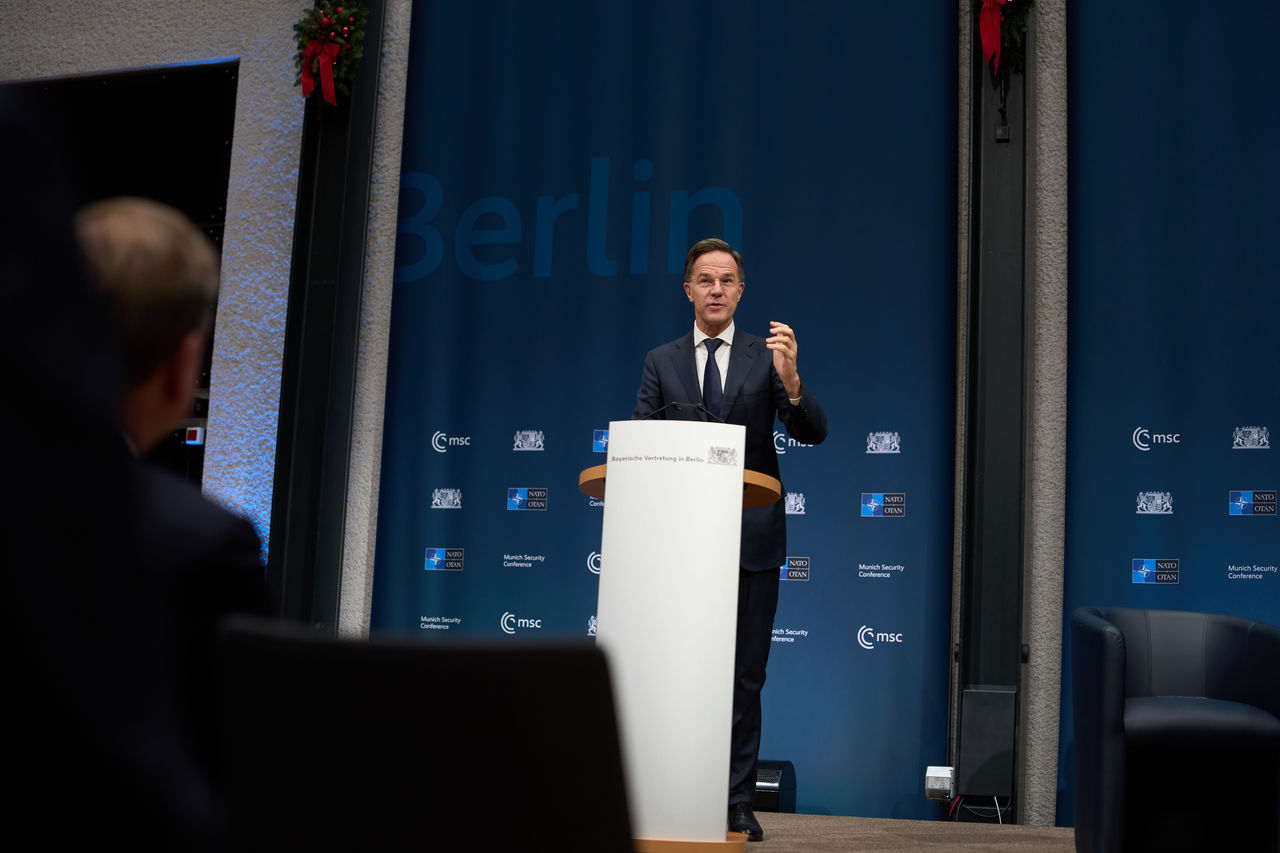
NATO Secretary General Mark Rutte warned that Russia poses an escalating threat to the alliance and urged faster action on defence investment and industrial output during a keynote speech in Berlin.
Speaking alongside German Foreign Minister Johann Wadephul, Rutte said NATO had taken significant decisions at the alliance’s summit in The Hague, including an agreement to invest 5 percent of GDP in defence and security-related areas by 2035, according to NATO. He argued that these steps were necessary in response to what he described as increasingly aggressive Russian behaviour toward both Ukraine and NATO members.
Rutte said Russia’s war against Ukraine remains central to NATO’s security outlook. He stated that Moscow has significantly increased its use of drones and missiles against Ukraine and expanded defence production, figures which NATO assesses as placing sustained pressure on Ukrainian air defences. “We are Russia’s next target, and we are already in harm’s way,” Rutte said in remarks quoted by NATO.
He also linked Russia’s military capacity to external support, asserting that China plays a critical role in sustaining Russia’s war effort. According to NATO’s assessment, a large share of electronic components used in Russian drones and missile systems originate in China, alongside additional support from Iran and North Korea.
Rutte highlighted NATO’s continued military assistance to Ukraine, including the Prioritised Ukraine Requirements List initiative, or PURL. According to NATO, the programme channels US-produced air defence missiles and ammunition to Ukraine, funded by European allies and partners. Rutte said that since its launch, PURL has supplied a substantial share of missiles used by Ukraine’s Patriot systems and other air defence assets.
Germany’s role featured prominently in the speech. Rutte cited Berlin’s plans to increase defence spending to 3.5 percent of GDP by 2029 and to expand domestic ammunition production, including new artillery shell manufacturing capacity, according to the alliance. He described Germany as a leading contributor to NATO’s deterrence posture and industrial base.
Beyond Ukraine, Rutte said NATO has strengthened its defences along the eastern flank through missions known as Eastern Sentry and Baltic Sentry. According to NATO, these operations are intended to address airspace violations, undersea infrastructure threats and other forms of hybrid activity attributed to Russia.
During a moderated discussion, Rutte addressed questions about negotiations to end the war in Ukraine. He said the United States is leading diplomatic efforts and that European allies are providing support, while cautioning that Russia’s willingness to accept a lasting settlement remains uncertain. “We have to test Putin on whether he is serious,” he said.
Asked about differences between NATO’s assessment of Russia and language in the recent US National Security Strategy, Rutte emphasised that, in his view, Washington remains committed to European and transatlantic security. He said NATO’s increased defence spending commitments respond to long-standing US concerns about burden sharing, according to the organisation.
Rutte concluded by warning that without sustained investment and unity, the risk of wider conflict would grow. He argued that NATO’s collective defence commitments, including Article 5, remain the central deterrent against further escalation, according to NATO.









In other news the sun is hot.
I’ll believe it when I see it. Nearly 4 years into the 3 day special military operation and I have yet to see any evidence russia is a legit threat to NATO
These clowns can’t even defend their own airspace from Ukrainian drones and missiles
Agree, it’s all Fear Porn being blown out of his posterior 🙄.