

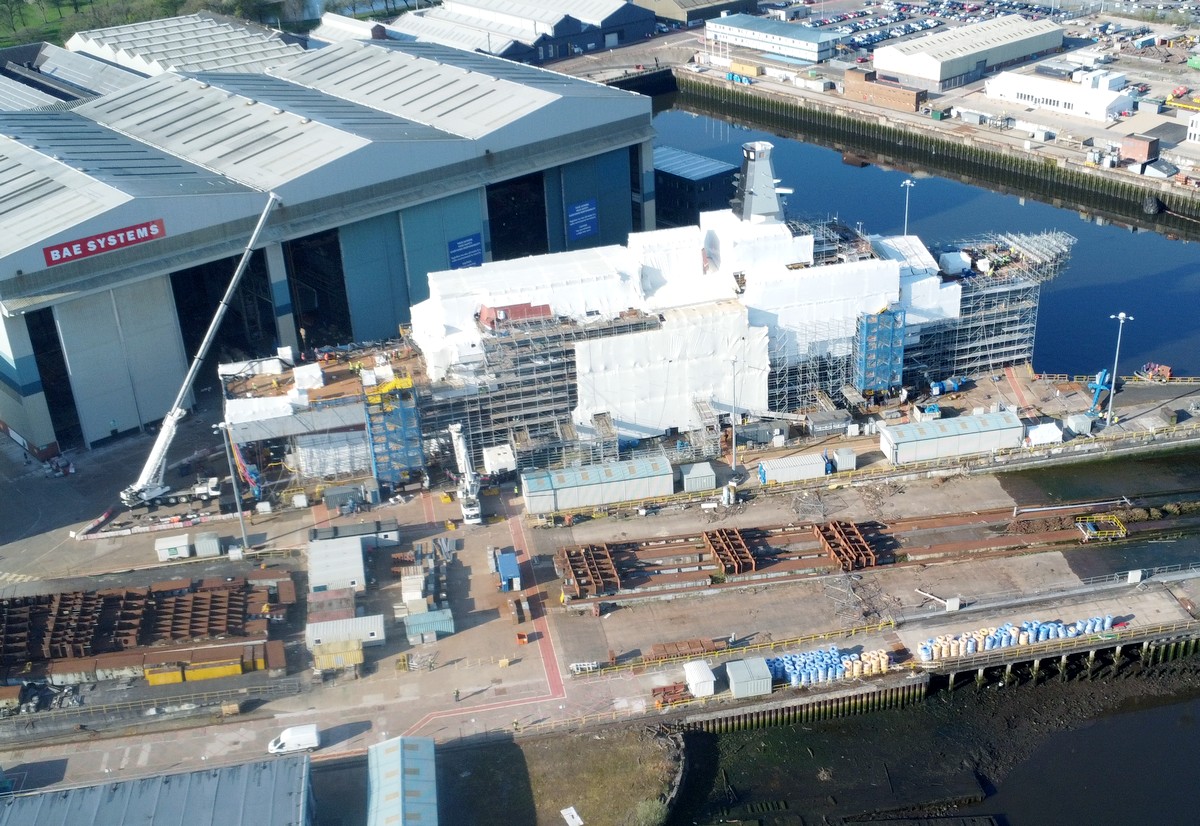
The flurry of new shipbuilding announcements risks introducing overcapacity and a return to boom and bust unless the government matches them with a coherent industrial capacity plan, the Scottish Labour MSP and former shipbuilder Paul Sweeney has told the UK Defence Journal.
Speaking after the UK-Netherlands amphibious ship agreement added another programme to a growing order book, Sweeney said the sector is “getting into a position where we potentially introduce an overcapacity,” and that balancing capacity against the demand signal is “the key challenge we’re really facing, and that’s what the National Shipbuilding Strategy was trying to address, and we seem to be drifting from that coherent approach with a series of disruptive decisions around shipbuilding programmes.”
The government, he argued, is announcing faster than it is planning, because “I think the government needs to step up and be clear about where the build locations for these programmes are going to be and how it plans to maximise all shipbuilding procurement through the Defence Investment Plan into British shipyards.”
‘We don’t have enough demand’ for more surface shipyards
His prescription begins with formally designating the core surface naval shipbuilding sites, which he identifies as Govan, Scotstoun and Rosyth, on the grounds that “we don’t have enough demand for any additional shipyards for naval construction in the UK without risking a boom and bust cycle, like we saw in the past with Portsmouth when the aircraft carrier programme ended. I think what we need to be doing is keeping this focused on core naval surface shipbuilding yards which have a clear demand signal for a sustained long-term drumbeat of ship design and construction.”
Drawing on his years in the industry, Sweeney walked through how a genuine capacity plan is assembled, from ordering shot-blasted steel plate and bar through the panel lines at Govan and Rosyth, into unit fabrication, block assembly and the final assembly halls, asking of each stage “what’s your monthly, annual capacity,” before working out “what’s the overspill, so what are you then going to subcontract out to your secondary yards,” since establishing what the core facilities can deliver and how they are sustained long term must, in his account, come before anything else, “because they’re your core naval shipbuilding sites.”
Sustaining those yards is a matter of tonnage and time, in his telling, because “ultimately, these yards need x thousand tonnes of steel going through them a year to sustain them, and they also need a major design interval as well, of one every ten years or so, and we’re approaching that focal point with the design cycle at BAE Systems, and we’re risking a falling off in steelwork demand through Rosyth as well, particularly dependent on this Danish contract award for Type 31.”
His answer is direct government action, since ministers “should be directly awarding this to sites as appropriate to smooth demand signal and to sustain capacity at its core naval shipyards that are required to sustain the baseline sovereign capability to build surface ships, which are Glasgow and Rosyth,” with spillover “marginal, but a bonus” for other sites whose challenge should be winning commercial contracts, an objective on which he said the national strategy is “really weak, and we need much more work on.”
Call for an ‘Airbus for shipbuilding’ in the UK
Sweeney also raised questions about the long-term intentions of overseas owners in British shipbuilding, cautioning that companies with commercial shipbuilding experience abroad have yet to make clear whether they intend to bring that work to the UK or to focus on naval orders alone, and suggesting the test will be whether they seriously try to pivot UK shipbuilding into the commercial market and invest in the yards for the long term.
Diversification of that kind is, he said, “very difficult to do in the UK without a coherent national plan, particularly around state financing for commercial shipbuilding contracts,” and he argued that supporting yards to win commercial work should be a central objective of the national strategy.
Fragmentation, on his analysis, is the structural fault beneath all of it, and consolidation the answer, because “what I’ve called for is an Airbus for shipbuilding in the UK, we basically need the British equivalent of a Navantia or Fincantieri, and this fragmentation actually is problematic for the precise reason I’ve just set out,” with capabilities such as pipe manufacturing, electrical and sheet metal work shared and integrated across sites rather than duplicated.
He noted that the incoming Prime Minister has set the direction himself, with Andy Burnham having indicated his goal of maximising shipbuilding procurement through the Defence Investment Plan into British yards, down to the tugboats, work boats and floating docks being delivered for the Royal Navy.








For years the SNP has refused to accept there was a shipbuilding programme in Scotland. Now it looks like it’s going tits up thanks to thanks to Starmer, the member for Scottish Parliament is panicking.
Well, anything to change the topic from the Theft and Corruption in his party.
Sweeney is Scotish Labour.
Sweeney doesn’t understand the concept of scheduling. This boom of shipbuilding isnt happening all at once.
Paul Sweeney does understand scheduling in shipbuilding he literally in the shipyards he’s talking about he work as production engineer and operations management
I don’t think he should be worrying about boom or bust. What he should be worried about is all the money disappearing to other parts of the country producing far smaller drones or modules which could be made in Watford or wherever and put together in any port.
Perhaps the SNP should be angling to retain as much work as possible by investing in people and facilities.
Boom and Bust! A favourite of Mr Gordon Brown.
The funny thing is that the boom is here already. Worrying about the bust is pointless.
We need kit and fast however one way or another we need to keep the pipeline flowing. It isn’t going to dry up at least not until we get world peace and a stable source of cheap energy for all. Not holding my breath.
Govan will be busy through till 2035 building T26 frigates.
Rosyth is building T31 frigates till 2030-2032.
Belfast is building FSSS until about 2033-2035.
Barrow is building SSN-AUKUS and Dreadnought ought to 2055-2060.
Appledore is building FSSS blocks until the early 2030s.
Confirmed, but yet to be distributed programmes are the ATS (formerly MRSS), the CCV (formerly T83) and the T91, T92, T93 and T94 LUSVs.
Rosyth gets the CCV. Belfast gets the ATS (and then the Tide-replacement programme). Govan is fine for some time, but can switch to new OPVs and LUSVs in the late 2030s. Barrow is fine. Appledore can build LUSVs.
Sweeny is complaining because BAE thought T83 was in the bag. He used to work at Govan.
Thought that might be the case, thanks for the information.
Yes both of them 😀
£3 billion a go, how many were we ever going to get?
Well quite. Personally I’m delighted, because the idea that we could get more hulls by using the cheaper A140 (an excellent AAW platform) had crossed my mind previously. Would be nice to put evolved SAMSON on it, so perhaps BAE still have an opportunity there.
He is more concerned that these future builds will happen outside Scotland ie Belfast.
Why the Navy or country should wait until there is free capacity in Scotland is beyond me.
Implying that all future build should happen in Scotland is rather silly.
I’d rather Govan got the CCV and Rosyth the OPVs and LUSVs, but otherwise I agree; it will be more efficient in the long run to have Rosyth as the ‘junior’ yard retaining just enough expertise to beat BAE with while the huge corporation able to build every system in a warship stay as the high end builder.
There is also the Point replacement for Belfast to get stuck into, there is no end of work on large ships for them to do.
Govan just doesn’t have the space in its build schedule to match the mid-2030s entry to service for the CCV. With the rumoured use of an AH140 hullform as well, Rosyth makes more sense overall (and needs the work more).
I’d rather have a pair of high-end warship builders, given that it increases competition and redundancy across the industrial base, although it is harder to maintain.
Govan should be building the bigger and more complicated ship it a more complete and experienced shipyard compered to Rosyth and Appledore
Govan doesn’t have the space.
Govan will be building T26 well beyond 2035, we will be lucky if they are all launched by 2040.. 13 is a lot of boats and they have only launched 2 9 years after the first keel was laid down..
Absolutely, but I think it’s better to be optimistic with the timelines as so to ensure that there is always something to build.
Missed the EUSTON.PROJECT…!
Most of these places have room for more build halls and if not there then other parts of the country.
We are not up to capacity when the capacity could be increased. T26 recently got a lovely new build hall underwritten by the client I believe in case the work dries up.
Ah but there Is plenty more work yet….. “1000 Ships” will take some time.
Oh and, where the heck Is TorpedoJ ?
Yu wot?
I’ve been on holiday, sir. Saw a trio of Rattler USVs pirouetting very neatly in Stokes Bay this afternoon. A P2000 headed past too but it only stopped briefly by them before heading on up Southampton Water.
We are to get a 1000 ship Navy…. apparently !
Oh good, I thought you might have jumped ship !
Yup I think a slip of the tongue .delete ships, insert boats.
He is right of course, after these companies have carefully gotten the UK shipbuilding industry back from the brink, they are once again on the cusp of betrayal and collapse.
We have to realise that companies need steady and large order books in order to meet their shareholders need for a return.
The need for us to invest and commit to that investment has never been greater than now, it actually not that much money when spread over 50 yrs, comes out at £5-8bn pa a lot of which we get back in income tax, companies tax and all the benefits of having people working instead of claiming benefits
I much prefer paying people to work and getting something back that is useful for the nation, than paying them to do nothing. It’s a choice
We have just had confirmation of 10 more ships in the 2030s… that’s before the T9x that’s plenty to keep them running into the 2040s.
that’s the problem – with this type of investment you need longer timeframes than 10 yrs to make it work
Babcock and BAES have sunk hundreds of millions into facilities and workforce, if you are leaving school and looking for a job do you really want to go into the shipyards when you know its famine or feast. Add in the fantasy 1k strong unmanned fleet which is a further 40 vessels per year (which will never happen imo)
the UK needs to be launching 2 surface ships(100m +) to maintain a small yet credible Navy with support fleet, we had this less than 10 yrs ago. That is a 50 strong manned surface fleet – hardly beyond our capabilities is it?
the orders do not support this tempo – hasn’t in years. successive governments have slowed builds and then complained about costs – but most of the costs are fixed, so it stands to reason if you slow something down by several years the cost per unit increases, most stark example is the carriers which were on schedule to come in £1bn less until HMT took the deliberate decision to slow the work down, bizarrely to save money (in yr)
There’s no job security and no orders security – why would anyone invest until this is resolved.
FYI – 10 yrs ago the fleet stood over 75 vessels – it is now a shadow of that with many ships not replaced and gapped. There also isn’t confirmation that 10 more ships are coming in the 2030’s as that isn’t supported by any orders. You have fallen for the same tricks they always pull (MRSS, MRS, LSD etc.).
A press release is not the same as hard cash in a contract.
Long term planning is the problem. We need to have rolling programmes rather than lots of one-off contracts. As one ship class ends production, production on the successor needs to be already started. Up to 12 subs? Fine. And when number 12 is finished production of the first one of it’s replacement class needs to be started. Same goes for aircraft. We need continuos production, not stop start.
The subs are a little different, because there’s just a single yard responsible for their construction, and so rather than jumping directly to construction of the SSN-AUKUS replacement in 2055-2060, they’ll move to beginning the decade-long process of constructing the replacement for the Dreadnought-class SSBNs, and then, once that is complete, start working on a fresh attack submarine batch. Same principle though.
Snp complaining about uk national ship building yet the snp fails to place contacts for calmac ships into scottish yards.
Given the Scots government have control over calmac and a Scottish yard, this weakens any argument he has.
He’s a Labour MSP….it’s literally the 2nd line in the article.
this is a controversial take I’ve used before, shipbuilders are shipbuilders they should be able to build warships and civilian ships the same they shouldn’t be we can only build one, when a shipyard becomes dependent on defense contracts they are at the mercy of the MOD , they should be biding for the specialist and high value civilian ships (Research vessels, Wind farm support vessel, Icebreakers, Dredgers, Heavy lift ships, Ferries etc) before defense contracts dry up and doing civilian work when not doing the defense , Cammell laird now (Balaena group) seems to be the only bigger shipbuilder in the UK that understands this
If recent announcements have been good for anyone it’s been good for British ship building. Two or three T83 replaced by 6 CCS and 3 MRSS replaced by 4 ATS plus a lot of drones.
When put like that !!!! 😁😁😁
Italy and France have the most successful hybrid civilian/military shipbuilding industries. Both have nationalized their main shipyards, they never stop building ships, they get plenty of export orders and the ships are built on their soil (as opposed to most T26/T31 exports actually being built abroad) and they successfully sell cruise ships which preserves the ability to build large ships.
Unless they copy some or all of this model, the British shipbuilding industry simply cannot survive off the RN’s orders and a few export orders here and there, expect if the Navy decided to double the size of the escort fleet (which won’t happen).
Fincantieri is not nationalized, yes Italy Government owns most of it- around 60% -via a sovereign fund but it is a public company. You can buy shares in Milan stock exchange.
And this very much brings us to models of state ownership and control and what are the most effective ways to manage critical infrastructure and natural monopolies that lack choice…
The Italians in its shipbuilding industry have essentially got it very right.. it’s essential state controlled and in all meanfull ways state owned… but the state stays hands free and uses that minority public stake to keep a profit motive.. while still getting almost all the profits back… its a blinding model.
It seems to me Sweeny (i.e. BAE) are complaining because the previous ‘aspirational’ fleet list has been replaced by a funded & committed pipeline. Isn’t that exactly what the NSS said was needed? BAE need to quit complaining, pull their socks up and be competitive with their bids.
Well it does when the Scottish government goes abroad for it’s ferries. But if instead we rebuild our navy we will be building ships for the next hundred years to get it to a decent size. Moreover we should be scrapping milibrains costly shit and then able to sell ship building to the world as we did in the past. There is absolutely no reason that we can’t when the Chinese, polish, Koreans etc. can
If Scotland does go independent..just how damaging will it be ….! Just from a Military prospective?
Shipbuilding moving South? Taking jobs with them!
Military bases closed?
Supply companies gone…?
Wonder what the jobs and monetary impact would be..?
If Scotland goes independent it will hurtscotland badly, it will mean we have to do some rearranging but I think we will cope better. However the point for me was that some of the current shipbuilding is in Scotland and frankly the Scottish gvernment are not supporting it even when using Scottish tax payer money.
The idea that buying foreign is cheaper is wrong, it is pretty much always wrong. If a police car (to stray away from ships) costs 20,000 from Germany and 40,000 from the UK the UK is still cheaper, you get tax back from those working, tax from the company making it, tax from the suppliers, tax form the workers in the suppliers, you dont pay unemployment and other benefits and working people commit less crime than those with diddly to do. This is the stupidity of our current system that emphasises cheapest price tag. The Germans, French, Italians, even the dumb Americans, dont use that stupd system, they look for best VALUE and that includes keeping companies employing people and existing. If all British poice cars had been Rover then Rover would be a thriving company. If all council vans had been LDV they would be a thriving company. The German police use Exclusively German vehicles and they infact have near 2 cars per policeman and never more than 6 months old so they ensure a steady income for the car ompanies which helps them invest.