

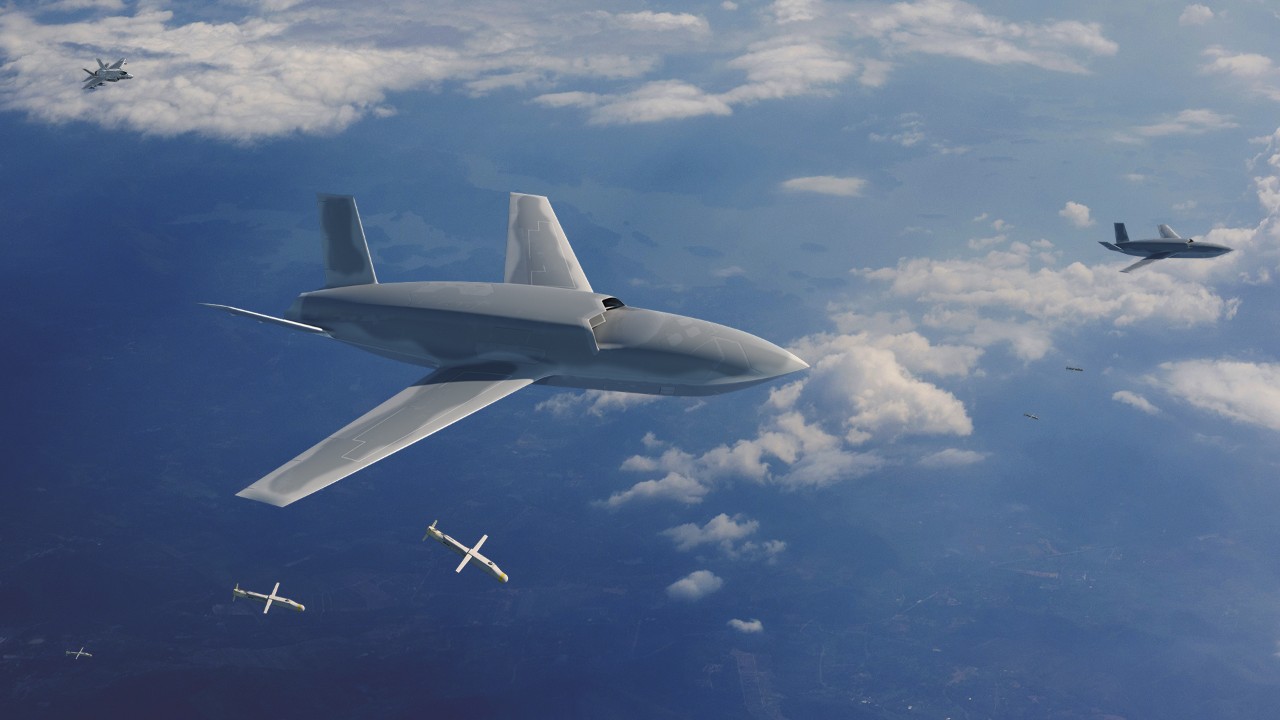
General Atomics and MBDA have committed to integrating the SPEAR precision strike weapon onto the MQ-9B remotely piloted aircraft and the Gambit 6 collaborative combat aircraft, the companies have announced at the Farnborough International Airshow, extending a partnership built through arming the RAF’s Protector.
The memorandum of understanding was signed at the show by General Atomics Aeronautical Systems President David R. Alexander and MBDA UK Managing Director Chris Allam, with the companies to work together to ensure both aircraft can carry and use the SPEAR weapons. “We’ve built an excellent business relationship with MBDA as part of the integration of the Brimstone missile onto the UK’s Protector,” Alexander said, as quoted in the press release. “So, working with MBDA to enable SPEAR on our broader MQ-9B line, and our Gambit CCA, feels like a very natural extension of our partnership.”
“The consolidation of MBDA’s relationship with GA-ASI is a testament to the strength of our long history of cooperation, most recently with Brimstone and Protector,” Allam said, as quoted in the release. “Remotely piloted aircraft and autonomous/collaborative platforms, such as MQ-9B and Gambit, are revolutionizing modern air combat. Integrating the innovative capability of SPEAR multiplies the effect these platforms provide into decisive operational advantage.”
SPEAR is MBDA’s miniature cruise missile, described in the release as a next-generation air-launched surface attack weapon providing a low collateral damage precision effect with a high load-out for persistence, reaching beyond the horizon so the launch aircraft remains safely away from hostile air defences while retaining engagement capability across a broad threat set.
Developed as SPEAR 3 for internal carriage in the UK’s F-35s, where eight can be carried in the weapon bays, the network-enabled missile pairs a turbojet with a multi-mode seeker to hit moving and relocatable targets at ranges far beyond the Brimstone it complements, and putting it on uncrewed platforms would spread a stand-off strike weapon bought for fifth-generation fighters across aircraft that can be risked more freely.






Good, hope they progress quickly with this. Aside from anything else, it gives an operational launch platform to MBDA to finalise whatever development issues they may have with Spear itself. That part of its development has been hampered by delays in the F-35 programme I believe, plus the RAF’s incomprehensible decision not to integrate it into the Typhoon fleet…
You’d think with new radars they’d put it on the Typhoon’s? Aren’t Italy ordering this for there’s too and they already have the Marte ashm? Maximise the capability of Typhoon while waiting for the F35Bs to get sorted.
I couldn’t agree more- the RAF seem to be deliberately underutilising the Typhoons because they want the shiny F-35s. Even though the F-35s need to be prioritised to max out carrier strike, and the Typhoon is going to be serving into 2040.
Frankly, this announcement that they’re integrating Spear onto MQ-9B also throws into question the assertion that F-35 needs to be Block IV upgrades to integrate with Spear. Unless we’re suggesting that the Protector’s sensor and combat suite is more advanced than a Block III F-35…?
I’d hazard a guess from my knowledge of software development, LM are just gatekeeping foreign weapon integration behind block IV not for any particular technical reason but because it would a) take resources away from block IV, b) integrating weapons for block III is a lot more effort than for block IV, c) it would more than double the effort because they’d have to certify it for both block III and block IV anyway and d) US weapons are taking priority though even some of those appear to have been delayed as well until block IV.
All of that makes sense, I wouldn’t argue.
Although, to your point b) and c), if I was the UK MOD, I would tell them to suck it up and do it for both- we’ll only be paying for one because of the delays to the aircraft delivery. For some reason we are playing awfully nice and soft….
Handy, but not really in MQ-9s useful range brackets as it isn’t really suited to flying below the horizon.
Will be good for Persian gulf boat-smashing or maybe volleying against a Russian corvette?
Yes, most corvettes in the Russian navy don’t have AD that’ll reach out to touch an MQ-9B at Spear ranges, a lot of the frigates only have maritime equivalents to BUK- which is also outranged by Spear. So a helpful capability to have for volleying off, as you say. That, plus the JSM, if I read the other article correctly!
Suspect MQ9 will be the testing / proving platform for remote ops with operational role out primarily on CCA once developed with some limited operational utility retained on Protector.