

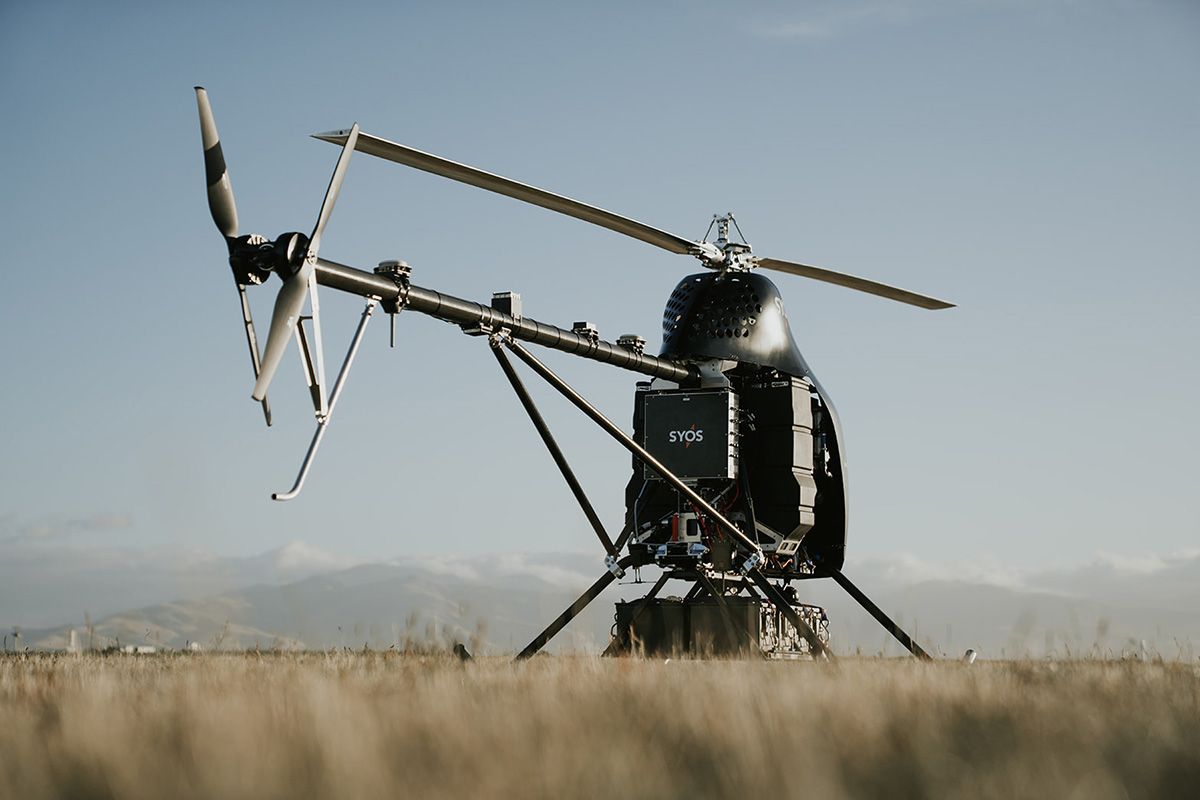
The SYOS Aerospace SA200 uncrewed autonomous helicopter has completed a series of fully autonomous mission trials, clearing the aircraft for serial production.
The trials, which concluded a five-year development programme, demonstrated the SA200’s ability to execute fully autonomous operations including take-off and landing from a moving platform, replicating ship-borne and vehicle-based operations. SYOS described autonomous operations from moving platforms as among the most technically demanding challenges in the field.
Sam Vye, CEO and founder of SYOS, said the SA200 “stands out for its ability to independently complete complex missions without human operation,” calling the milestone “testimony to the cutting-edge innovation and determination of our R&D and engineering teams.” Vye added that the company’s operational testing represented “some of the most difficult technically we could set.”
The SA200 is powered by SYOS’s AAIMS autonomy software, described by the company as an open architecture, platform-agnostic autonomy management layer spanning air, land and sea domains. According to SYOS, the software reduces operator burden, enables coordinated missions and swarming, and maintains navigation when satellite navigation or communications are degraded or denied.
The aircraft can carry payloads of up to 200kg and fly reconnaissance and surveillance missions in contested areas to a range of over 180km on standard 66-litre fuel tanks, extendable to 300km with a 150kg payload. Its modular structure is designed for rapid deployment and can be assembled or disassembled quickly for use in complex or dangerous environments. The SA200 incorporates anti-jam GNSS, encrypted data links and a self-healing mesh network, with vision-based navigation enabling continued flight in GNSS-denied environments.
The SA200 is a central element of SYOS’s participation in the UK Ministry of Defence’s Project NYX initiative, which aims to accelerate the development of uncrewed systems capable of operating alongside crewed platforms including Apache attack helicopters. Project NYX forms part of the UK’s broader push to integrate autonomous and uncrewed systems into its armed forces, with the Army in particular looking to develop rotary-wing uncrewed capability that can conduct resupply, reconnaissance and other tasks in high-threat environments.
Vye said the programme encapsulates the SYOS approach of “novel, ground-up thinking, and rapid development, in close partnership with the people who’ll use it and need to rely on it when it most matters,” adding that a focus on minimum viable capability levels and lean manufacturing enables the company to deliver the SA200 “at a highly affordable price point.”





Heavy lift ? 200 kilo’s…Put a Ford Transit on floats? It can carry 1400 kilo’s. 🤔
I’ve gained $17,240 only within four weeks by comfortably working part-time from home. Immediately when I had lost my last business, I was very troubled and thankfully I’ve located this project now in this way I’m in a position to receive thousand USD directly from home. Each individual certainly can do this easy work & make more greenbacks online by visiting
following website—.,.,.,.,.—>>> JobatHome1.Com
Doesn’t the bae systems backed uav have a 300kg lift?
Yes. I think the Schiebel S301 and the Tekever ARX also outlift it. I don’t know what the Anduril hybrid-electic system will do; however the marketing blurb reads “best-in-class payload capacity — far exceeding the programme’s requirements.” So it probably will outlift the SA200 as well.
So is this supposed to be in direct competition for Project NYX with the Certo Capstone we read about last week? I have doubts!
The Syos can lift up to 200kg over 180km or 150kg over 300km and 2 hours endurance (8 hours and 1000km with external fuel tanks). Capstone claims maximum payload capacity of 300kg and an operational range of up to 480km and 10 hours max endurance, but doesn’t reveal the direct weight/range trade off. Both boast good autonomy and anti GNSS-denied capability. It feels like Capstone wins out on top-trumps capability, which left the slightly lighter Syos SA200 to bid on cost.
However, the Syos has been reported as already out of the running, eliminated along with Lockheed and Leonardo. My source was FlightGlobal a week or two ago. Search “Nyx picks: UK MoD selects four contenders for Apache ‘loyal wingman’ project”. The downselected were: BAE Systems offering Capstone, Thales offering Schiebel’s S301, Tekever and Anduril, both offering their own platforms.
It’s Amazon what they can do nowadays.