

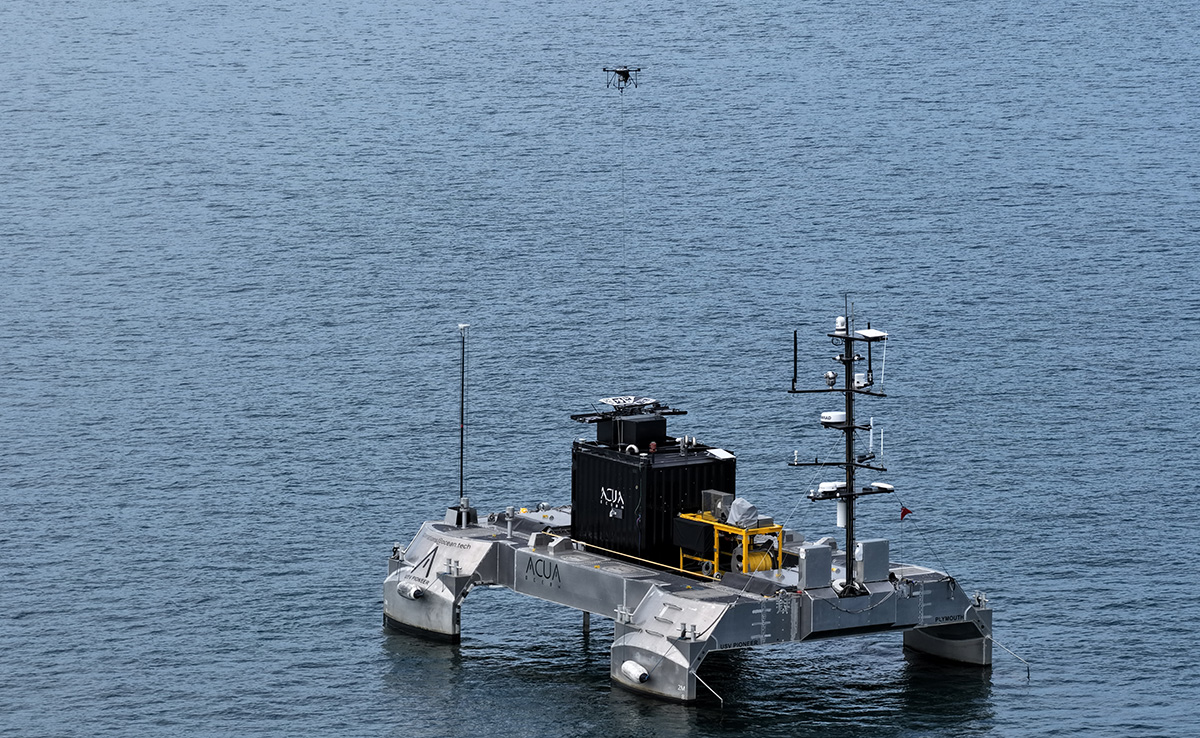
ACUA Ocean and Teledyne FLIR Defense have completed two days of demonstrations to the UK Ministry of Defence and offshore industry partners, showing an integrated tethered uncrewed aerial system operating from an uncrewed surface vessel under funding awarded by UK Defence Innovation, the UK Defence Journal understands.
The demonstration, held in Plymouth, saw Teledyne FLIR’s SkyCarrier platform autonomously launch a SkyRanger R70 drone operated remotely from ACUA Ocean’s USV Pioneer, which the company describes as the UK’s first Lloyd’s Register-certified remotely operated uncrewed vessel. The trial was intended to validate the technical integration of the tethered aerial system with the Pioneer’s modular payload architecture and to test the combined system’s performance in open-ocean sea states, ahead of further development and potential commercial deployment.
In its tethered configuration, the SkyRanger R70 was launched from its SkyCarrier container and flown from the Pioneer via a managed power and data tether. According to the companies, this arrangement removes reliance on onboard battery endurance and allows continuous aerial surveillance slaved to the vessel’s position, extending the surface platform’s surveillance reach from the waterline to altitude.
USV Pioneer has previously completed multiple Royal Navy intelligence, surveillance and reconnaissance and anti-submarine warfare demonstration contracts. In January 2026 the vessel operated in 4.25-metre wave heights, with ACUA Ocean reporting a 60 percent reduction in roll and a fourfold reduction in peak roll rates compared with monohull designs. The SkyCarrier system is designed to enable autonomous drone deployment from land vehicles, maritime vessels or fixed sites, with a ruggedised container that protects the aircraft when closed and unfolds into an articulating launch and landing pad. The SkyRanger R70 carries embedded NVIDIA processors for real-time object detection and classification, four computer vision cameras for autonomous operations, and a stabilised electro-optical and infrared payload suite.
The companies state that the combined system addresses a requirement identified by the Royal Navy for persistent, long-endurance maritime awareness without exposing personnel to risk, with relevance to anti-submarine warfare support, mine countermeasures, intelligence gathering and the protection of critical maritime infrastructure.
Neil Tinmouth, CEO of ACUA Ocean, was quoted in the press release as saying: “Securing UKDI funding for this demonstrator is a significant milestone for ACUA Ocean and for UK maritime autonomy more broadly. Integrating the SkyRanger R70 with the Pioneer creates something genuinely new: a persistent, deployable multi-domain ISR capability that the Royal Navy can put to sea today. Teledyne FLIR Defense bring a battle-proven, operator-trusted UAS to a platform that is built, certified and ready. We look forward to demonstrating what this system can do.”
Richard Cunha, Principal Product Director for Unmanned Aerial Systems at Teledyne FLIR Defense, was quoted in the press release as saying: “The SkyRanger R70 has earned its reputation in the most demanding operating environments in the world. Pairing it with the Pioneer Mk2’s exceptional sea-keeping capability and endurance opens up a new class of persistent maritime ISR mission that simply wasn’t possible before.”
UK Defence Innovation serves as the Ministry of Defence’s focal point for defence innovation, backed by a ringfenced annual budget of at least £400 million to fund exploitable technology and accelerate the delivery of capability to the UK Armed Forces. ACUA Ocean, founded in Plymouth in 2020, builds uncrewed surface vessels for ocean data collection and defence applications, and its Pioneer-class vessels were the first uncrewed craft to receive UK MCA Workboat Code certification.




Nice weather for it.