

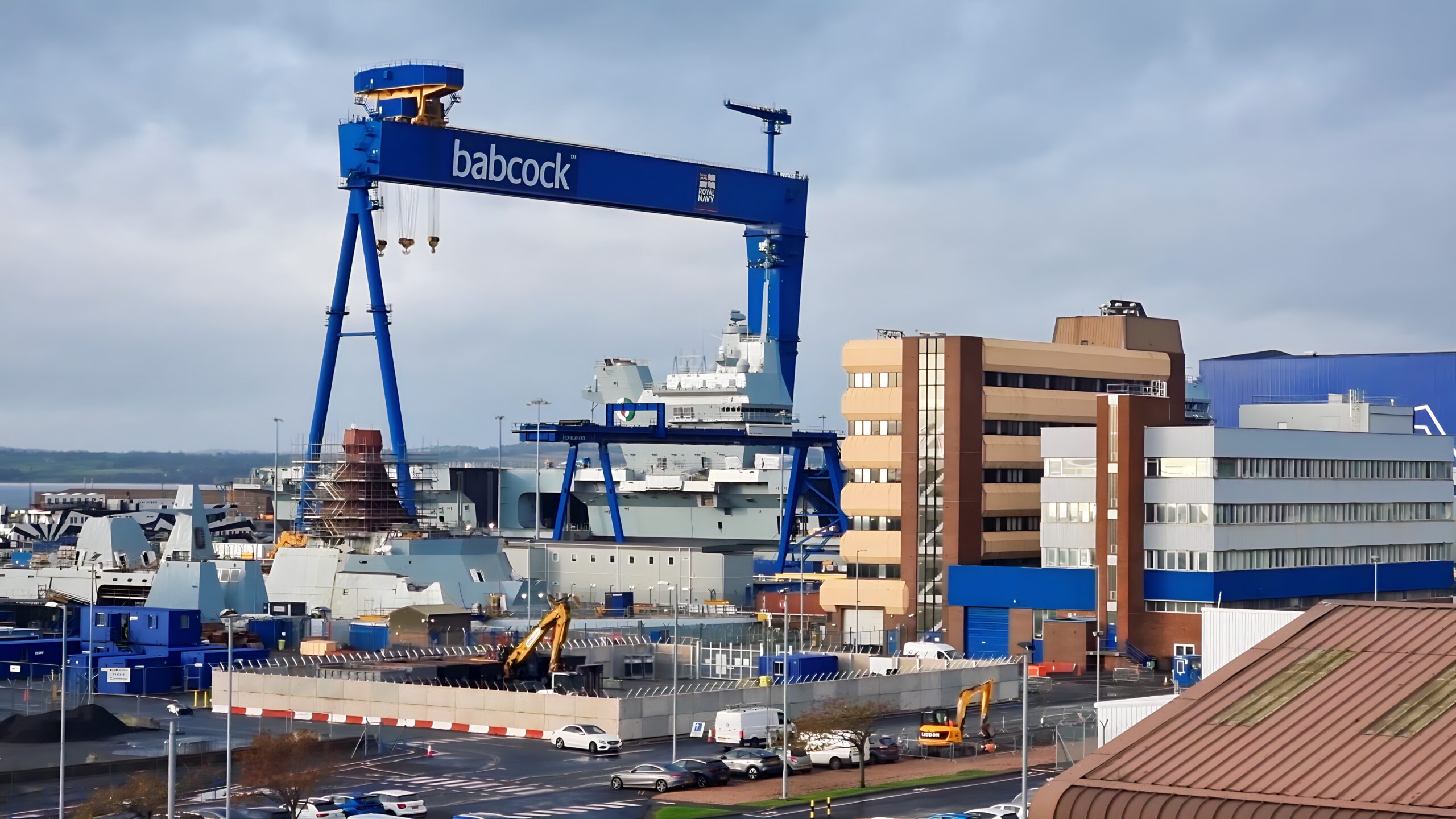
Much of the public narrative around Rosyth still centres on visible outputs: frigate blocks, rollout ceremonies and export announcements. That framing understates the scale of what is changing inside the yard, and it obscures where Babcock now believes its real industrial advantage lies.
The more consequential shift underway at Babcock’s Rosyth site concerns how ships are engineered, integrated and sustained across their service lives. Hull construction remains necessary, but it no longer captures the full measure of capability the company is trying to build.
Recent discussion around UK shipbuilding has increasingly touched on digital engineering, automation and whole-life asset support, though often without much emphasis. Public debate continues to focus on hull numbers and export campaigns, while Rosyth is being reorganised around software-managed processes that shape how ships are designed, modified and supported long after they enter service.
Babcock has made clear that future competitiveness will not be decided solely by the Arrowhead 140 design or the cadence of the Type 31 line. Greater weight is now being placed on systems integration, digital workflows and the retention of engineering authority across multiple platforms throughout their operational lives. This aligns with a wider shift in UK shipbuilding, where performance increasingly depends on data, modelling and modularity rather than sequential craft production.
At Rosyth, lifetime engineering now sits close to the centre of the operating model. The aim is to retain control beyond construction, allowing ships to evolve through digital twins, embedded sensors and condition-based maintenance, rather than relying on disruptive mid-life refits. For navies already struggling with availability and upgrade backlogs, that promise carries obvious appeal.
The rationale becomes clearer when set against broader naval thinking. Senior leaders have argued repeatedly that surface combatants must operate as adaptable nodes within distributed networks of sensors, weapons and uncrewed systems. Platforms that cannot absorb new technology at pace risk losing relevance well before the end of their design lives. Rosyth’s production philosophy reflects this assumption. Systems integration is being pulled earlier into the build cycle, and modelling tools are increasingly used to test production sequences, material flows and engineering decisions before steel is cut.
Some of these changes are now visible. The yard has been reconfigured to support digital workflows, automation and parallel construction. The Type 31 build strategy seeks to insert more systems at block stage, reducing downstream disruption and improving schedule predictability. Speaking this week at the keel-laying of HMS Formidable, Babcock chief executive David Lockwood framed the moment as more than ceremonial. “It’s really a signal of that drum beat of a frigate factory,” he said. “One in the water, one to a side here nearly finished in the hall, and the third one underway, and it’s a sign that we’re now building frigates in a professional, modern way.”
Rosyth’s evolution is not confined to surface combatants. Recent agreements with US industry point to a broader role. Lockwood confirmed that new work announced with Huntington Ingalls Industries includes “building components of the Virginia-class submarine, which is part of the overall desire to expand the capacity of the West to build submarines.” He added that “it’s the first off, and we expect it to lead to much more,” signalling Rosyth’s growing integration into allied supply chains rather than acting purely as a national asset.
The same logic underpins collaboration on future naval concepts. Babcock’s work with HII on what it calls ARMOR Force reflects interest in hybrid fleets combining crewed platforms with uncrewed systems. Lockwood described the partnership as one that allows both sides to “invent once, use many times,” emphasising a two-way flow of technology rather than a one-directional transfer.
Pace has emerged as a recurring theme. Responding this week to questions about urgency following recent naval conferences, Lockwood framed the challenge in two dimensions. “He’s looking for two things,” he said of the First Sea Lord. “One is pace of build, and the other is pace of innovation.” He argued that Babcock’s value lies in its ability to introduce change during construction and after delivery, integrating new capabilities as threats and technologies evolve.
Sir Nick Hine echoed that assessment when I spoke to him this week about progress since the Type 31 contract was signed. “We took a contract in December 2019 and we said we’d deliver five complex warships in ten years,” he said. “Here they are. Two and three are here, and four bits of four outside the dock hall. So we’re doing what we said we would do.” He accepted that pressure to accelerate remains. “Are we going fast enough? No, we never go fast enough,” he added, while arguing that current delivery rates compare favourably across the sector.
For Hine, Type 31’s significance lies in its adaptability. He described it as a potential backbone for a hybrid navy, capable of acting as a command platform for uncrewed systems with limited modification. “My offer to the Royal Navy was to deliver HMS Venturer and an unmanned surface vessel from HII as an initial operating concept for ARMOR Force in 2027,” he said. “It wouldn’t be everything, but it would be a really good start.”
Behind these programmes sits a broader corporate repositioning. Speaking earlier this year at DSEI, John Howie, Babcock International’s Chief Corporate Affairs Officer, described a role designed to align strategy, government engagement and international growth. “What we do is help join bits of the company together so the whole is greater than the sum of its parts,” he said. “We’re also trying to increase the volume of international business we have. We’d like to get to a better balance of UK and international.”
Export markets remain central to that ambition. Howie pointed to established positions in Canada, France, South Africa, Australia and New Zealand as platforms for further growth. The Type 31 programme illustrates the approach. “Before we’d even built the ship, we’d sold it to Poland and Indonesia,” he said at DSEI, adding that discussions now extend to Sweden, Denmark, New Zealand, Chile and “about 17 countries in total.”
Design choices underpin that appeal. Howie argued that scale and adaptability were deliberate decisions. “We’ve gone much bigger, more space, more adaptive, and that means export markets find it easier to reconfigure,” he said, adding that modularity also supports greater use of automation and robotics in UK production.
Rosyth’s role varies by customer. Some expect UK build, others prefer block construction or flat-pack delivery, while countries such as Poland have opted for domestic assembly. “I’m actually quite pleased how many people still look at UK build,” Howie observed. The same logic informs thinking on future support ships. “My view on MRSS has always been that it lends itself to the same model,” he said. “You need an assembly yard who can manage the customer, but you also need a network of yards that can contribute volume to get time down and cost base down.” Rosyth has space and planning consent for further expansion, though workforce availability remains the limiting factor.
Skills therefore sit at the heart of the transformation. A digitally mature shipyard requires workers able to operate robotics, interpret data and move between disciplines that were once tightly separated. Babcock has expanded apprenticeships, graduate schemes and reskilling initiatives in response. Howie highlighted the production support operative programme. “It’s a great way of getting people back into the workforce,” he said.
Looking further ahead, Howie framed Rosyth’s evolution as part of a deeper redefinition of the company. “Babcock today is a UK business with international operations,” he said. “The vision for Babcock is to be an international defence business headquartered in the UK, which isn’t the same. Philosophically, it’s quite different.” For Rosyth, that implies a role as an internationally relevant integration hub rather than a purely national build site.
That vision extends to how Babcock works with smaller suppliers. Howie acknowledged that SMEs often approach large primes cautiously. “We think if we can help SMEs scale up, productionise and get their products into bigger systems, that can help government directly and create growth,” he said. In practice, that positions Rosyth as a focal point for absorbing innovation across the supply base and turning it into deployable capability.
Reflecting on the company’s trajectory under David Lockwood, Howie described a cultural as well as structural shift. “Working with David has been fantastic because he’s full of ideas and lets us get on with stuff,” he said. “He’s got a strong moral and ethical background, he won’t tell government lies, and he listens. That helped us rebuild relationships.”
Over the past five years, Babcock has changed markedly, moving away from a more reactive industrial posture toward a defence business with clearer international intent. That shift has been as much about credibility and relationships as about programmes or platforms.
Those rebuilt relationships with government, allies and industry partners underpin the changes now visible at Rosyth. The move toward a continuous build rhythm, digital engineering and deeper international integration depends on trust as much as infrastructure. What is taking shape goes beyond a single frigate programme. Rosyth is being positioned as a long-term industrial asset within a more outward-facing, system-oriented defence business.
Whether that positioning holds will depend on execution under pressure. The test ahead is not confined to shipbuilding output, but to sustaining organisational clarity, engineering depth and credibility. If Babcock manages that balance, Rosyth may matter less as an individual yard and more as a reference point for how a UK defence company adapts to a harsher industrial and strategic environment.












Essentially Babcock are saying that they can build other designs than T31 if called upon to do so, and can develop and adapt those designs quickly.
“The aim is to retain control beyond construction”, however, just sounds like a cash cow.
“…JUST sounds like a cash cow” I think that is slightly disingenuous, Babcock is a business after all and cash cows are a very, very desirable aspiration for any business. Profit is not a four letter word.
“The aim is to retain control beyond construction”, Yes, Babcock is no longer defining its success just by the construction and delivery of hulls, they have pivoted to beyond just construction and delivery to optimising the entire operational life of the vessel, which we know can be decades. The physical ship is now just one part of a larger, continuous service offering, and this concept of continuous service is being welcomed by its current and potential customers.
Designing ships with modular interchangeable parts so that weapons, sensors, and digital systems perform harmoniously, rather than as separate, disparate components, this provides a platform for upgrades and customisations for new technologies to be installed far quicker than the established norm, insuring ships stay relevant throughout their lifespan with minimal fuss.
Palantir’s (Peter Thiel – Vomit!) Warp Speed software can manage the whole design and production process in real-time, reducing errors and bottlenecks.
As George said in the — Palantir tech to boost warship building with Babcock — article linked above … “digital tools are no longer add-ons but central to how navies expect industry to deliver capability at speed.”
I know there is an element of comparing apples with oranges – but an examination of the difference in performance over the last 10 years between Babcock Rosyth and Ferguson would be great material for a PhD thesis.
Reading the above article it seems to me that a significant part of the advantage is down to good leadership and a ‘can do, lets do’ attitude. Reading between the lines I also sense they are not afraid to take risks which in turn would mean they are willing to accept a level of failure from time to time. If I am right in that assessment I would say it is a welcome departure from the recent risk adverse British management style of recent decades and a necessary one if we are to rebuild our industrial base in this dangerous times.
So yeh, could be a very interesting PhD / DBA thesis.
Cheers CR
Well also a parent with cash to invest and sales/orders.
Ferguson not so much.
I would like to know what inspections they intend to do on the real ship to keep it’s digital twin up to date? Things go wrong, things break and when things are fixed they might not be the same as they were originally. If the digital twin is to be of use when planning refits/upgrades it has to keep abreast of these changes to each individual ship. This is before accidents or God forbid battle damage.
How does a ship’s digital twin kept up to date with the actual physical one, over a life time?
I think the answer to that might scare you 😉
Extensive Sensor Infrastructure, the physical ship is embedded with a vast and expansive network of Internet of Things sensors on critical components like engines, pumps, the hull, and navigation systems. These sensors continuously collect real-time data on key metrics, including vibration and temperature. Pressure / fluid levels. Fuel consumption / emissions. Navigational data like GPS, speed, route, weather / sea-state conditions. Structural integrity and hull performance.
This immense volume of data is collected by the sensors is transmitted from the ship, via high-bandwidth satellite connectivity such like Starlink or Inmarsat to a secure, cloud-based platform on shore — eeks! Starlink!!! … at least Inmarsat is British! The cloud infrastructure provides storage and computational power to aggregate, cleanse, and process the raw data streams, the data is transformed into standardised inputs (a single, consistent and uniform format, e.g. everything is in Celsius, dates are all in the DD-MM-YYYYformat etc. once the standardisation is in a single, predefined name across all the systems it is ready for analysis and integration into the digital twin’s software model.
This processed data is fed into software models that use AI … We’re doomed, doomed I tell ye! (Dour Dumfries accent) … and machine learning algorithms. AI systems continuously monitor the live data for deviations from normal parameters, flagging potential issues before they escalate into major failures.
Machine learning algorithms analyse historical and real-time data to predict future behaviour, such as when a specific component might require maintenance or how the ship will perform under different conditions. The digital twin “learns” from operational data, constantly refining its own simulation models to become a more accurate representation of the physical ship over time.
Holy fsck sounds like self-evolution … Cue Private Fraser,
The most advanced “true” digital twins have a two-way data link. Insights and decisions made using the digital twin (e.g., a new, more fuel-efficient route calculated virtually, or a change in engine settings) can be sent back to the physical ship’s control systems to optimise operations or perform maintenance, closing the loop between the virtual and physical worlds.
By using this cyber-physical feedback loop, the digital twin dynamically reflects the ship’s current condition and operational life, providing operators with unparalleled real-time awareness and predictive capabilities.
Scary shit indeed.
I think Inmarsat was bought up by an American company.
You are correct Jon, I didn’t know this until you pointed it out, just read up on it a bit.
So, in November 2021, the US-based Viasat agreed to a $7.3 billion about £5.46 billion in todays money, the deal was completed in 2023. As part of the acquisition agreement, Viasat made commitments to the UK government to maintain and expand Inmarsat’s UK operations, including keeping its headquarters in the UK for the combined company’s international business and increasing R&D spending. Very annoying that assets like these slither away.
WHY does the UK keep letting this happen?? Before long the whole country will be owned by US companies intent on extracting money ASAP. It’s ridiculous!
Agreed but what is the incentive for a UK owner in the hostile tax, capital and woke climate created by Liebore in a short couple of years? Their policies are a dust off from the 70’s and that’s national suicide. Get rid of Liebore double quick and be very strong to put UK ownership at an advantage. In the USA death duties only start at $5m, etc,etc. Here every generation is beaten down and has to start again. In a world beyond Wapping that doesn’t work.
If you’re meaning the Labour government,, it was happening well before that.
The UK government (bizarrely) permitted the sale of ARM to Japanese owners in 2016.
In the first half of 2024, 31 billion pounds worth of UK businesses were sold, mostly to America.
Since then, amounts per year appear to have reduced.
The answer to your question depends on several things. The reality for the Type 31 is that a digital twin probably won’t be kept updated throughout a ship’s life. The operator needs to have access to the digital twin to update both the models and the state. That requires MOD to have come to a purchase agreement with Babcock for the twin. Although the current MOD philosophy is that “data is a strategic asset”, which I believe appears in the 2025 SDR, that was not the case in 2019. So would MOD have paid Babcock for the modelling data when that was not the policy? Because purchase and maintenance of ships are run as separate contracts, it would not be in Babcock’s best interest to hand over the digital twin for free, when another company might end up using it.
Best use also requires a level of faith in digital twinning to make the most of the data in the various scenarios, operational use, training, maintenance, system of systems modelling and so on that make digital twinning worthwhile, and not just digital guff. I don’t recall any announcements that MOD have done that. I think you are describing a theoretical future where a twin follows a product through its lifespan, a future which the Type 31s probably will never see.
To be fair it might be a theoretical future for the MoD (who are usually behind the curve these days) but it is very much a current way of doing things in F1. Ok a F1 car is way simpler that a complex warship and is only in service for a year, but the basics as far as realtime support and analysis goes are the same or very similar.
Also F1 is an area where the UK still dominates and we are very very good at it with the following teams all based in the UK, Mercedes (Brackley), Red Bull (Milton Keynes), McLaren (Woking), Williams (Grove), Aston Martin (Silverstone), Alpine (Enstone) and Hass (Banbury). That is 7 out of 10 teams on the grid and represents a lot of very advanced tech that finds it’s way into all sorts of different applications, but the way they organise the teams and link back to their home base from anywhere in the world is relevant here along with the rapid and parrallel development cycles employed by F1. They will have been developing their current cars alongside a new car for next season that has to conform to an entirely different set of regulations. Rapid development is a real thing in F1 and the way they do it has become very very relevant in defense given what is happening in Ukraine.
If war with Russia really is only a few years away (god forbid) then we will need to make the best use of all of our talents.
Cheers CR
Have to say that was not my question, I reworded Pauls question above my reply – “I would like to know what inspections they intend to do on the real ship to keep it’s digital twin up to date? Things go wrong, things break and when things are fixed they might not be the same as they were originally. If the digital twin is to be of use when planning refits/upgrades it has to keep abreast of these changes to each individual ship. This is before accidents or God forbid battle damage.” – and I was trying to answer it. And yes I was describing a theoretical future, it’s the only one the multiples possible, but it is going to the way forward embraced by Gov’s., militaries and the various MIC’s. I don’t know why the Type 31s shoulsn’t be a part of it as, they are already deep in it.
As George points out at the top of this article – “The more consequential shift underway at Babcock’s Rosyth site concerns how ships are engineered, integrated and SUSTAINED across their service lives. Hull construction remains necessary, but it NO LONGER CAPTURES THE FULL MEASURE OF CAPABILITY THE COMPANY IS TRYING TO BUILD.” – My use of capitals.
Babcock’s strategy to facilitate lifetime service for ships is built into the concept of digital twins, it aims to streamline and transform maintaince etc. I suppose the crucial legal clarity involves who owns the data within the model and the IP rights. Contractual provisions are essential here, as the data shared often incorporates copyright material. In many government projects, the rights for specific data generated are typically managed under the Open Government Licence or specific contract terms, but the government department usually maintains control or ownership of its core operational data. The UK government enables and coordinates the use of the technology and owns the resulting asset data and specific twins built for its use, but generally licenses the core technological tools from the private sector. It’s going to be as before, but using different tools to experdite fuytre needs, accomodations will be made to ensure everybody gets their share.
Digital twinning really only took off in 2017 with mainstream adoption due to advancements in IoT, AI, cloud computing etc. and a decrease in sensor costs, digital twins became more feasible and were listed as a top strategic technology trend, although it started conceptually back in the 60/70’s with physical twinning, creating exact physical replicas of spacecraft for ground-level testing and problem-solving, which proved critical during the 1970 Apollo 13 mission, where engineers used these physical “twins” to simulate scenarios and find solutions to bring the astronauts home safely. It evolved to product lifecycle management frameworks that connected physical products with their virtual counterparts via a data flow, laying the groundwork for the modern digital twin definition, as coined by John Vickers from NASA around 2010. So it’s not new but it’s not old either. however, it has a long narrative lying before of it.
Obviously no one is going to build a physical twin of a Type 31 just to track it along side its other half, but a digital twin makes complete sense.
@George
It would be more useful to look at the level of pre outfitting of blocks.
When the first images of blocks were published we all couldn’t believe the lack of ducts, pipes and cables that were visible.
If this has been fixed progress has been made.
If this is digital guff then without implementation it is just guff.
The lack of visible ducts, pipes, and cables in the initial images of the Type 31 blocks is a direct result of the integrated digital design, not an omission in the design.
The entire ship was designed using advanced “digital guff” aka modeling software. All systems, including pipe and cable routes, are routed and deconflicted in a virtual environment before any physical construction begins, preventing the messy, exposed runs characteristic of older designs.
“… this is the way” except, now we are letting go of an adherence to the old traditions.
Interesting take…..
So, your take is that, “digital guff” removes the ends of the ducts which connect together after assembly?
FYI duct ends and fire main ends [and many other things] should be visible in the pre outfitted blocks.
Yes, as I said “… this is the way” except, now we are letting go of an adherence to the old traditions. (like removing your helmet) Stop thinking the old way.
FYI, I don’t need a FYI regarding “digital guff” as you call it.
Building Information Modelling (BIM), solves the problem of hidden services like ducts, pipes, and cables in modular construction by enabling precise design coordination and clash detection in a virtual environment before physical manufacturing begins.
3D model visualisation, BIM software creates highly detailed, multi-dimensional digital models that represent every aspect of the structure, including the precise layout and placement of Mechanical, Electrical, and Plumbing (MEP) systems. This allows all stakeholders, the architects, engineers, manufacturers, and contractors to visualize exactly where services are running within the modules.
Clash detection is one of the key functions here. The software automatically identifies conflicts “clashes” between different systems, such as an HVAC duct running into a structural beam or a plumbing line crossing an electrical conduit, while still in the design phase. By resolving these clashes virtually, teams prevent costly on-site conflicts, rework, and delays.
Designed for prefabrication: The precise data from the BIM model is used to generate detailed fabrication drawings and instructions for off-site manufacturing facilities. This ensures that the ducts, pipes, and cables are pre-installed within the modular blocks to exact specifications, ready for seamless connection when the modules arrive on-site.
Integrated workflows and collaboration in Cloud-based BIM platforms provide a central source of truth for all project data, ensuring that every team member works from the most current, coordinated design. This transparency streamlines communication, which is crucial for coordinating off-site manufacturing and on-site assembly.
Digital software can simulate the entire assembly sequence through an assembly simulation and logistics digital software can simulate the entire assembly sequence on-site, helping project managers plan the optimal crane placements, material staging areas, and installation order. This ensures that the pre-installed services align perfectly when the “blocks” are connected.
Digital twin and facility management after construction. The detailed BIM model serves as the foundation for a digital twin of the building. Facility managers can use this digital replica to locate hidden services easily for maintenance, repairs, and upgrades, using the as-built information embedded in the model.
–
just plonk the “address” below into google and read the page by Aktive – How BIM is facilitating the integration of prefabrication and modular construction techniques –
https+//aktive+fi/how-architects-use-bim-2/
I replaced the dots with +’s, google will still parse all the relivant info
Surely this is the kind off guff for your construction biz, enjoy your day.
Yes, I have a BIM team.
But all the BIM in the world won’t make the duct and pipe ends disappear….unless they aren’t there!
🤷🏻♂️
As Christopher Hitchens famously stated, “That which can be asserted without evidence can be dismissed without evidence.” so we are at an impasse … a Nash equilibrium of sorts. I suppose time will reveal the truth of Babcock’s trickery and artifice.
Hi magenta,
I have replied to you and SB below…
Cheers CR
Hi SB and magenta,
I have read this little exchange with interest so can I just put my tuppence worth in as well, please?
The article suggests that much of the work to digitise Babcock Rosyth has occurred over the last few years, since 2019(ish). As such the T31 program and the digitisation program have been running side by side along with the significant uplift in workforce numbers and infrastructure work as well. That is a hell of a lot of development and change especially when we factor in that the T31 is the first complex warship that Babcock have built ‘on their own’.
So it is highly likely that the digitisation system is being applied to the T31 frigates incrementally. This might explain why the production rate at first glance appears to be actually slowing down between the first and third ship..? As I would think that retrospectively applying BIM methods to an existing design would be quite the undertaking. We should also remember that Babcock are making a £70 to £90m loss on the program the last I read so I would not be surprised that they are treating these ships as a test bed to modernise their systems to ensure that they get something out of the program. If they pull it off without delaying the last delivery date then it would be quite the achievement, one that the country, NATO and our wider alliances sorely need us to pull off.
So if we see at least some pipe ends etc on the last frigate’s modules then we will know they have at least pulled off a partial application of BIM / digitisation processes on a design that was not originally designed using modern design techniques. That would still be something quite impressive I would suggest.
Also, the process planning and prototyping that magenta describes is something that could be applied to a non BIM designed ship, so that would be a quick win. Although there is obviously a high degree of interdependence between module assembly and BIM even if planning where to put the cranes is possible using the digital system.
What I am basically say is that Babcock are probably working very hard on significant number of fronts and seem to be making progress and taking some significant business risks as well – so well done them.
Also, I think you are probably both right because what we are looking at is work in progress. I have looked into BIM over the years but I am in no way an expert so apologise if I have got anything badly wrong.
Anyway, thanks for the interesting exchange.
Cheers CR
There’s a large plot of what looks to be prime unused real estate to the right of their current dry docks and sheds. They could easily build enough infrastructure there for another 2 or 3 hulls to be built simultaneously. Got to assume this is somewhere in their medium term plans, that would really ramp up UK’s ship building capacity – perhaps will be done if a second tranche of T31(2) are ordered?
There is loads of land space there. I don’t accept the comments of others that ‘space there is limited’.
They could always fill in the huge dry dock are that was excavated for the submarine refit complex that got half built.
Or they could reclaim other lands and basins as well.
So, so many options that they fortunately have.
As soon as something else gets ordered you will see rapid activity to enhance and increase production space. I am absolutely confident of that. As I have constantly said the order for T32 will be held until T31 is undergoing trials and RN can see that Babcock can build what they say that they can build. As it is there will be testing things and able to put hands on as well as visually inspecting quality prior to trials.
BAES have their hands full with submarines and T26 tightly followed by T83 so I can’t see them being interested in MRSS or anything much else.
H&W need to prove that they can build a quality ship and that has not been a given with NAV at some points in the past. I hope that the future is bright for them.
The joker is what is the plan for the Inchgreen site? There must be one unless the ‘plan’ is just to keep it vaguely usable just in case of need. Which of itself is not a stupid plan but there is a big gap between a hole in the ground being there and a usable dry dock with facilities and workers.
Interesting points – t32 being on hold til trials acceptance seems reasonable, and I very much hope you’re right (there’s been a defeaning silence on this program for ages now, just having to read between the lines and second guess re the potential hybrid MCM and patrol program).
At the moment it all comes down to future funding – with Al Carns and ex-generals etc starting to ramp up ‘preparing for war’ statements I’m hoping this will start putting pressure and scrutiny on funding next year and onwards. For all the talk of highest increases since Cold War etc, real terms level is not great and to deliver SDR-lite let alone full fat.
My worry is that the timelines are all making ’27-’29 a dicey crunch period. Increased likelihood for Russia to make moves on their own timeline, whilst simultaneously the worst period for RN fleet to be able to respond.
But like the budget big things are being signposted all the time.
I’m actually concerned about how much is being sucked into ‘big’ programs.
It is a load of £1-2Bn programs that need to be funded. RFA fixed. Munitions stockpiles so we can fight what we have for extended periods.
The only way of raising surface fleet strength in the next decade is A140 derivatives. If you put the drone stuff to one side.
Rosyth became the Hub for the Grand Fleet after 1916 although some remained at Scapa and Invergordon. We had by far the biggest Fleet in the World then. Over 30 capital ships. A problem where to base them all. That’s why its such a good place for Babcocks.
If we are heading to war with Russia let’s hope there are plenty of air defence systems in store to protect all these important sites, no point having them if they get levelled on day one by cruise missile strikes. Same goes for all our power stations and other vital civil and military infrastructure.
I’ve seen the odd Bloodhound missile lying around in various outside stores and even a local reclamation business! Anything more up to date? Na, not a chance… to be in storage they would have had to have been ordered and built, which we know they haven’t.
Given many commentators are suggesting 4 years and things will be hotting up between the eNATO and Russia and we are seriously up against it..! It would only take one Russian SSGN to get lucky and slip through our defences and even if they miss the High Value Targets such as shipyards they would not be adverse to hitting a block or two of flats or a shopping mall as a warning of what will happen if we don’t toe the line…
Things could be very very different is our glorious leaders don’t pull their fingers out!
Cheers CR
Might cynical old moi suggest that all Putin has to do now is hack the digital twins and insert some dodgy data , eg something that switches off all the ships’ weapons when the enemy hoves into sight, and he wins the war.
Seriously though, the thought of Putin hacking the electronic schematics of the T31 is a bit scary isn’t it?