

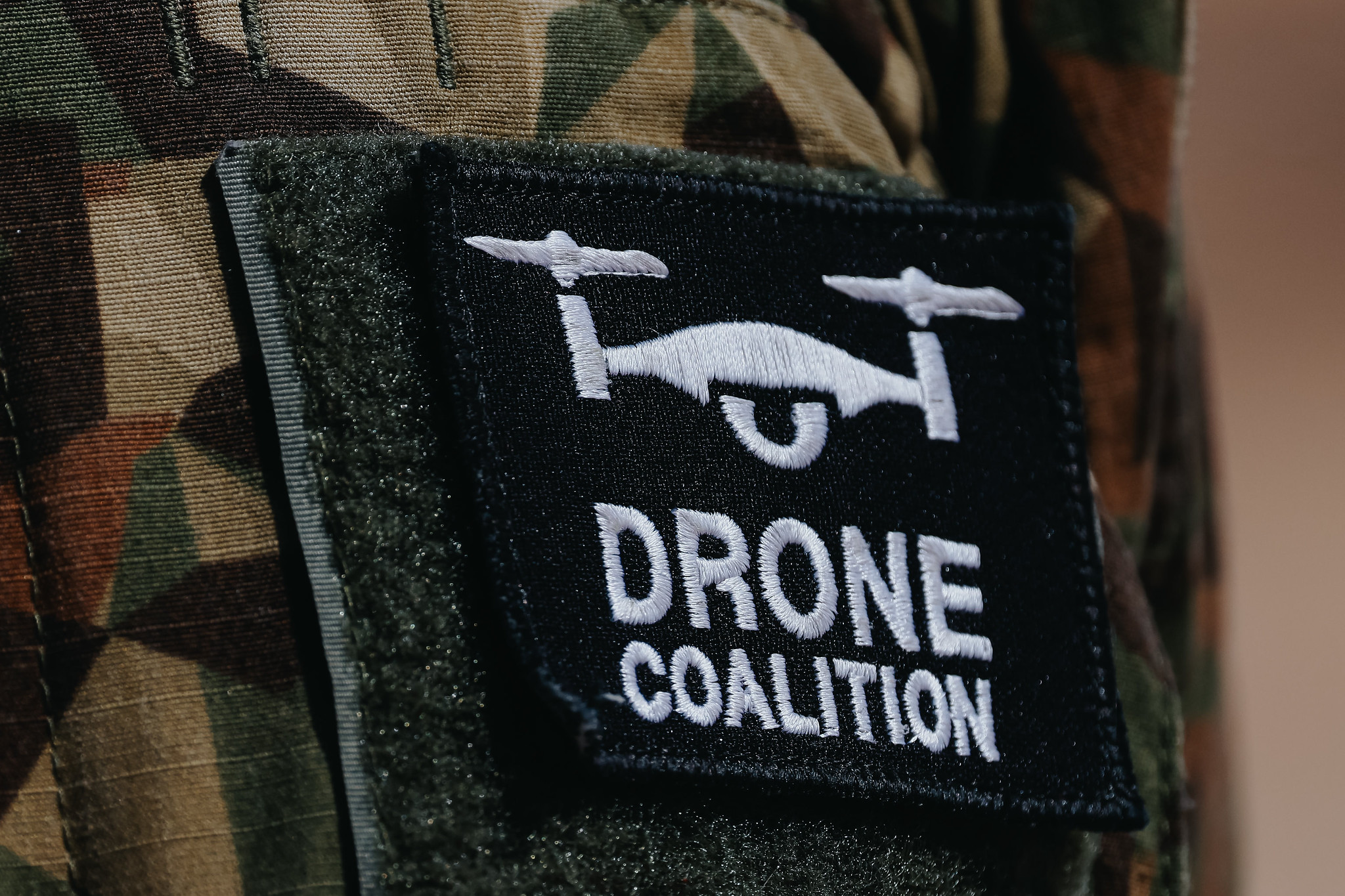
NATO is developing a new quality assurance system for counter-drone and other defence technologies, designed to give nations a reliable way to identify which systems have been properly tested and are worth procuring, sitting at the heart of the alliance’s broader effort to speed up how military technology moves from a company’s development programme into the hands of allied forces.
The badge is a quality assurance mark rather than a formal certification, and that matters considerably because a formal certification would imply a fixed, legally binding standard that a system either meets or does not, a process so heavyweight and slow that it would undermine the very speed the whole exercise is designed to achieve.
Instead, the badge provides an assurance level from a trusted party that a system has been tested against commonly agreed evaluation procedures and performs as described against specific operational use cases, following a model similar to the common criteria framework used in cybersecurity, where the goal is credible and independent assurance rather than absolute guarantee. “It’s not a certification, but it’s an assurance level by a trusted party that this system performs according to this performance,” a senior NATO official explained at a briefing in Riga.
What does it actually tell a buyer?
The badge is structured around use cases rather than a simple pass or fail, with NATO having identified a range of counter-UAS scenarios covering point defence, perimeter defence, border protection, convoy protection and others, and the badge indicating how a given system performs against each of those scenarios on a scale of one to ten, so that the intention is not to declare one system better than another in absolute terms but to help a nation understand which system is best suited to which specific requirement, an important distinction in a domain where no single solution covers every threat and every environment.
Testing takes place at NATO’s innovation ranges, dedicated facilities established under the Rapid Adoption Action Plan approved at last year’s Hague Summit, with six ranges currently operating across the alliance in Latvia, Estonia, Finland, Sweden, Italy and the Netherlands, each with a specific focus area, and Latvia’s range at Sēlija, run by the Autonomous Systems Competence Centre under Major Modris Kairišs, focused on uncrewed systems and counter-UAS and currently the most active with five campaigns planned in 2026 alone.
To ensure that the badge means the same thing regardless of where the testing was conducted, when one range tests a system observers from the other ranges participate, so that the methodology applied in Latvia is the same as the one applied in the Netherlands or in Italy.
What happens when a system is updated?
This is the sharpest question the badge system faces and one this publication put directly to NATO at a briefing in Riga, asking whether drone warfare’s additive nature, in which systems require frequent updates and iteration, means a company would have to restart the badge process every time it improved its product. “Drone warfare is iterative by its very nature,” I put to the official. “Systems require frequent updates. Can a company make those changes without having to restart the badge process?”
The answer was that the badge is tied to a specific system configuration at the time of testing, meaning significant changes will reduce the validity of the badge it holds, while minor updates may be considered within the scope of the existing assurance, though precisely where that line falls is still being negotiated with member nations. “The maintenance of the badge, and how regularly companies need to be testing in the innovation range, is part of the discussion we are having with nations at the moment,” the official said, adding that the concept is designed to evolve as the systems it assesses evolve rather than remaining fixed as a rigid standard.
Is 24 months fast enough?
The badge system sits within NATO’s Rapid Adoption Action Plan, which commits the alliance to getting new technology into service within a maximum of 24 months, a target I questioned at a NATO headquarters briefing in Brussels in February, asking whether that timeline was too optimistic given the pace of battlefield evolution or whether, in some cases, it might already be too slow. The answer was striking. “There are cases where 24 months can be too long… commercial off-the-shelf solutions can be acquired within six to nine months,” I was told, with the assurance that “based on empirical data… we’ve seen that 24 months is reasonable… and we’re having evidence that this works.”
The badge is one of the key mechanisms through which that timeline is supposed to be achieved, by de-risking systems in advance so that nations can move directly from a tested and badged product to a procurement decision rather than having to conduct their own national evaluation from scratch.
Who can get a badge?
The system is designed to be open to both traditional defence primes and newer non-traditional companies, with NATO having been explicit that the innovation ranges are particularly aimed at the latter given that larger established companies already have access to national testing facilities, and with Ukrainian companies already having participated in testing campaigns at Sēlija and firms from Japan, South Korea and Australia having expressed interest in future participation, while nations retain approval over which companies take part in individual campaigns and NATO maintains overall governance and visibility across the network.
The first pilot is expected in September 2026, once the governance framework has been finalised with member nations over the summer, and will likely cover a limited set of use cases and a small number of systems before the scheme is extended more broadly across the alliance.
Why does it matter?
The badge is designed to solve a specific and serious problem, namely that nations do not currently have a reliable common way to assess and compare counter-drone systems before committing procurement funding, meaning buying decisions are often made on the basis of vendor demonstrations, national testing conducted under different conditions, or simple familiarity, and a badge awarded by a trusted independent range against a commonly agreed methodology gives a procurement officer something they do not currently have: a consistent and comparable data point that another ally’s procurement officer can look at and understand in exactly the same terms.
Looking further ahead, NATO’s ambition is that the badge becomes a de facto requirement for any company that wants to be taken seriously in the alliance’s counter-drone marketplace, creating a pipeline that runs from testing at the innovation range, through the badge, into the catalogue of vetted solutions that nations can draw from when a requirement emerges, and from there into procurement, with the question of whether the system can evolve quickly enough to remain relevant as the technology it is assessing continues to change at battlefield speed still the one the alliance is racing to answer.









“Dib dib dib”
(It’s a cub-scout thing)
I’m off to play with my woggle.
I’ve gained $17,240 only within four weeks by comfortably working part-time from home. Immediately when I had lost my last business, I was very troubled and thankfully I’ve located this project now in this way I’m in a position to receive thousand USD directly from home. Each individual certainly can do this easy work & make more greenbacks online by visiting
following website—.,.,.,.,.—>>> JobatHome1.Com
I gather you have finished polishing your nuts
Ha ha, yes, but then I found I had a Screw Loose !
Ok then, name the film.
“Badges ? we don’t need no stinking badges”.
Am I playing with myself again ? 🤔😎
Is it Sound of Music?
Close… “The Treasure of the Sierra Madre”… Humphrey Bogart.
It was years ago when the World was all Black and White.
That was close…..my granny loved The Minstrels.
I have to go back and watch the Bogie movies, Casablanca iss my favourite. “I think this is the beginning of a beautiful friendship Halfwit”
Play It Again Cent !
😉
Side note; apparently the 1st German-Dutch Corps is taking over the Northern part of NATO Multinational Corps North East. So the Estonian Division and Nato Multinational Division North will both sit under 1 D/NL Corps and 1st Lithuanian Division and Multinational Division North East will sit under NATO MNCNE.
(FWIW 1 D/NL is neither a NATO formation nor a EU one, it’s a bilateral Dutch-German HQ which is made available to NATO or the EU as those nations choose).
So if in trouble you get your chopper out and hope for the best 🫣
Never had one of them, I much prefer the Sports Tourer types. It’s funny that Chopper Riders all seem to wear Waistcoats with Badges on though.
Anyway, This Badges system sounds like another Gravy Train for the next to useless to board. “Check A Trade” springs to mind.
Can we have a “Cold War Veteran” badge? All my newer shooting gear has annoying velcro patches and I would like to fill them to look more ally.
Another could be “I survived the Humber Pig” and “Only 7.62 will do as 5.56 is for wimps”.
I bet Atlas could make $5000 a day doing them!
There are plenty of companies that will make custom badges and patches FYI. I’m sure you can find enough buddies to place a decent sized order.