

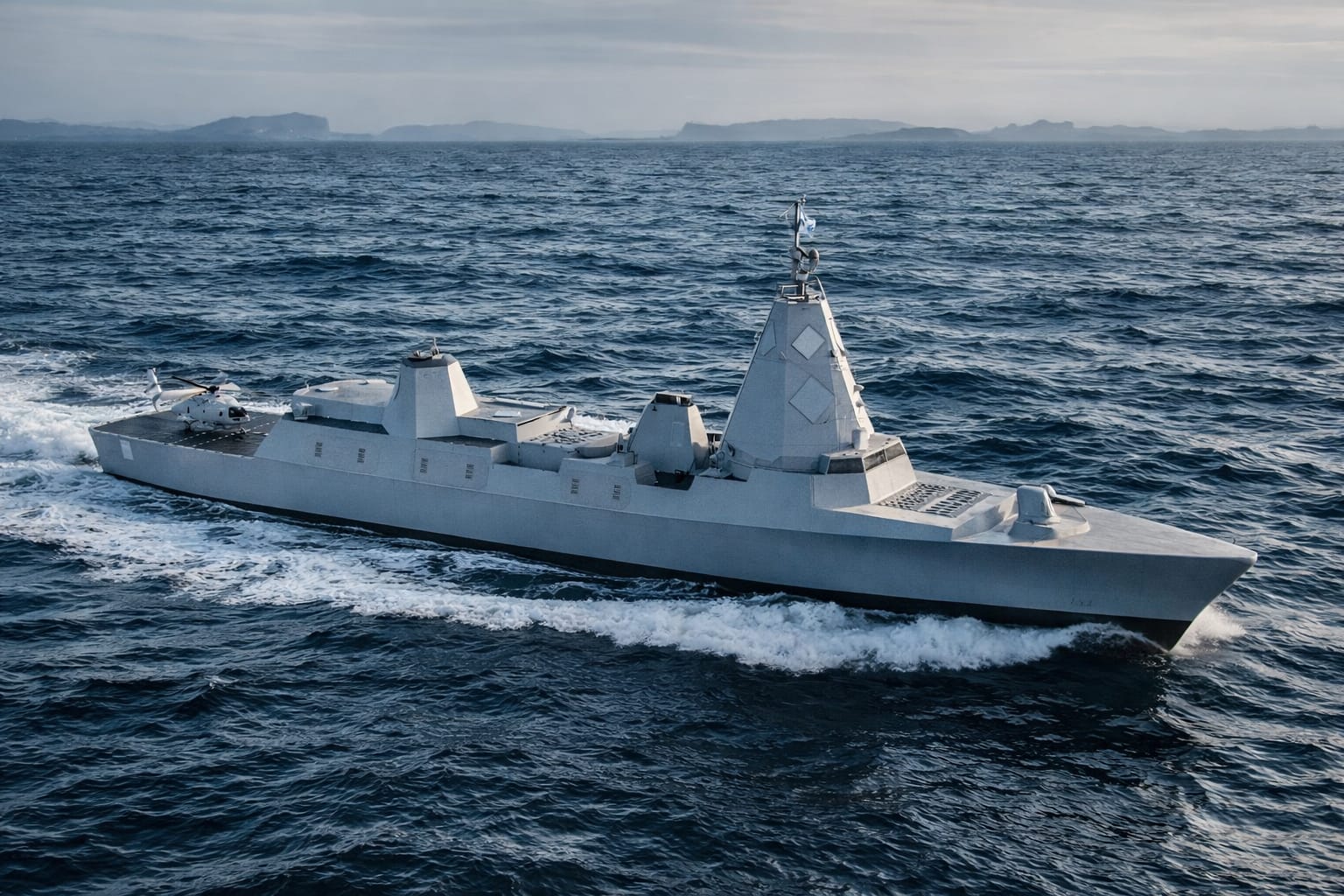
The future Type 83 destroyer programme remains under review, with the Ministry of Defence confirming that progress toward a formal business case is now dependent on both the Hybrid Navy Strategy and the forthcoming Defence Investment Plan.
In a written parliamentary answer published on 27 January, Defence Minister Luke Pollard said the Type 83 concept is “currently under review against the Royal Navy’s Hybrid Navy Strategy,” adding that future business case approval “remains subject to the Defence Investment Plan.”
The response follows earlier answers in which the government had indicated that the Outline Business Case for Type 83 was expected to be submitted in June 2026. That timeline has not been withdrawn, but the latest wording signals that the programme is no longer proceeding in isolation and is now being assessed as part of a broader restructuring of future naval capability.
Previous parliamentary answers describe Type 83 as forming part of the wider Future Air Dominance System, or FADS, a programme intended to replace the Type 45 destroyers in the long term. Pollard has previously said that FADS “will feature a combination of crewed and uncrewed platforms in a hybrid fleet formation,” incorporating next-generation radars, new combat management systems, advanced effectors and new communications technologies.
That system-of-systems approach also includes uncrewed surface combatants such as the Type 91 “missile ship,” alongside the advanced, minimally or optionally crewed Type 83 itself. According to the Ministry of Defence, the destroyer is currently planned to enter service from the mid-2030s and is assumed to have a service life of around 25 years.
BAE unveils warship concepts: faster, leaner, more firepower
However, ministers have repeatedly declined to confirm how many Type 83 destroyers will be built, stating that fleet numbers will only be determined at the Full Business Case stage. In earlier answers, Pollard said “the number of Type 83s will be confirmed by the Full Business Case,” reinforcing that no production commitment has yet been made.
The latest response suggests that even reaching that point now depends on strategic choices still being finalised. Decisions on Type 83 will be shaped by wider questions around crewed and uncrewed balance, affordability, and long-term force structure rather than a straightforward replacement of Type 45.
The Defence Investment Plan, expected later this year, hopefully, is increasingly emerging as the gatekeeper for multiple major programmes. Until that plan is published, the future scale, pace and configuration of the Type 83 programme remains unresolved.





If I can kick this off…why not less emphasis on the T91s and put all their earmarked mk41s and 40mm onto a few more T31s or a extra T26 or the T83s? For now to next 5 years anyway. How many T91s does the RN need or want and when?
Because that would mean spending more money now or in the near term.
The jam is always in the future, never now. Long term means more money funnelsd to the MIC for longer, jobs for longer, and all the rest of the initial gates, main gates, appraisals, assessments, full business cases. I’d love to know how much money gets spent in all these without an asset even existing yet. Ordered? That means buying the military kit and spending more money having people for that kit.
The “Defence” budget isn’t about that!
I’m at my most cynical this morning, hopefully I’ll calm down later
Spot on as ever mate, unfortunately, many regard the first duty of the defence budget is to create or secure British manufacturing as political virtue signalling and a political football, actual defence of the relm is always a distant second place.
Hi Daniele- no need to apologise for telling the truth. Since the 2010 Cameron cuts , MOD capital funding/procurement has been poor. 15 years later and they are still kicking the capital funding can down the road, for another day and another government to sort out..
The lesson that governments never learn : the cost of building a warship today is cheaper today than it will be tomorrow.
I expect the DIP will postpone Mk41 for T31s as part of the budget controls and focus on getting them into service and restoring escort numbers as a first step. With CAMM & NSM they’ll offer enough for the time being.
Please don’t throw away numbers of good ships to get drones. That’s all I ask of them.
Drones are cheaper, and gives 1SL something to highlight, rather than the fact 6 Frigates are left when there were 17 in 2010 and around 25 in the late 90s.
We have so few real war fighting assets, the military want more assets, they cost money, HMG don’t want to pay.
So, emphasise something else.
The Drones might br wonderful, but I don’t think they can self deploy, carry out HADR, carry RM, do Defence Engagement, be commands for young officers, and so on.
A balance is needed.
Yes, a good balance and we have to hope the decision makers get that right. I feel loading up too many mk41s, their missiles and systems on unmanned-lean crewed T91 type drones could potentialky deplete the armament levels of crewed ships themselves reducing their effectiveness and usefulness. Seems kind of silly to not take advantage of current T26/T31 build costs which must be at their lowest level now and buy a few more. What does the RN want, a dozen or more T91s? How much are they going to then spend on T91s and other drones? S
Wouldn’t a few more T31s be way more useful in all their roles and for presence at sea and doing port visits? The world’s forces have gone “drones mad”.
I would say reading between the lines that the T83 has two hopes of seeing the water, no hope and bob hope and he is dead. So what will replace the T45’s in the next decade a row boat with a manpad towed behind the aircraft carrier.
If politicians waffle could somehow be militarised UK would have the most formidable defence forces on the planet.
Indeed, “lethal” even…LOL
Statements full of nothing !
Given the way the government manages the RN, I think a service life of 30+ years should be assumed and planned for. It seems to be the new norm.
If the type 91 is happening then the only need for a big destroyer with a large radar in a task force is for ballistic missile defence. One type 83 with three type 91 will probably provide a far superior defence to two T45’s.
All a peer then has to do is knock out the mothership which is likely to be the larger vessel and everything is then potentially useless and a dead asset. But i could be very wrong on all this.
If I kept saying to my wife, purchase any new clothes is the subject of a “clothes investment plan” which would be due sometime I would be divorced by now, this government is clearly divorced from reality…. I will get my coat 🙂
Shorthand, or actually long winded hand for “it ain’t happening”
Another cost saving exercise that will become more expensive…..
They will be beaten the same way we beat Enigma.
We have carriers that will need defending by ships that can travel over 30 kts. Will Type 91 be suitable for a carrier strike group?
In other words the Government told the MOD to go away and finder a cheaper option that makes it look like we are not making more cuts
So no T83 and drones R us is the future
Same we are hearing about GCAP. The PM knows best but he’s not giving anything away this time; he’s keeping it secret. They’ve screwed the economy lets face it. The only way they would get to 5% would be to halve our GDP and they are working on that and 3rd world status.
“According to the Ministry of Defence, the destroyer is currently planned to enter service from the mid-2030s and is assumed to have a service life of around 25 years.”
How is this possible? Won’t we still be building T26s into the mid-2030s? Not to mention less than ten years to finalise design, budget, build and test a complete new class.
Dare I say it (!), but the Darings could surely serve into the 2040s. How about we order a couple more T26s and T31s to keep the yards going, get surface numbers near to where they should (T31 with CEC could add missile tubes to pad out the CSG, act as point defence) while we work out what T83/T91 should be, how they will work etc
If we order more 26 we delay 83 further, and we can’t staff 19 escorts let alone more
We can staff them, we’ve done it before and it’s entirely doable again given the will.
On the RNs figures, only half of the c. 12500 personnel described as “fully trained and deployable at sea” (and yes, that accounts for all those “on leave”, “in training”, “not deployable because of harmony rules” i.e. actually NOT “deployable and the 7500 RMs considered deployable) are actually deployed at sea
One of the biggest bottlenecks in training now is sea-time. Every ship that goes out is crammed to the gills with supernumaries, just to give them sea time
Yes but not the certain branches like engineering required to run these ships. That’s a reason for several retirements
If we get to the stage where we are starting work on a new T26 each year and completing in 6 years, then we could add an extra 4 T26s to the order and have then built by 2040, which would give 10 years to work out what T83 needs to be, and start work on the lead in ship in 2035, with a notional entry into service around 2045. Daring and Dauntless would probably be retired a couple years before that, but the extra T31s could help cover the gap, along with potentially T9X working alongside the remaining T45s, testing the SOPs of the FADS concept ahead of T83 entry into service.
The remaining 4 T45s would then be replaced 1 for 1 and ideally 2 extra T83s to replace Daring and Dauntless would follow to maintain 6 crewed AAW combatants (although clearly we aren’t ever going to get 1 for 1 replacement for T45, it’ll be 4 no doubt because “T83 is so much better than T45 we don’t need so many”, “T83 is too expensive to replace like for like” and generally because “we the Treasury tell you it’s like that, and that’s the way it is!”)
An extra 4 T31s would keep Babcock going to the mid-2030s, and help flesh out the escorts. Then depending on the FADS plan, Babcock could either switch to building the T9X ships, while BAES does T83, or Babcock starts work on modules for T83 which will then be transferred to BAES for assembly when the extra T26 are built.
I appreciate the crewing issues, but that’s a problem that needs to be overcome, not run away from. I’m not trying to downplay it, it is a major challenge and I feel a consequence across the Armed Forces from the steep reductions of 15 years ago. I do wonder with fewer people in, the connection with military families has been reduced, while base closures have cut connections with the local communities that once supported them, and generally speaking, there just isn’t the natural exposure that there once was.
Nevertheless, our population is larger than 25 years ago, the fleet is smaller than it was 25 years ago (even with my uncosted fantasy fleet additions), and the ships are less labour intensive thanks to automation (and will be increasingly leaner crewed going forwards). The big problem for me will be the money, and convincing the Treasury to part with it!
Obviously any argument over ship numbers (or anything else in Defence circles, even now) is shot down by the word “cost” but, that said, when we operate by a ‘rule of 3’ why didn’t we order 9 T26s and 6 T31s? Cost over capability, every day it seems.
1 for 1 replacement of the recent 13 T23s in the tresurys eyes
Why don’t they just save the bother. Build the Canadian T26 with the Bae render of 64 VLS cells instead of the mission bay. It means SPY and Aegis, but for a handful of ships the only benefit of a bespoke UK radar is for the shareholders. At least it would be in common with the Canadian navy.
Sounds like ripping up their entire design, we might as well make what we actually want
T26 isn’t a great destroyer hull being primarily designed for ASW. And BAE renders aren’t always accurate to reality.
With the modifications required to properly make it a destroyer the resulting cost might as well just be used for a custom design.
And there’s very strong arguments that anything short of 96 VLS isn’t good enough on a modern destroyer
The thing is we do have to remember a few balance points
1)how bad an AAW destroyer was
when the RN had 12 AAW destroyers the AAW destroyers were not actually very good and you needed a lot to defend a carrier as an example four Type 82 destroyers would have escorted a single CVA-01 strike carrier
2) Frigates that could not even defend themselves. When the 12 type 42s were planned an RN frigate was essentially armed with anti air weapons designed to make it harder to line up an iron bomb attack ( short range crewed guns and sea cat).
So the modern RN with AAW destroyers that can essentially murder a small airforce on their own and frigates that are more effective AAW platforms than a last generation AAW destroyer is a different beast with different needs..
But the problem is as always time and space.. one ship can only be in one place at one time no matter how powerful.. and this concept of time and space is utterly and profoundly vital to naval wars.. a naval conflict of years will spread across every ocean.. because the lines that feed a nation its resources are vast.. that is why the fundamental building block of maritime conflict is and always has been numbers.. the side with more mass even if it has poorer ships almost always wins ( 27 out of 29 times infact)… the smaller high quality side may win a battle but it will not win a war.. an extreme but fun model: you have HMS massive against a navy of 20 crap frigates.. every time HMS massive tracks engages and gets a kill chain on a frigate it wins.. those 20 crap frigates are scattered across the globe killing your maritime supply infrastructure ( ships, ports etc) at will.. as it takes years for HMS massive to chase them down one at a time..
So numbers matter massively.. those 12 AAW destroyers may not have been very good compared to 6 Type 45s but they could be in twice as many places in time and space..
So the thing is by all means if your average frigate can now act as a second line AAW escort and more than look after itself you can cut your AAW destroyers down.. but you still need to replace the numbers.. because an unmanned vessel is still only an adjunct to a crewed vessel not a replacement.. so a new type 83 and a pair of type 9x drone ships may be as effective as 4 type 45s working together.. but the set up can only be in one place at one time ( with the carrier) where as 4 type 45s can each be covering a different sea lane etc..
The answer is having a small number of high end AAW assets and then a large number of effective presence ships, not rivers 2s with a 30 cannon, but a ship than can make itself know.. NSM, CAMM, ASW drones etc.. this could even itself be an optionally manned vessel.. that could either have a small crew as a presence vessel or be a drone companion to a major surface vessel..
But we in the west have forgotten maritime dominance is delivered via mass and maritime dominance is how you control the flow of the world… China knows this profoundly as it suffered first from the RN and then from the USN essentially controlling its destiny.
If 9x drone ship is going to defend a carrier, it will need the propulsion system and fuel capacity to go with the carrier. That isn’t a simple drone ship , it will be the near size of a frigate.
It will need a flight deck to land engineers when something breaks and the fleet support vessels will need spare parts.
It will need VLS at £15m a pop and to be viable £50m worth of missiles sat in the tubes.
The current RN seems terrible at keeping the ships and subs it does have at sea.
A cynic will say this is fantasy and the MOD accountants will happily just park these drone ships in deep reserve, and they will rot.
Japan is planning big manned cruiser sized ships, Italy is planning big manned ships?
The UK? Same old waffle that we will be at the cutting edge of some hybrid navy.
A simple ASW drone ship in the ASW bastion concept may be feasible, plod along, TOW a TAS etc but again a cynic will say it’s a cost cutting brochure put together by senior officers and MOD officials who have already been tapped up for that civvy job.
I agree I think it’s a bit of a mistake although the US and China are going for large drones.. but they are in no way sacrificing mass of manned vessels..
Where I see a possibility is an optionally crewed vessels in the 2-3 thousand ton range.. it can then either be crewed and act as a patrol frigate or be unmanned and thrown down the threat axis to an amphibious or carrier group. The other place you could see drones is as ASW sensor tugs instead of fixed seabed sensor systems. But if you are wanting a warship replacement it’s going to need to be large and optionally crewed for most operations.
Why not aim for the best of both?
Full min max the ships. Full scale assets like the type 83 and type 26 take a long time to build. We can effectively say that if we enter a war the number of escorts we have at the start will be the number we have to use the entire duration.
But, if we had a smaller ship built to civilian standards that was armed with 16-32 Mk.41 and a 40mm, if we really needed to we could probably build that in a year so long as we had a design already, and certainly no more than two years. Give these ships no radar, only a data link, they won’t be capable of independent operation but will be a very quick way of increasing firepower. Small crew of 10, that means that it is manned and so nobody else can legally steal it while it is at Sea (any unmanned ship is legally scrap), aid with complex maneuvers such as going into port, and help with fire control, I’m not completely sure if we should fully trust AI to fire the missile just yet.
So, in my opinion we should build enough of the destroyers to maintain a constant number of three in the water at all times whether that is 8 or 9 or 10 that are required to manage that 3, we should go for that. Have a single one of those drone ships built during peacetime so that we know all the ins and outs, by all means if we can build 10 of these and afford it and send it wherever we need a bit of extra firepower but not another independent deployment that would be nice. But fundamentally the small ship is very quick to produce and so we should have them entering the water before a large war is over. And so by keeping the highest possible number of proper frigates and destroyers during peacetime we can have the highest possible number of deployments and then in the event of war it wouldn’t take a long time to increase the firepower by quickly producing the small low manned ships.
The Mk 41 silos are deep. That makes the ships big in itself. This is I’m sorry to say more waffle and kicking cans down the sealanes. Liebore wont spend anything from their precious welfare budget on defence, end of. They have wrecked an economy that was growing fastest in Europe and second in G7 in 18 months. Entirely predictable.
I other words, “we are not going to build it as drone ships are the future”
The T83 is not due for ten years, so it is a little premature to be getting anxious about the programme.
Unless the next two governments increase the defence budget considerably, up to the promised 3.5% of GDP, the chances of T83 construction commencing before 2036 are slim. This because the RN is trying to build 20 new surface vessels (1).over the next ten years, which looks well beyond the naval budget. And that is before they embark on this latest transformational quest for T91, T92, T93, Proteus.unmanned helicopter, more Dragonfires etc, etc, for which there are certainly no funds as things stand.
I would think that this bloated naval quest is most probably the biggest single roadbump to concluding the DIP. So it seems sensible to take a bit of time to clarify exactly what the T83 is meant to be, what role all these transformational elements are going to play and where the T91 missile sloop fits into the future battle plan.
(1) 8 x T26FF, 5 x T23 FF, 3 x Castle MCMV-MAC, 1 x Proteus MROS, 3 x FSSS.
That excludes the replacements for HMS Scott and the 3 x River 1 OPVs and assumes that construction of the first 3 MRSS, to replace the Bays, and the T83 DD will not start before 2036.
To be honest the T45s are going to be modernised to keep them as current as anything in the 2030s and these unlike the T23s were hulls that were built to last so there is really no reason why the T45s could not plod into the mid/late 2040s.. and I bet they will..
Also the need around AAW destroyers is changing.. the traditional AAW destroyers were the sole source of AAW capability in the RN as it’s frigates were incapable of air defence.. where as a T26 is going to be more capable than a T42.. the new role for the 21c AAW destroyer is more as the command and control of the integrated air defence system as well as the sensor platform for managing ballistic threats.. it’s probably better to have an adequate number of these hub vessels with backed by a mass of frigate types..
If you look at Italy it’s even bringing in a new concept in which its amphibious vessel has the most advanced sensor package in the fleet.
Given the BAES build rate of T26, if T83 is due in 10 years we would need to be cutting steel now!
The comedy show continues basically until the DIP or Delusional incompetence PLan is announced there is no idea what we will get until Rachel tells us how little we have to spend!
So it will be less about needed capability and more about how little they can spend and make it look like they are serious on defence we have helped create Trump and his like and encourage Putin 🤔🙄
So, immediate reaction: not going to happen and the can kicked down the road – much like the DIP.
Practically, those timelines seem… fantasy. No T83 is going FOC in the mid ’30s, we seem to have lost that ability.
Plus points, Labour seem to belief in Defence as a builder of the economy, so maybe colour us all stupid and they will get built with 2 drones, which could offer export potential, again.
To Jonathan’s points, we need 12+drones because of the 1 in 4 ratio; that requires crew but we are talking 10 years and a change in recruitment practices that might see the numbers tick up as we reach our magical 3.5%+1.5% or 5% on defence spending.
Then again, bio tec should have given us pigs that fly by then.
What’s the decade cost of a member of the RN in terms of wages, training, accomodation , pension accrued? A million quid?
So if the aim was ever to increase the size by say 10k that’s a £10b liability that the treasury will see. Then add any army uplift, and RAF.
Hence I doubt numbers will rise.
We will always be smallz niche, bespoke and buzzword laden as the treasury doesn’t value defence.
You can’t write that, that’s treason! You’ll be in Tower by tonight 😉
Can the flying pigs have lasers attached?
The difficulty with cutting the headcount by so much 15 years ago is we’ve also dispensed with the supporting personnel and infrastructure needed to train, house and equip those numbers.
So trying to get back to even close to our numbers pre-2010 (numbers that were broadly assessed in the post-Cold War era to be what was needed to maintain a cadre of trained forces across all fields that could deal with reasonable potential threats, rather than a cost-cutting exercise) would take years like you say, plus a lot of money, and we’d have to find new bases to put everyone because the old ones that were sold off have probably all been built on by now.
It’s all predictable in a slow-motion car crash kind of way, and yet here we are.
The problem woth drone shops and unmanned dor minimally manned is that just like all ships they break and need maintenance and repair as well as security in port etc. Look at how thr US has got on with the LCS to see how that has worked out
There is no money now.There will be no money later.Things will drift as usual.Remaining Type 23s will be flogged to death.3 Type 26s will be diverted to Scandinavia.So by 2040 you might have 5 x26s and 5x31s.The Darings with much hull life left will still be around.Carriers……Who knows…..All smoke and mirrors.Easier and cheaper to lie low and waffle..Plus Europe is arming up.We have a common enemy in Russia.Big countries in Europe between us and them on land and sea.Also eventually you will have a massively guilty America desperate to revitalize NATO and be friends again.Win,Win for the beancounters.
The good thing?
Thanks to the endless disasters with their propulsion systems, the T45’s have spent so much time alongside they are effectively new ships
We want eight and we won’t wait!