

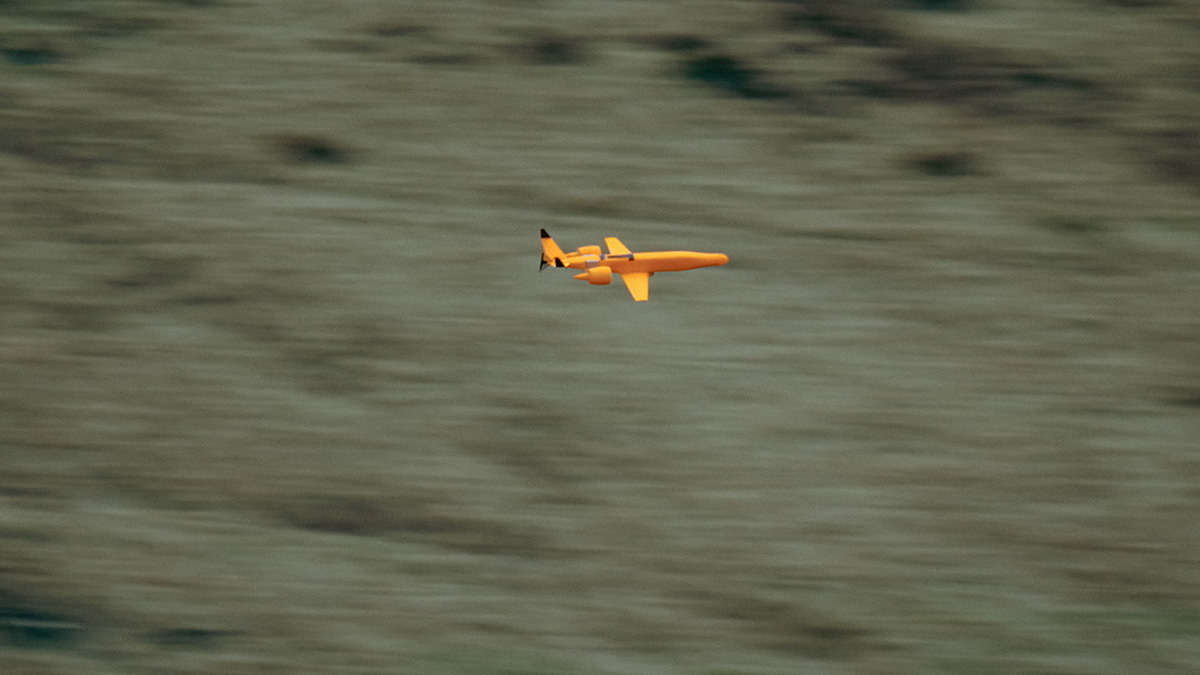
The Ministry of Defence has awarded £3.16 million to three companies to develop low-cost interceptors designed to shoot down drones, making the UK the first of five European partner nations to place contracts under a joint programme to strengthen air defence, the department has announced.
The contracts, awarded to Frankenberg Technologies, Greenjets and Cambridge Aerospace, will see the three firms develop and trial their designs for what are known as low-cost air defence effectors, weapons intended to provide a more affordable way of countering drones as adversaries field cheap, mass-produced systems in numbers that can overwhelm traditional air defences, which are more expensive and slower to produce. According to the department, Russia launched the equivalent of more than 200 drones per day into Ukraine in March 2026, and the work will support jobs at small and medium-sized businesses in Cambridge, Milton Keynes, Bristol and Stevenage, with each company holding a UK presence and committed to building manufacturing capability in the country.
The programme, called Low-Cost Air Defence Effectors, is being delivered by the National Armaments Director Group as part of a wider European effort known as Low-Cost Effectors and Autonomous Platforms, or LEAP, which brings together the UK, Poland, France, Italy and Germany to develop affordable effectors and autonomous systems.
Each nation is running its own national competition, to be followed by a multilateral phase, with the next stage focused on identifying solutions that can be produced in large numbers across the five partners, demanding the manufacturing capacity and reliable supply chains to deliver at scale. All three winners are SMEs, with Cambridge Aerospace only recently identified to the Ministry of Defence, which the department said demonstrates the value of widening access to new market entrants.
National Armaments Director Rupert Pearce said: “With the award of these contracts, Commercial X and the LCADE programme are demonstrating the powerful, low-cost capabilities we can deliver when we open up Defence and collaborate with some of the UK’s most agile, innovative companies. Through the LEAP programme, we are joining forces across borders to rapidly procure new systems, supporting both the UK and our allies against the growing mass drone threat.”
Greenjets’ chief executive said: “We are extremely proud to have been awarded this contract under LCADE and to be demonstrating the role innovative British businesses can play in rapidly strengthening national defence capabilities. We look forward to working with the MoD and our partners as we move into demonstration trials later this year.”
The contracts were placed by Commercial X, the NAD Group team tasked with accelerating procurement and lowering barriers to entry for smaller companies, which has previously put suppliers rapidly on contract for the government’s hypersonic and directed energy weapons programmes and recently signed contracts worth up to £4 million with 13 companies identified as future British unicorns.
The award gives early substance to the low-cost interceptor commitments running through the Defence Investment Plan, which puts more than £750 million into short-range counter-drone protection and rebalances munitions spending towards weapons that can be produced quickly and at scale, and it lands in the same fortnight as NATO’s Drone Edge initiative, under which allies committed over 40 billion dollars to counter-drone capabilities over five years.
The cost-per-interception problem the programme addresses was put starkly to the Defence Committee this week by Strategic Defence Review author General Sir Richard Barrons, who told MPs that technological change through directed energy and cheaper interceptors is driving down the cost per kill, but that the capacity to intercept, rather than merely detect, remains the layer of UK air defence with the furthest to go.








Reports from Ukraine are showing that shaheed style drones are less and less effective now as are cruise missiles. This is meaning the Russians are now doubling down on ballistic missiles. The UK is beefing up its drone and cruise missiles defences but still has no land based ABM capability and no defence beyond the NATO SM3 systems in Poland and Romania and any resulting coverage from Germany’s Arrow 3 system or our T45’s
This seems to me the most glaring deficiency in the SDR, however after listening to one of its authors tell parliament we needed £80 billion for an entry level system I can see why we don’t end up getting anything. Well done General Sir Richard Barrons, it’s not hard to see why defence procurement is in with people like yourself and the wheel.
The UK could easily have complied Germany and France and purchased an entry level basic ABM capability for the UK using SAMP/T NG and Arrow 3 for £6 billion over ten years.
Sorry for the typo, writing on IPAD with no edit function 😰
Any explanation as to how he comes to the £80bn figure? Shared inventories of CAMM and Aster should help mitigate some costs and maybe the SkySabre and SAMP/T systems could be adapted to fire both types especially the later and even NASAM’s to make use of older missile stocks. Not having any serious GBAD is inviting “Ukraine” level or worse destruction on concentrated “underdefended” assets.
Other European countries are investing in SAMP/T, IrisT, NASAM’s, Boxer Skyranger 30/35 and Tridon, why can’t the UK do something similar? RAF regiment, port, base and infrastructure defence will need to be integrated or interchangeable and not competing with each other. Surely the experts know whats needed and doing nothing or not enough is downright negligent.
No, he never offered any explanation of his £80-£120 billion cost assessment, I suspect it’s came from the same source as firing missiles off the deck of the Queen Elizabeth class which is plucking it out of his a**.
Not really the kind of assessment you expect from someone so senior, given a vital national task and testifying to parliament on the subject.
General Sir Richard Barrons appears to have about the same level of detail and knowledge as all the former Generals employed as talking heads by the Time’s and Telegraph, which is to say not much.
I have no idea how this man found him self as the sole military representative on the SDR panel.
I would imagine the cost estimate came from the cost of a Iron Dome type system, but to cover a nation the size of the UK.
We know what 80 billion buys as that’s essentially what the US has paid for its GMD which is an anti intercontinental ballistic missile defence system… not your standard ballistic missile defence system.
With that kind of statement it’s impossible to prove or disprove because he could have picked anything as his key variables.
What is he wanting to defend against? We’ve been talking about SRBMs in the Ukrainian context, the kind that SAMP/T shoot down and the kind that SeaViper knocked down in the red sea. But, he could have decided to include anything all the way up to ICBMs, which would require swatting down by something like the SM3, which is an altogether different kind of cost.
Also, what are you trying to defend? Main military bases, presumably given the discussion. But how about industrial centres, population centres? He could have decided that he wants to essentially blanket the entire country.
He’s using a statement with no context to justify not doing more than has been done. In reality, though, our troops in the baltics are more likely to be on the receiving end of ballistic missiles than we are in the UK, and I would be prioritising effective integrated GBAD for army foundations before we start talking about an iron dome for the UK.
Another interesting way to look at it would be to tally up what Ukraine’s donated patriots, SAMP/Ts, and other air defence systems would be and see what number you get there. Probably less than £80B.
Of all the systems you mentioned in that comment, only the Aster 30Block 1 can actually stop a ballistic missile heading for the U.K.
The rest are good for general air defence only.
Total cost of the USA’s, GBI system and GMD system, estimated to have cost over $70billion.
That’s given them 44 missiles – not even one per state.
The success rate of interception is 57%.
That interception rate is pretty crap compared to Israel’s Arrow system, which initially had a success rate of around 95% against the first Iranian ballistic missile attack. However it fell to around 75% on subsequent attacks due to the lack of ready missiles to fully replace the magazine of each system battery. But also due to Iran using high altitude release cluster munitions, which was fairly successful in overcoming Arrow 2, THAAD and Patriot in terminal defence. These stats are purely for the Arrow 2 and 3 interceptions. According to public information Israel has 3 Arrow 3 batteries, which is deemed sufficient to cover the whole of the country.
Again you have a fairly blatant cost discrepancy in favour of the ballistic missile compared to the interceptor missile. Currently there is no alternative to purchasing lots of interceptor missiles to counter the much cheaper ballistic threat.
That interception rate is against ICBMs.
No ICBMs were fired at Israel.
There’s a huge difference between intercepting the various types of ballistic missile, with ICBMs being the most difficult.
That may be correct, but the Iranian MRBMs intercepted by Arrow 3, were all intercepted in low earth orbit. I feel that it is the important statistic. Yes an ICBM can manage a higher altitude, but it still needs to transition from its orbital path and re-enter the atmosphere. This transition area is where Arrow 3 “should” be capable of intercepting either an ICBM or its deployed re-entry payload.
A Shaheed is a WW1 performance vehicle. It can only have success when the air defences are small compared to the number of targets it has to defend and the dumbness of the stylish hi-tech only military.
If the Ukranians had 600 Spitfires they would have made even less damage.
You are too uninformed to understand Barrons’ answer.
I highly recommend that everyone search youtube for this video –
“Defence Investment Plan: Lord Robertson and General Sir Richard Barrons speak to Defence Committee”
Streamed live on 7 Jul 2026.
Two of the authors of the Strategic Defence Review (SDR), Lord Robertson and General Sir Richard Barrons, give evidence to the Defence Committee on the newly published Defence Investment Plan (DIP).
Thanks for that pointer.
For the bulk of the shahed style drones they are now very easy to intercept.
The issue has now become as you say ballistic misiles, but also latter series Geran 4 and 5 drones that are rocket powered. Those drone are 300 kilometers an hour and the drone interceptors are struggling to intercept. The interceptors haven’t enough speed and crucially don’t have enough battery for the chase needed. Magyar has said the operators are very relient on skill and luck to make the intercept, not chase anymore.
As with everything things are constantly evolving.
Lets hope we can keep up with developments.
SAMP/T isn’t useful for homeland ABM. Its defended footprint is too small as it can’t intercept diving missiles at the ASTER’s maximum range. So many batteries would be needed for coverage of more than just the key military bases and Whitehall that it could well approach £80bn.
Arrow 3 would be an excellent option, there’s just one problem; do you see Burnham signing off on buying Israel’s foremost missile system?
Developing a national ABM system along the lines of Arrow (it has a lot of shortcuts to save money, which is sensible) seems to me the only viable strategy, as a suitably effective and politically acceptable option is not available. There is the Korean L-SAM perhaps, though as far as I can tell they haven’t exported any SAM systems before.
I think you wrong on the SAMP/T NG system, it’s rated as having a 150km radius protection zone using Aster 30 Blk 1 NT.
You can cover alot of the UK with very few 300km wide circles.
Arrow 3 relies on having a second tier system like Patriot or Aster 30 for atmospheric interception.
I do agree however that the UK should probably bight the bullet and build its own system. This is one of the most vital areas of modern warfare and allied nations are able and willing to pay a lot for it. Doing this probably fits in very well with Burnham’s vision of defence spending, industrial strategy and high value export jobs going hand in hand.
The new Gallium Nitrate Radar plate technology BAE is developing for T94 can easily be tailored to a land deployed system. MBDA would have to develop the missiles and base it on hit to kill technology. The system could be potentially combined with Cambridge Aerospace low cost ballistic missile interceptor as well and maybe a version of CAMM MR with hit to kill technology for high atmosphere interception.
The entire thing cousins also be combined with the type 94 and type 91 drones allowing the UK to be covered on land and out into the North Sea.
There is a difference between maximum range and realistic engagement envelopes. For example PAC-3 interceptors have under a 30km effective range against terminal phase ballistic missiles or hypersonics, SAMP/T NG and block 1 interceptors will be in the same boat. It’s one system protecting one base or small population centre.
To provide theatre wide ABM capability you need exoatmospheric reach which is only provided by SM-III (very expensive to the point only the US can afford it on land and everyone else with it only has a few dozen for naval vessels only), Arrow 3 (not happening with Isreal) or the US GMD (which is so expensive the US could only afford 44 interceptors total).
MBDA are developing the Hydis (hypersonic defence interceptor system) missile system. This will use the Aquila missile, which is similar in principle to the THAAD missile, as in very high altitude interception, so 125,000ft+. This is a purely endoatmospheric weapon. I have yet to see if MBDA will be looking at a exoatmospheric solution, as the cost are significantly more. However, I don’t believe the UK is part of the Hydis national consortium. Which is a bit stupid on our part!
I agree with you Jim, to put one’s eggs into the basket, using the weak excuse that we can’t afford everything is asking for trouble. However the Ukrainians have been hugely successful with drones and cruise missiles and does not itself posses ballistic missiles.
Anti ballistic costs more than ballistic, please correct if wrong. The aggressor can send up many missiles it will be so much more costly to shoot them down.
I’m not too concerned currently about lack of UK ballistic missile defences. Sure they would be nice to hsve but they are very expensive and UK isplaying catchup in all sorts of areas which have a higher priority. Good to see drone defence is beung looked at, after that cruise missiles. Ballistic missile defence last of the list because lets face it how many countries could hit UK at moment with ballistic missiles? And if it hapoened it would be a full on NATO response – and which coutries want that. So yes its an issue but there are a whole liad of things in UK defence to fix first.
My concern OldSchool is a single missile like Oreshnik being fired at the UK. We have no way to know if it’s conventional or nuclear. Such an attack can be used to intimidate the British government. Potentially it can be intercepted by SM3 in Poland or a T45 in the North Sea.
However my estimation is that if the UK was covered by an ABM system like Arrow 3 the Russians would simply not bother. While they might launch a single ballistic missile at us they would not launch multiple missiles to overwhelm an ABM system as it would very much look like an all out nuclear strike on the UK and the Russians would probably find large parts of Moscow and St Petersburg opened for new development by buckets of sunshine supplied by His Majesty’s navy.
In my mind now an ABM capability has become an Important step on the escalation/deescalation ladder. For example if Russian fired a ballistic missile at us and we intercept it, it humiliates Russia and instead of us and give us the option to respond with a conventional deep strike or do nothing at all.
This is the kind of game the Russians understand all too well.
But we don’t need a £120 billion Golden doom to achieve this.
T45s in the North Sea sounds like the way to go; plus CAMM-MR on land. Don’t scrap the T45s as you build the CCV ships, upcycle them 🙂
As you can see 6 T45s never cut it. Superb when they are working.
Everyone is assuming that because T83 has been dropped in favour of the CCVs that the T45s will just disappear. But by common agreement the hulls have a lot of life left in them. Given the will and the finance we could have more than 6 CCVs and/or we could retain some T45s as moored ABM platforms. Just saying.
Yes the hulls have a lot of life, the intention is to retiring from 2035 that is in the public domain.
My argument is 6 was never enough and certainly not enough to protect the mainland from the ballistic missile threat.
Technically you wouldn’t need a T45, as you could repurpose a number of oil rigs to be a semi-permeant air defence systems. Fitted with Sampson, CMS and some containerised VLS holding Aster Block 1NT. Though Aster is still a bit short ranged for this role, it needs a bigger booster.
“Ballistic missile defence last of the list because lets face it how many countries could hit UK at moment with ballistic missiles?”
France, Germany, Netherlands, Poland, Sweden? (not sure it has ATACMS), Turkey(soon if not already), Israel, US, Bielorussia? Rússia, Iran(soon if the wars stops), India, China, Pakistan(subm. only?), South Korea(subm.), North Korea(subm.)
Of course if you add a truck in merchant ship the list is enormous, albeit Heezbollah, Hamas are difficult since they have probably more supporters in UK than in Lebanon and Gaza…
Ballistic missiles are also becoming cheaper to make . Like drones ballistic technology is much more in reach to many more nations .
Indeed i just pointed that in another topic to the great expansion of rocket industry that his occurring.
Any space rocket is a potential ballistic missile and maybe an eventual ICBM.
that his > that is
Sorry?
Do you suggest we wait until our adversaries posses the means to do so!
“Heezbollah, Hamas are difficult since they have probably more supporters in UK than in Lebanon and Gaza”
Twat.
@Oldschool. That was my thinking too, why I believe so much is going into deep strike to make a ballistic missile strike an act that would be very costly to any protagonist in return, so making deterrence the prime defence against such an act over physical active defence. Preferably you want both mind, but as you say we are not currently (certainly politically) in any position to do that, what with so many other priorities alongside the costs of maintaining the nuclear deterrent. So until we sort other matters out this is not going to happen, but certainly the lack of base defence against almost anything, certainly at any scale, is a deep concern and needs looking at.
On a related point, it’s often said that because there is a lot of real estate between Russia and us that systems in Germany or Poland et al would likely engage missiles before they get to us, but if it were a ballistic missile aimed at us would they be capable of being engaged prior to the missile’s arc being in the region of the British Isles?
That’s highly dependent on whether Germany/Poland would authorise the interception. It’s not guarenteed!
All good news but as ever slow and a lack of urgency. The whole DIP, while superficially good but the whole PID (only 80 pages long) lacks urgency. In fact UK Government assessment states the expectation of being at war with Russia by 2030, that being so, they have ensured we will be “ready” for that war at 1/3rd of what is required (in the original PID/SDR) by 2035! You got to love our Governments eh!
Left and right hand come to mind. If this is how uk governance works generally then no wonder we so regularly head off in wrong directions so often and end up changing directions so regularly thereafter.
I’m guessing you never worked in a large multinationals company…
All large organisations are dysfunctional to some degree because they’re beyond the size of a single person to manage.
AlexS,
… there are seven countries with the ability to hit the UK with Balastic Missiles.
France, USA, Russia, China, India, Israel and North Korea all possess a ballistic missile capability to hit the UK mainland from their own territory or home waters.
Only France and the UK have Balistic Missiles within Europe.
Dutch and Germany have PLUS rocket, Germany will get ATACMS too and there is ELSA coming, Poland is getting some S. Korean rocket.
Everyone is buying ballistic missiles and with increasing range.
PULS rocket.
AlexS,
All systems like ATACMS, the PULS, when equipped with Predator Hawk rockets, and the K239 Chunmoo, with CTM290 missiles are defined as “tactical ballistic missiles” or “long-range guided artillery.” they have maximum operational ranges of approximately 290–300 km. Most TBMs in German service or those currently being integrated into NATO forces, like ATACMS, are designed for a 300 km range. Even if fired from the absolute edge of the German coast, a 300 km missile would struggle to hit anything beyond the immediate coastal waters or the very tip of the Kent/Essex coastline, leaving the vast majority of the UK mainland, including London and critical infrastructure, completely out of reach.
I understood your point when you were replying to OldSchool ““Ballistic missile defence last of the list because lets face it how many countries could hit UK at moment with ballistic missiles?””. I gave an difinitive answer.
You find lots of systems in the almost fictional 300km range due to MTCR rules.
Even for those that are not artificially restricted take a bit of warhead weight, increase fuel and then you got an extended range version.
No one can approach these threats in a formulaic way regarding range.
At this level and when the shooting starts you modify the figures for what you need operationally within engineering possibilities.
Like the RAF took guns and armor from Spitfires to be able intercept high altitude Ju-86.
Good point. The Spitfire is a very good example indeed, the plan was to move it to Griffon engines by the time any prospective superior performing German fighter was on the scene, presumed in 1943 I think. When the Fw190 broke that timeline the 2 stage supercharger for the Merlin previously demonstrated by RR but rejected was brushed off, fitted to essentially standard Mk V airframes because strengthened upgraded airframes (Mk Vlll) weren’t ready and you had a stopgap that became the most produced and long lasting Mk of the war. Amazing what you can do when the situation dictates, as we are seeing with all these new drone and missile options, even lasers/microwave weapons being developed that if they happened at all previously would have taken a decade to get to this point most like.
I believe the Iranians did pretty much what you said to try to hit Diego Garcia.
Yes and a BM with 5-10t can do a lot of damage to an house even without warhead if the objective is city terror/punitive political attack. The receiving side political system cannot survive it without reaction.
India – wrong
North Korea – wrong
Pretty sure we don’t need to worry about France. I doubt they’d want large radiation clouds blowing over the Channel.
Spock,
I don’t think it is wrong.
india, the Agni-V can hit London from India by adjusting the variables of weight and materials, the Agni-V is a three-stage, solid-fuelled missile. Crucially, India heavily upgraded it by replacing older steel components with carbon-fibre composite rocket motor casings, as carbon fibre drastically cuts the dead weight of the missile body itself. India has also successfully tested the Agni-V with MIRV – multi-warhead capability. By successfully adding MIRV capabilities to the Agni-V, India entered the exclusive club of nations possessing advanced multi-warhead delivery systems.
However … a MIRV payload bus is heavy. It has to carry multiple warheads, roughly 3 to 6 individual re-entry vehicles, the internal guidance computers and the propulsion fuel to separate them. When loaded down with this full multi-warhead setup, the Agni-V flies its officially stated 5,000 to 5,500+ km range. If the military strips off the complex MIRV bus and replaces it with a single, lightweight, highly miniaturised modern warhead, the drastic drop in dead-weight allows the rocket stages to propel it to much higher velocities, stretching that physical range to 7,500 – 8,000+ km. Following India’s early Agni-V tests, researchers at China’s PLA Academy of Military Sciences publicly stated that India was artificially downplaying the missile’s true capabilities, explicitly calculating that its structural physics gave it a latent 8,000 km reach. China views the “5,000 km cap” as a purely diplomatic cover story.
Global international defence agencies, including Chinese military analysts agree that India has upgraded the Agni-V and openly calculate that with a reduced payload and optimal trajectory, the existing Agni-V body has a true latent range of 7,000 to 8,000+ kilometres.
North Korea. Unlike India, which intentionally downplays its missile ranges to avoid geopolitical blowback, North Korea does the exact opposite. They deliberately advertise maximum range to maximise geopolitical leverage. North Korea doesn’t even need to “uncap” their missiles to reach the UK; their frontline ICBMs are built to overshoot it entirely.
Distance from Pyongyang to London: Roughly 8,600 km.
North Korea has two primary operational monsters capable of this flight.
Missile Fuel Type Range Status
Hwasong-17 Liquid 15,000+ km Operationally Deployed
Hwasong-18 Solid 15,000+ km Operationally Deployed
(hope the formatting sticks)
When North Korea test-fires their missiles, they fire them almost straight up into space, they use a physics trick called a lofted trajectory. In tests, the Hwasong-18 has flown to an altitude … an apogee of over 6,600 km before coming back down into the sea just 1,000 km away. When defence scientists flatten out that ‘insane’ vertical energy into a standard, normal attack trajectory, the math shows the missile can easily travel 15,000 km. At 15,000 km of range, North Korea’s ICBMs don’t just clear the 8,600 km distance to London; they have enough leftover fuel to fly completely over the UK, cross the Atlantic Ocean, and hit the United States.
India has the hidden physical capability to hit the UK if they rebalance their payload. North Korea has the overt physical capability to hit the UK, using their standard heavy setups.
Nope.
Spock,
Care to expand?
Nope, just use google*
* other search engines are available
… thought so.
You can’t afford my hourly rate 🤷🏻♂️
Where does Skyhammer fit in this?
Looks like sky hammer is one of the three systems as it’s Cambridge Aerospace that make it.
Thanks. A bit of a re announcement then, I thought that was done and dusted and was being bought.
Everyone can talk about T45’s in the North Sea until the cows come home, but they are not ABM ships.
ASTER cannot deal with fast crossing exo atmospheric missiles – a SCUD? Yes, if it’s fired at the shop, but it’s not got the range or speed to take anything beyond an SRBM
‘…the question we were set of 2.5% of GDP by ’27-28 and 3% of GDP by no later than 2034.’
Ballistic missile defence requires very expensive hardened infrastructure, very expensive systems integration, very expensive integrated radar/C2 in addition to interceptors.
The SDR brief could not remotely encompass such costs within its brief. Necessary military infrastructure upgrades alone would cost circa £80 billion.
That is why SDR 2025 stresses ‘NATO first’
‘Iranian ballistic missiles targeting Turkey were identified, tracked and successfully intercepted by NATO’s Ballistic Missile Defence’
‘We’re taking concrete steps to modernise also our command and control systems and adding more capabilities for ballistic missile defence. The NATO Support and Procurement Agency has acquired a large number of Patriot PAC 2 missiles in the last three years and it is in the process of acquiring more in the near future.’
NATO Summit Defence Industry Forum 07 July 2026
Consequently, in return, Britain must not, for its part, fail to provide what it is already committed to providing to NATO’s conventional deterrent on Continental Europe.