

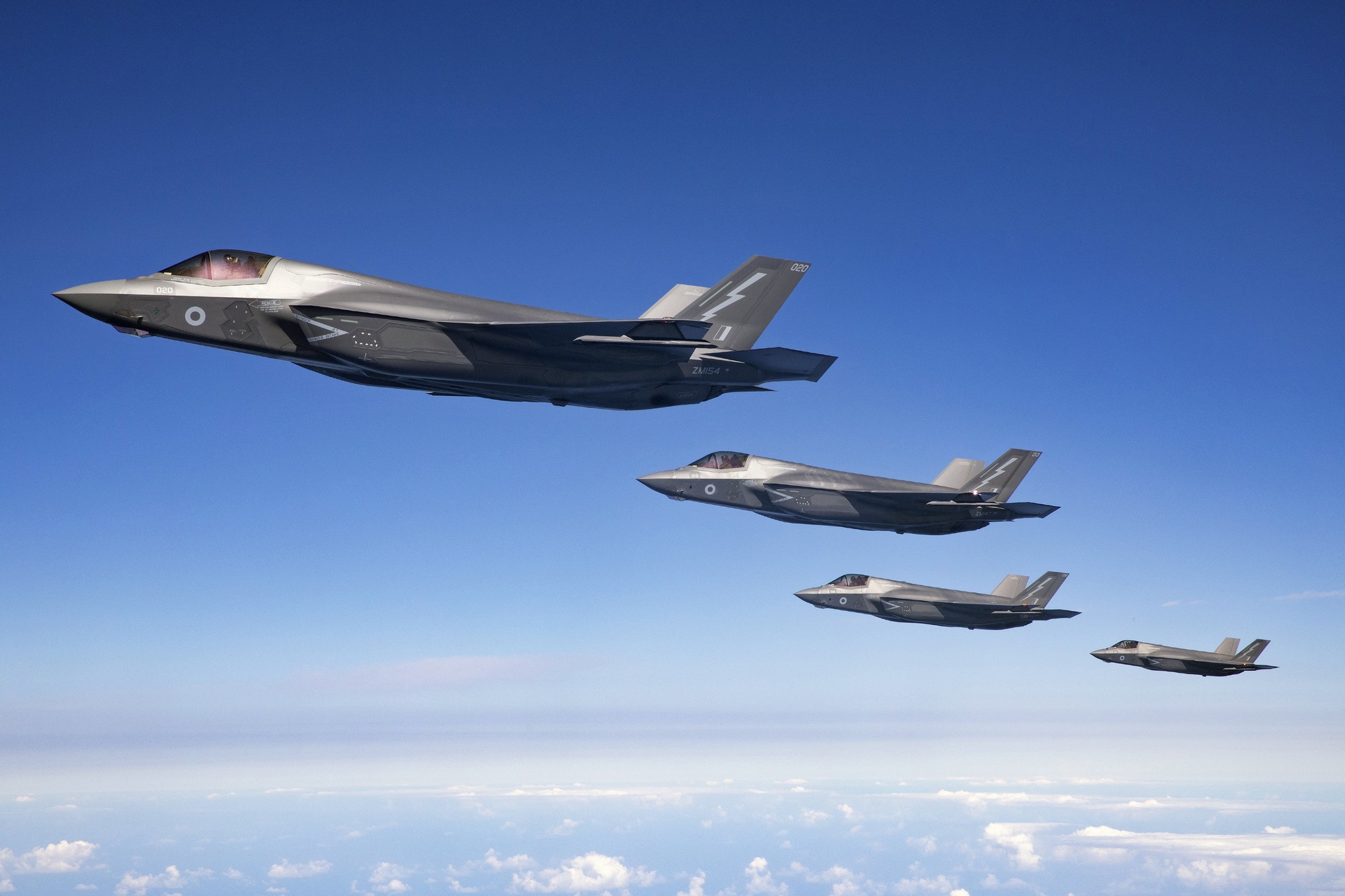
The UK does not expect to take delivery of any further F-35 aircraft until the early 2030s, a written parliamentary answer has confirmed, opening a gap of several years in deliveries despite the government having announced a follow-on order beyond the initial 48 jets more than a year ago.
Ben Obese-Jecty, the Conservative MP for Huntingdon, asked how many F-35A jets will be purchased and when the decision will be taken, referencing the Defence Investment Plan.
Minister for Defence Readiness and Industry Luke Pollard replied on 9 July: “As previously announced, twelve F-35A will be ordered. The exact delivery profile of F-35 aircraft is subject to negotiation between the UK and multi-national Joint Program Office, but the UK hopes to start taking delivery of the next batch of F-35 aircraft from the early 2030s.”
The answer puts a date on a gap that has been implicit since the government announced in June 2025 that the UK’s next tranche of 27 F-35s would include 12 conventional take-off F-35As for the NATO nuclear mission alongside further F-35Bs. Deliveries of the initial 48 F-35Bs, ordered across the programme’s early production lots, are now complete, with one aircraft lost in a carrier operating accident in 2021, meaning that from the arrival of the final jets of that first batch until the early 2030s the fleet will grow no further. The hedged language, that the UK “hopes” to start taking delivery from the early 2030s subject to negotiation with the Joint Program Office, leaves open the possibility of the gap extending further.
The pause carries consequences across several commitments. The 12 F-35As, which will be based at RAF Marham and join NATO’s dual-capable aircraft mission carrying US B61 gravity bombs, cannot be operational in the nuclear role until they exist, and a senior defence official confirmed at the Defence Investment Plan’s launch that the aim is to field them as soon as possible after 2030.
The F-35B force, meanwhile, is generating the air wing for HMS Prince of Wales on Operation Firecrest and the first NATO air defence operations flown from a European carrier, tasks that will fall on an unchanged number of airframes for the rest of the decade while the carriers’ role expands, including the planned use of HMS Queen Elizabeth as a floating headquarters for NATO’s Allied Reaction Force maritime component.







This isn’t new, I first read of this purchase gap on X some time ago.
Fab, isn’t it, that the RAF won’t expand it’s fast jet fleet at all leading up to the war various ministers say might be coming.
👏 👏 👏
I think RAF would love to expand its jet fleet.
HMT won’t fund it.
So much for a defence investment plan that has forced RAF to upgrade all the Typhoons T2/3 as make work in favour of new orders of F35.
Unfortunately most of the DIP increases were pre sent on:-
Pay
Pensions
Housing
UK Industrial Schemes
I won’t be too surprised to find that the British Steel fiasco was charged to MoD. Certainly Sheffield ForgeMasters was.
As I keep saying here no doubt to the annoyance of many, those are HMG priorities, last one especially.
I await a ministers comment on the actual military capability of any said purchase rather than the stock set of statements about jobs and keeping us all safe.
Well I have some sympathy for Typhoon upgrades as it gives a totally sovereign capability.
I’m just not keep on pushing F35B acquisitions backwards for the benefit of cash flow curves. There really does need to be a steady drum beat of deliveries to get to critical mass on both frames and people.
Absolutely.
This deferral may be due to the commitment to procure combat drones to fly alongside F-35s. If so, something will have to give way? The new Typhoon strategy is to improve what we have in preference to new aircraft. All this is possible if NATO remains intact, but without the collective fighter fleets, the UK will be found wanting.
A slight problem for us ordering F35B at the moment is they are being delivered without radars right now, because for the F35B Lockheed either build them with the mounts for the old radar, or the new radar (which is behind schedule as part of the TR3/Block 4 upgrade programme).
The cost of fitting it for the old radar then ripping it out and installing mounts for the new radar when it’s ready would not be economically viable.
For the USMC, they have a large enough fleet they can afford to take them fitted for but not with the new radar, knowing they will get fitted as soon as TR3/Block 4 is finalised. But RAF/RN, with such a small fleet it’s not worth spending money on jets which are not combat capable, plus it would be politically unpalatable to receive fighter jets that can’t fight, while at the same time it would be frustrating and questionable to order more of the older type aircraft. It’s a conundrum tho, as it would be good to get a few more Bs so individual airframes aren’t being overworked.
F35A doesn’t seem to have this problem, probably because despite the Lockheed marketing team claims to the contrary, it’s really a different aircraft to the B!
Delaying the F35A purchase to the early to mid 2030s pushes the delivery closer to when Tempest is supposed to be coming in, so is there much point in the split purchase of A and B?
Very true.
I agree that the split order seems even odder if Tempest is going fast into service although UK are doing their best to slow it down.
F35 without radar has lost most of the point of it. I can’t even see them being much use for training.
Very false. F-35’s with the existing radar are available today. Not clear if the new radar is available for export.
Yep, all F35s arrive with the 81 . . the 85 is an if and when.
So from all the reports I have read, you can either have your F35 fitted for and with the AN/APG81, but then you can’t fit the AN/APG85 at a later date because the bulkhead/mountings are different. Or, you can have your F35 fitted for the AN/APG85, but that radar isn’t ready yet, and because the bulkhead/mountings are different, you can’t fit the current AN/APG81, so you have to make do with Blue Circle until the ’85 is ready.
I thought this only affected the F35B, but I think it will actually apply to the A and C as well, it’s just the USAF and USN haven’t switched their orders from the original bulkhead design to the new bulkhead design, but that will come around Lot 18 possibly. breakingdefense reported last year that Lockheed are working on another bulkhead design that would accept either radar, but that wouldn’t be ready until Lot 20 at the earliest, so maybe in a couple years.
But yeah, you’re right, AN/APG85 isn’t cleared for export, although one would hope that as a Tier 1 partner, AUKUS, Special Relationship and all that, they might let us have them. If they aren’t going to, this wouldn’t be a stumbling block to placing a new order.
And, given we’ve not made any firm orders for more aircraft yet, hopefully by the time we do then TR3/Block 4 is sorted and we’ll be allowed the 85 radar.
I expect that around 2030 the government of the day will have to start making budgetary decisions around Tempest numbers. So I reckon that any F35 order will be moot. 138 down to 48. An indictment on defence MIC prioritisation over actual defence equipment and a lasting warning about never again going all in on an American project.
Exactly.
Know your priorities…..
Wait, what about the steel is MoD’s fault.
Does this mean that now all the remaining Typhoons will get the new radar and not just the initial 40? That’s a kind of sensible thing to do in the meantime.
And if the F35As are going to be delayed until the 2030s and the Tempest is due mid 30s why do they need to bother with it at all? The Tempest should be cleared for nuclear delivery won’t it?
I suspect further F35B orders will only be placed if Tempest is delayed significantly (which is likely)as orders placed in early 30s will not be available until Tempest optimistic timescales . In reality it means the RAF will only get the Typhoon upgrades in the next 10 years and no new fighter airframes! But the Government will be able to fund further work on Tempest. I think that is what it is all about but they cannot come clean because the US will not be pleased if we don’t place any further F35 orders which may be the only fallback option when Tempest timescales become real.
As I understand it we need to be nuclear cleared to carry US nuclear bombs that will be or already are stored in the UK. It is an American program and America qualifies the airframes for use. We have more than enough warheads and nuclear material to build our own air delivered nukes and as such we could then incorporate them on Tempest and declare it nuclear capable ourselves?
If the T2 order was placed tomorrow or if it was placed a year ago, nothing would arrive before 2030 anyway. F35 or Typhoon.
You lost me there with the T2 order?
Do you mean F35 Tranche2?
Yes mate.
No rush! Bimbling by this useless Labour govt
And it was different under the last government that didn’t order anything and resulted in so much stuff going out of service and capability gaps?
Defence is a mess but making it all about labour is having serious blinkers on.
They are the ones in power now making appalling decisions. So yes the mismanagement now is all labour . The Tories had their own set of disgraceful behaviour in this respect.
Yeah agree, but only been in power 2 years, just keeping it balanced.
Things take time to change, when you take over a from a government that did a scorch earth policy on the economy before they got booted out.
Oh sure, they did a scorched earth as they propped up the whole economy and it’s fraudsters on a Furlough scheme. Not bad right.
I agree Steve – though the threat warnings during Labour’s tenure have been extremely vocal. To not order a single fast jet at this time knowing it takes years to build and train the crews makes zero sense unless the spend priorities are elsewhere
Was there since Russia invaded crimea and increased when they attacked Ukraine fully and nothing happened. I agree we need a significant boost now, but where is the money coming from?
All our state assets have been either flogged off or outsourced resulted in everything being way more expensive and no money available. Look at the NHS something like 90% of all operations are done by the private sector. When there is no competition, there is no efficiency of scale and therefore no value for going with the private sector.
People keep talking about the welfare budget but the vast majority of that goes to pensioners and people in work that have serious illnesses. There isn’t a lot to cut. Cut the support and these people go unemployed and don’t add value to the ecomony.
We also shot ourselves in the foot with the trade barriers and cheap labour that we got from Europe. Again reducing productivity of the country and tax revenue.
Labour has brought in a number of wealth taxes but they have effectively just closed the black hole the last government hide.
I have sympathy for the government, as no free money. Only option is borrowing but that isn’t free.
The economy is a mess.
The economy is nearly on it’s knees – there’s no growth. Why is there no growth? there’s no incentive to work harder due to punitive tax regime on employers and employees. The rate of UK youth unemployment is an eye watering 16% contributed by the Chancellors tax on employers headcount. Try running a pub or a farm, what’s the point in getting a 2nd job if it changes the tax bracket.
The fact the blob (civil service) is at it’s highest headcount – over half a million! for nearly 20 years means someone has to pay for it. The MOD alone has >57000 civvie servants…
The govt has plenty of ££ it’s just incompetent in it’s economics and is doctrinally anti-defence in it’s spend priorities.
Economy is on its knees due to the significant drop in our exports following Brexit. Exports is where most of a countries value come from. Shock to no one that thought it through that if you put trade restrictions in place against your biggest trading partner you get less money. Well trump also seems to not know that and keeps TACO when it bites
🤡
It was only our biggest trading “partner” because we tied ourselves to it and paid much to be in there.
UK and the Eurozone have had next to no growth since 2008. Eurozone has only grown approx 15% since then!
The reason theres no growth is because our economies are taxed and regulated to death. Since 2008 the US economy has grown 85%. The Eurozone used to be the same size as the US, now the US is nearly twice as big. Nothing whatsoever to do with Brexit.
US economy is a false comparison. If you strip out the top 5 AI firms from it and it’s shrunk. The 5 firms losing huge amount of money.
Every independent economists and the world bank predict Brexit has cost the UK economy between 6-8%. Which is huge
That’s before the cost of all the new civil service staff required to handle everything that was handled by Europe before. Many studies say the difference is around 10x the annual cost of the NHS, which is multiple times the defence budget. So huge amounts of money would be potentially available
Its not a false comparison in the slightest. The US economy has gone up 85% and thats that. The EU has hardly grown. EU share of global GDP has fallen from nearly 30% to 12% in the last 3 decades. None of the largest companies on earth are EU and nothing is being create, no tech, AI, nothing. The EU is turning into a museum. The figures don’t lie.
Which 5 AI companies are you taking out and how are you calculating their contribution to total GDP?
I beleve the Tories and Reform have identified upwards of 50 billion a year in welfare savings Steve.
There are considerable savings to be had, but Labour won’t touch that with a barge pole, interesting to see if self anointed President Burnham Bounce gets a grip on that one.
Yes and ever single economist has torn it apart saying they are massively double counting and basing it on no data. If you really believe the conservatives after 16 years wouldn’t have cut anything they could have.
It was funny hearing the reform shadow councillor when questioned on the cuts and admitting he had no idea on the numbers and just believed there as huge money to save. That’s not how you run an economy.
It’s amazing that in the two years since they left office the Tories managed to identify £50 billion in welfare cuts, it makes you wonder how they never managed to find any welfare cuts in the 14 years they were in government. 😀
I’m absolutely blown away that a tiny party like reform with no access to the civil service like the official opposition gets has also managed to find such massive welfare cuts. 🤔
Tiny party? Reform has more members than either Labour, Tories or the LibDems
The abuse of Reform even continues the day Anne Widdecombe, the immigration minister and a lady of conviction like many of us, who believed WHAT SHE BELIEVED despite the mud throwing agenda, died.
Scum.
like self appointed May, Johnson, Truss and Sunak?
NHS: Nowhere near 90% by count nor by weight.
Where did that silly figure come from?
Breakfast clubs and paying for the planting of tree in Uganda are not priorities and yet strangely this so called well intentioned government haven’t the imagination to reprioritise resources?
What doesn’t help is the fact that we have a property Tax that was unfit for purpose in the first place and no properties are ever rebanded to reflect property values or It’s also the most regressive Tax going and doesn’t provide sufficient funds for local Government function and be self sufficient.
If that were fixed that’s £83.5 Billion Pa to go on other Tax cuts and fund Defence.
If Burnham actually wants growth then pumping the majority of any defence increase into UK industry is hell of a very direct multiplier.
I’m a realist or cynic when it comes to Politics and I can’t help wondering if our present DIP isn’t going to be rejigged PDQ and not for NATO defence purposes but political self interest.
For Labour to win the next GE they need to take back the North from Reform and boosting jobs, the local economies and creating apprenticeships does that quite nicely.
And when you need 3 Unions to get nominated it’s a bit of a coincidence that he has started making positive noises.
It is true that the Tories were not brilliant, but to say that they didn’t order anything is way from the truth. The fact is that it is Labour that is in power, and it has taken them two years to achieve nothing.
Fair. Over generalisation. They just hallowed out so much that it feels that way at times. All their talk talk delivered not a lot other than cuts across most of the public sector, with very little investment in the future.
Thirty years of “expert” politicians Steve where the only real considertion is “what can we get away with”..😢
150 (138) becomes just 47 (48 Including the one that fell off).
Is It any wonder why people on here have a Negative view 🤔
I did hear that Tempest would be “Up To 10” ….. 😁🏃♀️➡️🏃♀️➡️🏃♀️➡️🏃♀️➡️🏃♀️➡️🏃♀️➡️🏃♀️➡️🏃♀️➡️🏃♀️➡️🏃♀️➡️🏃♀️➡️🏃♀️➡️
Morning.
No, it’s not.
We’ve sat through the forces being dismembered piece by piece by impending piece from 91. I still think we have fantastic highly capable armed forces though, in numerous areas. But at a marquee level, there’s no or little depth to any of it.
Funnily enough, one area where we are well furnished is in the RAF Chinook force. There’s been no article here about it, but that’s falling off a cliff as well, nice and quietly of course.
Numbers hit 60, for a time.
Cut to 51 over last few years.
DIP confirms the 29 HC6As, so the oldest ones, all going as they hit major maintenance milestones.
So down to 22!
At the same time, 14 Chinook ER are incoming.
So, 36.
It’s claimed a tranche 2 of Chinook sustainment programme will be purchased. Another easy to make statement with no commitment of another governments money.
And the peach on top, at the time when the 23 AW149s are yet to start coming in, and the AAC Wildcat force is thrown away.
Just in time for the 2030 period of concern.
👏 👏 👏 👏 👏 👏
So the hedge trimmer has found another bit of fat to trim off.
Numbers, that’s my gripe, and will remain so no matter what apologist tries to explain it all away.
Great Rant mate…. I agree too.
It’s like every time a Politician says anything, you can Immediately just dismiss It as BS and Fluff.
RAF now at It’s lowest number of Aircraft Since It actually became the RAF.
I know, “But One F35 can be In 30 places at once and Is more capable than an entire Squadron of Tornado’s” blah blah blah.
Rant! 😆 Thought that was quite measured I’ve not fully got going yet!
If anyone has any suggestions to have say a 2008 force structure with 2026-30 Technology, capability and price tag, then I’m all ears. The numbers are to small. But i’ll say it till I’m blue in the face. Capability trumps numbers when the moneyisn’tavailable to do both. The RAF would rather be able to deploy 20 fast jets that can fly shoulder to shoulder with the USAF and match capability, then send 35 fast jets that are then asked to bring up the rear because they aren’t capable enough like Tornado F3s did in the first Gulf War. The RAF has learnt hard lessons from having aircraft that look good on a sqn wall charts, but found lacking in real combat. And our 107 Typhoons and 47 F35s will, and can provide more operational output and capability and be vastly more survivable then Tornado GR4/F3s, Jaguars and Harriers from the early 2000s. As I explained yesterday. We needed far more aircraft in service 20 years ago just to deploy the same number of aircraft we can today. Older aircraft needed far more maintenance between flights. Mean time between failure was far shorter compared to today. An EJ00 can stay on the airframe far longer than a RB199 or a Pegasus could before somthing goes wrong or it needs planned maintenance. That’s one example of hundreds that make a vast difference compared to 20 years ago. And even if the government magically pulled 50bn out of its back pocket for defence, it wouldn’t lead to vast orders of new fast jets. I would like to see more in service. Because I’m passionate about it. But things aren’t as doom and gloom when you can look past headline numbers.
Oh 🫡….. well that’s OK then. 👌
We had 79 Harrier GR7s in service. We never deployed more than 18. And that was max effort. And never more than 8 deployed on a carrier. 47 F35s have already far exceeded that. And vastly more capable. Those are the realities behind the numbers game. The French only have 42 Rafale Ms in service. But that doesn’t seem to bother anyone.
Rob, we had 12 deployed on Invincible class a number of times. Admittedly it was tight with the added Sea Kings and then Merlins.
The most i remember was 8 GR7s and 9 FA2s in late 2001 for Saif Sareea 2. We had 14 USMC AV8Bs on Illustrious in July 2007. And a Osprey visited us for the afternoon. Good times.
Holy cow Robert! That’s a lo of harrier metal on a small flight deck. No doubt the ASW Helos eere not embarked?
Hi mate. If memory serves me well I believe we just had 3 baggers onboard (AEW) When we had 17 Harriers on Illustrious it was bloody hard work on the deck. Just to get one jet out of the hangar usually involved moving another 5. It was true 24hr ops.
It’s the bigger picture though Robert.
You are forgetting the savage cut In numbers of other Aircraft since “your time”.
I’d really love/hate to see the numbers of Aircraft and Ships we had back in your 1987 example, compared to now.
Yes, but we had a lot of crap in service back then.
Hey Haflwit -please allow me.
In fairness, the following 1990 numbers were at the end of the Cold War, so comparisons are somewhat flawed. Robert’s commentary around numbers vs capability certainly holds true. From my 1980’s Air Force days, when the operational tempo picks up, things that can go wrong generally do. No doubt in mind however that the current balance is way off , particularly in light on of the Typhoon Tranche 1 retirement – with no replacement . Anyway, happy reading Sir!
1990 now
RAF front line jet sqns 30 8
Nimrod/Poseidon aircraft 35 9
RN destroyer frigates 46 12
SSN 17 6
SSK 10 0
The french only operate 1 carrier and have ordered an additional 12 Rafale M’s to accompany those 42 which are LIMITED TO CARRIER OPS. Whilst we have 47 state of the art 5th generation fighters with no spares, not enough engineers and having to share the jets with the RAF (which would not be a problem had we ordered more or gone with a split fleet of A for the RAF and B for the FAA). 24 F35s on HMS QE last deployment is an impressive capability, but i’m sorry it is certainly not sustainable or impressive if it impacts overall availability, we are struggling to do it all…
But at the end of the day. We have 2 operational carrier’s with 47 5th gen capable aircraft. And you don’t. 5th gen that could take part in the 1st night of war, when 4 gen Rafales won’t. Far more capability is to come. The French Air Force isn’t awash with Rafales. And old Mirages that would be politely told to stay at home.
As hypothesised elsewhere, while we are moving towards a large fleet of various drones, a good number to be armed, the critical support infrastructure like Helicopter support for resupply etc is being cut.
Re the thinning Chinook fleet, I think there is a causal link between Chinook and AW149 procurement.
I wouldn’t be surprised if it turned out that during argument between No10 and the treasury regarding the politically mandated AW149 procurement, a deal was reached that reduced the Chinook fleet to absorb the procurement cost.
Also, regarding general airlift and support, where is the A400 top up order once promised??
Hmmm, I wonder, we’d not be surprised.
End result is still fewer assets, Westlands happy, MPs happy, jobs filled, and the military still wanting BH! 😆😉
Atlas, quietly ditched possibly.
Promised? Of no value, a worthless statement regards politicians. I’m waiting for the 12 SSN, I’m also still waiting for the 22 Chinook that Gareth Ainsworth “promised” as a carrot for the closure of RAF Cottesemore in 2009 and the Harrier fleet getting cut. It never happened. 14 Chinook were ordered sometime later by the Tories.
I think people are all too ready to believe the grand proclamations of governments ordering X this and that, like “12 SSN” while some of us old cynics have seen it all before. We are thus seen as “moaning.”
No, I think we’re being realistic going by past and current behaviour.
If the Tranche 2 order was placed tomorrow new jets wouldn’t arrive before 2030 anyway. So not really any surprise. It gives the Lightning Force time to increae technician and pilot numbers up to a more comfortable level for sustainable operations and improved availability.
Which has merit, of course. Having missed lots 18 and 19 which were passed by, now 20 and 21 with nothing ordered either.
Lot 22 could have jets from 2030 if ordered in 2028, 2 year build time.
So delaying until the 30s pushes back even further.
I predict by the 2030s they’ll cancel tranche 2 entirely, GCAP funding needed.
I have every faith tranche 2 order for 27 aircraft will go ahead. If it is later, then they should come with blk4 and the new APG-85.
Silly question but why hasn’t a F35B replacement been ordered for the one that was lost? Is it just counted as attrition?
The tranche 2 order was to include a replacement.
I agree. Tranche two won’t happen. But by delaying it they see out Trumps administration so there’s no fall out from the fact they stop the fleet at 48.
I’d bet my left bollock we won’t see another order.
Hope I’m very wrong, but I have zero confidence.
If it happens, I shall be here to remind people.
What gets me is, and I’m not justifying the Nimrod/Poseidon capability gap but there was some degree of justification to it; metal fatigue and the existence of plausible replacements already on the market. With the Army Wildcat it seems to me, someone in the MOD has said “errrr, well, thrown the ‘drones’ label at that one and retire the fleet now”. Similar argument for the Navy Wildcats but there’s no credible product “on the market, right now” that can do there job, it all just seems like a ‘jam tomorrow”, ill thought out solution that only saves us money and does nothing for our militaries War-fighting-readiness by 2030.
FAA Wildcat remains though, until a replacement is found.
It’s the Army ones that are discarded from next year.
“Replaced by Drones” to me means the oft used MoD trick of taking the existing, presumably the entering service Eagle and Kestrel Drones, which were acquired to replace existing Drones, and using them as sole recc assst.
That’s fine for that role, the other wider utility and light transport tasks Wildcat can be used for go to the wall.
Like Libya, when assets we could have used had just been binned, I’m willing to bet that a situation arises within the next few years where the forces are crying out for helicopter support.
And some will be found from.somewhere, stretching the force, as no transport heli will remain in the Army save Dauphin, used for a specialist niche role and not widely available.
Am I right in thinking that there was also no mention of Merlin in the DIP, which is odd as we need to be thinking now about replacement strategy, even if a boost in numbers looks like la la land territory?
I believe Merlin is being extended.
Mate , that’s a great summary. The issue for me is the retirement of the the Tranche 1 Typhoon. Given the government “white noise” about F35A etc, this piece of news is disapointing. Another gap to diminish the RAF front line jets crisis.
There’s no mystery. People have a negative view because doubt and caution are the instinctive survival behaviours of the human brain. Half of 138 is 69, minus 1 lost overboard = 68, my predicted final number of F-35s . You know I’m right 😂
Ah…. You’re an Optimist I see !!! 😁
A realist….the only way out of it, is through it 😉
“Methinks I am a prophet new inspired,
This happy breed of men, this little world,
This precious stone set in the silver sea,
Against the envy of less happier lands,
This blessed plot, this earth, this realm, this England”
Let’s get with the program! We are rebuilding the UK, Norwegian, Dutch and probably Danish navies and the only European 6th gen fighter. 😂
Ah but when you are “In It, It’s hard to get out of It”.
“This blessed plot, this earth, this realm, this England”….. mostly “Lost the plot, built on the Earth, suffered with the Royal Members and given much of England away to the rest of the World. 🤔🫡😁
“Allah Akbar” 🧎➡️
Ah, yes indeed.
“This land of such dear souls, this dear dear land,
Dear for her reputation through the world,
Is now leased out, I die pronouncing it,
Like to a tenement or pelting farm:
England, bound in with the triumphant sea
Whose rocky shore beats back the envious siege
Of watery Neptune, is now bound in with shame,
With inky blots and rotten parchment bonds:
That England, that was wont to conquer others,
Hath made a shameful conquest of itself
Brilliant that 😁👌👌
If this meant we had time to pull out of the F-35A decision, I’d say perhaps not a bad thing. The RAF should concentrate on the Typhoon upgrades and GCAP. The F-35s should be primarily for the FAA. Lockheed, along with its subcontractors, needs to up its game and deliver an integrated version of the F-35 with all the bits in. I have no doubt that the joint program office is pulling them every which way but Sunday; nevertheless, delivering planes without radars is not a good look. Someone needs to rebaseline the F-35 programme, and put together a guaranteed upgrade path. The JPO needs to defend that path from all the political mind changing.
We still haven’t heard about upgrades to the current F-35s. Perhaps because nothing can be planned with the unstable situation, but also because the thrust of the DIP is aimed towards the F-35As and CCAs, not the F-35Bs.
What is the obsession with bashing f35a? Its primary role is to be a cheaper to operate aircraft for the OCU, that by itself makes sense. The nuclear role is just a political side note of little real consequence. By the way, there’s another bonus, it frees up f35b’s for squadron use, how is that a negative? I can’t see any positives to come from dropping f35a.
I’ve also seen suggestions that although cheaper to operate, the type means extra money logistics wise which rather negates any real saving.
Yes, it frees up Bs, it also means 12Bs not acquired.
Swings and roundabouts.
It’s not a fleet within a fleet, it’s a mini fleet acquired for desperate political purchases to help NATO at a time when there are already hundreds of NATO assets capable of carrying the US bombs. So debatable if even actually needed.
Also 12 less assets now for the QEC outlay, though I myself think 47 plus the 15 will be enough if they can make the CCA types a reality.
First because you can’t train people on some aspects of F-35B using F-35A, such as take-off and landing, and dispersed and carrier operations, so you will need to have F-35Bs in the OCU as well. Nothing wrong with logging flight hours, but don’t pretend it’s on the same plane. Most of what you can teach about an F-35B using an F-35A can be taught in the simulators. So the OCU will need more planes in total than it would if they were all F-35Bs, to supplement the teaching. Not that many more, but enough that it will wipe out the supposed savings of buying the cheaper F-35A. Perhaps we’d get extra savings through the greater availability of the F-35A. Except they’ll be doing nuclear exercises a few times a year which will offset that too.
Next, having 12 non-standard aircraft in a fleet is far from cheap. You need to maintain differently, and hold different spare parts. Train different maintenance crews. Unless the US is doing all the maintenance and inventory at Lakenheath on the UK’s behalf at cost, we’ll pay significantly extra to do it ourselves. By themselves 12 F-35As are not financially viable. Of course the RAF don’t want or expect them to be the only ones.
Which brings us to the final point. It feeds RAF exceptionalism, wanting to have the latest gimcrackery all to themselves. If we get 12 F-35As between 2031 and 2034, with GCAP becoming available in 2036/7, how much use will we get out of them for what the RAF really want, which is a toy they don’t have to share with the Navy? The RAF will move on to asking for GCAP for operational use and we’ll have 12 expensive-to-maintain planes hanging around doing a half-arsed job of training, and pretending to be for a nuclear use that will never come.
I don’t have a problem with the RAF using F-35Bs to supplement the Typhoons. No, the B’s aren’t as good for the RAF’s use. Yes, they might be able to use the first 12 F-35A as a crowbar to get another 12 and yet another, at the Navy’s expense and possibly leaching from the GCAP programme. However GCAP is coming and the current shiniest toy will only remain the shiniest for a decade. The RAF need to understand everyone is compromising these days, and they should too for the next decade. It will give everyone a better outcome in the longer run.
Spot on.
Why operate 12 “A” version as trainers for a STOVL fighter, with a good part of it’s time being carrier born? Answer… To suck up to the Americans. Completely pointless.
👍👍👍👍👍
Everything is jam tomorrow, well tomorrow in ten years time.
“Cream First” as we say In Devon.
You couldn’t make this stuff up.
Why are we buying jets to drop nuclear bombs we have absolutely no control over?
Here’s a suggestion, don’t conduct a strategic defence review as you are going to ignore it anyway.
And why even droppping free fall bombs which seems very cavalier considering all the tech onboard the F35s? Any glide kit or Paveway type tech available for these bombs? Could the air launched Stratos missile be adapted?
All that can be said really is the 2030s is going to be a very exciting decade! A war with Russia,all this new shiny stuff coming on line magically at the same time🙄very interesting indeed👍
Glad to see we are taking action! We’ve been hearing since 2024 that the funding has been ‘ring-fenced’ so why the delay? If they could also ditch the A order while they are at it and just order a second batch of 48(+1 for the one that didn’t go up) then i should think that would be enough to fill the carriers and feed the RAF until GCAP. Are the Typhoons
To pause? Weird choice of words.
Since no new order has been made, of course they aren’t going to receive new ones before 2030. And even though the F-35As have been approved, the official contract is yet to be signed so they won’t receive them before 2030. That’s not pausing to me.
Those F-35As are such a mistake. They’re technically too different from the B variant so the already strained maintenance will be even worse. They can’t reliably put more than 12-18 jets on the carrier without depriving the RAF completely as it stands so more F-35Bs should have been ordered instead to mitigate the availability issues.
The MoD already struggles to maintain CASD and now wants to deploy American bombs… That’s delusional.
But you’re French 🫡
I shouldn’t worry about It.
To add to that, apart from the US, we’re the only other NATO nuclear power (damn French! 🥖) already providing our own nuclear deterrent. If NATO or the US wants more nations in the nuclear sharing role, surely countries without a nuclear capability should be first in line to take on and pay for that role.
Some Labour MP was on Sky News today saying Burnham will do a better job of warning the public of the dire danger we are in. But his wallet will stay firmly in his pocket. We’re doomed!
Potentially makes sense to wait for block4.
I appreciate that that is likely not the reason for the delay, but why buy something that will then have an enforced upgrade. Buy it with the upgrade.
Damn good reason to wait until Block 4 is finally delivered before receiving anymore. But the knuckleheads on here haven’t thought of that.
This just reflects what this place has said for ages – there’s zero urgency from these lot. Embarrassing.
If the Tranche 2 order was placed tomorrow new jets wouldn’t arrive before 2030 anyway. So not really any surprise. It gives the Lightning Force time to increae technician and pilot numbers up to a more comfortable level for sustainable operations and improved availability.
Everyone seems to be moaning about this but it makes 100% sense and the money would be better spent elsewhere in the short term.
No point having nice new F35 if you haven’t got anyone who can fly the bloody thing because all the training aircraft are out of service. Great having a Gucci system but we can’t even sort the replacement for Hawk.
Why order anyway it’s obvious they are waiting for the long delayed block 4 which is what 2027 at a minimum.
May I suggest that the extra engineers and pilots comes from an RAF background. It is but a variation of an aircraft, so should not be too hard to be qualified to maintain or in the case of a pilot be able to fly both aircraft. In my time in the Fleet Air Arm as an aircraft electrician I covered a number of RAF trades and I can still see pilots hopping out af one type of aircraft jet or prop and into the other type. But then I believe now it’s about employing as many as possible to do the work a requirement or not. Let’s just hope we get the aircraft required without having to get villages towns or cities to sponsor an aircraft like in WW2.
So if the T2 order is placed in say 2030, when do deliveries arrive? 2035 ?
If shortages of spare parts and qualified engineers are reducing the combat availability of our F 35s, fixing that problem is more important than buying additional air frames.
The F35A plan should be quietly shelved.
Thinking F35 chaps, I don’t see anyone talking about the huge infrastructure changes that will be needed at Marham to accommodate a Nuclear capable weapon system 🙃
So, the F35 will be a British asset, but the weapon system will be American. What that means is that a contingent of American Marines will need to be based at Marham – this will be no different to St Mawgan where the weapon system loaded to the Nimrod was American with the control towers on the inner facilities guarded by US Marines and our own sovereign military guarding the outer complex – lot more to think about than the airframe alone 🥳
They may not operate out of Marham for nuclear operations. The F-35As could fly to Lakenheath, which is already nuclear certified, pick up the bombs to be installed there by the Yanks. Get some the American refuellers from Mildenhall to accompany, assuming we buy standard F-35s which we can’t refuel ourselves, and off we go on a US sponsored death jaunt. All three airfields are very close.
Very true Jon and a very sensible solution.
Either way it’s a one way trip for the aircrew.
Even if they did, and agree they probably wouldn’t, Marham has a double fenced SSA alike those at Wittering and Honington, at the SW end. Assume it is still useable? Plus there are vaults beneath some or all of the HAS, which are themselves secure areas. Is it that hard to add a few Watchtowers RAF Woodbridge style in the SSA if the US must have their own guards on site?
We should be developing a tactical nuclear missile anyway, not dropping US B61s which have plenty of available aircraft across ENATO.
Ahh, Honington. A lovely classic RAF station back in the Tornado TWCU days.
Honington would be a huge amount spending on it – not to mention the need to relocate the RAF Reg who use pretty much all of those HAS for training/ storage. Fond memories of Honington
Sorry, I wasn’t suggesting Honington for use, don’t even think the runway is open.
I was giving examples of other stations with high security storage areas, like that which already exits at RAF Marham.
Thanks DM
I have long thought that if the RAF ever purchased F35A, they should operate it out of Lakenheath. The cost to refurbish another RAF station would be considerable. This is presuming of course that an agreement can be made with the USAF, and we don’t have capacity at Marham. Pie in the sky stuff. But Just a thought.
Do I need word’s 🙄
You certainly need to punctuate correctly.
We need to he selling them not buying more.
Usual for UK government delay cancel or cut totally. Don’t really understand why buy F35A when we can’t refuel it and since it’s got only gravity nuclear bombs we can’t reach where it needs to go. Why aren’t they putting a nuclear warhead on storm shadow at least it would give it the needed range.
Once again another UK Defence Gap, beacuse of under funding of the RAF, RN and FAA by the Labour Government.
Also Labour Ministers andMP’s or Members of the Lords too, cannot blame the last Conservative Governments since 2015 to 2024, or the Coalition Government of 2010 to 2015 either too!
Labour have been in Government in charge of both the MoD and HM Tresuary now, for the last 2 years and one week by tomorrow (11.07.2026), they know UK Armed Forces are not upto the Job any longer.
Yes all because of bad defence cuts and worse under defence funding, by the Conservative Government between early 1990 to 1997, then by Labour Governments from 1997 to 2010 too.
Followed by the Coalition Government from 2010 to 2015, equally by the different Conservative Governments and Prime Ministers between 2015 to 2024 as well.
Though the return of a New Labour Government in 2024, then Labour Government to the present day to the 10th of July 2026, have been making Defence Cuts after Defence Cuts and under defence funding as well.
Whether to the British Army, Royal Navy, Royal Air Force, Royal Marines and Special Forces, plus to both Regular and Reserve Units and their defensive or Offensive Capabilities too.
Or the last few years of both Conservative and Labour Governments, equally giving away more and more UK Defensive and Offensive Weapons, Military Vehicles, Warships and Military Aircraft, or Helicopters and/or drones, plus tonnes and tonnes of shells and ammunition too!
I know this was given to the likes of Ukraine 🇺🇦 fighting a war with Russia, but also given away to others or sold off very cheaply as well.
However, all of these UK Defensive and Offensive Capabilities, given away or sold and/or just lost, were not replaced even in part, let alone on a one for one basis, by either the last Conservative Government or by the present Labour Government too.
Which brings us full circle to the RAF and FAA, now having to wait for the next 15 F-35B’s and 12 F-35A’s, until at least 2031 to 2034 for these 5th Gen Stealth Fighters, causing a serious Defence Gap Capability for the next 5 years at least.
Though the RAF are not even going to get any more Typhoon FGR.4 fighters either, instead the RAF Typhoon numbers will be cut too!
Along with Helicopters and Drones, Tanks, IFV’s, Artillery and Air Defence Systems, plus warships numbers all being cut, by the present Labour controlled MoD and British Armed Forces.
When the RAF needs between 12 to 18 F-35A’s plus between 22 to 28 F-35B’s as well, so the RAF has a credible forward deployed Air Defence and Offensive Strike Capabilities in an high threat environment!
While the FAA needs minimum of 84 to a maxium of 108 F-35B’s, to provide two fully operational Carrier Air Wings each of 36 to 48 F-35B’s, so both Queen Elizabeth Class Aircraft Carriers could deploy to fight two different conflict simultaneously too.
Though the RAF very much needs right now, more 4th Gen Typhoon Fighter FGR.4’s, at least enough to equip the RAF with a total strength of 120 to 150 Typhoon FGR.4’s.
Until the new British, Japanese and Italian 6th Gen Stealth Tempest Fighters, start coming into RAF Squardo Operational Service too.
The Labour Government and the New Defence Secretary plus the MoD, have made a major mistake here, by delaying new orders for both F-35B’s and F-35A’s Stealth Fighters.
I just hope it does not become a costly one for the UK, if a shooting war breaks out with Russia and Nato before early 2030’s, plus American President Donald J.Trump, decides to not back up Nato too?
We are governed by traitors, willing to sell out future generations for their own bank balance.
Considering the large set of design issues to sort out. The fact the manufacturer is incapable of delivering completed aircraft. It probably a wise decision to delay the order until 2030s we will get better aircraft.
TR3/Block 4 won’t be ready until 2031. Any aircraft delivered between now and then will not be combat capable.
Waiting until they are sees very sensible.
Aviation Week has published that the DIP also includes the RAF thinking of “finally” modifying the A330 MRTs to include tail refuelling booms. The reason is obvious we now have lots more aircraft that use this system over the drogue system. But also the future purchase of the F35A requires the tail boom method for mid-air refuelling. Especially if it will do the long range nuclear role. But also it is believed that GCAP will also use the boom method, as both Italy and Japan use it for their F35As, F2s and F15Js. But perhaps the most compelling reason is fuel transfer rates which apparently is 3 to 4 times faster with the boom, meaning the tanker aircraft doesn’t need to hang around as much.
Interesting, didn’t note that in the document.
Just hand them all to RN service, RAF doesn’t need them, they should focus on Typhoon, Tempest and drones.
There is absolutely no point acquirng more F-35Bs until Loxkheed Martin has completed TR3 and Block 4 upgrades, it would just be wasted money. LM is seven or eight years behind on development and the costs are soaring. Without TR3 and Block 4, the B remains a pretty basic and underwhelming fighter with a very limited kinetic punch.
As the RN has no plans to deploy both carriers at once – not enough escorts, helicopters, crews, Astutes – 47 Bs is quite enough to put 24 on the carrier, which will have to suffice until LM gets its act together. The navy boys shouldn’t grumble too much – the joint F-35B force, which was meant to provide both Close Air Support for the land forces and FSR capability for the carrier, has been completely snaffled by the FAA. With 24 on the carrier, there are none available for army CAS.
The RAF is quite right to switch to the F-35A. It is more capable, because it doesn’t have to cart around a heavy lift fan which limits its performance. It has twice the weapons payload. It is considerably cheaper than the B. And it has a much higher serviceability rate, due to the complexities of the B. The RAF needs a SEAD aircraft with.longer range to open up enemy air defences and the A is much the better option. The only pity is that we can’t afford more of them, RAF really needs a wing of 72 to replace the Tornado GR4s interdiction role.
The basic issue is that defence has been run down for 40 years and particularly so in the 14 Tory years. With defence nuclear now guzzling near on 40% of the procurement budget, there is nowhere near enough money to even retain our limited military strength, let alone grow it. This much-critisised Labour Govt is the first to increase defence spending significantly in 40 years. £15bn extra may be less than needed, but it is still a 27% increase in defence funding. That is the max that can be squeezed from the public purse right now and we should be grateful for it. But it is nowhere near enough to meet the defence needs and get us on the front foot.
If the RN gets 19 new frigates and up to 12 SSN-A, plus 3 FSS, 4 amphib ships, a second Proteus, 3 more Stirling Castle MCMVs and this extensive Project Bastion little fleet, there is no money for more F-35s, Typhoons, Atlas and Chinooks, and none for additional kit for the Army, other than what is already in the pipeline. Most strategic observers view this as rather back to front: as is obvious and borne out in Ukraine, defence of the NATO Europe area is primarily dependent on air and land forces. The RN has an important role to play in the North Atlantic, primarily an ASW one. But it is unquestionably the lesser task next to air-land defence. Yet once again, the bulk of the budget has been grabbed by the navy, with little for the RAF and, as usual, the square root of SFA for the Army.
I don’t know how the RN gets away with it time after time, but still we have the navy boys grumbling away about how hard done by they are!
We’re an island nation directly in the path of where our main possible enemy is likely to use its navy to enter any future war.
Should it do so it could decimate supplies to Europe from our allies and launch a devastating cruise missile attack on the UK.
We have historic expertise in naval warfare, for example the largest naval base in Europe, our nuclear submarines and the greatest tonnage of carriers in Europe.
I see it as entirely sensible for a British contribution to NATO to centre around sea and air. There are other European countries for whom it makes much more sense to base their military around the army (Poland).
Britain should be aiming to be capable of closing the GIUK gap to Russia with the aim of protecting Atlantic supply routes and providing air cover for mainland Europe as its priorities.
We should be planning this without the US, not because the us seeks to leave Europe but actually the us needs to ensure it could send every available force to China should China and Russia jointly move which strategically would be the best way for China to coordinate an attempt on Taiwan.
Having a massive army in Britain while Russia sails into the Atlantic with ease would be a huge disaster and would pull significant us forces into the Atlantic.
👍 Absolutely spot on Jon!
The RAF will soon have a pure, airforce only platform in Tempest within the next 10 years, or possibly even less. The justification for an F35A buy now is moot. It was never that strong once it was decided to go with the F35B (which is a shared asset and based at a RAF station) and if it comes at a cost to enabling carrier strike, which it clearly will be, then it’s also damaging U.K. Security.
The F35B is clearly more important for the U.K. at the moment (more Typhoons would be a better investment, but still not at the cost of a credible carrier strike capability) as the F35B can be used in multiple ways, most notably, onboard the 2x multi billion pound QE carriers that we spent considerable time, effort & treasure designing and building, and, are actually in service, right now and still consistently struggling to generate a decent air component.
Tempest which looks more like it’s genuinely going to happen now will also be a whole generation more advanced than the F35A🤷🏻 so 12x F35A at the expense of 12x F35B’s integral to an important part of the U.K. defence capability, a capability that can offer an increasingly more ‘European flavoured’ NATO something no other European nation can offer, 5th Gen carrier strike.
Tempest will be purely for the RAF, so that should be the RAF’s main aim, that and concentrating on ensuring Typhoon is kept bang up to date, the transport fleet being fit for purpose, expanding AAR capability, preserving a credible battlefield helicopter support capability (even though that should probably in the army’s realm of responsibility) further developing the RAF Regt’s role in GBAD and protection of bases and critical national infrastructure, getting pilots qualified, the space domain, and of course integrating UCAS, amongst other things I’m sure.
The RAF have a history of demanding anything that flies should come under their umbrella, and history has consistently taught us that that’s not the case, wasting money on a capability that won’t even be a sovereign option, at the absolute whim of someone as ‘stable’ and ‘reliable’ as Trump is folly especially as every penny will count, and that money has to go a long way.