

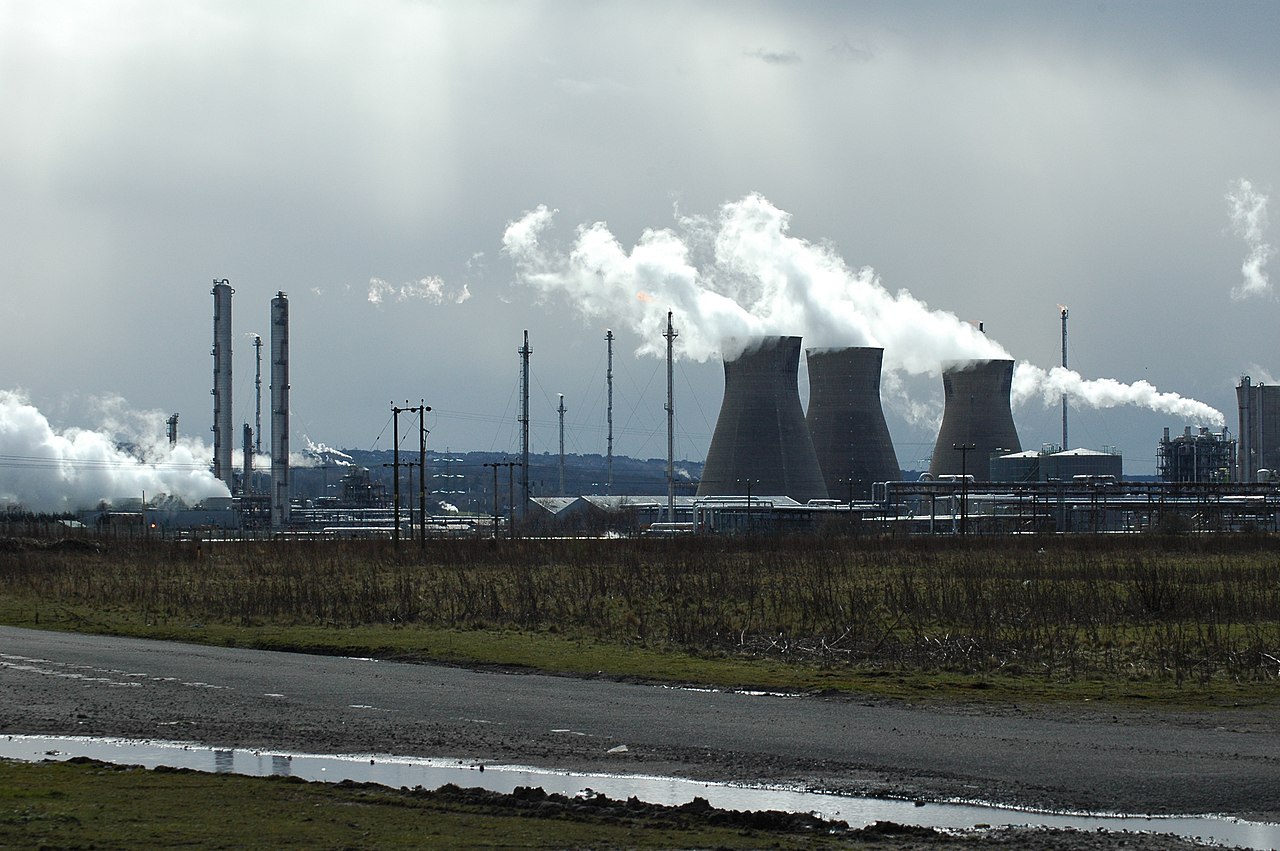
The UK government has partnered with INEOS in a £150 million joint investment to secure the future of Britain’s last ethylene plant at Grangemouth, protecting around 500 jobs at the site and hundreds more across the supply chain.
Under the agreement, the government will provide more than £120 million in support alongside a multimillion-pound commitment from INEOS, which has already spent over £100 million maintaining operations at the plant over the past year. The deal includes operational commitments from INEOS and safeguards to ensure public funding is used solely to improve the site, with provisions allowing the government to share in future profits.
Grangemouth’s ethylene facility is considered strategically important to the UK’s critical national infrastructure. Ethylene produced at the site underpins supply chains for medical-grade plastics, water treatment chemicals and advanced manufacturing sectors including automotive, aerospace and defence. The plant is also linked to the Forties Pipeline System, a key route for transporting North Sea oil and gas onshore.
The intervention forms part of the government’s modern Industrial Strategy, which identifies chemicals as a foundational sector supporting high-growth industries. Ministers say the package will help improve energy efficiency, reduce emissions and increase productivity at the site, strengthening its long-term competitiveness amid sustained pressure on European chemical producers from high energy costs.
Prime Minister Keir Starmer said: “When we said we’d protect jobs and invest in Britain’s future, we meant it and this is proof. Through partnership, determination, and our Modern Industrial Strategy, we’re delivering new opportunities, fresh investment, and security for the next generation of workers in Scotland. This is about good jobs, stronger communities, and a modern economy that works for everyone.”
Business Secretary Peter Kyle said the decision to intervene would “protect Grangemouth as a site of strategic national importance and secure 500 vital jobs in the area”, adding: “By partnering with INEOS we are backing the plant and its long-term future, giving certainty to workers and the supply chain going forward.”
Chancellor Rachel Reeves said: “We said we would stand squarely behind communities like Grangemouth and we meant it. Building on the millions of pounds we’ve already invested in Grangemouth, this vital package protects our national resilience and secures the livelihoods of hundreds of people employed at the site way into the future.”
Scottish Secretary Douglas Alexander described the deal as “a landmark moment for Grangemouth”, saying the £120 million government investment would protect “not just the 500 jobs at the plant, but thousands more across Scottish supply chains”.
INEOS chief executive Sir Jim Ratcliffe said: “This £150m investment in the future of a major UK industrial site demonstrates INEOS and the UK Government’s commitment to British manufacturing. UK Government support for INEOS’ investment shows the strategic importance of making things in Britain. It protects 500 high-value jobs, secures supply chains and preserves the industrial capability the nation needs.”
The agreement sits alongside wider plans for Grangemouth’s future, including £200 million earmarked from the National Wealth Fund to support new projects at the site, with around 140 proposals already under consideration. Recent announcements include backing for Scottish firm MiAlgae, which is developing a facility at Grangemouth to convert whisky waste into omega-3 products, and the creation of a taskforce to support workers affected by the planned closure of the nearby Mossmorran plant in 2026.
The government says measures to reduce industrial energy costs, including expanded support through the British Industrial Supercharger and proposals under the British Industrial Competitiveness Scheme, will further support energy-intensive sites such as Grangemouth.











Wise decision. The UK needs to retain certain capabilities and build other capabilities in order to protect our national interests.
Sounds a bit French to me! Backing essential factories of national strategic interest…preserving areas of national importance etc!! Maintaining sovereign capabilities!!! In the UK! What’s going on?
Yes it certainly seems there’s been an outbreak of common sense. Bit late for helicopters, underwater detection, avionics etc . . . Maybe even steel.
Good news here.
Yet I was reading on X that elsewhere other CNI factories are going to the wall under the Net Zero targets .
So HMG, emphasis on one area with the searchlight on it and even the PM and Chancellor wheeled out, while another area crumbles.
Yes?
Still, positives here at least.
Hi Daniele
Let’s keep the Reform bullshit about Net Zero destroying British jobs out of it. There is no evidence whatsoever that Net Zero has cost us any jobs at all. The allegation can be traced back to fossl fuel lobby briefings published in the right wing press. The fossilfuel cartel is rapidly losing market share to renewables and in desperation, they will do and say anything to deny global warming (“it’s a Chinese hoax”) and slow down the energy transition.
Detailed University College London research released last month found that 2010-2023, windfarm electricity has saved UK bill payers ~£14.2bn compared to having to buy and use gas to generate the same amount of power
Had we not invested in wind, the costs of building enough CCGT plant to cover electricity demand and the necessary grid upgrades would have been ~£133.3bn. During this period, the costs of government support were a mere £3.3bn each year. Not much to pay for domestic energy security
Since September 2021, renewables that are operating under CfDs have been generating electricity below the market rate – and so have been paying huge sums to the Treasury via the Low Carbon Contracts Company. £billions and £billions!! Reform and the dreadful duo Farage and Tice never mention that do they?
Source:
ucl.ac.uk/news/2025/oct/wind-power-delivers-ps104-billion-net-benefit-uk-consumers
Wind costs 4 times as much, because it is so unreliable, it needs plenty of back up.
@ John Hartley
Absolute crap. Why don’t you bother to check the facts before you do the fossil fuel cartel’s job for them?
UK renewables, particularly onshore wind and large-scale solar, are very cheap to build and operate (around £40-£50/MWh), significantly cheaper than new gas power. System costs for backup and grid balancing do increase costs, though currently falling gas prices are improving the picture. Despite assertions to the contrary CfDs are bringing costs down, with wind and solar electricity increasingly displacing volatile gas generation in the European wholesale market.
Key Cost Factors
1) Low generation costs – new onshore wind and solar are among the cheapest sources of new power in the UK, with costs per MWh falling to £40-£50 for new projects. And improve our energy security
2) No fuel costs – Renewables harvest free energy and have zero fuel costs (unlike gas), and carbon costs are also zero, making them stable in price.
3) The Contracts for Difference (CfD) scheme sets fixed prices, protecting consumers when gas prices spike. Early solar and wind farm installations generate juice that is priced according to the CFD regime under which they won their auctions. They are now paying huge sums back to the Treasury, as the price they get far exceeds their “support” CFD price.
4) New build CCGT – can be over £180/MWh, with high carbon tax costs and costs to connect to the grid.
5) System integration – the costs of upgrading the grid are significant but would have been necessary regardless
6) Profit margins for the UK energy generation and distribution system are approaching 25% and add significantly to household energy bills.
7) This year 2025 so far the UK has exported 9% of it’s renewable electricity, earning income for the Treasury and helping to keep costs down
In essence, the generation of renewable energy is very cheap, but the integration of that intermittent energy into the whole system does add complexity and cost. Though the long-term trend shows renewables making the UK energy system more resilient, secure and affordable by reducing reliance on volatile, inefficient and expensive fossil fuels. Even the best CCGT plant only operate at 50% efficiency, the rest goes up the cooling towers as “waste heat”
Hi David.
Nice rant, but totally different direction to what I was referring to, which was the ammonia plants in the UK, not energy production.
I’ve read they’re closing due to, amongst other things, carbon reduction costs.
A CNI just as this one in this report.
Daniele, more rubbish
The Confederation of British Industry issued a report last year strongly in favour of the net zero sector. Their detailed analysis showed unequivocally that the net zero sector is growing three times faster than the overall UK economy, providing high-wage jobs across the country, while cutting climate changing emissions and increasing the UK’s energy security
The CBI report showed that the net zero economy grew by 10% in 2024 and generated £83bn in added value. 22,000 net zero businesses now employ almost a million people in full-time jobs. The average annual wage in the businesses – £43,000 – was also £5,600 higher than the national average. The report analysed the growth attributable to businesses working in renewable energy, electric vehicles, heat pumps, energy storage, green finance and waste management and recycling.
Net zero is the British industrial opportunity of the 21st century. The sector is expanding strongly, with the 10% growth in 2024 following a 9% jump in 2023.
Farage, Tice and their Reform head bangers oppose net zero, apeing Trump’s pro-fossil fuel views. Their message is clear; vote Reform and destroy a million well paid green jobs and British leadership in the sector
David. You must be ignoring what I wrote in my reply….so, sadly, I’ll leave it there.
Not sure who in the Government decided to authorise this, but for once I am in full agreement with them. The race to Net Zero has not only killed off many industries along with increasing unemployment, but it has had a massive impact on our “Critical Infrastructure”. In times of increased tension, uncertainty and possible future conflicts, it is important that we have a critical infrastructure that can carry on, when our shipping lanes are closed, or our “overseas” suppliers suddenly pull the plug.
Let’s hope this is the start of a change in central government thinking and policy.
Careful, you’ll be dismissed as a Reform loony not caring about net zero with posts like this.
Yes, I too have read it’s having an impact on some CNI sectors, which I tried to highlight above.
Just checked, CF Fertilizers in Billingham, to be exact, which apparently impacts ammunition production as we now need to source it elsewhere.
Closed as uneconomical, with little fanfare from HMG compared to here, which I found curious.
CF Fertilisers UK Limited is a subsidiary of CF Industries Holdings, Inc
CF Fertilisers UK made the proposal to shut their ammonia plant due to a forecast in 2023 that producing ammonia at Billingham will not be cost-competitive for the long-term compared to importing ammonia. Primarily due to projected high natural gas prices in the UK relative to other regions and the impact of carbon costs.
Additionally, shutdowns in recent years of industrial customers’ UK operations which had consumed significant ammonia volumes for their businesses have created a supply-demand imbalance for ammonia production at the Billingham Complex.
The company believes that ample global availability of ammonia for import, including from CF Industries’ North American production network, will enable more cost-competitive and efficient production. Sales of ammonium nitrate fertilizer and nitric acid for its U.K. agriculture and chemicals customers will be supplied from it’s American plant moving forward.
So just like Cadbury’s chocolate, they have closed the British factory to concentrate production in America. Nothing to do with net zero whatsoever. Just the high price of “natural” gas here
Thanks.
Wonderful stuff, that its nothing whatsoever to do with net zero, despite it saying Carbon costs having an effect.
Yet it seens it is still going, yet we save this bit of CNI but let another go, my original point.
IIRC, it was a different government in 2023.
Good, but if Rachel cut the 78% tax on North Sea Oil & gas(even a little bit) + allowed new drilling, we would not need to subsidise Grangemouth. It would run at a profit by itself.
Lots of high-value jobs; bit like Manchester Utd then?
Sunak, just before the last election – heavily influenced by the fossil fuel cartel – changed the timetable for the introduction of EV’s to the British market; this change was opposed by the SMMT. Nissan then stopped production of their popular Leaf EV in the N East, BMW moved production of their electric Mini to Germany. Honda shut their Swindon plant completely, Stellantis cancelled development of their Vauxhall electric white vans and Aston Martin gave up on EV’s altogether. This deluded political decision has cost us thousands of well paid manufacturing jobs – not net zero!
Currently EV sales are doing very well here;
2024: A record year with ~382,000 BEVs sold, a 21% increase from 2023, reaching 19.6% market share.
September 2025: Record month for BEVs (72,779 units, +29%), boosted by the new £3,750 Electric Car Grant (ECG), making electrified cars over half the market.
November 2025: Growth slowed (3.6% BEV rise) to its weakest in two years, just before new road taxes took effect, despite EVs still making up over half of all new registrations.
Year-to-Date (2025): BEVs accounted for ~22.4% market share with ~386,000 registrations by mid-year, while Plug-in Hybrids (PHEVs) saw even stronger percentage growth
The fossil fuel cartel is losing. Last year (2024) renewables produced over 50% of global electicity. THis year renewables are projected to produce 61%.
Have you seen the high number of near new (2024) electric & electric hybrid vehicles that have SORN off the road declarations?
I believe the average car leasing loan has doubled over the past few years. My son, with my help, recently paid £13k cash for a 3 year old petrol Skoda Fabia with 16,000 miles on the clock. It’s a nice comfortable, quiet car which will give many years of reliable motoring. He sold his 1.4 L petrol VW Golf for scrap – it had over 200,000 miles on the clock- excellent German engineering. The dealer showroom was full of bloated EV SUVs priced at nearly £40k. Prospective buyers with more money and ego than common sense were drooling over them. What cost of living crises?