

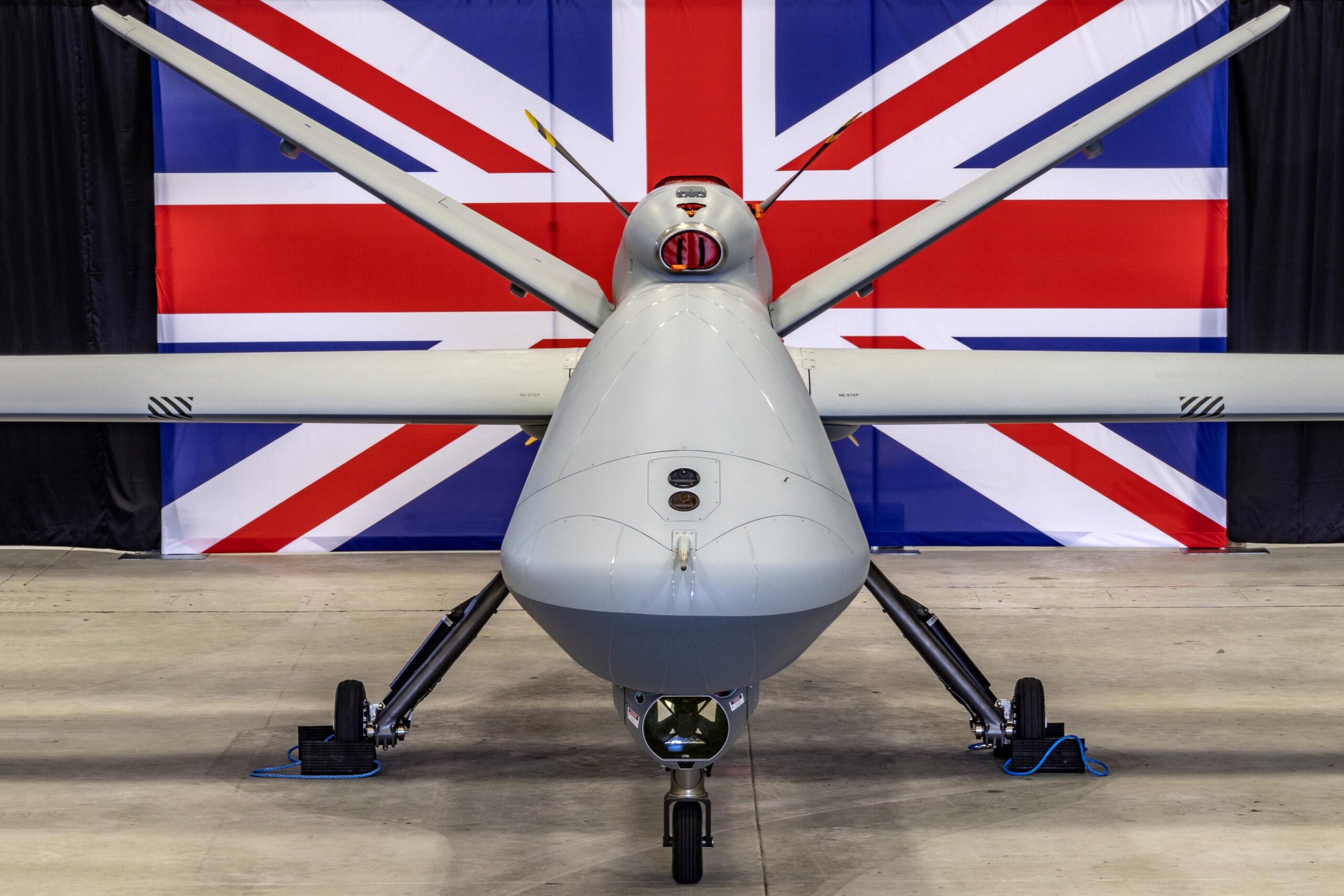
The Ministry of Defence has declined to explain why the RAF’s new Protector RG Mk1 remotely piloted aircraft has not yet reached Initial Operating Capability (IOC), despite the programme previously being expected to achieve that milestone in 2025.
In a written parliamentary answer published on 11 February, Defence Minister Luke Pollard responded to a question from Conservative MP James Cartlidge on the reason the aircraft had not declared IOC.
Pollard said:
“I am withholding the definition and specific criteria for achieving Initial Operational Capability as it would harm the security and capability of the Armed Forces.” He added that: “The milestone is clearly defined and the Ministry of Defence is working to ensure the necessary supporting requirements are in place so that it can be met at the earliest opportunity.”
However, while declining to provide the specific criteria, Pollard acknowledged that the aircraft itself represents only one element of the wider capability. He said: “In general terms, the air vehicles are but one part of the air system and therefore milestones will be achieved when requirements are met across a number of areas including; personnel force growth, infrastructure and support contracts, crew training and competence in role, and interoperability.”
The latest response follows earlier UK Defence Journal reporting that the Protector programme had still not declared IOC, even though the platform has already been used operationally. In a previous parliamentary answer published on 30 January, Pollard stated that: “Protector RG Mk1 has yet to reach Initial Operating Capability programme milestones.”
He added that the system: “has already deployed on operations and is providing valuable Intelligence, Surveillance and Reconnaissance support.”
Protector RG Mk1 is replacing the RAF’s MQ-9A Reaper fleet in the Armed Intelligence, Surveillance, Target Acquisition and Reconnaissance role. The aircraft is based on the General Atomics MQ-9B SkyGuardian platform and is designed to be the UK’s first certified remotely piloted air system capable of routine operation in controlled airspace.
The platform is designed for medium-altitude, long-endurance operations, with an endurance of more than 40 hours and a maximum operating altitude of up to 50,000 feet. It is powered by a Honeywell TPE 331-10T turboprop engine and is operated by a crew consisting of a pilot, sensor operator and mission intelligence coordinator.











Oh come on now, give It a chance, it’s only been 11 years since It was announced.
I wonder if the reason for withholding info is because there is a design defect that the UK government doesn’t want to embarrass the US about. I can’t really see any other realistic explanation on why they would need with withhold the info.
If there was a design defect then it would be public as other operators (Belgium, Canada, Denmark, Japan, Taiwan, India, and the U.S. Air Force/Marine Corps) would all have encountered it.
No this sounds like a parallel situation to the Astutes. Great kit, but we’re lacking the support structure necessary. With the Astutes it’s dry-docks for maintenance.
With the Sky Guardian it could be lack of trained personnel, which is mentioned in the article. Or it could be issues with where they based. Whatever, it’s an embarrassing cock-up (just like the lack of docks for the Astutes).
You are assuming that we took MQ-9B straight without asking for alterations to make it more acceptable to the RAF. We could have messed it up ourselves.
All we changed was the name, you’re the one assuming.
It was specified to carry both Brimstone 3A and Paveway IV and it’s possible that GA have had issues incorporating these U.K. manufactured weapons. Which would explain that it’s been used for surveillance missions. But the UK isn’t alone in using these munitions and it’s not unreasonable when buying a weapons platform that it be capable of using the weapons you already possess. Or would you prefer the USA’s inferior weapons for it instead?
Yeah I’m assuming as we don’t have anything to go on other than assumptions.
Or you just go off the facts we know: that other countries are operating these successfully so it’s obviously not a design defect.
Are the other operators working this model?
Your probably right, I just wasn’t expecting it to be that different from the reaper, since it’s effectively only an upgraded model, rather than a completely different air frame.
I listed them 🤦🏻♂️
A change in missile fit out doesn’t stop them entering service, look at the f35b. We could just use the old missiles until the fitout / training is done for the new ones, since the US is operating these. Something is clearly off.
Really? Then why don’t we have Meteors on our F35s yet… 🤦🏻♂️
It’s a completely different airframe from Reaper, it weighs about a tonne more at MTOW and has much more redundancy so that it can fly in civilian airspace.
If it was just training issues, I don’t see why they wouldn’t state it. It wouldn’t be the first time they have announced issues around training connected to the RAF. It’s just odd to me.
What does IOC even mean nowadays? the platform is already in use.
Ajax had IOC and then its was withdrawn. Crows-nest was flying missions for years before IOC.
As in “we’re completely clueless” 😒
Interesting. Maybe the personnel from the Reaper force have not yet fully transitioned.
A very minor one for me in the field of UK defence.
That’d be my bet, personnel related issues. Or maybe UK weapons intergration.
Ha.
Unmanned Autonomous Drones, held back due to Staffing Issues lol.
Here’s the UK defence Future.
Unless we want to expand the role of these drones into maritime patrol and/or carrier MPA/AEW, in which case having the fleet working is quite important.
It is.
But some clever clogs decided to bin Reaper, so Protector has to cover their role in the ME as well.
Not ideal. I’d have kept Reaper on station in role.
So I doubt there will be many spare, even if the Maritime fit is bought. I don’t think it has yet, for the MPA mission?
All that of course would have necessitated an increase in staff, in ground stations, and all the rest.
Another delay.
We haven’t bought the MPA kits yet, but it’s reputedly one of the most confident DIP purchases as it was name-checked repeatedly in the SDR and also wouldn’t cost that much.
What is less likely is us buying extra to make up the numbers as we transition, but we are moving from 10 to 16 aircraft with much longer endurance so we could keep 6-8 in the ME and convert the rest, which would still be the largest SeaGuardian fleet in the world and also double our MPA mass for the more routine missions.
Yes, 16 is decent. Pity it’s not the 24 that Cameron grandstanded over, but still.
My ideal fleet would be for 8 to stay on ME duties (that’s a bit much but we never know what’s going to kick off), 8 to be converted to land-based MPA standard and 8 more to be purchased as a Crowsnest replacement and maritime supplement to E7 making 24 in total. Depending on funds a further 8 could do carrier-based MPA or the land-based ones could be converted to wing kits, it depends on how much the MoD is willing to pivot to the navy and the navy are willing to commit hard to ASW.
Mate, agree with you on 24 , could be done if they kept Reaper as you pointed out – big missseed opportunity IMHO.
Yes the mod has an annoying habit of retiring kit before the replacement is in service
Hi TJ, is the UK looking at the Sea Guardian variant of this too?
Converting some of our existing fleet to the SeaGuardian standard or above was in the SDR and was one of the clearest recommendations so I’d say government tipped them off that they were planning it. There haven’t actually been any published procurement plans though, so it isn’t certain.
“Due to the stable and safe state of the world today, we couldn’t be bothered with the UK’s defence. After all we are now the third world’s breadbasket, no doubt they’ll all stand up for us if things go pear shaped” – the British powers that be, probably
Anything to do with MOD procurement means late, over cost with no one taking responsibility.
SeaGuardian is not protector.
Other countries use SeaGuardian with no issues. To REALLY cock something up add MOD procurement.
We are an absolute laughing stock
Everyone it seems can get kit working. Except us