

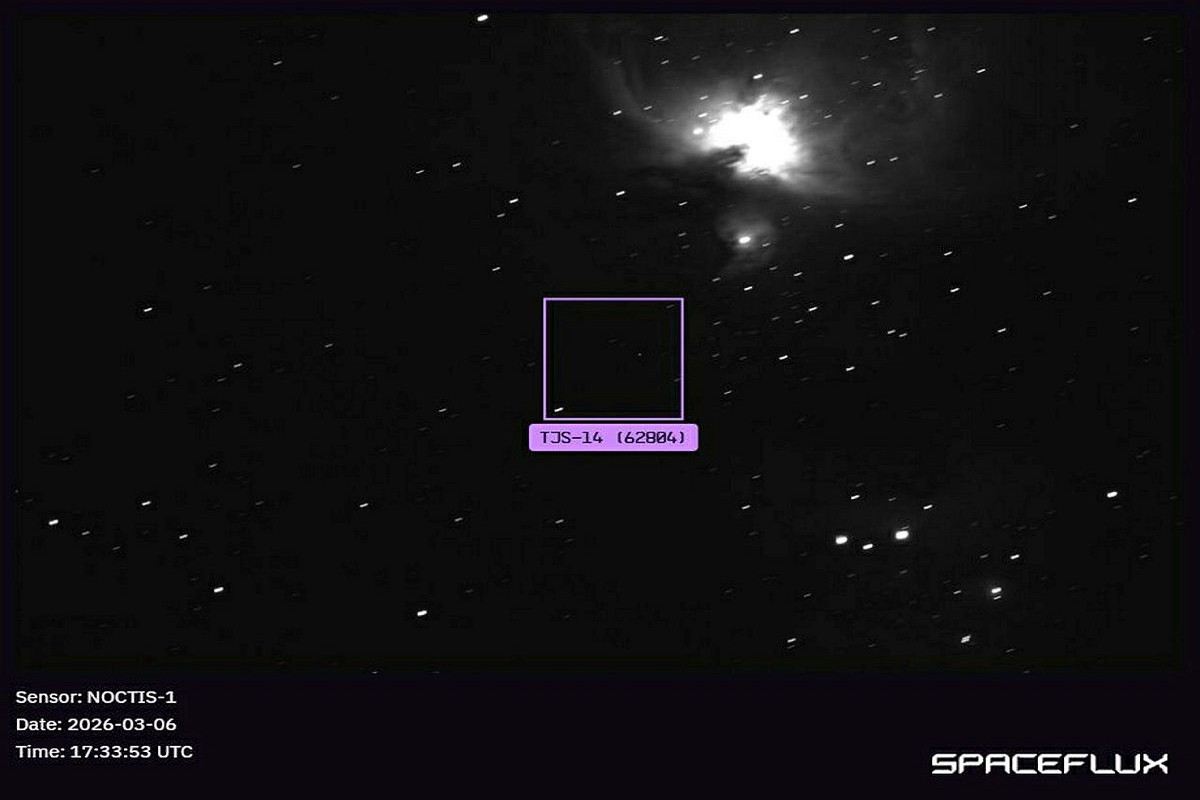
A new software system designed to track threats to British satellites has reached operational status six months ahead of schedule, the Ministry of Defence has announced, as the UK also released the first images captured by its Noctis-1 military space telescope.
Major General Paul Tedman, Commander of UK Space Command, said the combination of Noctis-1 and the new Borealis software represented a step change in the UK’s ability to operate in what he described as the invisible front line.
“Protecting and defending the invisible front line in space requires us to see and understand what is happening in orbit and then make decisions at machine speed. Noctis-1, with Noctis-2 swiftly to follow, will provide us the sovereign eyes we need to augment our space domain awareness. Data is the coin of the realm in space operations. Borealis exploits edge software to make sense of the vast amounts of information we ingest and then model actionable choices to my operators in the National Space Operations Centre. Together, they represent a significant enhancement to the UK’s space capability.”
Borealis rapidly compiles, fuses, and analyses data from multiple sources to provide the National Space Operations Centre with a faster and more accurate picture of the space environment, including debris and satellites from adversaries that could pose a threat to UK assets. Images and data from Noctis-1, formerly known as Nyx-Alpha, are fed directly into the system. The first images released from the telescope show the International Space Station, the UK’s Skynet military communications satellites, and other satellites from nations around the world.
/MOD/2026/May/MOD-Noctis-1%20image%201%20SKYNET%205D.gif.iCfjmpSBMiMhBwNlYBMA.qjXe3aoi0A.jpg)
The system is being rolled out under a £65 million five-year contract with CGI UK, supporting 100 skilled jobs across sites in Leatherhead, Reading, and Bristol. Neil Timms, Senior Vice President of Space, Defence and Intelligence at CGI, said delivering the system to operational readiness half a year early reflected the company’s track record in complex space programmes.
“By combining deep domain expertise with modern engineering practices, we’ve provided a scalable capability that can adapt as mission demands and the threat landscape continue to evolve.”
Luke Pollard, Minister for Defence Readiness and Industry, said space had become a contested domain. “Protecting our satellites from adversaries keeps our economy moving and keeps us all safe. As we increase defence spending we are investing in new defensive capabilities in all domains, including UK space-based capabilities.” Space Minister Liz Lloyd said Borealis represented a significant step forward in the UK’s ability to monitor, protect and defend critical space capabilities. The UK Space Agency co-funded the investment alongside Space Command.
Nearly 20% of UK GDP is estimated to be reliant on satellite services, covering navigation, financial transactions, weather forecasting, military operations, and global communications. Borealis is deployed at the National Space Operations Centre, which delivers the UK’s space surveillance and protection mission.







Not sure how this is bad news but I’m sure someone is about to tell me 🤔
Well I suppose the emergence and development of a new front line is not exactly goods news, but delivering something to the MoD 6 months early is definitely impress and on my list of good news stories.
Russia has demonstrated an effective anti SAT weapon back in early 2022 just before they invaded Ukriane with a live firing at one of it’s own ‘dead’ satellites. The resulting debris field has caused significant issues since and there are still some bits and pieces zipping around in orbit. Any future conflict with could well see them do something similar threatening western satellites that are becoming increasingly important in C2 roles around autonomous vehicles, Atlantic Bastian being a particular example.
As such tracking rogue objects in space is potentially really important capability both economically and may be militarily as well. So this is a an interesting good news story in my eyes as well.
Cheers CR
I’ve gained $17,240 only within four weeks by comfortably working part-time from home. Immediately when I had lost my last business, I was very troubled and thankfully I’ve located this project now in this way I’m in a position to receive thousand USD directly from home. Each individual certainly can do this easy work & make more greenbacks online by visiting
following website—.,.,.,.,.—>>> JobatHome1.Com
I’ve gained $17,240 only within four weeks by comfortably working part-time from home. Immediately when I had lost my last business, I was very troubled and thankfully I’ve located this project now in this way I’m in a position to receive thousand USD directly from home. Each individual certainly can do this easy work & make more greenbacks online by visiting
following website—.,.,.,.,.—>>> PayAtHome1.Com
CR,
Fearless prediction: Space will become an exciting and very sporting frontier in the foreseeable future. Wager on the CRINKs to place disguised nukes (e.g., a Tsar bomb equivalent) in orbit, despite multiple treaty prohibitions. Virtually guaranteed. Perhaps time to raise the shields, man the phasers, and arm the photon torpedoes? 🤔😉😁
Hello mate,
Hope are you well. Nukes in orbit has got to be the scariest of scenarios and one that could easily come to pass, assuming it hasn’t already been done.
Hell the idea figured in the Clint Eastwood film Space Cowboys..! Fun film 🙂
Cheers CR
Not at all. The negativity ( see below ) is, as is so often the case m, the spin put on it by the likes of Pollard.
Not the system. ISTAR is king.
I’d read we are getting 13 other smaller sensors as well, I forget their names without looking it up in the files at home.
This could be pretty confusing if you haven’t followed the story. The telescope, Noctis-1, is in a remotely operated station in Cyprus, operated from RAF High Wycombe. One might be forgiven for thinking it a “space-based capability” from the article. Announcements say it primarily tracks objects in geostationary orbit, but it has ultra-fast panning capabilities allowing it to track fast very moving objects across the sky, which obviously wouldn’t be necessary to image geostationary satelites. It’s clear the LEO satellites are on its agenda too, and that’s just as well considering the increasing importance of communications clusters such as Starlink to the military. There is speculation as to whether it’s built in the mountains like a traditional telescope. Some sources say Noctis-2 will be colocated, but others have put it specifically in Akrotiri. It will consist of a large-scale electro-optical static array with at least one infra red facility feeding in. While announcement again talk about geostationary targets, this is more credible set up for purely geostationary. Operational date some time around 2030.
I’m not sure when the AUKUS DARC multi-dish radar tracker is supposed to come on stream (at Cawdor), but I imagine it would complement Noctis-2 when it does, providing radar tracking of geostationary threats. It’s likely the two systems will be able to cross-cue.
The whole thing feels like a properly thought out programme. And it’s coming in early too. Congratulations to Space Command.
Good post.
I too assumed it would be at Troodos Mtn, rather than Mt Olympus, speculation regards a site at Akrotiri is interesting.
Cool stuff.
So what happens after we detect the threats ….. ?
Don’t panic chaps…I have a plan….a cunning plan…..
Ah but… Is It more cunning than previous cunning plans ?
Baldrick, is that you ? 😁😁😁
Baldrick tells me we are planning a series of satellites with cow prods apparently with unique experience gathered from tipping V1s off target. British ingenuity at its best I think we can all dis-agree.
I rather think that lots of Meetings will be had to discuss the various options ?
Ah!
It’s always the way mate. Isn’t there that story going round about the US officer telling the RN they’ve got cutting edge ESM/Intell, and know when they’re going to die? As they lack so much offensive capability to do much about it?
Probably a fake story.
This to me is, partially, like Fylingdales and the 4 minute warning, and why ministers like Pollard infuriate with their “keeping us safe” bollocks that gets inserted into every statement. It’s not “keeping us all safe” at all, it’s giving information.
But, yes knowledge is power, and ISTAR is king.
So, with Fylingdales, and this, that means hiding under the table or stairs ( if you can be bothered, Pollard probably won’t have to ) or, regards the military, knowing other nations satellites are over you at a specific time so sensitive kit is under cover.
The article I read on this concerned a Chinese satellite, and Russian killer satellites moving closer to our own, presumably the operators could defend against that by initiating a burn to move the bird to a different position.
This is good kit to have.
Overall, though, we’re beholden to the US, as usual, regards most of our hardware.
The burn is all part of the game of course, you can indeed use it to distance yourself from another satellite, but the more you use it the shorter your satellite’s active service life is going to be.
Out of interest could this set up discover potentially dangerous asteroids approaching Earth as we still have limited capability to do so judging by our most recent belatedly detected ‘near miss’. I would presume its deeper space range would be too short to give more than an equally belated warning even if it could spot such objects. ☄️🛸
It’s a good question Spy.
Oh the Irony !
Being our “Spyinthesky” I would rely on you knowing !!!!
I suppose in theory under ideal circumstances it could detect an asteroid, but anything the size of a satellite will almost always burn up anyway so it’s bigger ones that are the risk, but they’re all already being tracked as it is.
Hi DM. Any idea of what space based surveillance capability the RAF have? Apparently the US was (reportedly) providing Ukraine a lot of intelligence about Russian assets on the ground. Now they’re not (thank you Donald). Could the UK now be filling that gap? For ourselves, of course, as well as UKR.
We have S.I.D. In orbit plus Moon base S.H.A.D.O. monitoring all near earth activity.
Commander Straker heads up the department.
Hi Crab.
Sorry for late reply, I’ve been away.
I don’t think we have much beyond the small sats Tyche and Carbonite II, very, very small fry.
Traditionally, we have had access to US space based sources of IMINT, along with the longstanding arrangement between GCHQ NSA for SIGINT take from their satellites, as part of 5 Eyes/ UKUSA agreement. Our own attempt there ended with cancellation of Zircon ( AFAIK ) which was I think a SIGINT bird, not IMINT.
I’ve heard rumours that the Skynet constellation might have some hidden features but if so, it’s all classified.
Cannot help much I’m afraid, space based we’re not well furnished, which is why ISTARI is so important.
Ahh, I guess you never watched the series “U.F.O.” then Daniele ? It was classic Gerry Anderson stuff, way ahead of It’s time.
Thanks Daniele
I knew it would be ahead of time. I saw it in the stars! 🎆 Well done CGI.
Could you put more adverts on the article please, I could almost read the content.