

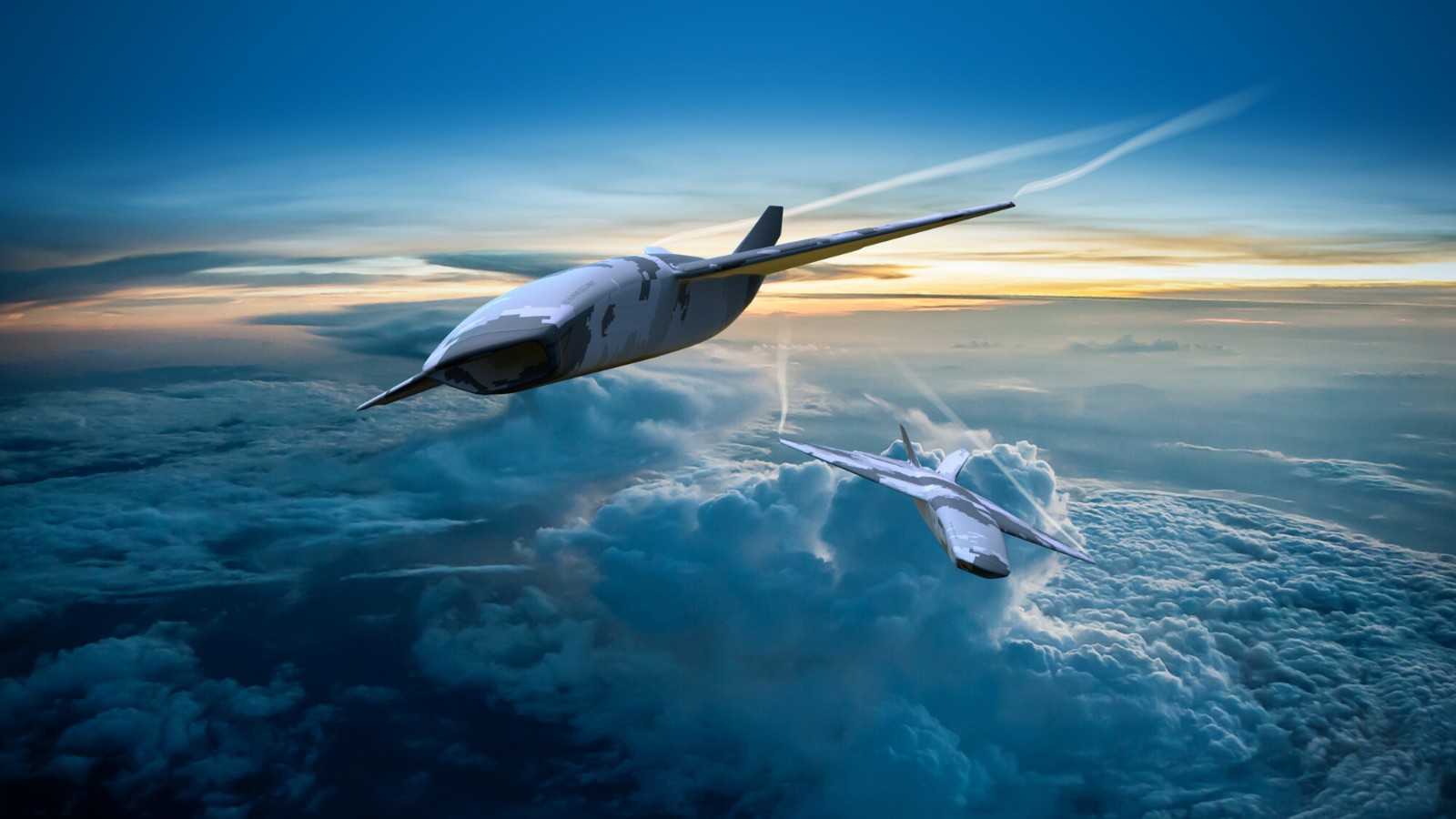
A written answer in Parliament links the UK Collaborative Combat Aircraft to the Royal Navy’s Hybrid Carrier Air Wing, as industry imagery shows the new drone fighters flying from a carrier deck.
The Ministry of Defence has confirmed that the UK Collaborative Combat Aircraft programme is supporting delivery of the Royal Navy’s Hybrid Carrier Air Wing, in response to a parliamentary question on when production of the air wing would begin.
Stuart Anderson, Conservative MP for South Shropshire, asked Defence when production would commence on the first Hybrid Navy Carrier Air Wing. Answering, Minister of State Luke Pollard said: “The Hybrid Air Wing is not a single product with one production start date. It is an evolving mix of crewed and uncrewed aircraft and one-way effectors that will be introduced incrementally.”
Setting out where the work stands, the minister added: “Delivery is already under way through the integration and trialling of uncrewed systems, supported by investment in Project PANTHEON and the UK Collaborative Combat Aircraft programme.”
The reference places the UK CCA effort, announced by the government as StormFighter and backed by £300 million in the Defence Investment Plan, alongside the Royal Navy’s own carrier aviation work rather than treating the two as separate lines of development. Previous written answers have pointed to the RAF and Royal Navy working together on the CCA, and Project VANQUISH, the trials strand sitting under PANTHEON, has been described by the Royal Navy as a joint endeavour with the RAF to demonstrate a fixed-wing autonomous collaborative platform from an aircraft carrier.
Project PANTHEON received almost £250 million in the Defence Investment Plan, allocated to the development of autonomous systems to begin building the Hybrid Carrier Air Wing and to trials of jet-powered drones intended to work alongside the F-35B force. The plan stated that the Queen Elizabeth-class carriers would exploit uncrewed systems, including CCAs, to augment the F-35B force, with the wider Maritime Aviation Transformation programme aiming to move the Fleet Air Arm toward a largely uncrewed force by 2040.
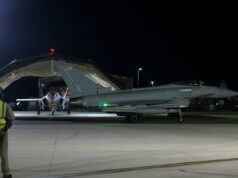
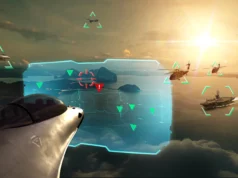
Industry has also been depicting its CCA offerings in a maritime setting. Promotional imagery released alongside the unveiling of BAE Systems’ Brontanax at the Farnborough International Airshow yesterday showed the aircraft operating from a carrier deck, and similar depictions have accompanied other manufacturers’ collaborative combat aircraft concepts.







This would be excellent news if possible and backs up my thought about pop-up airfields, which would allow this craft to use STOL-type airports or rural airfields. The convention that RAF planes operate from their bases could be about to change. Vertical take-off drones and F35s could also function from improvised landing grounds or from hundreds of rural airfields across the country.
So in other words, functionally a successor to Harrier.
The future may be shiny and new, but as usual it also looks very familiar.
Obviously not a vertical craft; however, if it can operate both at base and at a dispersal airfield, the STOL element could prove vital in times of aggressive military action against the UK. The changes to all three services in the coming years will be seismic, with current job functions changing beyond recognition. Thousands of skilled mechanics, computer analysts, and defensive and offensive drone controllers will need to be trained and enrolled into a new AI-dominated multi-force. The current three services will inevitably become less defined as drones such as those featured here become used across the spectrum of shared operations. The Harrier field units were before their time where RAF and Army worked side by side on the battle front. There appears to be no reason why F35Bs can’t function in a similar way in combination with crewless fighters and vertical drones.
I suspect launch rigs like that shown with Nyan will become much more common at least for the less heavy examples. Another reason perhaps why a mix of higher end and lower end heavier drones will be useful, some restricted to airfields but can operate seamlessly with Tempest and the like with higher performance and less capable versions with a smaller profile but can be launched from almost anywhere and can still operate, if in more limited fashion, with fighters or other platforms as required. That would be a nightmare for any opponent.
A military spokesperson recently commented that battlefields are constantly scanned and that detection is a major concern. Concealment by camouflage or electronic systems is now a high priority. He was actually talking about the Army’s CH3, though the same issue applies to the RN and RAF assets. I would suspect that most critical RAF bases are prime targets, so appropriate dispersal is probably part of vital war planning. If so, the ability to deploy Stormfighter from a wide selection of improvised bases could prove to be a huge advantage, and STOL capabilities would be highly desirable. I can see no reason why ski jump take-off assemblies can’t be strategically placed across the country to enable enhanced take-off dynamics and allow for heavier airborne arsenal.
Yes we need this to work in future years.
Seems unlikely the UK will be able to develop two simultaneously so hopefully the CCA can do both carrier and conventional take off and landing.
Something like the Gambit family with four in one would be great.
Images of the Bae CCA show it with twin nose wheels. This is similar to the T45 Goshawk version of the Hawk trainer.
In really you can ski ramp launch a pretty heavy fighter and load.. the Russians threw about 30,000lbs of conventional take off fighter of a ski ramp.
So the RAF are looking for a fighter drone of 11,000lbs+ it should be easy to throw it off the end of an Elizabeth.. it’s got no pilot, no pilot life support, no cockpit or cockpit interface controls.
The challenge will be landing as it’s likely a conventional 11,000ib conventional take off drone will need some form of arrested landing.
Afternoon Jonathan, certainly BAE Systems prototype appers to be ‘carrier prepared’ lookat the undercarriage etc.
Regarding landing, two things are required, we need arrested recovery and an angled deck, both absolutely required.
As previously mentioned, it would allow higher RVL speeds for the F35B too.
Do you need an angled deck? Let’s have a think. Angled decks improve safety in case of a bolter (they also allow you to separate landing ops from parked aircraft and launch ops. They don’t necessarily allow simultaneous launch and recovery. A bolter is normally caused by a pilot messing up a landing approach….. There’s no pilot.
The USN now uses “magic carpet” that basically lands carrier jets automatically. It’s so good, that it has done away with the requirement to carrier qualify student pilots. The latest Chinese “amphibious” drone carrier has an inline deck with catapult and arrestor gear. So does the Turkish carrier.
So I have a genuine question…. do you need an angled deck when it comes to unmanned aircraft?
Hi Bob, yep, absolutely we need an angled deck, to safety deconflict deck ops if we have heavy Combat drones crossing the stern at 100knots +.
Otherwise, safety requirements would dictate that there’s nothing forward of the landing CCA, massively impinging on deck operations.
It could blow a tyre, have a collapsed undercarriage leg and go tumbling straight down the deck, spilling burning fuel, turbine blades and munitions as it goes….
It has to be an angled deck, unless they are vertical/STOL designs, that’s now looking very unlikely
To go for STOL with only wheel braking a Vanquish CCA would require a landing speed similar to F35B SRVL, or 70ish knots. So a straight deck wouldn’t be quite as dangerous as straight-through CATOBAR, but still hairy in the case of undercarriage collapse or blown tyre- how frequent is that on US carriers?
All those nasty things can happen during take off too but they don’t stop the CVFs having an axial runway.
You don’t need an angled deck period. CVA01 had such a narrow angled deck that it might as well have been zero.
BTW Bae have stated the new drone can take off without a catapault over the ski jump but would require an arrested landing.
The QEs have a wide enough flight deck that a CVA01 style parallel deck would probably be the best option to avoid losing the huge starboard quarter deck park in the event of adding CATOBAR or even a STOL landing deck.
The problem is that the ramp is displaced to the port side of the bow and moving it to starboard to deconflict with the landing deck might cause issues with air flow for aircraft taking off next to the island as well as limiting wingspan for MQ9B type STOL drones.
No need to move it. Jeesh.
That or have two runways at very shallow angles to each other.
Or just the one runway that’s already there 🙄
No need for an angled deck, reduces the runway length for takeoff. With precision landing I don’t think it’s required.
We will see Jim, personally, I dont see another way to safely recover heavy CCA, coming over the stern at 100 knots.
A single mishap on landing could be catastrophic for the ship, causing extensive damage.
You want that mishap ‘safely’ over the side, not tumbling down the center line.
I dont personally think an angled deck would cause significant issues, as the deck is so big. F35B’s frequently start their take off runs in about a third of the deck anyway.
You’ve failed to explain how a runway angle on a CVF prevents your catastrophic mishaps.
You’ve failed to explain how a runway angle on a CVF prevents your catastrophic mishaps.
You’ve still got the digital stutter I see Ron🤣🤣🤣
An angled deck is a lot safer by its very nature, the CCA has a clear deconflicted route, goes safely over the side and doesn’t go storming down the centreline, shedding its airframe, turbine blades, burning fuel and ordinance as it goes.
As ive mentioned, I find it alarming that project Ark Royal was shelved. The Defence review pretty much ignored the carriers and effectively cancelled any investigative work to equip them for CCA assets.
Still not giving any reason for your demand for angle decks I see.
Er, ok Ron…..
I’ll simplify it..
Angled deck = Damaged/ malfunctioning CCA deconflicted and safety over the side.
No Angled deck= a flight deck center line crash, probably significant damage and loss of life.
Good enough reason I think….
Angle runway: aircraft parked to port and starboard of runway. Clear ahead. Prime F-35 vertical landing spots occupied by runway. Runway too short for unassisted take off. No ski jump.
Axial runway: aircraft parked to port and starboard. Clear ahead. Prime f-35 vertical landing pads still available. Runway long enough for Brontamax unassisted take off over ramp.
No brainer, axial wins.
The USAF did a study many years ago, most of their tactical aircraft types could use a ski-ramp unmodified.
https://apps.dtic.mil/sti/html/tr/ADA237265/index.html
It’s not quite as simple as that as you need to balance the aircraft’s take-off weight with the lift being generated along with the thrust from the engine. The critical factor is the engine’s performance. Ideally you want the power to weight ratio to be 1:1. But aircraft that can also use the main fuselage to develop lift can get away with a power to weight ratio closer to 0.9:1. The smaller value, just means you have a much smaller threshold before you enter a risk zone. The high the value the more margin for error the jet can cope with, e.g. as the wheels leave the ramp the jet flies through a small air pocket (volume of air with less air density). So you have to rely on the engine’s thrust to get you out of trouble.
In truth, you can get away with using an engine with a lot less power, but if the jet is launched via catapult. At some point the RN must bite the bullet a declare the QEs need a catapult, as it makes designing and powering the jet so much easier.
Because of the extra engine, the B variant has the highest landing weight, meaning that the aircraft may need to jettison unused weapons in order to land vertically on the deck. So, weight is a critical factor here.
Not yet it doesn’t. It cannot carry enough UK weapons ro make it unable to vertically land.
Not internally, no, but surely a max load of underwing Paveway plus AMRAAM and ASRAAM is too much?
Incorrect. At the moment, the UK’s F-35B cannot be configured such that it can’t vertically land.
Oh Gawd…. here we go again !
Angled deck, Cats and Traps….. wish I was an expert 😁
Not sure it will need any of that. Presumably this drone will be quite light and might simply blow of the deck.:)
BAE indicate that this, like Taranis, will be roughly Hawk sized. That would mean an MTOW of up to 20000 lbs.
It’s certainly going to need arrestor gear, as does Turkey’s Kizizelma with an MTOW of 19000 lbs
Bae agrees with your comment.
And a pretty chunky engine to push it along!
Not sure why this is surprising. I would have thought it would be one of the top requirements.
Not sure it would need to be vertical take off and landing just it needs to get up and down intact (including weapons etc).
I wouldn’t get too excited about a picture of a Queen Elizabeth carrier appearing on the background large screen at the Brontanax launch, or the CGI’s from some American companies. At the end of the day the RN doesn’t have the money to go it alone with a purpose built naval CCA. It either piggy backs the RAF’s Storm Fighter programme, or looks for an American solution. Either way, as junior partner with shallow pockets, the RN’s mandating of STOVL capabilities is soon going to hit the reality that for cost and performance reasons it won’t make it in to the final requirements. Some form of STOBAR or CATOBAR kit is going to have to be fitted to the QEC. Incidentally, I see that a fly-away unit cost of £20-30 million is being talked about for Brontanax, it may be considered an “attritable platform” by the RAF but losing a couple a year to just accidents would be painful for the RN.
You are mistaken, the RN hasn’t mandated STOVL for any CCA drone.
STOVL is a very reasonable assumption to make given that the Project Vanquish RFI requires a high-subsonic, jet-powered aircraft able to take off and land from a QEC carrier without the need for catapults or arrestor gear.
Not at all. The expense of developing and manufacturing a unique STOVL CCA for the RN, is not only prohibitive but also unnecessary.
A STOVL requirement of CCA, for QE’s would considerably exceed 20m each!
If this is the CCA they are planning to fly from a carrier very soon, then the arrested landing discussion is nearly settled. The carrier won’t have what we think of as a classic arrestor system.
There are two caveats I can see though. Firstly, they never actually said the CCA would land back on the carrier anytime soon. So I suppose they could meet their claim of ‘flying from’ a carrier by launching and sea and landing onshore. A technical loophole, probably not happening.
Secondly, they may thought of a way to have a lightweight arrestor system that can be fitted and removed – a better engineered version of two containers with a wire or arrester net between them that just needs to be drop on the deck. Seems unlikely though.
So perhaps they do have a plan to land this onto the carrier deck as it is now – no arrestor system. Or perhaps there’s another cunning plan I havent though of
A long winded comment that is summarized in your nom de plume.
I know there are limits to my knowledge and understanding
I try to show my working out
I recognise that others may know more than I do
You should try it sometime 🙂
I do but not necessary here.
Here’s a crazy idea: use a carrier drone to launch and recover the combat drone. Imagine something like a very large quadcopter, which takes off vertically from the QEC deck with the combat drone slung underneath. It lifts it to an appropriate height and distance, then releases it, and it flies away.
On its return, the carrier drone would somehow have to capture the combat drone, before returning to the QEC ship and landing vertically again. No need for cats or traps.
Probably bonkers, but is it any more bonkers than trying to land a fast jet onto a ship at sea in the first place?
There was a project that did this a few decades ago. Look it up.
Ah, you obviously have a broader knowledge than I do. Can you recall what this project was called?
Shorts PD.17 VTOL fighter jet take off platform should give you some references
Wow, that’s bizarre! Thanks for the help.
No prob 👍
There are indeed drones coming on line that do precisely that and it’s an area that will inevitably expand I think.
So there are drones like this already under development? I’ll be interested to see if anything actually comes of them.
As an aside, we should all be concerned that project Ark Royal was cancelled.
Ive said it before, but with an increasing focus on Europe and a defence review that provides no force structure increases, the long term future for the carriers is far from certain.
If the QE class are passed over again for significant investment in SDSR30 re the physical changes to operate CCA and increased self defence, then I would expect both to be gone by 2040.
Without a significant increase in defence spending, then carrier capability will start looking vulnerable, an opportunity for a future government to get rid of two large ships and the F35B fleet as low hanging fruit ripe for picking.
These ships need significant investment to enable them to remain relevant in a rapidly developing CCA future.
Labour lefties hate carriers as being a relic of empire. It’s part of their DNA.
Strange then that Labour initiated the two we have.
Very strange but maybe explained by the constuency if the then CoE.