

Royal Mail has unveiled a set of eight Special Stamps showcasing some of the UK military’s most iconic jet-powered aircraft, alongside a further four stamps marking the 30th anniversary of the death of jet engine pioneer Sir Frank Whittle, the company stated.
The stamps and a range of collectible products are available to pre-order from 23 July, with general sale beginning on 30 July. Royal Mail developed the issue in collaboration with the Ministry of Defence, drawing on its expertise to reflect the aircraft’s place in Britain’s military aviation history. 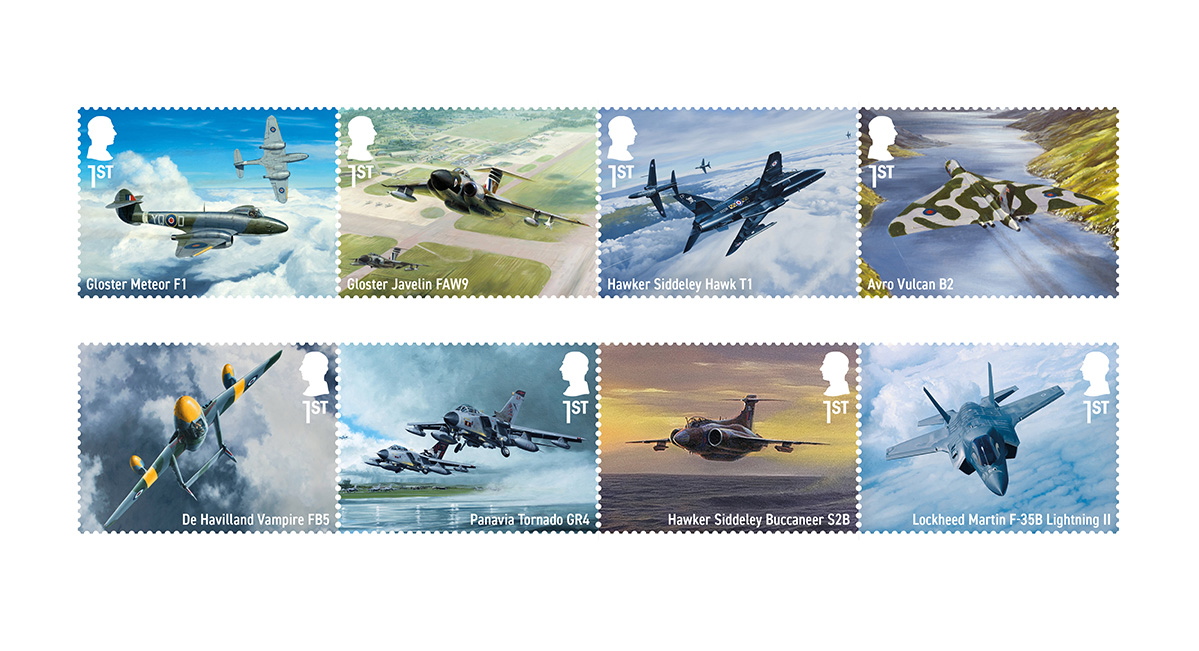
The main set of eight marks a number of anniversaries falling in 2026, including 50 years since the Hawker Siddeley Hawk entered service, 70 years since the Gloster Javelin and Avro Vulcan entered service, and 80 years since the de Havilland Vampire entered service. The aircraft featured are the Avro Vulcan B2, Gloster Javelin FAW9, Hawker Siddeley Hawk T1, Lockheed Martin F-35B Lightning II, Hawker Siddeley Buccaneer S2B, de Havilland Vampire FB5, Panavia Tornado GR4 and Gloster Meteor F1, the last shown in a newly commissioned illustration by aviation artist Chris French. A separate miniature sheet of four stamps commemorates Whittle, whose development of the jet engine underpinned modern military and commercial aviation.
David Gold, Director of External Affairs and Policy at Royal Mail, was quoted in the press release as saying: “Britain has a proud history of aviation innovation, and these stamps showcase some of the military jet aircraft that have played a significant role in that story. From the pioneering Gloster Meteor, the first Allied jet fighter to enter service, to the Hawk, which has trained generations of military pilots, these aircraft represent decades of engineering excellence and technological achievement. We are also proud to recognise the contribution of Sir Frank Whittle, whose development of the jet propulsion engine transformed aviation and changed the course of history.”
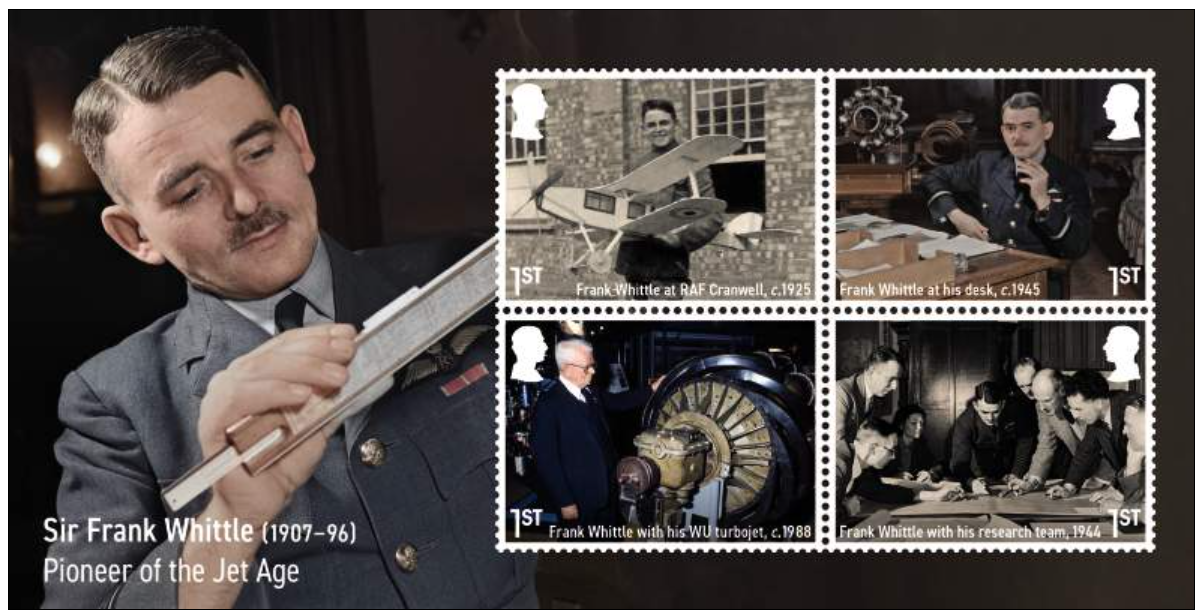
Whittle’s son, Ian Whittle, was quoted in the press release as saying: “My father used to say, ‘Inventing it was easy. Making it work was the difficult bit.’ His determination to turn a revolutionary idea into a practical reality transformed aviation and changed the world forever. I am delighted that Royal Mail is celebrating this extraordinary legacy with a set of stamps. It is a fitting tribute not only to my father’s pioneering achievements, but also to the generations of engineers, designers and aviators who helped shape Britain’s world-leading contribution to aviation.”
The issue traces the arc of British jet development from the Gloster Meteor F1 of 1944, with a top speed of 415mph, to the F-35B Lightning II, capable of more than 1,200mph. Frank Whittle first envisaged a gas-turbine jet powerplant in 1928 while at RAF College Cranwell, aged 21, patenting the idea two years later. Through his company Power Jets Ltd, the Whittle Unit became the world’s first turbojet engine to run successfully on 12 April 1937, and an improved version, the W1, powered Britain’s first turbojet aircraft, the Gloster E28/39, in 1941. The technology was subsequently shared with British aero-engine manufacturers including Bristol, de Havilland and Rolls-Royce, whose turbojets went on to power the Meteor and the Vampire.
A Presentation Pack containing all 12 stamps is priced at £22.50, with pre-orders open through the Royal Mail website and by telephone. The stamps span aircraft that shaped the RAF across seven decades, from the Vulcan’s Cold War nuclear deterrent role and its ultra-long-range Black Buck strikes in the 1982 Falklands War, through the swing-wing Tornado GR4 that served from the 1991 Gulf War until its retirement in 2019, to the stealth-capable F-35B now flying from the Royal Navy’s Queen Elizabeth-class carriers.





Can’t believe they didn’t include the Harrier! 🤦🏻♂️
Or Typhoon…but if 12 stamps…so 4 not in view?
8 of the jet aircraft and 4 of Sir Frank Whittle.
Yes and a lot of great and successful planes missing
Hawker Hunter or English Electric Canberra instead of Javelin
English Electric Lightening instead of Vampire
Hawker Siddely Harrier instead of Hawk (sorry great plane but more a trainer /light attack)
Typhoon instead of US designed F35 (lots of UK content but…..)
Please don’t anybody tell me the stamps were issued to commemorate some plane anniversary dates – Vampire 80 years and Javelin 70 years Most of the others – no and the 2 just mentioned were not as illustrious as others above
Maybe the stamps issued should have been 8 of Frank Whittle (4 already portrayed with 4 of first ever and jets powered by Whittle engines
Gloster E28/E39 (First British Jet)
Gloster Meteor (First RAFJet) Therefore the HS/BAeHawk could stay on original 8 stamps
Mikoyan-Gurevich MIG 15 (Klimov derived from Whittle engine)
Bell XP 59A Airacomet (GE derived from Whittle engine)
Grumman F9F Panther (P&W derived from Whittle engine)
It still amazes me that we did not allow the Meteor to fight over Germany with especially the ME262 unless one of them fell into enemy hands and we lost technological advance
Then we gifted the engine to our allies the Russians and the USA
Brilliant! the Mig 15 was a great success and hit us hard in the Korean War
GE and P&W became principal competitors to UK jet manufacturers
Had the 1940 Tizard Mission, which gifted many scientific advances not succeeded then Lend-Lease may never have happened…
Where is the original lightning?
The mighty Gloster Javelin, the only fighter aircraft unable to ‘loop the loop’.
But, nevertheless, a salutary reminder of how seriously this country used to take its own defence and security.
Today, things are rather different. We now have a Foreign Secretary who organised the 2013 defeat in parliament of any attempt by this country to punish breaches of the Chemical Weapons Convention by Syria. Russia then invaded Ukraine the following year…a coincidence? We have a Defence Secretary effectively ruling out increases in defence spending required to meet our NATO commitments and we have financial commitments to the batty ‘net zero’ political agenda which will preclude, given war in Europe for the last twelve years, any prudent enhancements to our national defence and security for the foreseeable future.
That will not have gone unnoticed overseas. This country is the least safe and secure today since 1938.
🤡
Laughs in Net Zero zealotry, as Oil Refineries and Storage are destroyed world wide, huge plumes of smoke and pollution and all our hard work wiped out… Meanwhile, they continue to drive it through, despite the undefended nation without those defences would fail it’s carbon emissions if anything blew up.
Complete lunacy…until correctly viewed as a political agenda, leveraged to force through ‘societal change’.
The science is clear that the natural world produces a great deal more CO2 than the burning of fossil fuel…and those entirely natural CO2 increases follow temperature increases rather than causing them. The most significant greenhouse gas is water vapour, clouds!
A political agenda, pure and simple; one that imperils the security, prosperity and well being of everyone in this country.
and the earth’s flat…
The Magellan-Elcano expedition (1519–1522) provided empirical evidence that the earth was not flat.
Empirical evidence today demonstrates that man made CO2 emissions are not driving climate change. The whole basis for the daffy ‘net zero’ has been comprehensively debunked. Climate scientists have officially retired the most extreme emissions scenario, RCP 8.5 (and its successor SSP5-8.5), classifying it as implausible…and it is that scenario upon which Britain’s ‘net zero’ by 2050 political agenda for societal change is based
‘Since 1750, additions to the atmospheric CO2 concentration derived from natural emission sources associated with biological processes are about 4.5 times larger than the contribution from fossil fuel emissions (e.g., 22.9 ppm per year from nature, 5.2 ppm per year from fossil fuel combustion).’
Refined Reservoir Routing (RRR) and Its Application to Atmospheric Carbon Dioxide Balance,Koutsoyiannis, 2024
‘CO2 also lags temperature by ~~800 years in the ice core record, on a longer time scale.
Atmospheric CO2 lags temperature at all measured time scales.’
The Phase Relation between Atmospheric Carbon Dioxide and Global Temperature, Global and Planetary Change, Volume 100, Humlum, Stordahl, and Solheim
‘…natural oscillation has resulted in alternating warming (w) and cooling (c) phases superimposed on a long-term secular trend: 1850–1880 (w), 1880–1910 (c), 1910–1940 (w), 1940–1970 (c), 1970–2000 (w), and possibly 2000–2030? (c) (e.g.: Wyatt and Curry, 2014). Evidence of this oscillation has also been recently observed in sunshine hours over central Europe (Lüdecke et al., 2024), suggesting a direct link between surface temperatures and cloud cover.’
Losing the ‘sky is falling’ Chicken Little ‘net zero by 2050’ boondoggle will permit the next government to meet Britain’s defence commitments to its allies…but if Putin’s ‘little green men’ set up camp within Poland’s Suwalki Corridor before then, Britain, as we have seen, will be able to offer everything short of real help to its allies and that not within any useful timeframe…
Wot? No proper Lightning? Anyway, when did the RAF’s F-35 become the Lightning II?
Wot? No proper Lightning? Anyway, when did the RAF’s F-35 become the Lightning II?
Wot? No proper Lightning? Anyway, when did the RAF’s F-35 become the Lightning II?
The U.S. Air Force chief of staff announced Lightning II as the F-35 name during a Joint Strike Fighter Inauguration Ceremony 07 July 2006.
But there was only ever one true Firebird.
Blackbird, my beloved
Nice although a pity there’s nothing from the Fleet Air Arm
The Blackburn Buccaneer was originally a carrier jet and then had a second life a strike bomber and was effective in the first Gulf war
Buc, Lightning? Both FAA!