

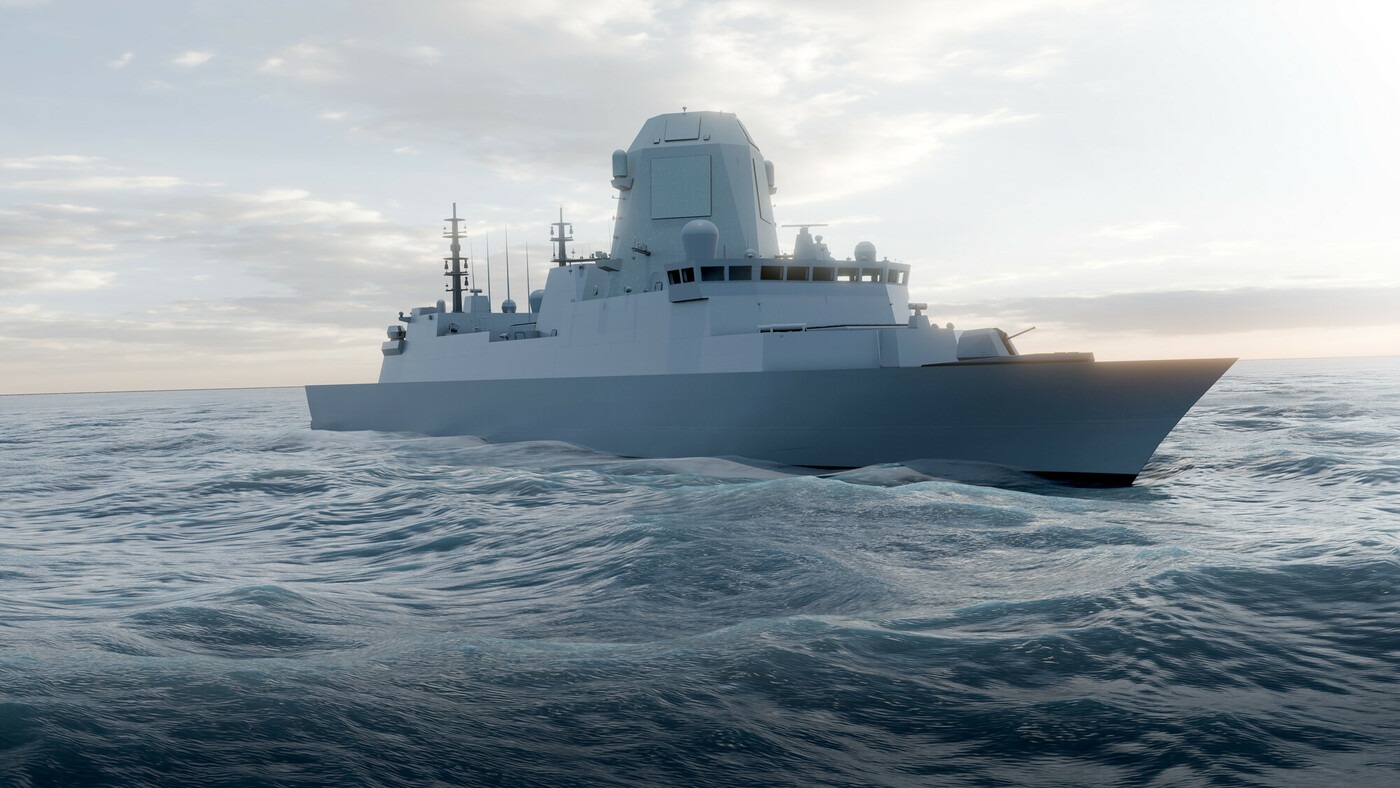
The Royal Navy’s planned Type 83 destroyer has been dropped in favour of at least six new Common Combat Vessels built to coordinate uncrewed systems in the air, on the surface and beneath it, under the government’s long-delayed Defence Investment Plan, the Sunday Times was first to report.
The six Type 45 air defence destroyers now in service had been due to be replaced by the next-generation Type 83 class, a concept that sat within the Future Air Dominance System and never moved beyond an early design phase. In its place, the department said the hybrid Common Combat Vessels would deliver more resilient air defence by acting as control hubs for drones across all three domains, and would extend the Navy’s “reach, resilience and firepower without a proportional increase in crew or cost.”
Delivery is expected from the early 2030s, and the ships are to be built in the United Kingdom.
Defence Secretary Dan Jarvis, as reported by the Sunday Times here, said the new class as a response to a changing threat, saying the vessels would give sailors “hybrid ships that are designed and built for the increasing threats we face.” He added that the ships would be “British-built, supporting jobs across the nation” and would hand the Royal Navy a capability built for modern warfare.
This a big one, a shift from large destroyers towards a distributed fleet in which fewer crewed warships orchestrate networks of autonomous platforms. It aligns with the Hybrid Navy direction set out in last year’s Strategic Defence Review, which spans Project Beehive’s uncrewed surface vessels and AUKUS work on underwater drones. Steve Reed, the Housing Secretary, said the full plan would be published within days, telling Sky News the country had to be ready for “any future war,” not the last one.
The Type 83 had long been named as the Type 45’s successor but stayed thinly funded. Defence minister Luke Pollard told Parliament earlier this year that around £1 million had gone on platform-specific design over three financial years, part of roughly £6.9 million of broader work under the Future Air Dominance System, and that the concept had been inherited in an underdeveloped state.
Industry thinking had pointed to the shape of the new vessel for some time. At DSEI 2025, UK Defence Journal reported, BAE Systems set out a system-of-systems vision for the future surface fleet built around a large Air Warfare Command Ship carrying sensors, missile batteries, guns and directed-energy weapons, paired with smaller, highly adaptable combatants. One concept, based on the Triton trimaran demonstrator, was shown as a lean-crewed sensor and effector platform fitted with Artisan radar, a 40mm gun, vertical launch cells and a towed sonar array, with full autonomy under study.
Gavin Rudgley, a BAE design lead, pointed to reduced crewing as a central driver, telling the briefing that lower complements would come through “automation, autonomy and the embodiment of artificial intelligence.” Geoff Searle said the company was modernising its combat management system under the Re-Code contract to create what he called the “foundation of the sovereign core” capability, able to integrate partners, equipment and uncrewed systems. Asked by UK Defence Journal whether the future ship could evolve from the Type 26 frigate, given the resemblance of the concept, BAE representatives confirmed it was one option under review, with one official describing the proven design as “an obvious thing to build on.”
A competing route has come from Babcock, which has previously pitched its Type 31 frigate for the role. Under a concept it calls ARMOR Force, the firm would turn the Type 31 into a controlling node for a fleet of large autonomous surface vessels built by the United States shipbuilder HII, dispersing anti-submarine, air defence and strike capability across wide areas of ocean. The proposal centres on HII’s ROMULUS family of uncrewed surface vessels, fitted with swappable containerised payloads moved by a modular handling system that Babcock would develop at its Rosyth yard, and is presented as the industrial answer to the First Sea Lord’s call for a Hybrid Navy and an enabler of the Atlantic Bastion, Atlantic Shield and Atlantic Strike concepts.
Babcock pitches Type 31 frigate as command platform for uncrewed systems
Sir Nick Hine, chief executive of Babcock Marine, described ARMOR Force as “our response to the First Sea Lord’s call for a re-imagined Hybrid Navy,” built on open NATO standards to operate alongside allied forces, with the company saying its autonomous mission system would be deployable by the end of 2026.
The Conservatives attacked the wider plan as inadequate. James Cartlidge, the Shadow Defence Secretary, said the reported changes amounted to “too little, too late from Labour on Defence,” arguing the settlement carried barely more money than its predecessor and pointing to the resignation of former defence secretary John Healey, who he said had warned the funding would leave Britain “less safe.” Andrew Bowie, the Shadow Secretary of State for Scotland, said it was extraordinary that ministers did not accept the plan must “fund both drones and destroyers,” warned that failing to invest in the Navy would damage the shipyards on the Clyde and at Rosyth, and said his party would redirect money from the government’s agreement to cede the Chagos Islands to Mauritius towards a new frigate fleet.
Healey stood down earlier this month after a dispute over the plan, saying the government had not committed the resources needed to keep the country safe, before Jarvis secured around £1 billion of additional funding that took the settlement to at least £14.5 billion, short of the £28 billion officials had identified as required.
With the full Defence Investment Plan due before NATO leaders meet in Ankara on 7 and 8 July, the Common Combat Vessel now carries the weight of the Royal Navy’s future air defence, a role that until this weekend belonged to a destroyer the service has yet to design and that must be ready before the Type 45s are due to leave service in 2038.




This makes a lot of sense, just knock them out on T26 hulls. Finally the MoD is starting to see sense, you can’t go around expecting budgets for a new form of warfare while desperately clinging to the sacred cows of old. T83 was always a bd idea. An evolved T26 with T91 sloops was always the obvious answer. An evolved T31 may also be more than capable. No Gucci Class Cruisers costing £3 billion each required.
Hopefully the Army starts seeing sense now too.
With their 10,000 drones, seems like the BA might be coming around.
Not sure, they still seem offly attached to their Apaches, chinooks, paras, special force, armoured recce and light artillery but here hoping 😀
Those bloody Apaches need a firm re-evaluation. Chinooks are useful for transport, but I just don’t see how one looks at Ukraine and then concludes that Apache is a good investment.
Interestingly enough the Isrealis were getting rid of Apache and have now committed to keeping them and expanding the force.
Isreal are focused on fighting insurgency warfare. Not a war against a peer or near peer opponent. The US would be a better benchmark, which has put all it’s helicopter programs on hold whilst it reassesses. I suspect Apache will turn into stand off weapon platforms, lobbing missiles from long distances rather than close support than they were originally designed for.
Hezbollah are pretty capable though. Thing is we own Apache now. The investment has been made and they are essentially still brand new. They are going to be with us for at least a decade or more. I think they could be very usefull in the anti drone role aswell as others. There won’t be any consideration to withdrawing them.
It’s difficult to know. The challenge with drones is they fly low and are small, meaning traditional radars struggle to spot them or can’t at all. For an Apache to provide anti drone defence it would need to fly high to get ground clearance to spot them, opening it up to SAM / RPG fire and effectively nullifying it’s design of operating as a pop up platform. I guess you could have cheap drones providing the survalliance and the Apache just acting as a rocket platform. However just having drones going after drones seems a better option.
Saying that there will always be a need for cavalry and that is effectively their role. Something to make a quick break through the flanks and attack from weaker defended angles. So will be a role for them, just probably more reduced than imagined when they were ordered.
With ranges from armement up to 10km and a defined speed of 250km/h? You will have to upgrade armement at least and it will not upgrade the interception speed. So set goals for interceptions may be limited. Having a 50m€ plateform to do so may not be the best defender nor the best attacker. It is heartbreaking, for these attack helicopter were the tip of the spear, but it is time to recognize that they are no longer able to play the role they use to. Sorry for the pilots.
Look at what’s happened to Ka-52s, no reason a drone couldn’t do that to an Apache. They need to go and be replaced by drones.
So Iran is not a near peer?
No where close to a peer, although that has blurred considering they just beat the US at a war.
singapore is a peer of the royal navy.
🙄 Sigh.
?
Don’t worry about it…..
Okay 👍
This is clearly one more cost saving measure. These ships will never be as capable as the Type-83s let alone surpass them! Hell, they may as well sell the Queen Elizabeth and Prince of Wales now. (and get it over with)
T83 never got past initial design phase. You don’t know what capabilities it would have except it would be large and expensive.
T83 never got past initial design phase. You don’t know what capabilities it would have except it would be very large and very, very expensive.
There FIFY!
Just what I was thinking .QECs… let’s be blunt there vessels don’t fit into the current Goverments defence thinking of ‘small’ localised Defence on a shoe string…..!
Would not be suprised if the Brazilians have had a look Already..
Drones may work in the confined space of the Black Sea, but the open ocean may be different. Like you, I think this is cost saving, dressed up as being “world class”.
i don’t think anybody really has a definative plan for the navy at all. w can’t have a hybrid navy if we’ve no ships to start with. the wrong people in the wrong places are making decisions that they get off the back of a fag packet (do they still make them)?
brazil or chile like the R.N CAST OFFS a couple of supercarriers would be perfect then we can have ocean back.
@ Jim – What a stupid and ignorant comment, you useless tosser. Back on the late night drugs are we?
his comment was fine, unlike your abusive response. the RN has been concentrating on fewer and fewer high-end platforms for decades, we’d have been lucky to end up with 3-4 T83s given the size of the fleet they need to defend. Moving much further back towards a distributed system of lower-end platforms makes sense in the current environment. Even the T31 (which will likely form the basis of CCS) was based on an air defence ship, the combination with semi-autonomous missile ships sounds a good move esp given the budget envelope.
Nonsense.
For gods sake David, pack it in, sod off to Facebook if all you want to just hurl insults at people.
I think his spiritual home is Xitter – perhaps he got lost in migration?
shuttup big noseLOL ONLY KIDDING PAL
The T26 can’t take the top weight of the radars or carry the power plant needed for the electricity. The laws of physics don’t actually change
I think it’d be based on the hull but in all other respects it’ll be a different ship.
While t26 is one option, I’m sure other hulls will be considered (e.g. Arrowhead 140)
Reports are now suggesting it’ll be a modified T31 hull.
That makes sense.
It’s cheaper to build as it doesn’t have all the noise reduction that the type 26 has and those modular mission bays would be perfect for the workstations needed for drone and sensor control. As well as housing the various smaller drones
Unless we want a completely new design the options seem to be either to widen T26, like the Canadian River class, or to adapt T31. Be interesting to see which direction we take. The ‘large amphibious transports’ suggested for the RM will also need to be factored into planning. Jarvis has already directed £500m towards ‘new boats’ for the RM. I’m guessing this means insertion craft – which will have to be launched from something.
If the plan is for the first ships to enter service in the early 2030s, I struggle to see how a T26 derivative fits that timeline. The T26 build programme is already committed well into the 2030s. An evolution of the T31 seems far more realistic, T32 anyone?
*delivered
Tend to agree. Babcock are in pole position; they need the work from 2030 and their stretched T31 > T32 concept with slipway doesn’t look a million miles away from an affordable platform for the ‘common combat’ drone control vessel which has emerged as the highest spending priority ahead of MRSS and T83. A T83 AAW cruiser might happen in the future but I suspect the powers that be reckon there’s a lot more they can get out of T45. I wait to see what the DIP has to say about MRSS.
Agreed. If this is the direction, it does put Babcock in a strong position and gives them steady work through the 2030s, while also pulling the RN further into the hybrid fleet concept sooner rather than later.
It also does not really close the door on a larger, more complex T45 replacement in the future if that is what is ultimately needed. If anything, these CCVs would generate a lot of useful lessons on integrating unmanned systems, command and control and distributed lethality at sea, which would feed into whatever comes next.
As you say, we just need to see what the DIP actually says now 👍
The Canadian T26 has Spy7 radar & if you match that to the extra MK 41 cells BAE offered as an option to the Australian version, you get a formidable air defence ship.
Does not look like they are going to go for a proper very high end AAW.. just a general combatant with lots of drones.. the T26 or T31 can do this.
We dont need an exquisite frigate anymore – if a mothership is the new requirement then any big vessel (including Tide, Albion, Bays QEC can take the biggest radar out there
Said it many times now – but an updated/ improved damen Karel Doorman, ticks a lot of boxes. What do we need
1. Ability to have best in class Radar
2. 5 CISTAR capabilities
3. Some sort of CEC
4. Some ability to protect itself (containerises?)
5. Maybe some ability to refuel/replenish and maintain its unmanned vessels (depending upon size
6. Ability to keep paces with CSG
7. Ability to stay on station for long durations as needed
Damen already offers most of this and you could argue its flight deck could be reduced for better replenishment and drone facilities, add in an ice breaking hull and we are sort of there.
Other vessels could be upgraded as well, not least the point class which would be interesting.
using a vessel this size gives lots of options and it can take all the top weight the latest radars demand and has plenty of space below for power generation. whether we should go down this route is for others to decide, but it has been part of RN strategy several times,
Getting creative – perhaps its not a bad idea to use old oil rigs and position them where needed to set up a set of command posts, depending upon cost of course
With all due respect bollocks – this is just an excuse to cut the type 45s and buld something nebulous that doesn’t do anything. It doesn’t meet the UKs defence requirements – even officially, which we took 2 YEARS to define in the SDR.
This is purely political bollocks.
Good. Drones-carried armaments systems offer major advantages, this is a good move IF the CCVs carry a large radar system.
So the Royal Navy is supposed to have a core strength of just 19 hulls based on either type 31 or type 26 or what ever they decide to come up with and a few dozen optionally maned vessels?? and all of this is based on what’s happening in Ukraine??
it’s poorly thought out and will poorly implemented when it eventually happens
Yes, they’re supposed to operate on 19 hulls. That’s not going to increase if the only approved ship design is a 12000t cruiser.
Mass through smaller, scaled assets is a solution.
Tell me where a heavy air defence radar and accompanying drone systems have been deployed in the naval theatre in Ukraine?
The thing is though by switching from a hardware defined navy to a software defined navy, the Royal Navy have introduced a single point of failure.
and I think that question that you ask is misleading
Not at all. You claimed this is drawn from Ukraine, I ask where it has appeared there.
Your single point of failure is?
Well, if the “Mothership” is taken out, all your fancy drones become expensive floats.
Stupid argument. If your conventional destroyer is knocked out, you similarly lose all capability.
The RN isn’t going to be faced with the same type of warfare as Ukraine. Russia with HGV and BM sat in their own water firing 2000km range weapons towards RN manned and LUSV. That is going to require high end AAW radar and missiles to detect and shoot them.down.
Otherwise the £200m 90m LUSV are going to be sunk by far more numerous £10m ship killers.
I know David. That’s what they intend to purchase. They just don’t want the massive weapons load that accompanies it as well.
Once again. Radars have top weight and need power , that defines the size of hull.
The radar is only part of the capability though. Systems are networked together now. 2 or 4 autonomous warships could provide far greater reach, sensor range and weapons when operating with a new command warship that will still have its own sensors and weapons.
Please explain how you intend to be able to do defence against ballistic missile and hypersonic weapons without the radar? All you people are saying its that we don’t want to defend against a major and increasingly important weapon systems because of the current fashionable drones. Drones are a force multiplier but if you don’t have the sensors they are just sitting ducks
I didn’t say there wouldn’t be a radar. Networked sensors can cover vast amounts of airspace. I don’t know how the tech will work, and you don’t either. Because we don’t know the exact requirement.
Nobody has said we don’t want to defend against ballistic missiles and hypersonic weapons. You’ve just made that up. The air dominace system is to do exactly that. It’s just not based on a single large very expensive 1bn+ Destroyer design.
How many times do have to be told before you understand. To carry a large radar high up needs a large hull. To generate the power needed requires big generators. There are physical limitations imposed by small hulls. You can’t handwave away away inconvenient details
You need a large hull, but if all you’re carrying is the radar, you don’t need a 12,000t hull.
Are you being deliberately obtuse? Ships will capsize if you have too much weight high up, you know like big heavy radars that need to be high up so they can see over the curvature of the Earth. The laws physics do actually apply even if the are inconvenient to your theroy crafting
There are plenty of ship design methods that can balance the vessel.
BAE offered concepts with large radars that maxed out at 10,000t, and then a smaller concept at about 8500-9000t, yet retaining the same radar.
I’ll take the work of BAE over your own ‘theory-crafting’.
BTW, just yelling ‘the laws of physics’ does not mean that you actually understand how these things work.
With today’s technology, yes. But you don’t know what technology or how this will work. So you are just guessing. Do you work for BAE Systems? Or Babcock or Thales? I’m guessing no is the answer. So stop trying to predict something you don’t know anything about. It’s called an air dominace system for a reason. It’s not just to shoot down pigeons. There will be many layers to this capability. Not just one very large, very expensive warship.
Is this new technology going to make the Earth flat?
Have a look at BAE’s work in radar miniaturisation, sensitivity and modern T/R modules.
All targeting smaller radars, with world-leading performance.
We have 13 Frigates on Order but with the out of Service date of the 6 t45 as 2035- 2038 and with now No Obvious destroyer Replacement seems 13 is the number…
perhaps some upgraded OPVs dressed up as Corvettes/Frigates.?
we may also get 6 extra operations vessels..But they may well be just Drone Control vessels..!
They wont.
The Type 45s and Type 83s are basically just command facilities a VLS, and a radar which we’ve only just spent spending a fortune fixing.
This is just complete and utter political nonsense.
I think this might turn out to be a big mistake
Agreed, it will not happen for years. Google ‘Rogue Rattler Yacht’ to see how well the ‘Hybrid Navy’ is doing. However something has to change we cannot take 20 years to design, build and equip a class.
You keep posting one incident as though it’s unusual.
Wait till you see how many accidents conventional destroyers are involved in…
Hint cheaply built Russian ships with radars worse than you can buy off the shelf from garmin, drunk conscript crews, on a narrow sea with trageting data provided by a 3rd isn’t a comparison that you think it is
Right. I’m not talking about the Russians.
Your the one who thinks drones can replace fleet defence
I think a hybrid approach could be more capable overall, which is the opinion I’ve had for a long time.
You want to converse, or just keep deflecting?
Isn’t the T31 designed to co-ordinate uncrewed systems?
Given they’re very close to becoming operational surely anyone with a grain of sense trials uncrewed systems off a T31 before committing to a completely unproven naval strategy.
I remain totally unconvinced that experience in Ukraine which is basically a static front line is a valid reason to completely redefine the future Royal Navy.
That’s not to say I’m not open minded, only that I see it incredibly foolish to commit to a future naval strategy that isn’t proven.
You’re completely right in that we should be careful about over applying the learnings from Ukraine.
Everyone is always preparing for the prior war while the next one almost always proves to be different.
Yes, I agree that Ukraine should not be translated ship-for-ship to the Atlantic. Sea Baby drones and Maguras are not ideal for the North Atlantic.
That said, the practices and technology relating to drone control is useful, and should be applied.
Type 31 is based on a frigate that’s been withdrawn from combat service due to its combat system failing in drone combat. I wouldn’t bet on it being able to coordinate itself let alone anything else.
Hopefully not. They should know what they’re doing with this. Last thing the UK wants is to leave itself even wider open on the high seas. But expect this to be done by others including adversaries who are still building up their traditional ship and sub numbers so how long will any advantage last? Like to see a few more T26 /T31 and new OPVs in the fleet to back all this up.
How does this leave us more open on the high seas, Quentin?
If command ships are taken out them drone ships may have a limited ability to operate independently. Once all that is gone what is there left, potential exposure and gaps if nothing to back it all up? No subs at sea, T45s being upgraded and limited availability so less escorts for any CSG.
I’m actually with you on still wanting to have even a few more manned ships, including T83 types and being less obessive on drones.
Is announcement a blending of T32 with T83 and even a bit of MRSS?
I understand the first point, but doesn’t that apply to a manned ship anyway as well? If you whack the radar of a T83, it’s not going to be able to function.
That then of course builds into the rest of your arguments.
Crewed ships can have humans on board that can make flexible decisions, AI can only respond according to its training data.
No matter how flexible your human crew is, if an AShM whacks their radar, they’re not doing air defence anymore.
Not if you have the power for ladar and direct energy systems. Once again inconvenient facts
You still need a radar to track the incoming targets, Ron…
…Inconvenient fact
Meanwhile our enemies edible their efforts to jam the datalink between mothership and drone or worse take the thing over,
How could it go wrong ?
I love how people assume this hasn’t been considered…
so how do you think they will address the issue of the single point of failure that has been introduced??
If you believe that these large drones will have just one mode of communication, or one mode of software-based self-defence, you’re living in the 90s.
Similarly, why do you assume that a manned warship would not have similarly exploitable deficiencies.
The RN needs mass. It’s the thing people consistently note as an issue on this platform. This is an attempt to address it. Manned warship numbers remain the same. Hulls increase overall.
They do need numbers but not at the expense of capabilities! That is the problem with the UK Government they promised much but never deliver on it….The Royal Navy only got half of their Type-45 Destroyers and the same will happen with the Type-26 Frigates. In both cases not fully equipped either. Oh, and even the Queen Elizabeth Carriers didn’t arrive fully equipped with Weapon Systems nor Aircraft.
What makes you think this arrangement is any less capable?
Because they can’t carry the radar
We’ll have to wait and see what they come up with. What might be the detection and targeting capabilities of a collection of say two dozen networked NG Artisan ‘Bastion’ radars.
Range of radar is a function of power output. 4 small radars won’t provide fleet defence against hypersonic and ballistic missiles. The radar horizon against sea skimers is defined by the height of the radar above the surface. 4 smaller radars lower down isn’t as effective as 1 radar higher up. You can’t handwave away the laws of physics or the curvature of the Earth
Your sea skimmers point is well taken. The experience of the Falklands was no doubt the reason the RN chose to stick with a high mounted rotating radar for T45 rather than the more fashionable but heavy flat faced arrays.
BMD seems to be the real challenge in that the attacking missile gets the advantage once it starts coming down. Hence the need for early detection at range which I agree implies more radar emitter power.
That said, astronomers use interferometry to achieve high resolution images of distant emitters in the radio, visible and I/R. But you have to combine signals from separated detectors. I am just asking whether, rather than put all your radar eggs in one power basket, as it were, a group of more modestly sized radars couldn’t be networked to work in an analogous way.
But you can work around them.
For example, having picket radar drones spread out around the central CCV to provide early warning.
Alternatively (or additionally) unmanned rotary-winged AEW assets could be operated above the destroyer group to provide advanced warning.
They’re still planning on having a large radar. Stop making things up.
How many times do you have to be told that ships will capsize if you have too much top weight. See HMS Captain for details
Ron, capsizing depends on the ships beam.
To counteract a tall radar, engineers widen the ship’s hull. A wider beam raises the metacenter (M), giving them a safety buffer to lift the center of gravity higher without risking a capsize. Massive masts on modern destroyers look heavy, but they are often built out of advanced, lightweight materials like aluminum, carbon fiber composites, or thin high-tensile steel. To offset the weight at the top, engineers place massive amounts of heavy weight, like fuel tanks, engines, or dedicated ballast at the very bottom of the keel. This helps to pull the center of gravity back down.
And yet history tells us … In 1628, the Swedish King ordered a massive new flagship called the Vasa. Halfway through building it, he demanded an extra deck of heavy bronze cannons to look more intimidating. The master shipbuilder died, the politicians took over, and no one dared tell the King that his new cannons made the ship top-heavy.
The Vasa launched, sailed about 1,300 meters into Stockholm harbor, hit a minor gust of wind, tilted over because its beam was too narrow for its height, filled with water, and sank to the bottom on its maiden voyage.
Nearly 400 years later, Australia did the exact same thing with the Hunter class. The only difference is that modern software caught the mistake on a computer screen before the ship could slide into the water and pull a Vasa. But the hubris? That hasn’t changed a bit.
Canada is currently walking open-eyed into the exact same trap Australia just spent ten years trying to crawl out of. They watched the Hunter-class struggle, they watched the weight grow, they watched the costs explode, and their response was, “Well, yes, but we’re Canadians. It will be different when we do it.”
Hubris, indeed.
How can you say “the same will happen with the Type-26 Frigates” when in June 2026, Defence Minister Luke Pollard explicitly confirmed that the Royal Navy’s force structure remains unchanged, ensuring all eight vessels will be delivered, despite recent cooperation and production slot agreements with the Royal Norwegian Navy.
The original requirement for 13 hulls was split into the Type 26 programme (for the eight ASW-focused vessels) and the Type 31 programme (for five general-purpose vessels), the government has repeatedly reaffirmed the commitment to the full eight-ship Type 26 fleet. The ships are legally secured and contractually financed through 2035. The government has no intention of cancelling them, and the capital is effectively reserved in the long-term fiscal forecast … However, to be clear, being “paid for” in a government sense does not guarantee the operational readiness of the ships once they hit the water, that depends on the much more volatile annual operating budget.
I reiterate though … Government ministers have repeatedly affirmed that the funding for all eight is ring-fenced within the long-term capital budget. This means the money is “committed” in the treasury’s forward-looking spending plans, which is the British government’s way of ensuring the programme doesn’t get cancelled midway due to annual budget fluctuations. So stop spreading / sewing misinformation, just makes you look/seem like a numpty.
The T26’s are being constructed with a comprehensive, full-spectrum suite of sensors and weapons rather than being “fitted for, but not with” (FFBNW) in the sense of leaving major capability gaps. The design philosophy focuses on high end anti-submarine warfare while maintaining enough flexibility to adapt to future threats. While the ‘full equipment’ list is substantial, the Type 26 is intentionally modular to remain relevant through the 2060s. The ‘Flexible Mission Bay’ is a critical feature that allows for the carriage of containerised equipment, unmanned underwater/surface vehicles, or specialized boats without needing structural refits. This design acknowledges that while the core ship is heavily armed, the payload or specific mission gear can be swapped as technology matures or operational requirements shift.
The carriers were never, ever going to arrive with a fully fledged air wing, that’s your fantasy, most probably derived from media hype.
But, I’ll tell you this for free …
1/ The uk hasn’t got the coin to have all the lovely toys OR to fund them throughout their ’service life’.
2/ the Mod suck big, Big, BIG donkey balls at procurement.
3/ That all Gov.’s suck donkey balls come defence funding; because … see number 1/.
…my above is a reply to Scott.
Not sure why the reply option doesn’t appear on your prior post about the Australian and Canadian T26 versions. It is my understanding the top heavy weight issue with the Hunter is due to Ceafar. The SPY 7 in the River is lighter. Also, the missile load is smaller for the River class T26.
Ha, we’re all fedup.
Yes top heavy because of CEAFAR. Ultimately, the first generation of the Hunter-class integration served as a painful, multi-billion-dollar lesson in naval architecture. However, the resulting technological refinement means future warships will receive CEAFAR’s legendary tracking precision without the severe weight penalties that marred the initial design.
While Canada successfully avoided the physical weight crisis of the Type 26 hull, they did so because their strategic goal was entirely different from Australia’s. Canada chose commercial convenience and off-the-shelf reliability, whereas Australia accepted immense engineering risks specifically to foster and protect a breakthrough sovereign industry.
Australia’s rationale was to cultivate a sovereign jewel. In contrast, Australia’s prioritisation of the CEAFAR radar wasn’t just a military decision; it was a decades-long national industrial policy. The Australian government deliberately mandated the radar because CEA Technologies is the country’s premier defense technology success story. If the Australian Defence Force didn’t buy it and force its integration onto the fleet, no foreign navy would take the technology seriously. By taking the engineering hit on the Hunter class, Australia ensured that the intellectual property, engineering jobs, and manufacturing base for world-leading digital beamforming remained permanently locked inside Australia.
The irony is Canada is now buying Australian radar technology, Canada’s aversion to developing its own radar didn’t stop them from recognizing how good Australia’s technology is. In a major defense export shift, the Canadian government recently signed a $2.5 billion AUD deal to purchase an advanced Australian designed over-the-horizon radar system from the ADF to secure Arctic surveillance and defense.
Ultimately, Canada prioritised a safer, predictable warship design by letting an American giant handle the radar. Australia chose to absorb a brutal, multi-billion-dollar naval design penalty to force their home-grown tech into the global top tier.
That would be the same government that claimed the Type 32 was a great achievement…..
Plus that we would cut the Type 45 numbers to allow faster delivery of the Type 26.
That cutting Type 45 numbers to 8 was fine and we’d still be able to maintain the minimum requirement of 5 avaialble at anyone time due to improved reliability.
Similarly that the Type 45s having combined engagement capability would make up for cutting the numbers to 6.
Essentailly everything is complete BS.
The real question is how Australia and Italy and indeed Spain and ffs Turkey on supposedly smaller budgets are consistently beating the UK’s capability to buy and develop equipment.
This DIP is probably the end of AUKUS and GCAP too….. why the hell would you join the UK on anything military when we have the complete lack of political will to spend on anything or complete any program, if I was Japan I’d be bailing immediately.
Nope that is one of the few bright lights about the DIP both GCAP and AUKUS remain fully funded.
Either way the Japanese need us for dual cycle engine and Steakth airframe design.
I will simply cite the example of the near continous assault our digital infrastructure and the continuing battle Ukraine armed forces has with the Russians attempts to jam them. This drone control ship is a single point of failure with a ship sized target painted on it,
Well done, you’ve cited an issue plaguing all military hardware – the adaptations of the enemy.
One high EMP and radio communications are out due to atmospheric ionisation. A crewed ship still maintains its ability to do its mission .
Have the people making the decisions spoken to or read reports by the people doing the maths? Jamming a unitary warship’s communications doesn’t prevent it fighting unless you’re doing a powerful electronic attack. Comms signals are a lot weaker than radar and a lot easier to jam.
I’d be surprised if they’d spoken to the people who have spoken to the people who have spoken to the people doing the maths. Each step in the chain will degrade the nuance, as Powerpoint slide-packs take the place of thought-through complexity and ever busier people with ever less time and ever less focus explain the Chinese whispers on upward.
Modern QUANTUM COMPUTERS and AI are becoming amazingly powerful …its Doubtful Encripted military Communications will be Safe for long…
Drones may become Obsolete before they’ve started..
Guaranteed the Chinese, Americans And probably the Russians are working just as hard to block Drone Communication as to develope them…!
…perhaps HMS BELFAST is the future…???
Ahh sarcasm the lowest form of whit or in your case probably the highest you can manage.
As for your comment that they had thought of the vulnerability of the data link, I believe the designer of the titanic did something similiar regarding his vessel sinking, look how that turned out!!
You should not be commenting on ‘wits’ if you can’t spell the word, first of all.
Secondly, why are we suddenly deciding to compare to the Titanic? Really?
Dear oh dear. You really are struggling. I would have thought the comparison to the Titanic was obvious but maybe I should not challenge your great intellect so heavily and give an example closer to home. Two examples as I am feeling generous.
1)The Germans went through the entire war believing their Enigma was unbreakable. Alan Turing and Herbie Flowers thought differently Oppsey ( I do hope I have spelt that correctly)
2) I believe a US drone was hijacked relatively recently by an Adversary,
2)
You are so right, as we can never fully predict the actions of our adversaries, or potential adversaries, or even who will be out future adversaries the only best and sensible course of action is to do absolutely nothing. Phew I’m glad we got that sorted out.
Again, no one said do nothing.
Then as you know so much about what Not to do what is your vision for the future??
My vision?
A hybrid manned/unmanned air defence group, centred on a manned warship with a powerful radar but minimal armaments – e.g, a main gun, self-defence guns and a small VLS.
Spread out around that are multiple ‘shooter’ drone ships, that launch on command from the manned vessel.
Spread.out in a further ring are several picket radar drones, providing advance warning of low altitude threats.
No, the obvious solution is to accept the opposite side is as cunning and resourceful as you are and multiply by ten And not realise that drones have a part to play in a complementary role but handing over entire capabilities to drones is extremely foolish .
And just how do your draw the conclusion that only drones will be used? Does it say that anywhere?
No money in the DIP for a replacement the type 83, seems pretty obvious to me. Air Defence will be entirely drone based.
They’ve literally announced a minimum of six new air defence control ships. Manned ships building on an enlarged T31.
No they have announced Drone control ships . Not high end type 45 replacements . And what these drone control ships will be based on has not been declared . It is a toss up between a T31 or a T26 hull without the acoustic stealth.
It’s being reported that the T31 is the chosen hullform by various journalists.
This is the T45 replacement. It’s a disaggregated system of air defence assets.
A drone control shipo that’s not capable of defending itself against ballistic missiles or hypersonics and submarines because if it was it woudl be a type 83….
It’s a complete joke.
May we are a little ray of sunshine. However on this I agree 100%. Drone could be very powerful in combination with manned assets. Fortunately thanks to the Labour government foul up over the Turbine power unit for the Type 45 and the Tories glacial rate of implementing the PIP. There is plenty of hull life left in the 45s and they can go well past their original out of service date, hopefully with an even more powerful radar and CIC.
CCV + Type 91, 92, 93, and the new 94, with sensor and radar🤔
With all the potential drone ships and subs they might them need a MRSS sized type tender vessels with heavy duty cranes and a dock to possibly pick them up, transport, refuel, repair and re-arm?
Bit OT but if HMS Albion still has some life in her would a quick cheap further upgrade “Argus-like” be worth it?
She’s unfortunately been cannibalised in order to support the sale of her sister Bulwark to Brazil.
However, I think your idea is interesting, and if you’ve not already seen it, you might be interested to look at the American submarine and destroyer tender concepts.
The key to air defence is a powerful radar able to cue effective missiles on to multiple targets. Using a dedicated ASW design as the basis for this new platform seems odd. The cost of the command vessels and their unmanned linked companions is sure to cost more than conventional replacements for T45.
If it is to be capable of controlling subsurface, surface and air sensors and weapons, expecting it to be low manned is ambitious, to say the least.
Not sure that BAE have the capacity to build these for delivery by the early 2030s, given the T26 programme for UK and Norway.
I’m not convinced this is anything but a way of justifying delay and making the inadequate DIP look vaguely credible.
If we can afford these and new maritime transport ships, why did Healey feel he had to resign?
Because Healey was offered £2b less than Jarvis, mostly because Jarvis has the ability to threaten to resign.
Over 4 years? Backloaded to the year after the next election? How much is that £2bn worth? And is it new money or just headline money which has to be spent in future years on the same thing as this year? And where did you get the number £2bn from? I’ve heard £2bn, £1bn and absolutely nothing extra at all. All rumours.
Let’s wait for the DIP to see which irrelevant number pops up. All are so far below the needs of the military to provide a conventional deterrence that I don’t believe it matters.
The government press release does state that these CCVs are to be delivered from the early 2030s and will replace the T45. But T45 will last until 2040(Daring to return later this year ) so there will be an overlap.
T45 is highly specialized for a single role – air defence – combining a high mounted radar with proven Aster missiles with CAMM to be added.
CCV may be intended to have a wider range of capabilities but I don’t see how it can deliver as effective an air defence as T45.
With the QEs uniquely lacking in self defence systems, this seems a very risky plan.
I’m not sure well this has been well thought through. I would love to see some decent analysis of the options. e.g. by RAND Corp. Of course the MOD has occasionally done this in the past (UK Naval Shipbuilding, CVF, T45), but then ignored the recommendations.
Well, from after speaking to someone who claims to be apparently working on the project, the type 83 hasn’t been dropped, and the ccv was what the type 32 was going to be. We will see.
Interesting. Could you elaborate (no worries if not)?
That would make a lot more sense – replacing T83 in the immediate spending priorities but not cancelling T83 (or what ever it ends up being called – plenty of time for multiple changes in designation over the next ten years!) and not a replacement for T45 in the AAW/ABM role. I can’t see though how BAE’s Clyde yards can have any part in building them though, given they will be busy building T26 for the UK and Norway until almost 2040.
No. Government press release states it is to replace T45 instead of T83.
Yes, you are absolutely right, I’ve just been reading the ‘fleet of drone warships’ article and the press release. Remarkably big call by an outgoing PM and (possibly) Defence Minister for an AAW capability that won’t need replacing until almost 10 years after they say this new system will come in.
So we are not getting more than 19 frigates and destroyers….but since CCV is a manned frigate, in the short term we are 😂
This just kicks the can down the road for a T45 replacement, the first of which will need to be replaced in 12-15 years. That assumes the QE and POW are still in service then, a carrier group without a strong AA defense is rather useless. A T-26 follow on would work, providing it can be upgraded with an ABM radar and equipped to fire the Aster 15/30 SAMs.
A destroyer is basically a ship with the biggest possible radar on it with missiles that have a long reach, am I missing something, how is this capability not required anymore? do we no longer need to worry about multiple very fast sea skimming missiles heading towards our carrier group anymore? If this new class of t26 going to have the same artisan radar, if so I don’t get it, an expert on here needs to explain it to me, Yeah it’s all about drones now, but having a sword and a spear is better than just having a dagger.
It is but they don’t wannt to pay for it
Which is why Healey resigned? Defence on the cheap
Tough choice for a Labour government
Welfare or Warfare..?????
They do love a bit of both but only seem to want to throw money at one ……… if only they would ditch the FabianISM then the Country might benefit …
Happy to receive expert correction but understanding of this CCV idea is that it is a practical, affordable way we can implement the Atlantic Net and Bastion concepts by using a combination of T26s, cheaper T31 based CCVs, SSNs, USVs, UAVs and UUVs rather than deploying a large ‘traditional’ but unaffordable fleet of T26s. The CCVs will be network ‘hubs’ capable of integrating threat info from multiple sensors and instructing appropriate effectors – across surface, sub surface and air domains. Thinking about the complexity gives me brain ache. The system will indeed need adequate radars and AA missiles to defend key assets in the network against ABM and air launched hypersonics but I reckon BAE will come up with the goods with the NG Artisan family. A carrier strike group could be viewed as a micro or subset of Bastion / Atlantic Net. Just my take.
Agree with all this 👍
Granted this is still a few years away but is the kit discussed in the article even technically feasible yet, at least to a point where it’s safe and secure when used?
It will take a long time to test, outside of simulations where I’m sure the concept performed well enough provide a lifeline to a desperate senior leadership team. It’s hard to accurately model something you have no experience of in the real world.
Exactly. Also, is there not also a risk that even if the mothership is in working order, it couldn’t deploy if, just one of the drones is kaput? Too many points of failure. Either it all works or none of it works.
This doesn’t seem like a good idea to me. How will the drones be capable of ballistic missile defence without a large, powerful radar that could only be mounted on a large ship (aka a destroyer)?
Because if you have 4 autonomous warships networked together, they could cover a vast amount of airspace.
4 autonomous warships that aren’t big enough to carry the top weight of the radar or have the power generation needed, working together can’t shoot down ballistic or hypersonic missiles. The laws of physics don’t actually change when you add the word autonomous .
We don’t know what size they will be or what sensors and weapons they will carry. People are just guessing or trying to put a negative spin on it. If the requirement is to be able to shoot down ballistic missiles, then they will have the capability to do so.
Don’t be naive. It’s so they can play numbers game and ignore fleet defence capability. It’s budgetary not a better way doing things.
Fantastic news once again, putting the UK at the forefront of cutting edge war fighting capability across all three domains and better still, we get at least six these starting In the early 2030’s and all part of the 1000 ship Royal Navy Plan.
No corner of the Earth shall feel alone now that the UK Is going fully Global.
Have we got enough dry docks ?
Oh and.
This sounds like what T32 was described as. “A platform for Autonomous Vehicles”.
All hail Boris Johnson. 🫂
Oh how we all took the piss….. 😂😂😂
So maybe there’s still the hope that out of the proposed “1000” ship navy the RN might finally get through the 20 vessel mark as 980 drones is an awful lot of drones floating around or parked sonewhere and maintenance will be very busy!
intriguing.
This is all sounding very Sunday Times reporting without any defence knowledge behind it. Lets see what the DIP brings with the detail.
Makes sense, i’m sure some will be up set but the war drones etc are advancing we need to be at the cutting edge or get left behind, the upgraded Type 45 have a good few years in them, as they were always broken. Yes they will need replacing but we can not have every thing.
That is the point, we can not and will not have every thing some demand, no government cuts welfare the NHS for defence its never going to happen, Smaller but better equpt is better than as we are now small with a lack of just about every thing, going big has passed in to history. We can not afford it and we can not supply the man power or maintain it.
Drones won’t stop ballistic missiles, the type 45 has
Well exactly and the article has not indicated what distributed capability, if any, would replace that. Either way this all sounds like a project that will be dogged with delays with an incoming life extension for the Type 45 until 2045. The safest solution build the T83 and this. I can see why Healey resigned, if this is the flavour of things to come. It will all change again in 2029, when this government is binned. Regardless of claims about a 10 year strategy.
Agreed, but can we cover every threat?
Talking of the T45s, would like to see sone news on the CAMM upgrades in particular because if they can afford to stuff all this drone ships with mk41 VLS why have they gone with the 4×6 CAMM farm unless there’s a mix as on T26 or a maybe a newer quad based CAMM farm that I think Leh mentioned a while back?
Still hoping that the DiP will tell us there will be an increase in numbers of subs….
so babcock suggesting we buy amercian drone boat to accompany its t31. are we going back to the arsenal ship debate? this time an unmanned drone boat with drones onboard to be overwatched by manned t31 t26 ? if we are inventing new class of warfare how do reduce risks that its not a future cockup, accepting navy probably needs to move with the times.
It’ll be interesting to see if the US does or is doing something similar and China well and others. If the UK goes for a 1000 ship nsvy whats stopping the US wanting 5000 and then China10000! Half jostling a bit, but ideas, tech, tactics and methodologies will be copied. Got to feel a bit for all the marine life having to deal with all this. Some of the drone subs look “whale” like.
If there’s a wrong road to go down ..!
I’ll guarantee HMT/MOD will probably find it…
an opponent knows a drone boat and drones onboard, is out there. they can trigger a response with decoys, they manipulate some false flag event. can the algorithms anticipate crazy ivan thinking?
Romulus isn’t quite an arsenal ship. It’s more like a single layer container ship where each of the containers will have magic defence capabilities. That could be sensors, effectors, drones, medical, anything you can dream of. Because Romulus doesn’t need to provide it, it doesn’t care what the capabilities are, provided the cost and technology is moved into magic space (aka someone else’s problem). How it’s all integrated, well that’s a container provider’s problem too. Romulus will provide power, relay comms and may have a bank of VLS for show. Better than some similar concepts which don’t even relay comms, also leaving that for each container.
It’s not well thought through; it’s fast, dirty and cheap.
well, i do see the ‘unmanned’ taxi going up and down my london high street these days.
Another day, another project… for sometime.
I’ll wait to see what the DIP actually comes up with, my own take on this is we see a reduced crewed version of T26, one that mounts a more capable radar and other C&C sensors, ‘possibly’ leaning on BAE Systems previous study, replacing the modular space with a large vertical launch platform, packed with mk41.
Each ship acting as the key node with 4 plus unmanned missile silos, so you have your T83 Cruiser in effect, with hundreds of missiles.
I would add, these T91s need to have both laser and robust point defence gun systems too.
Building some 12,000 ton monster Cruiser would have become a hugely expensive white elephant, with only 3 being ordered.
You got it John 👍
Mmmm so this is the ‘same’ plan that caused the previous DS and armed forces minister to quit is it?or is it something dreamed up on the hoof and the supposed incoming PM has had a five minute briefing and said “ oh that’s nice” and given it the nod? Seems suspicious to me as Carns himself has stated the DIP lent heavily towards legacy systems and no forward thinking!
Battle tanks were supposedly obsolete, new tanks are being designed and bought.
Manned aircraft seem to be unable to operate over the battlefield, there are numerous new aircraft projects.
Why are we the only nation that has DDGs that is not replacing them like-for-like? What do we know that others do not?
‘Why are we the only nation that has DDGs that is not replacing them like-for-like?’
#$$$
£££_
#€€€
In other news, but similar….
Germany just cancelled all six of its 11,000 tonne F126 frigates.
Instead they going for up to eight 4,000 tonne MEKO 200 derivative frigates instead
They are still getting 8x f127 “frigates” which are about 10000tn and around 100 vls no?
They are still getting between 4 and 8 F127 frigates. Interestingly these are based on the MEKO 400, so it seems they’ve decided to go ‘all-in’ on the MEKO family for both.
Exactly. Also, is there not also a risk that even if the mothership is in working order, it couldn’t deploy if, just one of the drones is kaput? Too many points of failure. Either it all works or none of it works.
No you just get less coverage, there will be a minimum number deemed necessary to provide coverage. The drones won’t be ‘tied’ to a partial CCV. It’ll go to see with whichever ones are available of the type it requires.
Cheers Spock. Here’s hoping we buy enough!
I only have two concerns about the concept.
• Jamming of comms between the CCV and the drones.
• That we don’t buy enough drones to make it work.
Realistically we can’t justify having two QE class carriers – not enough planes, not enough support ships to keep them safe and barely enough sailors to operate them. Scrap one (use it for spares) and use the money saved to provide more surface ships and/or drones.
save a crews wages or then just redeployment so no wage saving, a year’s fuel bill other bits n pieces at a time when there is precious few vessels capable of active duty. Not much £ saved. Do think there will be second generation updates for carrier’s when a stovl drones eventually arrive though nothing obvious at moment.
When I 1st heard this, I had to check the date to make sure that it was not April 1st…
So we have swapped a class of 6 plus air defence destroyers for 6 frigates. Thats if we get six.
It is quite clear to see how DIP is being trimmed to downgrade the RN.
This is a cost cutting PR plan. How do you stop hypersonic ASBMs with a drone ship.
By firing an Aster 30 Block 1NT from either the CCV or from one of its Type 91s, queued by sensors either aboard the CCV or one of its Type 94s. 🤷🏻♂️
Again, very short-sighted decision, the Common Combat Vessels should complement and not replace the T83.
The cruiser sized T83 would have the advantage of carrying heavier and more sophisticated radar/comms, and have the generator capacity for future DEW equipment.
Agree totally…
It comes from the same stable as the lets only build 6 T45 instead of 12. I do not know how they have the nerve after doing the defence review and then only funding half the DIP.
They suck and the sooner they are out the better….
Classic, we will go for cheaper to get more mass, oh but we still only are getting 6. Even with drones, as they are networking to a central command ship and we will only have 2 operational at any time, we can still only operate in two places. If you are escorting a carrier with just one of these plus drones then that single command ship being taken out takes down your entire system. I think this direction would be much more justifiable if they were suggesting switching 6 type 83’s for 8 type 26 varients (or equivalent). You could have a radar system on it akin to Canada’s River class which has ABM capabilities, switch the gun to a 57mm, 32 mk41 upfront, 32 mk41 to replace the midship mission bay. 64 VLS with 32 CAMM (quad packed 8 cells), 32 CAMM-MR (duel packed 16 cells), 32 Aster 30 NT, and 8 anti-ship. Type 26 batch 2 is coming in at around 850 million I think so some redesign plus radar and cells should still be in the 1 billion ballpark rather than the multi-billion proposal for a type 83.
A question that really should be asked is that If Russia had tried to invade a much better equipt country than Ukraine with unrestrained access to advanced wester weapons from the beginning then how would the war likely have played out?
I remain entirely unconvinced that Russia would have made any significant advances against western air power and that their armour would likely have all been taken out from the air as it crossed the borders.
I’m not dismissing drones as irrelevent, they clearly have some very good use cases but I dont have the confidence that either Russia could have done better in its initial ground invasion if it had abandoned armour and attempted it with drones nor do I have confidence that Ukraine could have repelled the initial Russian advance any better with drones rather than the Javelin/Nlaws and Manpads.
The war in Ukraine is a very specific situaiton. Ukraine wasnt well equipped from the start and remains one hand tied behind its back, most of the war has been fought with the rather crazy acceptence that Russia can attack Ukraine but Ukraine should not attack Russia and there appears to have been a drip feeding of weapons into Ukraine set at just the level needed to stop Russian advances.
If Nato bombers were unleashed on Russias front lines I think you’d see a dramatic change in the war very quickly and I don’t see any amount of drones changing that.
Its even worse at sea imho because sea conditions are very hostile, distances vast and refuel / rearm are massive logistical isues.
Do we really need to commit to this direction right now? I see no good reason why these systems cannot be trailled on a T31 until proven.
IF the concept is to make these ships arrowhead based T32’s and keep the concept of an air defence destroyer in the background pending the result of ongoing autonomous testing then that seems like a sensible strategy.
May as well scrap the carriers then and their near useless air contingent.
Why can’t a destroyer be a drone carrier as well?
As usual lions led by donkeys Though I am loathe to put donkeys in the same category
🤡
I think we’re missing the woods for the trees here. The question will always come down to what the concept of operations is, or even what our deployment requirements are, versus the ships we need.
How many of us have said or been told that we are never going to build up the escort force to the levels of the JMSDF? Or that recruitment and retention scuppers any ordering of ship numbers into fantasy land. The Type 9Xs seem to fit the bill, the key is to not neuter the crewed escort ships or survivability and lethalty.
So maybe this does mean we plateau at that now dream-land of 24 frigates and destroyers. But given they are the size of WW2 cruisers, and often perform the same role as WW2 cruisers… then surely the political spin and win is to redesignate them cruisers. and give the FF/DD designations to the Type 9Xs?
You then tell the public we have more cruisers than since WW2, and that we’re not cancelling destroyers but actually build more than ever (just smaller than what they’ve grown to the last 50ish years).
Well sad not to see nice shining hulls and the RN not to go back to the traditional ways but I guess it’s what works the best and what they need in today’s warfare ? There again is this just to cut cost again which keeps the Treasury happy , What are the odds on that ?
We need flexibility, because they will be use in tomorrow’s warfare, not today’s.
They would be better off replacing the old T45s with up-to-date T45s as the old ones break down.
A hull based on a T31 or even T26 won’t work as a good replacement for a destroyer.
I agree the ships need to be smaller though. I’m pretty sure T45s can be made smaller. Probably models already exist for exactly that.