

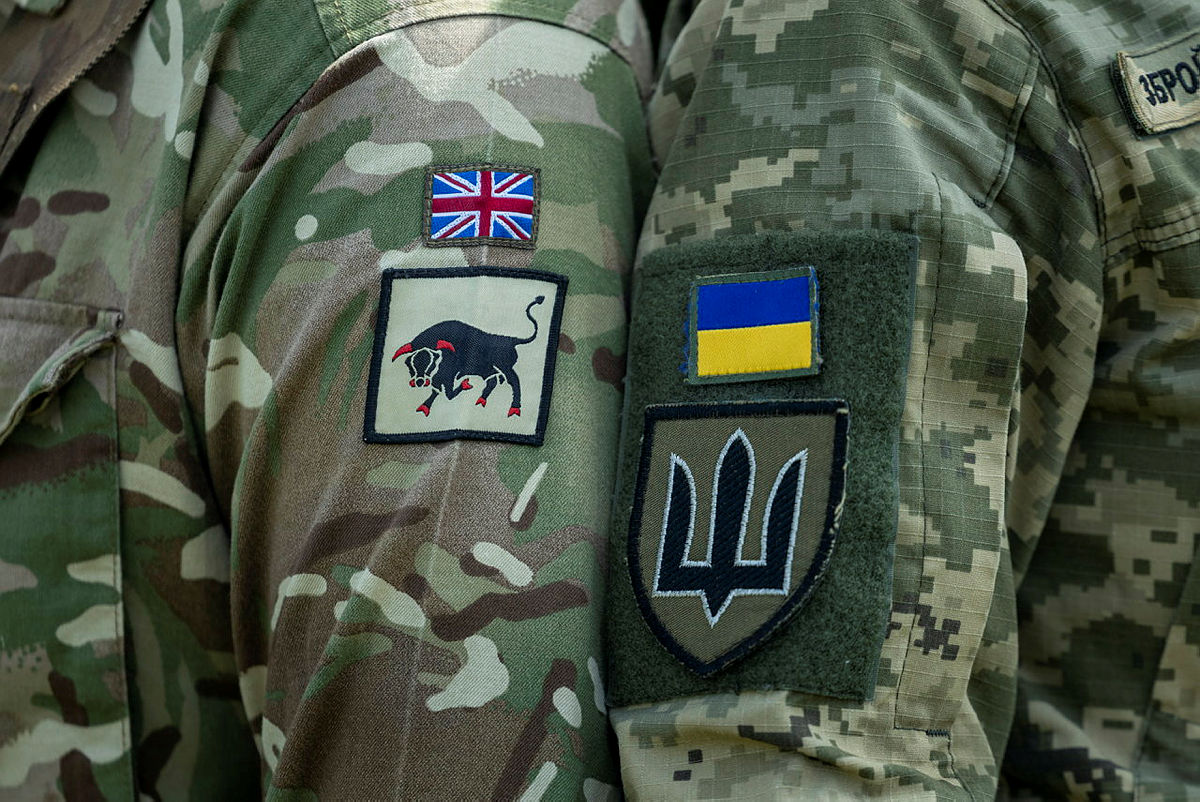
The government has declined to set out details of potential UK military contributions to a proposed multinational force for Ukraine, citing operational security as planning discussions continue with allies, the Ministry of Defence stated.
The position was set out in a series of written parliamentary answers responding to questions from James Cartlidge, Conservative MP for South Suffolk, following the publication of a Declaration of Intent between the United Kingdom, France and Ukraine on 7 January 2026 covering the possible deployment of multinational forces to support Ukraine’s defence, reconstruction and long-term sustainability.
Asked what discussions had taken place on scenario planning for UK naval assets, Defence Minister Al Carns said the Defence Secretary remains in regular contact with French, Ukrainian and other partner nations on Ukraine-related security issues, particularly in the event of a cessation of hostilities.
“The Secretary of State for Defence has regular engagement with Ukraine, France and other partners on Ukraine-related security in the event of a cessation of hostilities,” he said.
Carns added that the government remains committed to maintaining readiness across the armed forces, including the possibility of deployment to Ukraine, but said further detail could not be provided.
“Planning continues at pace, but we will not be drawn into the details of any future UK Armed Forces deployment, including its levels, composition, assets, and participating nations, due to the risk to operational security,” he said.
The same response was given when Cartlidge asked for information on potential UK land force contributions, as well as any ranges for personnel numbers or equipment that might be assigned to the proposed Multinational Force – Ukraine.
Further questions seeking confirmation of which nations had agreed in principle to contribute air, naval or land assets, or to deploy service personnel, were also declined on the same grounds. The minister repeated that discussions with allies were ongoing but said the government would not publish details of participating nations or force structures.
In his responses, Carns reiterated that the government views such planning as necessary contingency work rather than a confirmed deployment.
“This Government is committed to ensuring our Armed Forces remain ready to respond to all challenges, including deployment to Ukraine,” he said.






I wonder why – we’ve barely any infantry, artillery or GBAD. Has anyone actually spelt out to the politicians in numbers how pathetically small our armed forces now are! They act like we spend >5% of GDP on conventional forces when it’s probably nearer 1%. Given in 1945 we spent 40% it shows how out far we’ve fallen – yet they still carry a big mouth
So you think we should realise the plans and it’s not about OpSeC?
On spending
Yes we spent 40% of GDP in 1945 mostly funded by insane levels of borrowing
Is that what you’re advocating?
If it helps the long term average for UK defence spending prior to 1939 is about 2.5% of GDP. The Cold War was some what of a blip.
Indeed and much of the spending when it went up pre war was kept from the public (a lot easier back then) because the anti war mob were still a very powerful lobby. Lansbury was still saying as late as 1938 in a statement post dialogue with Hitler that all he wanted was peace, literally after having just listened to him having pleaded to him for harmony and understanding, rant off in a bastardised combination of Trump and Putin on a bad day about the Jews et al out to get him. Trouble is now we are being secret about how very little we are doing to re arm, not disguising how much we are doing.
Our spend and tempo should equate to threats. You mention 2.5% pre 1939 – which as a % purely invested in conventional capabilities (not pensions, nuclear) is a significant uplift from today..
As for OpSec – it doesn’t take much to understand the weaknesses in our ORBAT
Jim I appreciate the point you are making but comparing U.K. defence spending today with that of a World Power that Great Britain was pre 1939 is no comparison. The Royal Navy even after the cuts post WW1 and the international naval treaties was the (joint) largest on the planet by a significant margin.
Even though much diminished after WW1 the British Empire was still economically powerful and rich compared to the vast majority of nations so that average of just 2.5% GDP was enough to sustain a super power.
The country despite suffering a severe economic depression also belatedly recognised a deteriorating international situation to rearm. Imagine if that generation waited until the economic situation improved before raising spending? We would all be speaking German!
Britains entire history and success was built on a long tradition of not spending much on a peace time military and especially an Army. America was the same.
Large peace time militaries are a total waste of money. Very few countries can sustainably spend much more than 3% of GDP on the military long term without suffering consequences of failing infrastructure and economic collapse. This is what enviably doomed Hitler and also ended the Soviet Union.
Britains strategy primarily revolved around having a sufficiently strong navy and strong public finances and in the event of continental war it would in effect buy an army by financially supporting a combination of continental powers while simultaneously building up its own army to conduct peripheral campaigns before eventually generating sufficient force with Allie’s to confront its now weakened enemy on the main battlefield.
That’s how we won ever single war since the Spanish succession.
It’s was not lack of military power that ended the British empire, it was lack of money
The USA is increasingly in a similar position, increasingly reliant on foreign credit to keep the wheels on for a military budget it’s can’t afford. It’s running a 7% budget deficit which is insane in peace time.
That sufficiently strong navy was in effect the most capable navy on the planet for over two centuries. When we reduced that Navy the Dutch sailed up the Thames and burnt it and at the time the lesson was learnt by our leaders and we didn’t repeat that mistake for 300 years.
There are several reasons why the British Empire came to end but the Fall of Singapore early in 1942 certainly signalled the death nell. You could argue if we hadn’t been supporting the Soviet Union that more modern equipment could have been deployed to the Far East and had military spending increased earlier then we might have been able to deploy a stronger naval force but in truth to fight wars across the globe against determined and capable enemies was not possible without the total mobilisation of the British Empire. This took time and as you pointed out economically broke the country and led to the break up of the Empire.
Perhaps a lesson for the current US president that, however, strong you are, you still need allies. He doesn’t understand this and we have certainly forgotten that even with allies you need a truly independent foreign policy with hard power to back it up.
TBF the issues’ in the Far East had little to do with modern equipment. The failure was operational and doctrinal by all three services. The Intelligence services failed to grasp how much Japanese Air Power was actually concentrated in the area. The Navy had run Indomitable aground and was miscomunicating with the RAF. The RAF was slow to scramble and only got to the site of Force Z when Prince of Wales was on the way to the bottom.
The Army was not doctrinally prepared to fight the Japanese in Malaya in 1941. Having better equipment would have had little effect, and when you compare Malaya in 41 to the later campaigns in Arrakan and Kohima/Imphal the starkest differences are in the mindset of the British and Indian forces, who by that point where comfortable with operating in the Jungle and Japanese infiltration tactics, and had developed doctrine that was appropriate to counter them.
If Percival was not in charge of Singapore but instead had someone like Slim, could Singapore have held?
I don’t think so, but with caveats.
The issues with the British Army in Malaya ran much deeper than just the man in charge. As I said it the doctrine just didn’t exist within the army, and it was thoroughly unprepared from Percival down to the lowest Private to fight in a way that it would’ve had to.
Bill Slim in 41 also isn’t Bill Slim of 44-45. A lot of what he put into practice was in reaction too the Japanese tactics in Burma and Malaya at the start of the war. He had the benefit of the Post Mortem of Singapore basically, and worked out what a gamble Japanese infiltration tactics actually where and could take time go get his troops both ready and accustomed to fighting in a 360 battle that would ultimately ruin Japanese jungle warfare tactics. But even if he identified the vulnerability of the Japanese doctrine in 41, he just wouldn’t have had the time to get the Army to a place where it was capable of it.
So I guess my caveat is, if the Bill Slim you are probably thinking of was time traveled back a few years and placed in command of Singapore in say, May 1941, then yes, maybe Singapore holds and the Japanese Army starves in Malaya.
Cheers Dern. My Grandfather was part of Slims Army in the RA. He never mentioned what he got up to or where. One thing though, he deliberately would not buy anything made in Japan! Which I think says a lot.
All of what you say is true but we had no tanks in the Far East and the Japanese did. We did have some comparable quality (canon armed) Hurricane IIc’ s flown from Indomitable in the Far East at the outset but most of the RAF inventory was of obsolete aircraft such as the Brewster Buffalo.
Undoubtedly Indomitable would have been sunk if she had encountered the Japanese at the time because of her obsolete air group.
The interesting bit about Jungle warfare was there was 1 British officer who grasped the problem and he took his unit, The Argyll and Sutherland Highlands into the jungle before hostilities for intensive training and acclimatisation. They fought from the Japanese landings in Malaya back to Singapore largely acting as the rearguard.
He was evacuated from the island before its fall to Australia and shared his knowledge specifically with the Aussies to assist them in the defence of New Guinea.
I am sorry but I can’t remember his name but this man would certainly have shared his experience with Bill Slim.
I visited Singapore last year and arranged for a days tour with a local WW2 guide (my wife loved it but she did marry a history anorak) and the combination of a lack of modern equipment, awful leadership, a lot of inexperienced troops and a complete underestimation of the enemy was a deadly combination.
The sad fact is that we were chased back into the Indian Ocean and Somerville’s fleet of largely obsolete warships eventually hid in vast expanse of the Maldives archipelago after loosing Hermes, Cornwall and Doresetshire amongst others.
Therefore even if we had better leaderships in Singapore the garrison would have been surrounded and under siege with no credible chance of resupply or relief, which may have delayed the result but not the outcome.
C S Smiths book about Task Force 57 gives a good account of these events amongst several other excellent books that are well worth a read.
A few things I’d disagree with: 1) The British Army having tanks would have just meant that there would have been abandoned tanks on the road to Singapore as they where abandoned in the retreat. If anything MacAlister-Stewart kind of goes to show that (also the fact that the 14th Army also had almost no Tanks later in the war, at it’s height it had one armoured Regiment per Corps, and for considerable time less than that because Tanks aren’t that useful in the Jungle). Japanese infantry tactics where what won them Malaya, not Tanks. Certainly for the ground forces the lack of modern equipment was the least of the factors as that remained a constant with the 14th.
Bill Slim absorbing MacAlister-Stewarts teachings and is a very long shot and I don’t really give the idea that he would teach Slim who’d then teach the entire army much credence. Not in 1941.
I also push back on Somervilles fleet being largely obsolete. It came very close to giving the Japanese an incredibly bloody nose during the Indian Ocean raid, and the loss of Hermes, Cornwall and Dorsetshire was more down to some very bad luck rather than the Royal Navy not being up to the task.
When the Japanese invaded, they had over 200 tanks and we had no anti tank weapons or tanks so even if we had the best jungle trained infantry on the planet we would have lost but I take your point.
I also agree whilst not having such a decisive impact as in other theatres the tank was an essential part of the war in the Far East and much later in the war the Japanese had lost most of theirs and those that remained were obsolete. Those we had even in relatively small numbers were superior to anything the Japanese could field but at that stage of the war much of the Japanese Army in this theatre were suffering with malnutrition on the borders of India.
Our jungle tactics certainly evolved over time with the likes of Wingate and the Chindits and thank you for reminding me of MacAlister-Stewart because he has one hell of a story. I am sure he would have been asked to widely share his experiences because they were so unique but it took us a long time to come to terms with the jungle environment and I am sure others gained similar knowledge in the British Army’s longest ever retreat back into India.
My only other point about the jungle campaign was the increasingly crucial importance of airpower particularly with supply by air to the troops provided by Air Transport Commands Dakota’s (You can keep your VCs and MCs Sir, give me a DC anytime….- From a rescued Chindit).
Our East Indies fleet was made up of predominantly old and slow vessels but we certainly did come close to catching Nagumo’s force off guard and luck certainly played a part but our carrier groups were small when compared to the Japanese, with obsolete aircraft and many inexperienced air crew. Our first strike would have not have powerful enough to be decisive and within insufficient aircraft in the CAP we would have suffered significant losses.
Fortunately, Somerville preserved his fleet and it was eventually reinforced with more capable modern ships and aircraft late in 1944 as our Naval commitments in Europe reduced. The BPF was then born creating the most powerful RN fleet in history but which most know nothing about (The Forgotten Fleet).
Anyway none of this matters because as we all now know it was the Yanks that won it all according to Donald.
All the best.
Um no, and if we are going into outright falsehoods I’m going to call this conversation quits. The British Army in Malaya was well equipped with both Boys AT rifles and 2lber guns, both of which where more than capable of dealing with even the most advanced Japanese Tanks.
So pretending like the lack of AT weapons had anything to do with the defeat, let alone the claim that “if we had the best jungle trained infantry on the planet we would have been defeated” is a straight up lie.
Next “Those we had where superior bla bla bla” nope. We didn’t use our tanks in anti-Tank roles in Burma, we used them in infantry support roles on the offensives in places like Arakan in very first world war anti-Machinegun roles, rather than in Anti-Tank roles. The British Army didn’t have enough Tanks to use them in an anti-armour role, simply because they physically couldn’t get them there responsively, even if that had been doctrine. [Also Tanks are not all that mobile in the Jungle so even if we had them in large numbers their use as anti-armour would have been minimal]
“I am sure he would have been asked widely to share his experience.” Yes. With the benefit of hindsight. Not in Summer of 41.
The East Indies Fleet also had two modern carriers that, unlike the Japanese fleet where trained in night ops alongside (No the British Aircrew where not inexperienced, they’d been flying for years) Hermes, also trained in night ops. The R Class, while slow where not obsolete and had they gotten the Kongo’s under their guns as they nearly did would have, they’d have come off the better. Both the R Class and Warspite where in fact considerably less old than Nagumo’s Kongos.
“fortunately” nope. Somervile lost several ships with no losses inflicted on the enemy because he missed his opportunity to attack (no fault of his really just bad luck) and then had to go on the defensive because most of his fleet was recalled to Europe. He didn’t preserve it, he had it taken off him.
I can’t really wish you all the best after the distate left by the whole “The British Army in Malaya didn’t have anti tank weapons” sadly.
“withholds details” as in… the prime minister hasn’t got a clue. He thought it was just for a sound bite.
The point is moot, as long as a ceasefire isn’t set in place then this remains a theoretical military deployment. And by the looks of the world, we are far from peace. Maybe by then the UK would have enough soldiers to send and imperial star destroyers
Certainly sounds very Death Star ominous at the moment. It’s getting surreal what with pay Trump a billion and you can sit on a Peace Commission for Gaza and be allowed to watch him do nothing but stash the cash away in some dodgy bank account to ‘keep it safe’ while planning a Casino. This really is becoming gangster politics and damn the little people.
Fuck, they approved the Chinese super-embassy. Disappointing.
Trolling Trump, seems to have been coordinated with Canada.
How so?
I’m in two minds here.
Keep your friends close, and your enemies closer.
And make as much money out of them as you can.. let’s be honest the we have always has power from selling stuff..
To me this is attributed to Napoleon:
“Your meddling in continental affairs, and trying to make yourselves a great military power, instead of attending to the sea and commerce, will yet be your ruin as a nation. You were greatly offended with me for having called you a nation of shopkeepers. Had I meant by this, that you were a nation of cowards, you would have had reason to be displeased; even though it were ridiculous and contrary to historical facts; but no such thing was ever intended. I meant that you were a nation of merchants, and that all your great riches, and your grand resources arose from commerce, which is true. What else constitutes the riches of England. It is not extent of territory, or a numerous population. It is not mines of gold, silver, or diamonds. Moreover, no man of sense ought to be ashamed of being called a shopkeeper. But your prince and your ministers appear to wish to change altogether l’esprit of the English, and to render you another nation; to make you ashamed of your shops and your trade, which have made you what you are, and to sigh after nobility, titles and crosses; in fact to assimilate you with the French… You are all nobility now, instead of the plain old Englishmen.”
I agree, though I think some concessions should’ve have been forced from the Chinese side.
It’s increasingly apparent that the upcoming years will be dominated by China. The old rules of the Cold War, in which the Western allies were tightly knit and cooperative (on the whole) are no longer in play.
Similarly, the ideological warfare that formed the basis of the Cold War is also absent. Instead, it’s been replaced by culturally-ingrained social conflict. There are no more red lines; the United Kingdom exists within a liminal space, in which no clear solution penetrates the fog of our own making. Our traditional partners in the United States are helmed by manifest volatility, and the pre-existing infrastructure of the special relationship, no matter how secure in actuality, must now brave the court of the misinformed. Our relations with Europe have been soured by nationalistic fervour, yet it is here that the most ready opportunities lie, and some action, however limited, has been taken. Beyond our immediate neighbours, the decline of the Royal Navy means that the dream of a global Britain rests as a climber, perched lightly upon a curled lip of rock – almost nothing physical to support below for support. And past all of this, the People’s Republic wait in the wings, not as an enemy perhaps, but certainly far, far from a friend.
In a world in which our island is ever-more isolated and vulnerable, we cannot afford to brandish batons of ideology, nor abandon pragmatism for symbolism. Look to Europe, consider to the PRC, and be wary of the USA. The ‘multi-polar world order’ is here, if such a volatile pantheon of powers can be described in any way as an ‘order’, and the UK must be firm and quick in its decisions.
For as much as these coming decades are to be known as the ‘Chinese century’, the importance to the UK must not be understated. The nation stands not on a precipice but a peninsula in the oceans of history. Will we retreat back into the fading glories of the past, or take to the seas of the future, and see where they lead? I, for one, hope that it will be the latter. And if it is, perhaps Britannia’s reign over these symbolic, chronological waves may yet endure.
Forgive my prose, but if I don’t use this flipping degree, I might as well lose it. 😉
They do so that those who regularly practice the ability to form linguistically complex, rather than simple listing, sentences, have a significantly decreased risk of dementia in their later years.
Well spoken Leh!
No, I enjoyed reading that. My wife tells me I too am good with the written word, better than the spoken.
Operational Security my arse, embarrassment more likely due to the sudden realization that we don’t have anything to send.
Real reason is we as in the MOD do not know what they can scrape togeather to send. Be interesting to see what wheel light stuff we send and excuse as to why not much heavy armour, Can not wait hear those reasons
Putin would never agree to this anyway. To do so would be to let NATO get even nearer his eastern border, and that would be the end of him.
So as usual Starmer is talking stale wind.
Correction: I think you mean nearer Putin’s ‘western border’. Unless of course our little force is planning to invade Russia from the Pacific as well…
Why do you think HMS Anson is heading to Australia? 😉
Why do you think HMS Anson is heading to Australia? 😉
Operation Fortitude South. ( Redux ) 😏 👍.
I was wrong so I apologise and after some more reading this morning I have found quite an interesting paper on the use of 2 pounder AT weapons in Malaya. I genuinely had in my head that we had none.
You do seem to be deliberately miss construing my point about MacAlister-Stewart because his experience would certainly have not been listened to in the Summer 1941 but early in 1942 it would have invaluable. Did you mean 1942?
As for our modern carriers they carried Hurricanes of limited range and endurance with the Radar equipped Fairy Albacore. Both of these armoured carriers had limited aircraft capacity because of their design compared to US and Japanese vessels. Whilst Somerville was perhaps unlucky in the way the raid played out he was very careful to avoid giving away any indication of his position because of what he was facing, which at that particular time was the best carrier strike force in the world. FAA aircrew were comparatively inexperienced, fewer in number and flying obsolete or inappropriate aircraft.
Arguing about the relevant strength of battleships is rather immaterial as they were undoubtedly playing second fiddle to carriers despite providing useful AA protection but ours were too slow to keep up.
For Somerville despite the losses he had preserved his fleet as pressures grew closer to home and the threat from the Japanese waned after defeat to the USN. Again you have deliberately misconstrue my words.
There is great piece on this whole episode in C S Smith’s book on TF57 but you are obviously widely read.